

A practical comparison of vaporizer types for dry herb to help you choose the right device for your lifestyle
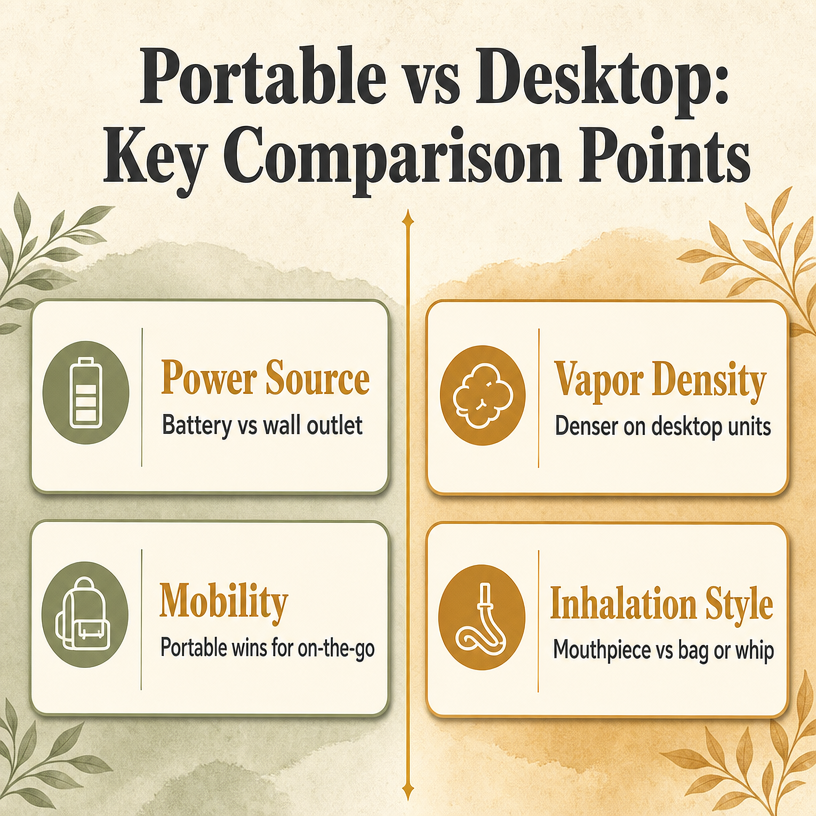
Portable vaporizers are battery-powered devices built for on-the-go use, while desktop vaporizers plug into a wall outlet and stay fixed at home. Desktop units produce denser vapor because they have unlimited power, but portable devices let you vaporize anywhere. Choosing between them comes down to where you mainly use it, how much vapor density matters to you, and whether mobility is a priority.
What Is the Core Difference Between Portable and Desktop Vaporizers?
The most fundamental distinction is power source and mobility. Portable Vaporizers run on rechargeable batteries and are small enough to fit in a pocket or bag. You can use them at a coffee shop, outdoors, or anywhere else without needing counter space or an electrical outlet. Desktop Vaporizers draw power directly from a wall outlet and are designed to stay in one place. [1]
- Power source: portable vaporizers use rechargeable batteries; desktop vaporizers plug into a wall outlet
- Mobility: portable devices fit in pockets and bags; desktop units require counter space and a nearby electrical outlet
- Session length: desktop units support longer continuous sessions; portable devices are limited by battery capacity
- Temperature control: desktop units typically offer more precise digital controls; portable devices range from simple presets to advanced settings
This difference shapes the entire user experience. A portable vaporizer gives you flexibility—you can pick it up and vaporize whenever that moment feels right. A portable vaporizer lets you vaporize on a walk, in a parking lot, at a social gathering, or anywhere else without being tied to an outlet or counter space. [2]
The battery constraint is the other side of that coin. Most portable units deliver 3 to 5 sessions before needing a recharge, and higher temperatures drain the battery faster. Desktop units do not have this problem. Because they draw continuous power from a wall outlet, desktops can maintain consistent high temperatures for sessions that run 30 minutes or longer without any drop in performance. [1]
Both types of vaporizers work on the same basic principle—applying heat to dry herb to release vapor—but they serve different lifestyles. The devices fall into several broad categories. Desktop units are home-only devices that excel at producing quality vapor through larger chambers and precise temperature control. Portable vaporizers run on rechargeable batteries and are designed for discreet, on-the-go use. [3]
The choice between them ultimately comes down to where you use it most, how important vapor density is to you, and whether mobility is a priority.
Browse Dry Herb Vaporizers to explore related options.
How Do Heating Methods Affect Vaporizer Performance?
Heating methods are where the real performance differences emerge, and they apply to both portable and desktop vaporizers alike. The three main approaches are conduction heating, convection heating, and hybrid heating. [4]
- Conduction heating: herb makes direct contact with a hot chamber surface, producing instant vapor with relatively even heat distribution
- Convection heating: hot air passes through the herb, generally delivering cleaner flavor and more consistent extraction throughout the chamber
- Hybrid heating: combines conduction and convection methods, balancing quick vapor onset with more even heating across the herb
Conduction heating works through direct contact. The herb sits against a heated chamber wall, which releases vapor quickly since the surface stays consistently hot. The tradeoff is that herb closest to the wall heats first, so extraction might not be completely even throughout the chamber. [5]
Convection heating takes a different approach. Hot air passes through the herb rather than heating it through direct contact. This tends to heat the herb more evenly throughout the chamber and generally preserves herb flavor more faithfully since there is no contact with a scorching surface. The drawback is that convection requires more energy and longer draws to produce vapor effectively. [5]
Hybrid devices combine conduction and convection heating, giving you the quick onset of conduction with the more even heating of convection. The result balances vapor density, flavor, and efficiency, though hybrid units tend to consume herb more quickly than single-method devices. [6]
The heating method influences not just vapor quality but also how efficiently the herb is used, how much flavor is preserved, and how the device performs over repeated sessions. Chamber size and design matter as well—larger chambers in desktop units can hold more herb and support denser vapor, while smaller chambers in portable devices offer greater efficiency but produce less vapor per session.
Read What Is a Vaporizer and How Does It Work? for more detail.

How Do Vapor Production and Session Quality Compare?
The most noticeable difference between portable and desktop vaporizers is vapor production. Desktop units produce noticeably denser vapor because they maintain steady high temperatures throughout entire sessions. [1]
- Vapor density: desktop units produce denser vapor over longer sessions; portable devices are constrained by battery capacity and typically produce lighter vapor at equivalent temperatures
- Flavor quality: desktop units, particularly convection models, generally offer cleaner flavor; many portable devices still deliver solid flavor, especially newer convection-style models
- Temperature control: desktop units typically feature precise digital controls; portable devices range from simple fixed-temperature models to advanced adjustable settings
The limiting factor for desktop vaporizers is no longer power but rather how much herb fits in the chamber. Portable devices face a different constraint. Battery capacity limits how much power the heating element can draw, which directly affects vapor density, particularly at higher temperatures. That said, a well-designed portable unit with quality heating can still produce satisfying vapor—it just will not match the sheer volume and density of a desktop at the same price point. [2]
Flavor clarity is another area where desktops have an advantage in some cases. Desktop units, especially those using convection heating, tend to preserve herb flavor more faithfully since there is no contact with scorching surfaces. The digital temperature controls on most desktops also allow precise targeting of specific temperature ranges to emphasize different flavor notes. Many portable devices still deliver solid flavor though, particularly newer models with convection-style heating chambers. [3]
Both types of vaporizers ultimately achieve the same goal—heating herb to release its compounds—but the desktop’s sustained power advantage becomes clear in longer sessions where consistent vapor production matters most. The practical differences come down to session length, vapor density, and temperature control rather than the fundamental outcome. [1]
For users who prioritize intense flavor and precise temperature control, a desktop may be worth considering. The choice between them depends on whether you value maximum vapor concentration and hands-free convenience, or need the ability to vaporize on the move. [2]
What Are the Inhalation Methods and Session Styles?
The inhalation method shapes the actual experience of using a vaporizer, and this is a concrete functional difference between desktop and portable devices. Desktop vaporizers typically offer two distinct methods: balloon-bag systems and whip-style inhalation. [1]
- Balloon-bag systems: vapor fills a bag before inhalation, providing hands-free delivery that cools vapor before it reaches the lungs
- Whip-style inhalation: vapor travels through a tube directly to the user, offering a minimalist setup with less equipment to manage
- Draw-through mouthpieces: standard on portable devices, delivering vapor directly from the heating chamber with no bag or tube involved
With a balloon-bag system, the vaporizer fills a bag with vapor that you then breathe in. This method is popular for social sessions because multiple people can pass around the same bag. Whip-style inhalation uses a tube connected directly to the heating chamber—you breathe in through the tube and the device does the rest. Many desktop units support both methods. [2]
Portable vaporizers are draw-through mouthpieces only. You inhale directly through a mouthpiece that connects to the heating chamber. The mouthpiece design varies across models, from simple friction-fit pieces to precision-machined components with cooling elements. [3]
The practical difference shows up in vapor temperature. Balloon bags allow vapor to cool considerably before it reaches your lungs, making each draw feel gentler. Direct-draw mouthpieces deliver vapor closer to chamber temperature, which registers as warmer. Balloons handle the work of moving vapor for you, whereas draw-through requires you to pull air through the heating chamber yourself. [1]
Balloon bags require setup and disassembly, plus the bag itself needs cleaning. They are not complicated, but they add steps that are absent with portable devices. Portables win on simplicity and discretion, making them better suited for quick solo sessions or situations where drawing attention matters less. [2]
Read What Is a Bong and How Does It Work? for more detail.
Which Vaporizer Type Is Easier to Use and Maintain?
Portables are often described as low-maintenance, but desktops are not difficult to care for either. The maintenance fundamentals are the same for both types, and the core cleaning steps take just a few minutes once a routine is established. [1]
- Allow the device to cool fully before cleaning after each session to avoid burns and ensure residue wipes away cleanly
- Brush out the heating chamber after each use to prevent buildup that affects vapor quality and heating efficiency
- Wipe the mouthpiece with a damp cloth on a weekly basis to keep it clean and free of residue
- Perform a deeper monthly cleaning of the heating element using isopropyl alcohol to remove stubborn buildup
- Replace screens, seals, and filters as they wear out to maintain consistent vapor quality and device performance
Here is a practical maintenance checklist that applies to either vaporizer type: allow the device to cool fully before cleaning after each session; brush out the heating chamber after each use to remove residue; wipe the mouthpiece with a damp cloth weekly; perform a deeper cleaning of the heating element with isopropyl alcohol monthly; and replace screens, seals, and filters as they wear out. [2]
Desktop vaporizers require a few additional steps related to their larger and more complex design. Check seals and connections on the main unit and any attachments on a regular basis, since the complex internal parts wear over time. Balloon bags require cleaning after each use, and some are hand-wash only—these need thorough drying before the next session. Wipe down the exterior surfaces regularly, and keep the power cord and connections clean and free of residue. [1]
Most of the maintenance burden is the same between the two types, so choosing a desktop does not mean accepting significantly more upkeep overall. The real question is whether you want a device that stays in one place or one that moves with you. [2]
Read How Do I Maintain My Vaporizer for Best Performance? for more detail.
How Do I Choose the Right Vaporizer for My Lifestyle?
Choosing the right vaporizer comes down to matching the device to how you actually live. The first question to ask is where you will use it most. If your vaporizing happens mainly at home, at a desk, or in another fixed location, a desktop unit plays to its strengths. If you need to vaporize on the go—at social events, while traveling, or throughout your day—a portable device is the practical choice. [2]
- Identify your primary use location: home or fixed space favors desktop units; travel or unpredictable schedules favor portable devices
- Be honest about your usage patterns: many people overestimate how often they need to vaporize on the go
- Set a realistic budget that accounts for how the device fits your lifestyle—if you want both portability and quality, you may need more than one device
- Consider your experience level: beginners benefit from the simplicity of portable devices, while experienced users often want the precision of desktops
Many buyers purchase portable vaporizers for the mobility they offer but end up using them mostly at home. If you primarily vaporize at home, a desktop device would likely give you better vapor quality for the same budget. Consider how often you actually need to vaporize away from home before committing to a portable device. [3]
Budget is a real consideration. Portable vaporizers range from entry-level models around $30–$50 to mid-range units at $100–$250 and premium devices at $300 or more. Desktop units typically fall into the mid to high range. If you want both portability and premium quality, you may end up with multiple devices—a solid desktop for home and a portable for on-the-go use. A quality desktop can serve as a reliable home base, while a portable handles situations where you need to vaporize away from home. [1]
For vaporizer users new to the category, portable vaporizers are generally the better starting point. They are simple to operate, require no setup, and are ready to use within seconds. Many portable devices have straightforward one-button interfaces and preset temperature settings. Desktop vaporizers offer more control and better vapor quality but require more setup, counter space, and a power outlet. [2]
What Are Common Questions About Smoking Accessories?
Are desktop vaporizers more powerful than portable ones?
Desktop vaporizers draw power directly from a wall outlet, so they can maintain consistent high temperatures without the limitations of a battery. This lets them produce denser, more voluminous vapor over longer sessions. Portable vaporizers are constrained by battery capacity, which is why they generally produce lighter vapor, especially at higher temperatures.
What is the main benefit of a portable vaporizer?
The primary benefit is mobility. A portable vaporizer fits in a pocket or bag and lets you vaporize anywhere. Battery power enables discreet, quick sessions on the go, without needing an electrical outlet or counter space.
Do I need to understand heating methods to choose a vaporizer?
Understanding heating methods helps you prioritize what matters most. Conduction heats material through direct contact with a hot surface, producing instant vapor and conserving battery. Convection uses hot air to heat material, generally delivering cleaner flavor and more even extraction. Hybrid devices combine both. Most mid-range to premium portables and desktops offer at least one of these methods.
Which type of vaporizer is better for beginners?
Portable vaporizers are generally easier for beginners because they are simple to operate, require no setup, and are ready to use within seconds. Many portable devices have simple one-button interfaces and preset temperature settings. Desktop vaporizers offer more control and better vapor quality but require more setup, counter space, and a power outlet.
Can I use a portable vaporizer primarily at home?
Yes, and many buyers do exactly that. Many people purchase portable vaporizers for mobility but end up using them mostly at home. If you primarily vaporize at home, a desktop device would likely give you better vapor quality for the same budget. Consider how often you actually need to use a vaporizer away from home before committing to a portable device.
Which Vaporizer Is Right for You?
Desktop vaporizers deliver superior vapor quality and precise temperature control when used at home. Portable vaporizers give you the flexibility to vaporize anywhere. Most people benefit from starting with a quality portable to see how it fits into their actual routine, then adding a desktop later if home use becomes a priority.
The decision really comes down to one question: do you need maximum vapor quality in a fixed location, or do you need the ability to vaporize on the move? There is no wrong answer—only what matches your situation. Many experienced users eventually keep both devices, since each serves a different purpose in their routine.
If you are choosing between the two and want a single device, a desktop is the better choice for home use with superior vapor density and precise temperature control. A portable is the better choice for anyone who needs to vaporize on the go or has an unpredictable schedule. Many people end up wanting both eventually, which is worth considering if your budget allows.
For vaporizer users new to the category, starting with a quality portable in the $100–$150 range gives you room to learn what matters to you before potentially investing in a desktop later. The vaporizer market has improved significantly, and both device types offer strong options at accessible price points.
Where Does This Smoking Accessory Information Come From?
- Planet of the Vapes: Desktop vs. Portable Vapes: Key Differences Explained
- VapeFully: Portable vaporizers vs. desktop vaporizers – a comparison
- Greenstone Retail: Portable vs. Desktop Vaporizers: Which One Is Right for You?
- Planet of the Vapes: Conduction vs Convection vs Hybrid: What’s the Difference?
- VapeFully: Conduction vs. convection vaporizers – a comparison
- DynaVap: Conduction vs Convection Vaporizers: What’s the Real Difference?