
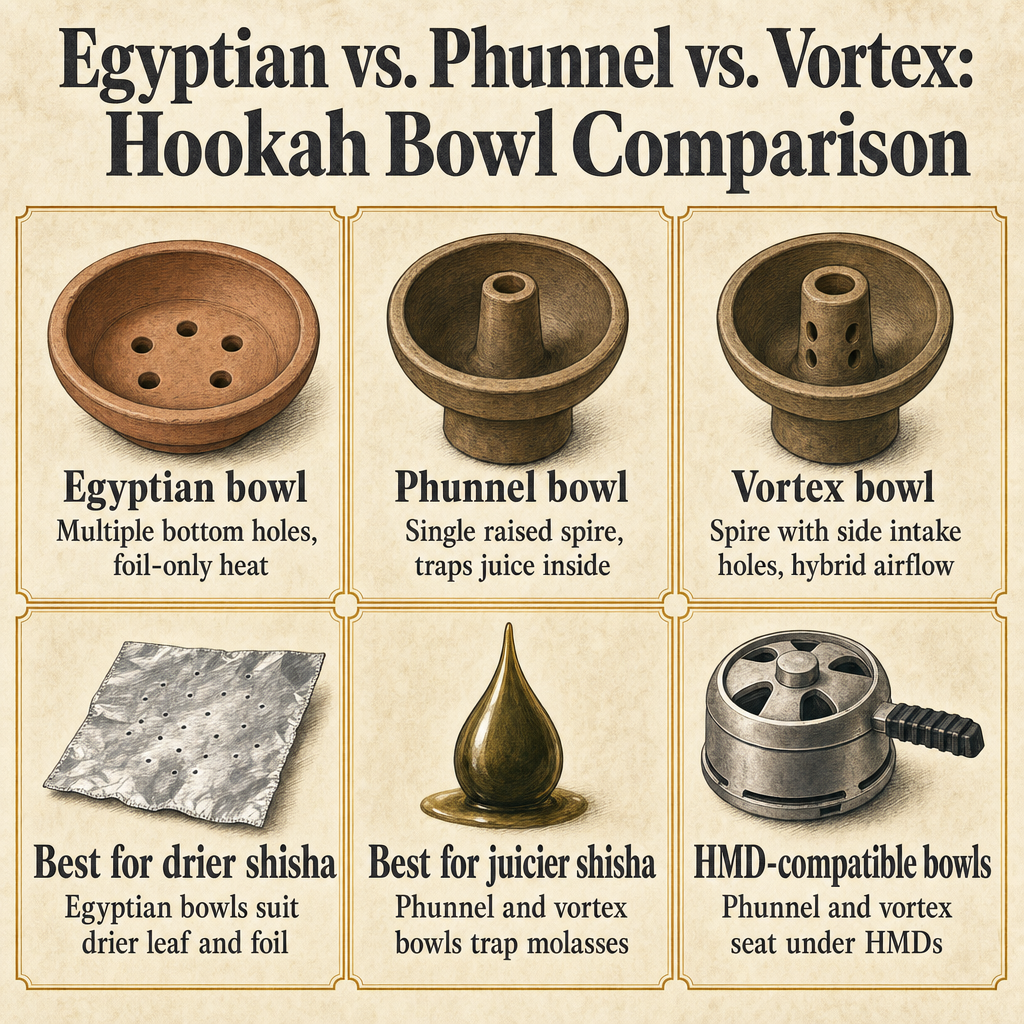
The three main hookah bowl types are Egyptian (multi-hole, foil-only), phunnel (raised central spire, single hole, HMD-friendly), and vortex (raised spire with side intake holes, also HMD-friendly). Each design controls airflow and juice differently: Egyptian bowls pull air through several small bottom holes, while phunnel and vortex bowls trap juice inside the bowl with a raised spire [1] [2].
The bowl’s material — clay, ceramic, glass, or silicone — then changes how it holds and releases heat across the session [7]. This guide walks through every main bowl style, the materials they’re made from, how each one handles juice and heat-management devices, and a short buying checklist to match a bowl to your shisha, your heat source, and your experience level.
What Are the Main Types of Hookah Bowls?
Most hookah bowls sold today fall into three main style families, and the labels shift a bit from shop to shop. Egyptian, phunnel, and vortex bowls all sit on the same stem port, but the air, juice, and heat path inside each one is different.
The Egyptian style is the classic shape most people picture when they think of a hookah bowl — a wider, rounded clay body with several small holes punched in the bottom. You cover it with foil, poke the foil, and place coals on top. It is the oldest of the three styles and is still the most common one shipped with entry-level hookahs.
Phunnel bowls came next. They look similar to an Egyptian bowl at a glance, but the bottom is solid except for one raised central spire with a single hole at the top. That spire is what changed the modern hookah session — it traps molasses inside the bowl instead of letting it drip down into the stem [1] [2].
Vortex bowls are a smaller, hybrid design. They also have a raised central spire, but instead of one big hole on top, the spire has intake holes drilled into its sides. The vortex bowl was created to solve the same drip problem as the phunnel, with a slightly different airflow path [4] [5].
If you want a broader look at how those same design ideas show up in another accessory category, the related comparison What Are the Different Types of Dab Rigs? breaks down another side-by-side comparison of three common shapes and the design trade-offs behind each one.
- Egyptian bowl — also called classic or traditional; multiple bottom holes; foil-only; best with drier shisha.
- Phunnel bowl — raised central spire with one large hole on top; traps juice; works with foil or a heat-management device.
- Vortex bowl — raised central spire with intake holes on the sides; traps juice; works with foil or a heat-management device.
- Same shape, different label — many vendors sell the Egyptian pattern as ‘classic’ or ‘traditional,’ so the names are interchangeable.
How Does an Egyptian Bowl Work?
An Egyptian bowl is the simplest of the three designs. It is a small clay or ceramic pot with several small holes — commonly a five-hole pattern — punched straight through the bottom. The shisha sits inside the bowl, foil stretches across the rim, and the coals sit on top of the foil.
When you pull on the hose, air travels down through the coals, through the foil holes, down through the tobacco, and out through those small bottom holes into the stem. The pull feels lighter and more open than a phunnel, partly because the air has several paths out instead of one [1] [2] [3].
Because the bottom of the bowl is open, any juice that runs off the tobacco has a straight path down the stem. Traditional Egyptian bowls are usually described as foil-only — the rim-to-port geometry does not seat a heat-management device (HMD) cleanly, so most users cover the bowl with foil and manage heat by moving coals on and off the foil.
Egyptian bowls pair well with drier, older-style shisha and with beginners who are still learning to manage foil. For a refresher on the stem, hose, and bowl anatomy that an Egyptian bowl sits on, see the hookah primer What Is a Hookah and How Does It Work? for a quick read on the whole setup from base to bowl.
- Air path — air enters through the foil, moves through the tobacco, and exits through several small bottom holes into the stem.
- Five-hole pattern — the most common punch is five holes, which spreads airflow evenly across the bottom of the shisha.
- Juice behavior — juice can drip from the bowl into the stem; less mess with drier shisha, more mess with very wet shisha.
- Heat source — usually foil and coals; most Egyptian bowls are not designed to seat a heat-management device.
- Beginner fit — simple, forgiving design that pairs well with drier tobacco and a slower, lower-heat session.
How Does a Phunnel Bowl Work?
A phunnel bowl takes the same basic clay-pot shape and changes one key part: the bottom is solid except for a tall central spire with a single large hole at the top. The tobacco goes around the spire, foil or an HMD sits across the rim, and the air you pull travels down through the tobacco and out the top of the spire.
That one design change has two big effects. First, the spire holds shisha juice inside the bowl instead of letting it drip down the stem — molasses pools around the spire rather than running into the downstem, which means fewer harsh sessions and a longer-lasting bowl [2] [3] [4].
Second, the single central hole puts heat through the tobacco in a tighter column instead of fanning it across several holes. That lets you pack the bowl a bit looser, drop a heat-management device on top, and run a longer, lower-stress session without babysitting the coals as much [1].
Most phunnel bowls are made from glazed stoneware, which is a denser, kiln-fired clay. The glaze keeps the stoneware from soaking up flavor from one session into the next and makes the bowl easier to wash between uses. The thicker body also holds heat longer than a thin earthenware Egyptian bowl.
For a different take on a single-path airflow design, the curved-bowl walkthrough What Is a Sherlock Pipe and How Does the Curved Shape Work? shows how a similar one-channel airflow pattern shapes the session in another accessory category.
- Air path — air enters through foil or an HMD, moves down through the tobacco, and exits through one central hole in the top of the spire.
- Juice behavior — the raised spire traps molasses inside the bowl, which suits juicier modern shisha.
- Material — most phunnel bowls are glazed stoneware; the thicker body holds heat and washes clean between sessions.
- Heat source — works with foil and with most heat-management devices; phunnel bowls are the go-to match for HMDs.
- Heat feel — slower ramp-up and longer hold than an Egyptian bowl, especially once an HMD is seated on the rim.
What Makes a Vortex Bowl Different?
A vortex bowl is what you get when you take the phunnel’s raised spire and move the air intake to the sides instead of the top. The spire is still there, but instead of one big hole at the top, it has a ring of small intake holes drilled into its sides. Air enters the spire through those side holes, so the juice-trapping job stays the same, while the airflow path through the tobacco changes.
The vortex design was made for juicier modern shisha. The side intake pulls air down around the spire rather than through a single column on top, which keeps the air moving even when molasses starts to pool around the base [5] [6].
The trade-off is that a vortex bowl is more sensitive to packing. If the tobacco is packed too tight, the side holes clog and the draw gets heavy. Most guides recommend a fluffy, even pack below the rim with no shisha falling into the spire, and foil holes poked only over the tobacco rather than directly over the spire. A useful mental model is the way a tightly-packed side-intake design needs clearance to breathe — the same idea shows up in the side-port guide Steamrollers, where airflow lives or dies on how open the chamber stays.
Coals on a vortex bowl usually go around the edge of the foil instead of over the center. That keeps heat off the spire, lets the side intake stay open, and avoids scorching the tobacco that sits next to the spire. Coals on the rim take a little more attention than an HMD on a phunnel, but the airflow can feel more even once you find the right packing density.
- Pack the bowl fluffy and even, stopping just below the rim of the spire.
- Keep all shisha out of the spire itself so the side intake stays clear.
- Poke foil holes only over the tobacco, not directly above the spire.
- Place coals around the outer edge of the foil instead of in the center.
- Reach for a vortex bowl when the shisha is juicier than an Egyptian bowl can comfortably hold.
Which Hookah Bowl Material Holds Heat Best?
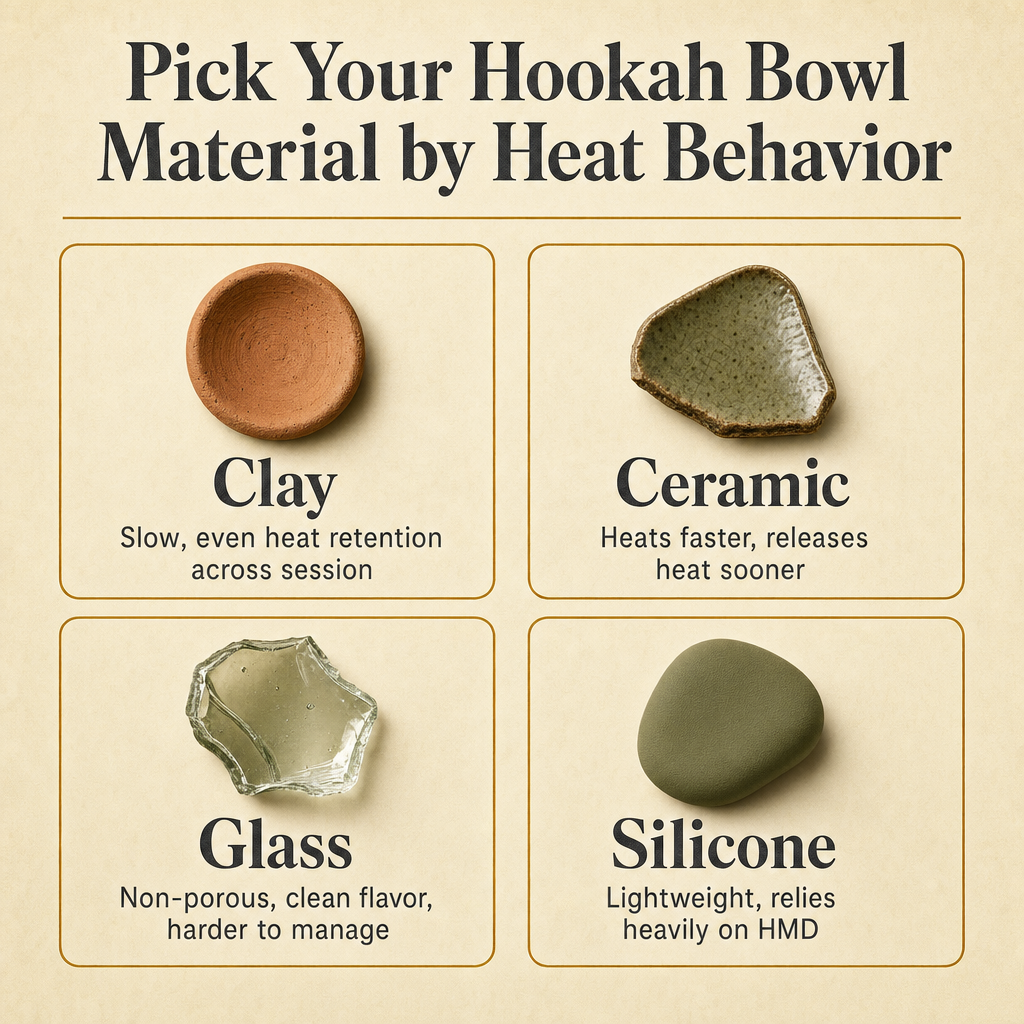
Bowl style controls airflow and juice. Bowl material controls how fast the bowl heats up, how long it holds that heat, and how it reacts to your heat source. The four common materials are clay, ceramic, glass, and silicone, and they each behave differently across a session [7].
Clay is the most traditional hookah bowl material and is widely described as the strongest heat-retaining option. Clay absorbs heat from the coals slowly and releases it back into the tobacco steadily, so the bowl holds a steady temperature even as the coals start to fade. Most Egyptian bowls and many phunnel bowls are clay.
Ceramic bowls heat up faster than clay but also release heat sooner. That faster ramp-up is forgiving for beginners — you do not have to wait as long for the bowl to come up to temperature — but a longer session can run hot once the coals are well-lit and the bowl is fully warmed through.
Glass bowls are non-porous, so they do not hold flavor from one session to the next and are easy to rinse clean. The trade-off is that glass releases heat faster than clay or ceramic, so it usually wants an HMD or close coal management to keep temperature steady across a full session.
Silicone bowls are the lightest of the four. They do not absorb much heat from the coals at all, so they rely almost entirely on a heat-management device to maintain temperature. Without an HMD, the silicone bowl can feel cold and uneven, especially in a drafty room.
To compare another accessory where silicone has become a popular material, the shop’s silicone-bong roundup Silicone Bongs covers a similar trade-off — lighter and tougher, but with a different heat profile than glass or ceramic.
- Clay — slow to heat up, slow to release heat; long, even sessions; the traditional material for Egyptian and many phunnel bowls.
- Ceramic — heats faster than clay and releases heat sooner; a forgiving fit for beginners learning coal placement.
- Glass — non-porous with clean flavor and easy cleanup; releases heat fastest, so it usually wants an HMD or close coal management.
- Silicone — lightest of the four, with the lowest heat retention; relies heavily on a heat-management device to hold temperature.
Which Hookah Bowl Should You Buy?
The right hookah bowl depends on three things: the moisture level of the shisha you usually smoke, the heat source you prefer (foil or an HMD), and your experience level. Match those three to a bowl style and a material, and the rest of the buying decision is easy.
If you mostly smoke drier shisha and you are comfortable managing foil, a clay Egyptian bowl is a classic pick. It pulls light, it spreads heat through the five-hole bottom, and it has been the default on entry-level hookahs for decades [1] [2] [3].
If you want the most flexible setup, go with a glazed stoneware phunnel bowl. It traps juice from juicier modern shisha, it seats cleanly under an HMD, and it holds heat long enough for a longer session without much babysitting. Most experienced hookah smokers run a phunnel as their daily driver for that reason.
If you want tighter airflow through a juicier pack, a vortex bowl gives you that hybrid draw — but it asks for a more careful pack and foil poke to keep the side intake clear. Reach for a vortex when you already have a pack style you trust and you want to push airflow a little harder [6].
On materials, clay is the strongest heat retainer, ceramic is the most forgiving for beginners, glass gives the cleanest flavor with the most attention needed, and silicone only really works with an HMD seated on top. Pick the material that matches how you manage heat.
One note that applies no matter which bowl you buy: hookah smoke and charcoal combustion products contain toxic agents, and the water in the base does not filter them out [8]. Authoritative public-health sources note that hookah smoking is not a safe alternative to cigarettes, and the bowl style does not change that. Use this guide to pick a bowl that fits your setup, and use the public-health framing as the boundary line for any accessory discussion. When you’re ready to order, Treehouse Lifestyle runs free shipping on orders $150+, so a new bowl is easy to bundle with coals or an HMD in the same cart.
For a hands-on upgrade to pair with a new bowl, the in-stock bubbler pick Fish Bone Glass Bubbler – 6.25" / 14mm F shows a similar airflow-and-clean-flavor story in a different accessory and bundles well with a fresh bowl and a pack of HMD-compatible coals.
- Drier shisha + foil → clay Egyptian bowl with a five-hole bottom.
- Juicier modern shisha + HMD → glazed stoneware phunnel bowl.
- Tighter airflow + careful pack → vortex bowl with side-intake spire.
- Beginner-friendly material → ceramic for fast ramp-up and forgiving heat.
- Long-session material → clay or glazed stoneware for slow, even heat retention.
| Bowl style | Best shisha | HMD-compatible | Material match |
|---|---|---|---|
| Egyptian (clay) | Drier shisha | Foil only | Clay or ceramic |
| Phunnel (stoneware) | Juicier modern shisha | Foil or HMD | Glazed stoneware |
| Vortex (stoneware) | Juicier modern shisha | Foil or HMD | Glazed stoneware or clay |
| Silicone bowl | Any, with HMD | HMD only | Silicone |
Frequently Asked Questions
What is the difference between an Egyptian bowl and a phunnel bowl?
An Egyptian bowl has several small holes punched into the bottom of the bowl (commonly a five-hole pattern) and pulls air through the tobacco from below, while a phunnel bowl has a single raised central spire with one large central hole and no bottom holes. Phunnel bowls trap shisha juices inside the bowl; Egyptian bowls let juices drip down the stem [1] [2] [3].
How does a vortex bowl work, and when is it worth using?
A vortex bowl is a spire-style bowl whose central spire has intake holes on the sides instead of one big hole at the top. Air enters through those side holes while the spire keeps juice from running into the stem, so vortex bowls suit juicier modern shisha and need a packing style that keeps the side holes clear [5] [6].
Which hookah bowl material holds heat best?
Clay is widely described as the strongest heat-retaining bowl material — it releases heat slowly and evenly across a session. Ceramic heats up faster but releases heat sooner, glass is non-porous with clean flavor but harder to manage, and silicone retains the least heat and relies heavily on a heat-management device or close coal management [7].
Are phunnel bowls compatible with heat management devices (HMDs)?
Which bowl type is best for juicy versus dry shisha tobacco?
How many holes does an Egyptian bowl have, and why does it matter?
Egyptian bowls are commonly described as having a five-hole pattern punched into the bottom. The multiple small holes spread airflow evenly across the shisha so heat distributes through the leaf rather than over a single column, which is what makes Egyptian bowls forgiving with drier tobacco and foil heat management [1] [2] [3].
Which Hookah Bowl Should You Reach For First?
Bowl style controls airflow and juice. Bowl material controls heat. Pick a phunnel bowl in glazed stoneware if you want the most flexible everyday setup, a clay Egyptian bowl if you stick to drier shisha and foil, and a vortex bowl if you already pack carefully and want a tighter, juicier draw. Ceramic is the easiest material to learn on, and clay or stoneware is the easiest to live with for long sessions. Match the bowl to your shisha, your heat source, and your experience level, and the rest of the upgrade is just taste.
Sources
- Kaloud Inc.: Egyptian Bowl VS Phunnel Bowl: Which One Is Best?
- Khalil Mamoon: A Comparative Guide To Egyptian vs. Phunnel Bowls
- Fumari Inc.: Egyptian Hookah Bowls Vs. Phunnel Bowls – Which Is Better?
- MOH Hookah: Which Hookah Bowl Is Best?
- Hookah.com: Vortex Hookah Bowl Tips: Maximize Performance for Best Results
- Amazon (product listing): Vortex Hookah Bowl product description
- Hookah Partner: Hookah Bowl Heat Retention: Which Materials Perform Best?
- Centers for Disease Control and Prevention: Hookahs | Smoking and Tobacco Use
- American Lung Association: Facts About Hookah