
A guide to traditional, mini, recycler, and electric dab rigs
Dab rigs are water-filtered pipes purpose-built for consuming cannabis concentrates. Unlike a bong designed for dry herb, a dab rig uses a heated banger or nail to vaporize a small amount of concentrate, delivering the vapor through a water chamber for a smoother inhale. The four main styles—traditional glass rigs, mini rigs, recycler rigs, and electronic rigs (e-rigs)—each serve different priorities around size, filtration complexity, and convenience. This guide walks through how each type works, what sets it apart, and what to consider when choosing one.
How Do Traditional Dab Rigs Work?
A traditional dab rig is the original dabbing device. It works by combining a torch-heated attachment with a water chamber to produce vapor from a cannabis concentrate. The process is straightforward, though it does involve an open flame, which is worth knowing about before you start. [1]
- Heat the banger with a butane torch for 20–40 seconds until it glows faintly red.
- Let the banger cool for 10–30 seconds to reach the right temperature range for your concentrate.
- Use a dab tool to place a small amount of concentrate onto the heated banger surface.
- Cover the banger with a carb cap to trap heat and help the concentrate vaporize efficiently.
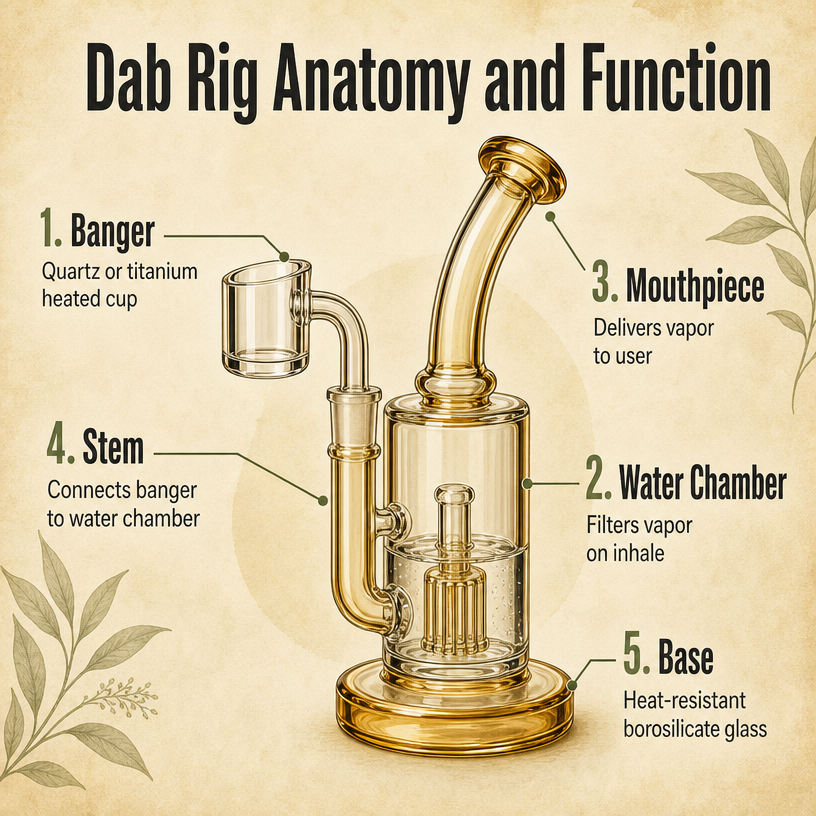
The core component is the banger—a small, cup-shaped attachment made of quartz or titanium that screws or seats into the rig’s stem. You heat the banger with a handheld torch until it reaches the right temperature, then use a dab tool to place a small amount of concentrate onto the heated surface. The concentrate vaporizes immediately, and you inhale the vapor through the rig’s water chamber. [1]
The water chamber serves the same basic function as the water chamber in a standard bong: vapor travels through water before reaching your mouth, which cools it down compared to breathing vapor straight from a heated surface. The mechanics are similar to a laboratory gas washing bottle, where smoke or vapor is drawn through water to produce a smoother result. [2]
Most traditional Dab Rigs are made from heat-resistant borosilicate glass, which can handle repeated exposure to torch flame without cracking. These rigs tend to be larger than mini rigs, often 10 inches or taller, which gives the water chamber more room to filter and cool vapor before you inhale it. [2]
A complete traditional rig setup includes a few separate pieces beyond the rig itself. You will need a quality torch (most people use a butane torch rather than a standard lighter), a dab tool to handle the concentrate, and a carb cap to cover the banger after you drop the dab in, which helps the concentrate vaporize more fully. Each piece plays a role in getting a good experience.
Browse Glass Dab Rigs to explore related options.
Browse E-rigs / Electric Rigs to explore related options.
What Is an E-Rig and How Does It Differ from a Traditional Dab Rig?
An e-rig—short for electronic rig—is a category of dabbing device that replaces the torch flame with an electrical heating element. Instead of heating a banger with a handheld torch, you set a target temperature on the device and it heats the banger or nail electronically. This means no open flame, no guesswork about whether the banger is hot enough, and no torch fuel to replace. [1] [3]
- Portable e-rigs run on rechargeable batteries and work well for travel or discrete use away from home.
- Desktop e-rigs require a power outlet and generally deliver more stable long-term temperature control.
- Precise temperature settings let you tailor the heat to specific concentrate types for better vaporization.
- No torch means no open flame, which simplifies the setup process and reduces equipment needed.
E-rigs come in two broad formats. Portable e-rigs look a bit like oversized vape pens and run on rechargeable batteries. They are designed for use on the go, though battery life varies depending on the model and how often you use it. Desktop e-rigs need a power outlet and tend to offer more consistent temperature control and longer heating cycles. Both formats let you set exact temperatures, which is one of their biggest advantages over traditional rigs. [3]
Temperature control matters because different concentrates vaporize best at different temperatures. Wax, shatter, and live resin each have ideal temperature ranges, and holding the heat in the right window makes a difference in how much of the concentrate actually converts to vapor rather than wasting it. With a torch, you learn to read the banger’s color and feel; with an e-rig, you just pick a number on a dial or button. [3]
The tradeoff is that e-rigs are electronic devices, which means they have components that can wear out, firmware that may need updating, and a dependence on battery charge or power outlets. Traditional rigs have no electronics at all—just glass, water, and flame. Some users prefer the ritual and control of a torch setup; others prefer the convenience and consistency of electronic heating. [1]
If you are new to dabbing, an e-rig can be a gentler entry point since you do not need to learn torch technique at the same time as temperature management. If you already enjoy the full torch ritual and want precise control, an e-rig complements that toolkit rather than replacing it entirely. [3]
Read What Is a Dab Rig and How Do You Use One? for more detail.
Read E-Rig vs Traditional Dab Rig: Which Should You Choose? for more detail.
How Does a Recycler Dab Rig Work?
A recycler dab rig uses a multi-chamber design that keeps water moving through the device rather than letting it settle in one place. In a standard dab rig, vapor bubbles up through a single water chamber and the water eventually stills. In a recycler, the water and vapor travel through two or more connected chambers, and the design of the glass routes used water back into a reservoir while fresh water keeps flowing through the main filtration path. [4]
- Multi-chamber design routes water and vapor through connected paths rather than pooling in a single base.
- Continuous circulation keeps fresher water flowing through the main filtration path on each inhale.
- Longer vapor path through multiple chambers and water surfaces provides extended interaction before delivery.
- Taller, more intricate glass construction offers performance benefits but increases fragility and cleaning time.
The continuous water circulation is what gives the recycler its name. Vapor moves from the banger into the first chamber, then through a tube or pathway into a second chamber, and the motion of you inhaling pulls water from the second chamber back down into the first. This creates a loop where the water is constantly recycled through the system. The practical result is that the main chamber stays clearer of standing water, which means each hit pulls through fresher water rather than water that has already been used. [4]
This design appeals most to users who want ongoing filtration without the main chamber filling up. Because fresh water keeps cycling through, the vapor encounters multiple surfaces of water and glass as it travels, and the path it takes is longer than in a single-chamber rig of the same size. Some users notice this as a difference in how the vapor feels, though personal preference plays a large role in whether a recycler is worth the added complexity and cost. [4]
Recycler rigs tend to be taller than mini rigs and often have more intricate glasswork, which means they can be more fragile and harder to clean. The multiple chambers and internal pathways require patience to rinse thoroughly. If you travel frequently or want something easy to throw in a bag, a recycler is generally not the best fit. They are best suited for home use where the extra size and maintenance are less of a concern.
Browse Recycler Bongs to explore related options.
What Are the Benefits of a Mini Dab Rig?
Mini Dab Rigs are compact dabbing devices, typically under 8 inches tall, that pack the core dab rig experience into a much smaller frame. They still use a water chamber and a banger, so the basic mechanics are the same as a full-size traditional rig. The reduction in size mostly affects the water chamber and the overall vapor path length, which changes the experience in a few predictable ways. [4]
- Compact size under 8 inches makes them highly portable and easy to store discreetly.
- Smaller water chamber preserves more of the concentrate’s flavor profile during inhalation.
- Lower price points offer an accessible entry point for beginners exploring dabbing.
- Reduced water volume shortens the cooling path for users who prefer a warmer vapor experience.
The main benefit of a mini rig is portability. A rig that fits in your hand and slips into a bag is much easier to move around than a tall borosilicate glass piece that needs a flat surface and a safe space to set down. Mini rigs are popular with people who want to dab on the go, keep something discreet at a friend’s house, or simply prefer not to have a large glass piece sitting out. [4]
The smaller water chamber means less water is involved in the filtration, which shortens the cooling path compared to a larger rig. Some users prefer the shorter path because it preserves more of the concentrate’s original flavor characteristics, since vapor interacts with less glass and water on the way to your mouth. Others prefer the additional cooling a larger chamber provides. Neither is objectively better—it comes down to personal preference. [4]
Mini rigs also tend to be more affordable than large traditional or recycler rigs, which makes them a common entry point for new dabbers. You can find solid mini rigs across a range of price points, and the lower investment makes it easier to try dabbing without committing to an expensive full setup. They also use smaller bangers and less torch fuel per session, which brings the ongoing cost of each dab down slightly.
Read What Are the Different Types of Bongs? for more detail.
What Are the Main Differences Between Dab Rig Types?
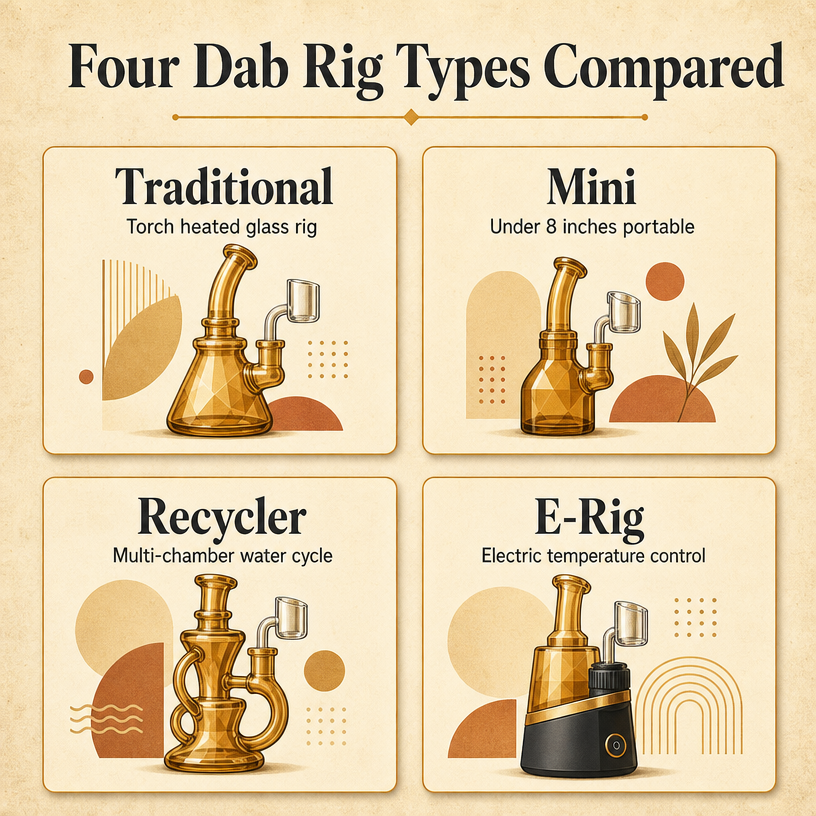
Choosing among the four main dab rig types means weighing how each one handles heating, size, water system complexity, and maintenance. No single rig is the best choice for everyone—the right option depends on where you plan to use it, how much control you want over temperature, and how much setup work you are willing to put in. [1] [2] [3] [4]
- Traditional rigs use torch-and-banger heating with full manual control; e-rigs use electronic heating with precise temperature settings.
- Mini rigs are under 8 inches tall and portable; traditional and recycler rigs are typically 10 inches or taller and best for home use.
- Recycler rigs use multi-chamber water circulation for ongoing fresh filtration; traditional and mini rigs use single-chamber static water filtration.
- Maintenance varies from simple rinsing for mini rigs to thorough multi-chamber cleaning for recycler rigs.
Traditional rigs offer a pure torch-and-banger experience. They require a butane torch, a dab tool, and a carb cap in addition to the rig itself. The heating process involves more steps and more equipment than any other type, and temperature is managed by feel and timing rather than a dial. The payoff is direct control and a wide range of affordable options. [1]
E-rigs eliminate the torch and add electronic temperature control. They run on batteries or AC power and let you set exact temperatures, which removes the biggest variable from the dabbing process. Portable e-rigs add convenience but come with battery life limits; desktop e-rigs offer consistency but need a power outlet. The trade-off is that you are working with electronics that may need updating or replacing over time. [3]
Recycler rigs take the water system further by adding chambers and pathways that keep water moving through the device. The filtration path is longer and the water stays fresher during a session, but the glasswork is more complex, harder to clean, and generally more fragile. Recycler rigs are typically the most expensive of the four types and are best suited for home use where the extra features matter most. [4]
Mini rigs condense the dab rig concept into a portable format. They sacrifice some water chamber size and cooling capacity in exchange for convenience and price. They are the most travel-friendly option and are often the most affordable, making them a common first rig for new dabbers. [4]
Treehouse Lifestyle carries dab rigs across all four categories, and free shipping on orders $150+ makes it easy to explore a new style without worrying about added costs at checkout.
What Materials Are Dab Rigs Made From?
The vast majority of dab rigs are made from heat-resistant borosilicate glass. This is the same material used in laboratory glassware and many types of kitchen glassware, and it is the standard for a good reason. Borosilicate glass handles repeated exposure to high temperatures without cracking or warping, which is obviously important when you are putting a torch next to it every session. [2]
- Borosilicate glass resists thermal shock and handles repeated torch heating without cracking.
- Quartz bangers heat and cool quickly, ideal for short, precise vaporization windows.
- Titanium nails retain heat longer, giving a wider working window after heating.
- Silicone skins and bases add durability and grip but are not used in the vapor path itself.
Borosilicate glass is made by adding boron trioxide to standard glass, which lowers its thermal expansion coefficient. That means it expands and contracts much less when heated and cooled than ordinary glass does. In practical terms, you can heat a banger with a torch, set it down on a room-temperature surface, and the glass will not crack from the temperature difference. Standard glass would likely shatter under the same conditions. [2]
Quartz and titanium are the primary materials for bangers and nails rather than the rig itself. Quartz bangers heat up quickly and cool down relatively fast, giving you a short window to work in after heating. Titanium nails retain heat longer once they are hot, which extends your working window but can make it easier to overheat the concentrate if you are not careful. Both materials are non-reactive, meaning they do not add flavor or residue to the vapor. [1]
Beyond glass, some dab rigs incorporate silicone parts, particularly in the base or as a protective skin around the glass. Silicone is extremely durable and can absorb an accidental drop that would break a glass piece. However, silicone is generally not used in the vapor path itself because it can retain odors and is harder to keep truly clean compared to glass. Most serious dabbers stick with all-glass vapor paths for purity of flavor and ease of cleaning.
Which Dab Rig Type Is Right for You?
The right dab rig depends on what matters most to you. There is no universal winner across all categories—each type makes different trade-offs that suit different priorities and situations. Thinking through three core questions can narrow the field quickly. [1] [3] [4]
- Choose a traditional glass rig if you want maximum control, full-size water filtration, and enjoy the torch ritual.
- Choose an e-rig if precise temperature control and convenience matter more than tradition.
- Choose a recycler rig if you prioritize extended filtration and ongoing water freshness in a home setup.
- Choose a mini rig if portability, price, and discretion are your top priorities.
First, where will you primarily use the rig? If you want to dab at home and have a dedicated space, a traditional glass rig or a recycler rig gives you the full experience without the compromises that come with miniaturization. If you want to dab away from home—in different rooms, outside, or while traveling—a mini rig or portable e-rig is far more practical. This single question eliminates at least two options for most people.
Second, how much control do you want over the process? A traditional torch-and-banger rig puts every variable in your hands: how hot to heat, how long to wait, how big a dab to take. If you enjoy that level of involvement and the small ritual of prepping and heating, a traditional rig is satisfying. If you want consistent results with less active management, an e-rig’s temperature dial is appealing. Some users eventually end up with both—a traditional rig for slow home sessions and an e-rig or mini rig for quick use.
Third, what is your budget and how much maintenance are you willing to do? Traditional and mini rigs are straightforward to clean—warm water, isopropyl alcohol for residue, and a rinse. Recycler rigs require more patience due to their multiple chambers. E-rigs need occasional firmware updates and battery care on top of glass cleaning. The more complex the system, the more ongoing attention it tends to need.
What Are Common Questions About Smoking Accessories?
Do dab rigs use water filtration like bongs?
Yes. Like a bong, most dab rigs include a water chamber that filters the vapor as you inhale. The mechanics are similar to a laboratory gas washing bottle—smoke or vapor is drawn through water. The main difference is that dab rigs are purpose-built for concentrates, using a banger heated with a torch rather than a bowl for dry herb.
What is the difference between a traditional dab rig and an e-rig?
A traditional dab rig uses a torch to heat a quartz or titanium banger before placing concentrate on the heated surface. An e-rig replaces the torch with an electrical heating element, allowing you to set and maintain a specific temperature electronically. E-rigs eliminate the open flame, provide precise temperature control, and are available in both portable and desktop formats.
How does a recycler dab rig work?
A recycler rig routes water and vapor through multiple chambers, causing water to circulate back into a reservoir rather than simply pooling in the base. This continuous flow reduces standing water in the main chamber and provides ongoing filtration through multiple paths.
What is the typical size of a mini dab rig?
Mini dab rigs are typically under 8 inches tall, making them significantly more compact than standard dab rigs. They retain water filtration in a smaller chamber and are designed for portability and discrete use.
What is a banger on a dab rig?
A banger is the quartz or titanium cup attachment on a dab rig that is heated with a torch before concentrate is applied. The terms banger and nail are used somewhat interchangeably in the industry, with quartz and titanium being the most common materials.
Which Dab Rig Type Will You Choose?
All four dab rig types—traditional, e-rig, recycler, and mini—deliver the core dabbing experience of vaporizing concentrates through a water-filtered system. The differences are in heating method, size, water system complexity, and how they fit into your lifestyle. A traditional glass rig rewards hands-on users who enjoy the torch ritual. An e-rig trades that ritual for precision and convenience. A recycler rig pushes water filtration to its most elaborate form for home use. A mini rig brings the core experience into a portable, affordable format.
Think through where you will use the rig most, how much temperature control you want, and how much maintenance you are comfortable with. Those three factors will quickly narrow your options. Treehouse Lifestyle carries dab rigs across all four categories, so you can explore different styles and find the one that fits your setup. Free shipping on orders $150+ applies to your order, making it straightforward to try a new format without added cost.
Where Does This Smoking Accessory Information Come From?
- Wikimedia Foundation: Vaporizer (inhalation device) – Wikipedia
- Wikimedia Foundation: Bong – Wikipedia
- DabConnection: eRigs – DabConnection
- DabConnection: Rigs – DabConnection