

Your complete guide to smoking accessory terminology — from bong anatomy to joint sizes, percolators, dry pipes, and accessories.
Smoking accessory terms are the names and definitions a beginner needs to shop for pipes, parts, and accessories with confidence. This guide covers bong anatomy, joint sizes, percolator types, dry pipe styles, and the accessories you will encounter most. By the end, every product listing and shop description makes sense.
What Are the Parts of a Bong Called?
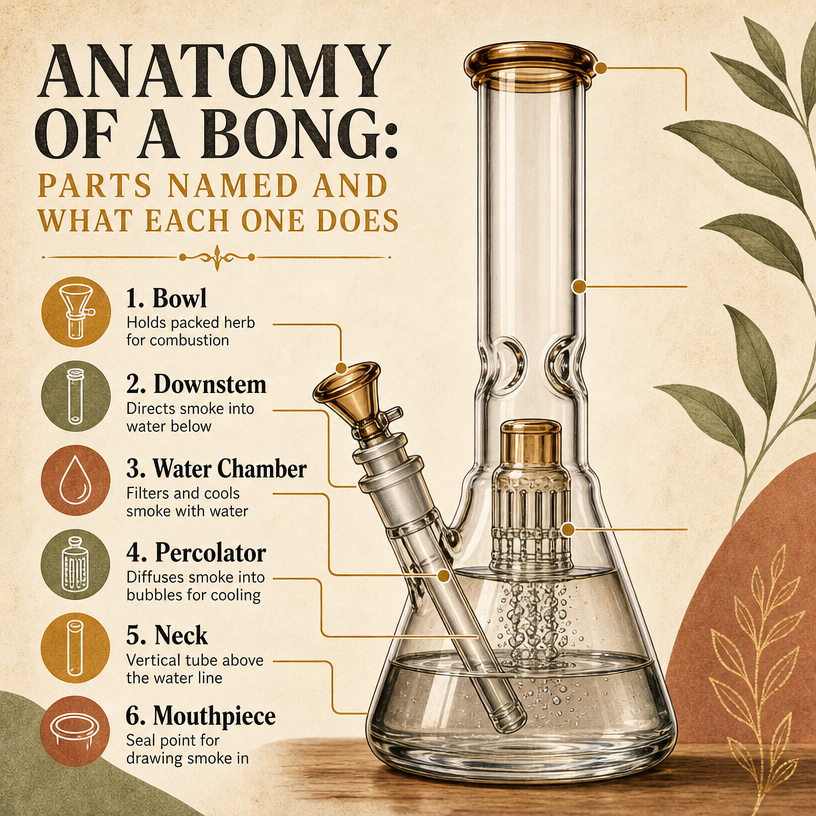
Every bong, regardless of shape or size, shares the same basic anatomy. Manufacturers may vary the design, but the parts are universal across the industry. Learning these names means you can read any product listing without getting lost in jargon.
- Bowl: the removable cup that holds herb for combustion [1]
- Downstem: a glass tube that directs smoke from the bowl into the water [3]
- Water chamber: the lower body section filled with water that cools smoke [1]
- Percolator (perc): an internal device that diffuses smoke into bubbles for extra cooling [1]
- Neck: the vertical tube that carries smoke from the water to the mouthpiece [4]
- Mouthpiece: the top opening where you seal your lips to draw in smoke [4]
The bowl is the small cup at the top of the downstem where you pack your herb. When you light it, the flame draws smoke down through the downstem and into the water below. Bowls are removable and come in different sizes to match different joint sizes. [1]
The downstem is the glass tube that connects the bowl to the water chamber. It directs smoke from the burning herb down into the water. Some downstems have small slits near the bottom to diffuse smoke into finer bubbles. [3]
The water chamber is the lower part of the bong that holds water. This is where smoke makes contact with cool water, which lowers its temperature before you inhale. [1]
The percolator breaks smoke into tiny bubbles as it passes through the water a second time. Not every bong has one, but those that do generally produce a cooler hit. [1]
The neck is the vertical tube that runs from the water chamber up to the mouthpiece. Smoke travels up through the neck after it passes through the water. [4]
The mouthpiece is where you seal your lips to draw smoke into your mouth. Most are slightly flared or rounded for comfort. Keeping it clean matters for taste. [4]
The base sits on the surface the bong rests on. Bases come in many shapes: straight tube, beaker, round, or flat. Beaker-style bases hold more water and tend to be more stable than straight tubes.
What Is the Difference Between a Bong, Bubbler, and Dab Rig?
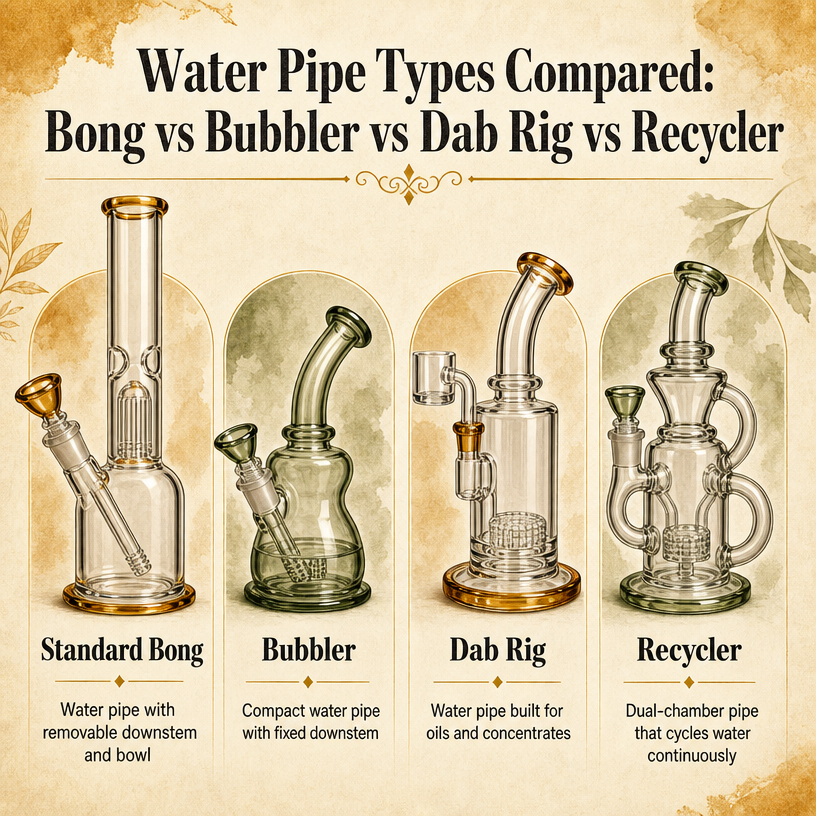
The three most common water pipe types beginners encounter are standard bongs, bubblers, and dab rigs. Each one is built for a different type of material and a different smoking experience.
- Standard Bong: water pipe with removable bowl and downstem, sits flat during use [1]
- Bubbler: compact water pipe with fixed downstem, produces a bubbling sound [1]
- Dab Rig: water pipe built for oils and concentrates, uses a heated nail [1]
- Recycler: a dual-chamber bong that cycles water to keep filtration fresh [1]
A standard bong, also called a water pipe, is a larger device that sits on a flat surface during use. It has a removable bowl and downstem, and the water chamber is typically at the base or mid-body of the piece. Bongs can range from small personal sizes to tall, complex rigs with multiple percolators. [1]
A bubbler is a smaller, handheld water pipe with a fixed downstem. The downstem is fused into the body of the piece and cannot be removed. Bubblers produce the characteristic bubbling sound as you draw, which is where the name comes from. Their compact size makes them easier to store and transport than a full-sized bong. [1]
A dab rig is a water pipe specifically designed for oils, waxes, or concentrates rather than dry herb. Instead of a bowl with a flame, a dab rig uses a heated nail that you apply concentrate onto. The nail is often made of quartz, titanium, or ceramic. Some dab rigs use a dome to trap vapor; others are designed as a single piece without one. [1]
The key difference between all three comes down to what you are smoking and where you are smoking it. Dry herb goes in a bong or bubbler. Concentrates go in a dab rig. Portability is highest with a bubbler, lowest with a large bong. [2]
Our guide to <a href="https://wordpress-production-3a6d.up.railway.app/blog/complete-guide-smoking-accessories">what smoking accessories beginners need</a> and our breakdown of <a href="https://wordpress-production-3a6d.up.railway.app/blog/parts-of-a-bong">what each bong part does</a> cover these pipe types in more detail.
Read What Smoking Accessories Do Beginners Need? for more detail.
Read What Are the Parts of a Bong and What Does Each One Do? for more detail.
Read What Is the Difference Between a Bubbler and a Bong? for more detail.
| Pipe Type | What It Smokes | Heating Method | Key Feature |
|---|---|---|---|
| Standard Bong | Dry herb | Bowl with flame | Removable bowl and downstem |
| Bubbler | Dry herb | Bowl with flame | Fixed downstem, compact size |
| Dab Rig | Oils, waxes, concentrates | Heated nail | Built for concentrate use |
| Recycler | Dry herb or concentrates | Bowl or nail | Dual chambers cycle water continuously |
What Do Joint Size and Gender Mean When Shopping for Pipes?
Joint size and gender are the two details most likely to confuse a first-time buyer, and they are also the most important to get right when buying replacement parts. If you order a bowl that does not match your pipe’s joint, it will not seal properly.
- 10mm: smallest joint size, found on compact pipes and some bubblers [1]
- 14mm: the most widely used joint size across standard bongs [2]
- 18mm: larger joint size, standard on heavy-duty and large pieces [5]
- Male joint: a protruding connection that inserts into a female socket [2]
- Female joint: a socket that accepts a male insert such as a bowl [2]
- Glass-on-glass: a sealed ground glass connection without rubber o-rings [5]
Joint size refers to the diameter of the ground glass connection point on a pipe or accessory. The three standard sizes in the industry are 10mm, 14mm, and 18mm. A 10mm joint is the smallest and most common in compact pipes and bubblers. A 14mm joint is the most widely used size across standard bongs and water pipes. An 18mm joint is larger and appears on heavy-duty or large-format pieces. [1]
Joint gender describes whether the connection point is male or female. A male joint inserts into the pipe. A female joint accepts an insert. When you hear someone say a bong has a female joint, that means the joint on the bong body is a socket that accepts a male bowl. Most standard bongs feature a female ground glass joint on the body and a male bowl piece, but the reverse also exists. [2]
Glass-on-glass refers to any pipe or attachment that uses two ground glass joints to create a sealed connection without a rubber o-ring. Glass-on-glass joints provide a tighter, more inert seal than standard connections that rely on rubber. They are common on mid-to-high-end pipes. [5]
When you are shopping for replacement bowls, ash catchers, or other accessories, always check the joint size and gender of your pipe first. These two specs must match. If you are unsure what size your pipe uses, measuring the diameter of the opening with a ruler gives you a quick answer. <a href="https://wordpress-production-3a6d.up.railway.app/shop/accessories/Downstems">Browse our full selection of downstems</a> to see the range of sizes and styles available.
What Do Percolators, Recyclers, and Ice Pinches Actually Do?
Percolators, recyclers, and ice pinches are the features most advertised on water pipes, and they are also the least clearly explained in most product listings. Understanding what each one actually does helps you evaluate whether a particular bong is worth the upgrade over a simpler model.
- Tree perc: upright glass arms that break smoke into bubbles [3]
- Honeycomb perc: a flat disc with a grid of small holes that diffuses smoke [3]
- Showerhead perc: a perforated head that disperses smoke downward into water [3]
- Recycler: dual chambers that continuously cycle water for fresh filtration [1]
- Ice pinch: indentations in the neck that hold ice cubes for extra cooling [4]
A percolator is a secondary filtration device inside the bong that forces hot smoke to pass through water in the form of many small bubbles. This process drops the temperature of the smoke before it reaches the neck. Percolators come in several common shapes. Tree percs have multiple upright arms that look like a branching tree. Honeycomb percs are flat discs with a grid of small holes. Showerhead percs have a slit or perforated head that disperses smoke downward into the water. [3]
A recycler takes the percolator concept a step further by adding a second chamber. Water and smoke cycle continuously from the first chamber to the second, which keeps the water moving and prevents it from reaching the mouthpiece during a session. The cycling action also pulls fresh water through with each inhalation, maintaining consistent filtration throughout. [1]
An ice pinch is a set of small indentations in the neck of a bong, usually just below the mouthpiece. These indents hold ice cubes in place above the water line so the smoke cools against the ice before you inhale. The feature is especially common on straight-tube and beaker-style bongs where the neck is wide enough to accept cubes. [4]
Learn more about how bongs work in our guide to <a href="https://wordpress-production-3a6d.up.railway.app/blog/complete-guide-bongs-water-pipes">what a bong is and how it works</a>.
Read What Is a Bong and How Does It Work? for more detail.
What Are the Different Types of Dry Pipes?
A dry pipe is any handheld smoking device that does not use water. Dry pipes are simpler than water pipes, require no setup or cleaning between uses, and are generally more portable. The four styles most commonly found in shops and online stores are spoon pipes, chillums, Sherlock Pipes, and one-hitter bats.
- Spoon pipe: curved body with a bowl and carb hole, the most common dry pipe style [1]
- Chillum: a straight pipe with end-to-end channel and no carb [2]
- Sherlock pipe: curved stem with bowl positioned below the mouthpiece [3]
- One-hitter bat: a small pipe holding a single inhalation’s worth of herb [5]
Spoon pipes are the most recognizable dry pipe shape. They are named for their spoon-like silhouette: a short, curved body with a bowl at one end and a mouthpiece at the other. Most spoon pipes have a small carb hole on the side near the bowl. To use one, you pack the bowl, cover the carb with your finger, draw smoke, then release the carb to clear the remaining smoke from the chamber. [1]
Chillums are straight, cylindrical pipes with no carb hole. Smoke enters at one end and you inhale from the other, with the herb sitting in a shallow dish at the mouthpiece end. The lack of a carb means you control airflow by how tightly you pack the bowl and how hard you draw. Chillums are often made from glass or stone and are some of the oldest pipe designs still in use. [2]
Sherlock pipes feature a distinctive curve in the stem that drops the bowl below the level of the mouthpiece. This design distributes heat more evenly across the bowl and gives the pipe a hands-free rest position. Sherlock pipes are popular with pipe smokers who prefer the traditional aesthetic. [3]
One-hitter bats are small, tubular pipes designed to hold exactly one inhalation’s worth of herb. They typically have a thin bowl that fits into a matching tube called a dugout. One-hitters are the most discreet option and are popular for personal, on-the-go use. The small bowl size also makes them useful for micro-dosing. [5]
Explore our selection of <a href="https://wordpress-production-3a6d.up.railway.app/shop/hand-pipes/sherlock-pipes">Sherlock pipes</a> to see how this classic style is represented in our catalog.
What Are Bong and Pipe Accessories Every Smoker Should Know?
Beyond the pipes themselves, several Accessories appear in every smoke shop catalog and online store. Understanding what these accessories do helps you decide which ones are worth adding to your collection.
- Ash catcher: attachment that traps ash before it enters the bong water [1]
- Grinder: device that shreds herb into even pieces for a consistent burn [3]
- Cleaning supplies: isopropyl alcohol and coarse salt for dissolving residue [3]
- Dugout: compact storage container with a one-hitter and herb compartment [3]
An ash catcher is an attachment that sits between the bowl and the downstem. It catches ash before it enters the main water chamber, which keeps your bong cleaner for longer and reduces how often you need to change the water. Ash Catchers also add an extra stage of filtration since the smoke passes through water in the catcher before reaching the bong. [1]
A grinder breaks whole herb into smaller, evenly sized pieces for a more consistent burn. Most grinders have two or more compartments: teeth that shred the herb, a screen that separates the ground product from the finest particles, and a collection chamber below. Some also include a small kief compartment for collecting the concentrated powder that falls through the screen. [3]
Cleaning supplies are an ongoing necessity for any pipe owner. Isopropyl alcohol and coarse salt are the standard combination for cleaning glass pieces. The alcohol dissolves residue buildup while the salt provides abrasive scrubbing action. Pipe cleaners, long thin brushes designed to run through the inside of narrow glass tubes, are also essential for keeping downstems and necks clear.
A dugout is a small storage container, often wooden or metal, with two holes: one for the one-hitter bat and one for a supply of ground herb. Dugouts are compact and discreet, designed for people who want a portable, all-in-one setup for dry herb use. [3]
Shop our full range of <a href="https://wordpress-production-3a6d.up.railway.app/shop/accessories/ash-catchers">ash catchers</a> and other accessories to find the right additions for your setup.
What Are the Best Materials for Smoking Accessories?
Most smoking accessories fall into one of three material categories: borosilicate glass, Pyrex glass, or quartz. Each has different properties around heat resistance, durability, and thermal shock that affect how the piece holds up over time.
- Borosilicate glass: heat-resistant glass that handles temperature changes well [3]
- Pyrex glass: a brand-name version of borosilicate glass with the same properties [5]
- Quartz: a glass material that handles direct heat exposure well but can crack from impact [5]
- Silicone: a flexible, durable material that does not affect flavor
Borosilicate glass is the most common material for smoking accessories. It contains boric acid, which gives it better resistance to temperature changes than standard glass. You can pour hot water into a borosilicate piece without it cracking from thermal shock, which is why it is sometimes called scientific glass. Most mid-range bongs and pipes are made from this material. [3]
Pyrex is a brand name for a type of borosilicate glass, so it shares the same thermal shock resistance properties. When you see Pyrex listed as a material on a smoking accessory, it refers to the same borosilicate composition. The name is used more often in North American retail, while scientific glass or borosilicate appears more in wholesale and brand descriptions. [5]
Quartz is a naturally occurring glass material that handles direct heat exposure better than borosilicate. Quartz nails on dab rigs, for example, heat up faster and cool down more quickly than titanium or ceramic. However, quartz is more vulnerable to physical shock from drops or impacts. It does not flex the way some borosilicate formulations do, so it can crack from a hard fall even if thermal stress would not bother it. [5]
Silicone has become a popular material for pipes and bangers in recent years because it is virtually unbreakable and can be folded or packed without damage. High-quality food-grade silicone is inert, meaning it does not affect flavor, and it withstands both high heat and freezer temperatures.
What Are Common Questions About Smoking Accessories?
Is a bong the same thing as a water pipe?
Yes. In the industry, ‘bong’ and ‘water pipe’ are used interchangeably. Both refer to a pipe that uses water to filter and cool smoke before inhalation. The term ‘bong’ is more common in consumer-facing retail, while ‘water pipe’ appears more often in product listings and industry wholesale catalogs.
What is the difference between a male and female joint?
A male joint inserts into the pipe body. A female joint accepts an insert such as a bowl or nail. Most standard bongs and water pipes use a female ground glass joint on the pipe body and a male bowl piece, though the opposite configuration exists. Gender matters when buying replacement bowls or ash catchers, as they must match the pipe’s joint type.
Can I use a 14mm bowl in an 18mm joint?
No. Joint size must match exactly. An 18mm joint is larger in diameter than a 14mm joint, so a 14mm bowl will not seal properly in an 18mm female joint and will leak air. Adapters exist, but a matched size pair is the standard approach.
What is the difference between a bubbler and a bong?
A bubbler is a smaller, handheld water pipe with a fixed downstem. It produces a bubbling sound as you draw and is generally more portable than a bong. A standard bong is larger, often has a removable downstem, and sits on a flat surface during use. Both filter smoke through water, but the bubbler’s compact design makes it better for personal, on-the-go use.
What is a recycler bong and who is it for?
A recycler bong has two connected chambers that continuously cycle water from the first chamber to the second. This design keeps water moving, preserves the flavor of oils and concentrates, and prevents spent water from reaching the mouthpiece mid-session. They are popular among concentrate users who want the cleanest possible flavor.
How Do You Put All These Smoking Accessory Terms to Use?
Knowing the terminology makes every step of buying and using smoking accessories easier and more confident. When you understand what a percolator does, you can decide whether the feature is worth the higher price. When you know the difference between 14mm and 18mm joints, you stop worrying about ordering the wrong replacement bowl.
For beginners, the best starting point is a simple spoon pipe or small bong. Both give you the core experience without overwhelming features. As you grow more comfortable, you can explore percolators, different joint sizes, glass-on-glass connections, and accessories like ash catchers and grinders.
Whatever direction you take, Treehouse Lifestyle has the accessories and replacement parts to match. We carry a full range of smoking accessories across all the categories covered here, with free shipping on orders over $150 so you can build out your collection without extra costs.
Where Does This Smoking Accessory Information Come From?
- Thick Ass Glass: The Ultimate Bong Terminology Guide
- Smokea: Glossary of Terms
- Smokits: Smoke Shop Terminology 101
- HEMPER: The Complete Visual Guide to Bong Part Names
- The Dab Lab: Head Shop Dictionary (Lingo & Terminology)