
A complete guide to two-way humidity control packs, RH levels, brand comparisons, and how to keep your dry herb fresh longer.
Humidity control packs are small, reusable pouches that automatically regulate moisture inside any sealed container, keeping dry herb at the ideal relative humidity (RH) level of 55–62%. They work bidirectionally — absorbing excess moisture when humidity rises and releasing moisture when air dries out — so your herb stays in the sweet spot for flavor, texture, and preservation. The two dominant brands, Boveda and Integra Boost, use different internal solutions but deliver similar long-term stability once fully conditioned.
What Are Two-Way Humidity Control Packs and How Do They Work?
Two-way Humidity Control packs are sealed pouches filled with a specialized moisture-regulating solution. They are designed for use inside airtight containers such as glass jars, plastic storage containers, or travel cases. The pack’s outer membrane allows water vapor to pass in and out while keeping the internal solution contained. [1]
- Semipermeable membrane allows water vapor exchange while containing the internal solution
- Bidirectional regulation absorbs moisture when humidity is high and releases it when humidity is low
- All-natural ingredient formulations — salt-water solution (Boveda) or glycerin-water blend (Integra Boost)
- Requires an airtight storage container to function correctly and maintain target RH
- Non-toxic, food-grade materials used by both major brands [1] [2]
The mechanism is called bidirectional moisture exchange. When the air inside your container holds too much moisture, the pack absorbs the excess. When the air becomes too dry, the pack releases stored moisture back into the container. This cycle continues automatically as long as the container stays sealed. [3]
Both leading brands rely on natural ingredients. Boveda uses a saturated salt solution made from purified water and food-grade salt compounds. Integra Boost uses a glycerin-and-water blend with no salt. Neither brand uses toxic materials in their standard formulations. [1] [2]
These packs only work inside sealed or airtight containers. An open container allows ambient humidity to constantly fluctuate, and the pack cannot maintain its target level. If you store your herb in a bag or an unsealed jar, a humidity pack will not deliver the promised results.
The science behind these packs is straightforward. A semipermeable membrane separates the internal solution from the surrounding air. Water molecules move through the membrane in whichever direction restores equilibrium. This is the same principle used in food packaging and pharmaceutical storage. [3]
See HIPPIE WIG WAG HAND PIPE as one current product example.
Boveda vs. Integra Boost: Which Humidity Pack Should You Choose?
Boveda and Integra Boost are the two most widely available two-way humidity control brands. They serve the same core function — maintaining a preset relative humidity inside a sealed container — but they differ in formulation, response speed, and how they signal when replacement is needed. [1] [2]
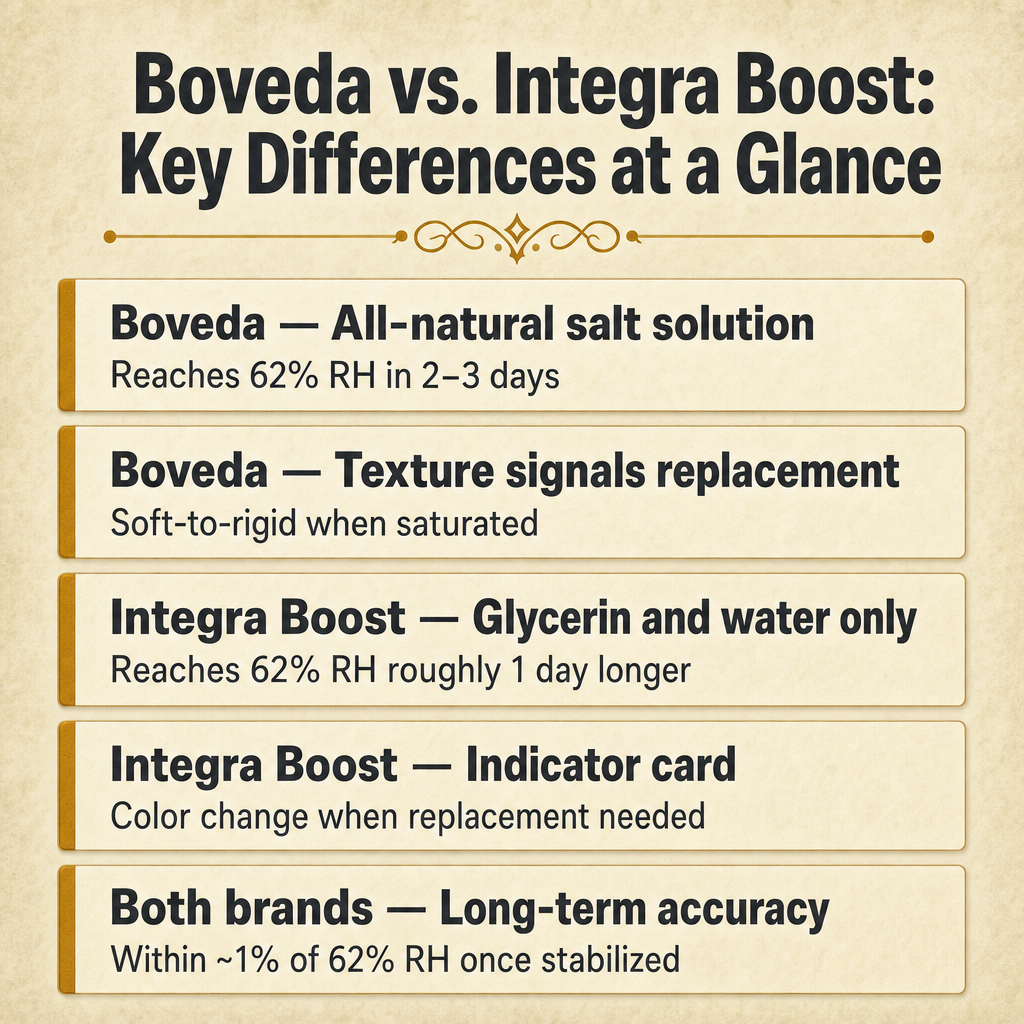
- Boveda uses an all-natural salt solution; Integra Boost uses a glycerin-and-water formulation
- Boveda reaches 62% RH target in 2–3 days; Integra Boost takes roughly 1 day longer
- Both maintain humidity within ~1% of target once fully stabilized
- Boveda signals replacement through texture change (soft to rigid); Integra uses a color-changing indicator card
- Both are described as non-toxic and free of harmful additives by their respective manufacturers [1] [2]
In terms of formulation, Boveda relies on an all-natural saturated salt solution. Integra Boost uses glycerin blended with purified water. Both manufacturers describe their products as non-toxic, salt-free (Integra specifically), and compliant with FDA standards for food contact. [2]
Speed to target is one meaningful difference. In controlled side-by-side testing, Boveda 62% RH packs reached their target level within approximately 2 to 3 days. Integra Boost took roughly 1 day longer to stabilize at the same level. Once both packs were fully conditioned, they performed nearly identically — each stayed within approximately 1% of the 62% target. [4]
The way each brand signals replacement differs. Boveda packs feel soft and pliable when active. When fully saturated, the internal solution converts to a solid state and the pack becomes rigid and hard. You can detect this by feel alone. Integra Boost includes a separate indicator card that changes color when the pack is exhausted, removing any guesswork. [4]
For long-term storage, both brands are effective. The decision often comes down to whether you prefer Boveda’s faster conditioning or Integra’s visual replacement indicator. Some users appreciate the tactile check with Boveda; others prefer the explicit color signal from Integra.
Read How Do I Store My Smoking Accessories the Right Way? for more detail.
| Feature | Boveda | Integra Boost |
|---|---|---|
| Internal solution | All-natural saturated salt | Glycerin and purified water |
| Time to reach 62% RH | 2–3 days | ~1 day longer than Boveda |
| Long-term accuracy | Within ~1% of 62% target | Within ~1% of 62% target |
| Replacement signal | Texture change (soft → rigid) | Color-changing indicator card |
| Available RH levels | Multiple, including 62% and 72% | 62% and 72% |
What Relative Humidity Level Should You Store Dry Herb At?
The optimal relative humidity range for storing dry herb falls between 55% and 62% RH. This band preserves the herb’s moisture content, protects its aromatic compounds, and prevents the conditions that lead to mold growth. [5]
- Optimal storage range is 55–62% relative humidity for preserving flavor, aroma, and texture
- Below 50% RH causes trichomes to become brittle and break off during handling
- Above 65% RH creates conditions that allow mold to develop inside sealed containers
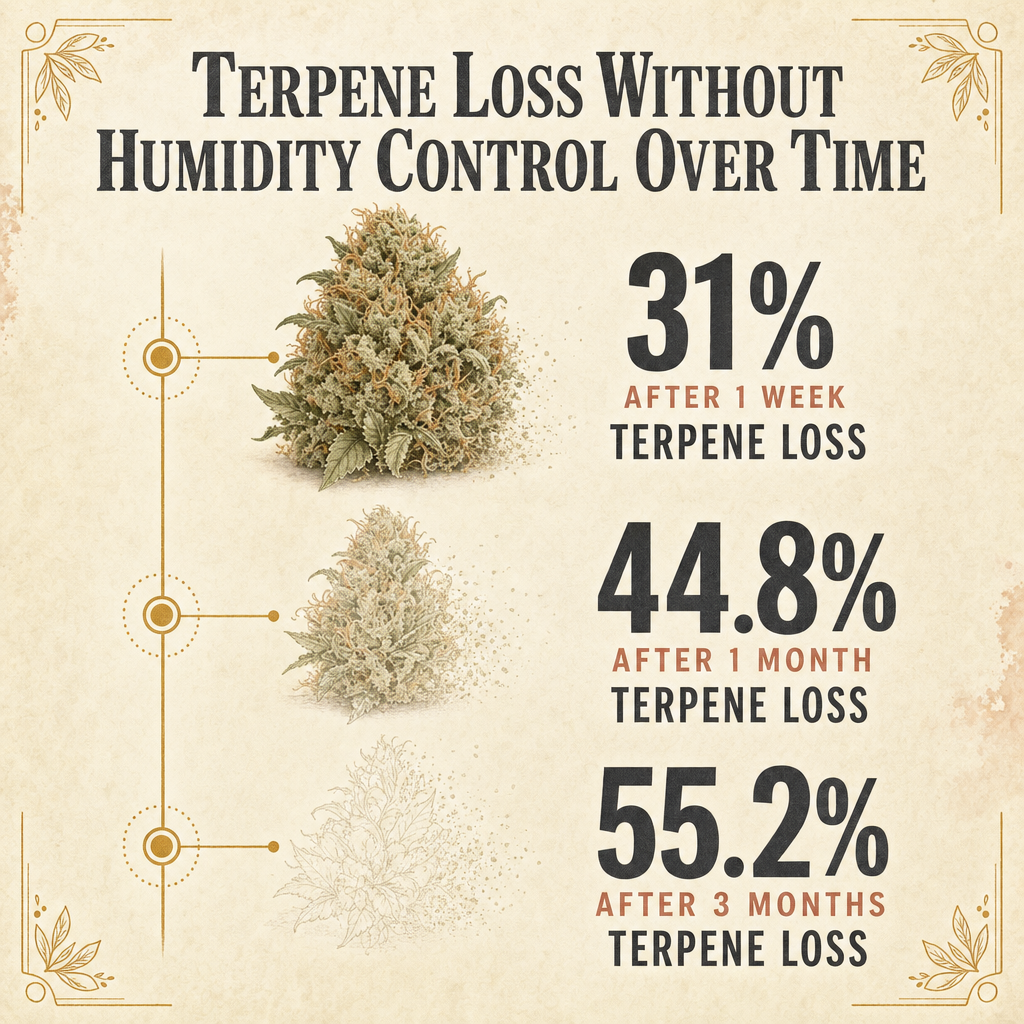
- Terpene loss without humidity control reaches 31% after one week and 55.2% after three months
- Research confirms 55–65% RH is the critical band for preserving cannabis chemistry [6] [7]
Research published in the Journal of Cannabis Research documented what happens without proper humidity control. Dry herb stored in uncontrolled conditions lost 31% of its terpenes after just one week. After one month, terpene loss reached 44.8%. After three months, more than half of the original terpene content was gone. [7] Terpenes are the aromatic compounds responsible for each strain’s distinct flavor and scent.
Below 50% RH, the herb dries out excessively. Trichomes — the tiny resin glands on the surface of the herb — become brittle and prone to breaking off through normal handling. This means you lose the most aromatic and flavorful parts of the plant through simple friction and movement. [7]
Above 65% RH, excess moisture creates conditions favorable for mold. Mold can develop rapidly in sealed containers with elevated humidity, rendering the contents unusable. [7] The 55–62% window is narrow by design — it balances terpene preservation with moisture levels that discourage microbial growth.
Most experienced users recommend 58–62% RH as the sweet spot. Some prefer the slightly lower 55% end of the range for long-term archival storage where a marginally drier product is acceptable in exchange for maximum chemical stability.
Read What Are the Different Types of Bongs? for more detail.
How Do You Know When to Replace a Humidity Control Pack?
Humidity control packs have a finite lifespan. They absorb moisture over time, and once the internal solution becomes saturated, they can no longer regulate humidity. Most packs need replacement after 2 to 6 months of active use. The exact timeline depends on container size, how often you open the container, and the ambient humidity in your storage environment. [3]
- Typical replacement window is 2–6 months depending on container volume, opening frequency, and ambient conditions
- Boveda signals replacement through texture change — the pack goes from soft and pliable to hard and rigid when saturated
- Integra Boost includes an indicator card that changes color to signal when replacement is needed
- Larger containers and frequent opening accelerate saturation and shorten usable lifespan
- Always replace packs before they become fully rigid to maintain consistent RH levels [3] [4]
Boveda packs signal replacement through texture. An active Boveda pack feels soft and slightly damp to the touch. When fully saturated, the internal solution solidifies and the pack becomes hard and rigid. Once you notice this texture change, the pack is exhausted and should be replaced. [4]
Integra Boost takes the guesswork out of this process. Each package includes a humidity indicator card that sits inside the container alongside the pack. When the card changes color — typically from blue to pink — it signals that the pack has reached saturation and replacement is due. [4]
Several environmental factors affect how quickly a pack exhausts. Larger containers hold more air and require more moisture exchange to maintain RH. Frequent opening and closing introduces new humidity each time. Storage in humid climates accelerates saturation. A pack in a small, rarely-opened jar will outlast one in a large container that gets opened daily.
Never use a pack past the point of saturation. An exhausted pack cannot regulate humidity and may actually introduce moisture problems rather than solve them.
Read E-Rig vs Traditional Dab Rig: Which Should You Choose? for more detail.
What Size Humidity Control Pack Do You Need for Your Container?
Choosing the correct pack size ensures the pack can condition the air volume inside your container without becoming overwhelmed. If the container is too large relative to the pack’s moisture capacity, the pack will saturate quickly and fail to maintain target RH. If the container is small, a larger pack than necessary works fine but represents unnecessary cost.
- Match pack gram rating to the amount of dry herb being stored — small jars (3–14g), medium containers (up to 28g), large storage (multi-ounce)
- Consult manufacturer sizing charts as the starting point for selection
- Size up when using plastic containers (which absorb some moisture) or when opening the container frequently
- A pack that is too small for the container will saturate rapidly and fail to maintain target RH
- Treehouse Lifestyle carries humidity control packs in a range of sizes for any storage need
The general rule is straightforward: match the pack’s gram rating to the approximate amount of dry herb you are storing. Smaller packs work for individual small jars holding 3–14 grams. Medium packs suit containers up to roughly 28 grams. Larger containers and multi-ounce storage require the highest gram-rated packs. [3]
Most manufacturers provide sizing charts. Following these charts accounts for the expected air volume in typical Storage Containers. If you are using an unusually large or unusually small vessel, size up or down accordingly.
Here is a step-by-step checklist to guide your selection:
First, determine the total volume of dry herb you plan to store in the container. Second, consult the manufacturer’s sizing guide for your chosen brand and match the herb weight to the appropriate pack size. Third, consider the container material. Glass jars have minimal moisture absorption, so standard sizing applies. Plastic containers may absorb a small amount of moisture, so a slightly larger pack can compensate. Fourth, if you open the container frequently, choose the next size up to account for humidity exchange during each opening.
Treehouse Lifestyle offers humidity control packs in multiple sizes to fit containers of every volume. Free shipping is available on orders over $150.
What Mistakes Should You Avoid When Using Humidity Control Packs?
Even the best humidity control packs deliver poor results when used incorrectly. Understanding the most common mistakes helps you avoid them and get the full benefit of these products.
- Do not use 72% RH packs for dry herb storage — this level exceeds the 65% mold-risk threshold
- Never use humidity packs in non-airtight containers — ambient humidity fluctuations will prevent regulation
- Avoid placing packs in direct contact with dry herb to prevent localized surface moisture buildup
- Re-equilibrate after opening: allow the pack 24–48 hours to restore target RH after container is resealed
- Audit your setup: check pack type, container seal, pack position, replacement status, and install date
The most frequent error is selecting the wrong relative humidity level. Packs are available in multiple RH targets, most commonly 62% and 72%. The 62% level is designed for long-term storage where you want to maintain herb at the optimal preservation range. The 72% level is generally too humid for dry herb storage and is better suited to keeping certain foods or botanicals from drying out. Using a 72% pack for long-term herb storage can push humidity above the 65% mold-risk threshold. [5]
Another common mistake is using humidity packs in non-airtight containers. If the container lid does not seal, ambient humidity will constantly fluctuate and overwhelm the pack’s capacity to regulate. The pack will saturate far ahead of its expected lifespan, and humidity will remain unstable. Always use an airtight container.
Placing the pack in direct contact with the herb is also inadvisable. While the pack’s outer membrane prevents leakage, direct prolonged contact may cause localized moisture buildup on the surface of the herb closest to the pack. Keeping the pack slightly separated from the herb — for example, in a corner pocket of the container or a dedicated compartment — allows air circulation to distribute humidity evenly.
Failing to re-equilibrate after opening is a subtle but real issue. Every time you open a sealed container, fresh ambient air enters and changes the internal humidity. The pack works to restore target RH, but this takes time. If you open the container frequently and for extended periods, the pack will work harder and saturate faster.
Here is a five-point checklist to audit your current setup:
First, verify you are using 62% RH packs for dry herb storage. Second, confirm your container has a tight-sealing lid with no visible gaps. Third, check that the pack is not placed directly against the herb. Fourth, note the pack’s current texture or indicator status. Fifth, calculate approximately when the pack was first used so you can anticipate its replacement window.
See PAX Flow Vaporizer with Grip Sleeve Bundle as one current product example.
What Are Common Questions About Smoking Accessories?
How do two-way humidity control packs actually work?
Two-way packs contain a saturated salt solution or glycerin-water blend inside a semipermeable membrane. When the surrounding air is too moist, the pack absorbs water vapor. When the air is too dry, it releases stored moisture. This bidirectional exchange continues automatically as long as the container remains sealed, maintaining a stable preset relative humidity.
What’s the difference between Boveda and Integra Boost humidity packs?
Boveda uses an all-natural salt solution; Integra Boost uses a glycerin-and-water formulation. Both maintain the same target RH accuracy once fully conditioned. Boveda typically reaches its 62% target 1–3 days faster, while Integra includes a color-changing indicator card so you know when to replace it. Boveda signals replacement through texture change — the pack goes from soft and pliable to rigid when saturated.
What relative humidity level is best for storing dry herb?
The optimal range is 55–62% relative humidity. Below 50%, trichomes become brittle and prone to physical damage. Above 65%, mold becomes a risk. Within the 55–62% band, terpene loss is minimized and the herb maintains its flavor and aroma over months of storage.
How long do humidity control packs last?
Most packs last between 2 and 6 months depending on container size, how often the container is opened, and ambient humidity conditions. Once a pack becomes rigid or hard, or once Integra’s indicator card changes color, it is fully saturated and should be replaced.
Can humidity packs preserve terpenes and flavor over time?
Research shows that dry herb stored without humidity control can lose approximately 31% of its terpenes within one week. Humidity control packs maintain the 55–62% RH range that slows terpene evaporation, helping preserve the herb’s original aroma and flavor profile during extended storage.
Is a Humidity Control Pack the Right Storage Upgrade for You?
If you store dry herb for more than a few days at a time, a humidity control pack is one of the simplest and most cost-effective upgrades you can make. The cost per pack is modest, lifespan is measured in months, and the difference in herb quality after extended storage is substantial. Boveda and Integra Boost are the established choices, and both deliver reliable results when used correctly. [1] [2]
The key variables are straightforward: choose the right RH level (62% for dry herb), match the pack size to your container and herb volume, use a properly sealed container, and replace the pack before it becomes saturated. Avoid the common mistakes of wrong RH selection, non-airtight storage, and direct product contact, and you will see a meaningful difference in how your herb retains its original character over time. [3]
Browse Treehouse Lifestyle’s selection of humidity control packs to find the right size and brand for your setup. Free shipping is available on orders over $150.
Where Does This Smoking Accessory Information Come From?
- Boveda Inc.: Two Way Humidity Control Packs – Boveda Official Site
- Integra Products: Integra Boost 2-Way Humidity Control
- Streampeak Group: How to Use Two-Way Humidity Control Packs Effectively
- GrowersHouse: Humidity Control Pack Comparison Test: Boveda VS Integra Boost Review
- Marijuana Packaging: Maintaining Terpene Profiles with Proper Humidity
- Boveda Inc. / ACS Laboratory: Terpene Preservation Experiment: Boveda vs. Traditional Storage
- Journal of Cannabis Research (PMC): The preservation and augmentation of volatile terpenes in cannabis inflorescence