

A vape atomizer is a vape’s heating part or assembly. It may be an e-liquid coil head with a wick or a model-specific concentrate chamber. Replace a worn e-liquid head when flavor changes or a burnt taste persists. Check connections before replacing a part for a no-atomizer error, and match every replacement to your exact device. [1] [6] [2] [3]
What is a vape atomizer, and how is it different from a coil?
Think of a common e-liquid coil head as a small assembly, not just a piece of wire. It has a casing, a heating element, and a wick. The wick draws liquid toward the element, and electrical power heats the element to produce vapor. Innokin explains that the element can be wound resistance wire or resistance mesh. Those are different forms of the heating part, not a reason to assume one fits every device. [1]
The naming gets confusing because people often call the whole head a coil. A brand may call that same complete part an atomizer or atomizer head. In a more precise description, the coil is the heating element inside the assembly. When someone says to replace the coil, check whether they mean the complete removable head or a separate element in a rebuildable setup. [1] [4]
Concentrate devices add another meaning. Puffco uses atomizer language for dedicated heating chambers, including designs with heating along the chamber walls. That is a different assembly from a cotton-wick e-liquid head. It needs its own compatibility checks and care instructions. [6]
When browsing Atomizers, check which device each part fits. The category name alone does not identify the assembly you need. Your manual should show which part can be replaced. Here is how the parts work together in a common e-liquid head:
- Start with the casing: it holds the wick and heating element together as a head that fits the device’s specified connection.
- Next, identify the wick: it brings e-liquid toward the heating element and must be saturated before use.
- Then identify the element: electrical power heats the wire or mesh where the liquid reaches it.
- Finally, check the name in the manual: coil may mean the inner element or the whole head, while atomizer may name a different assembly.
Do you need to replace the coil, the pod, or the whole chamber?
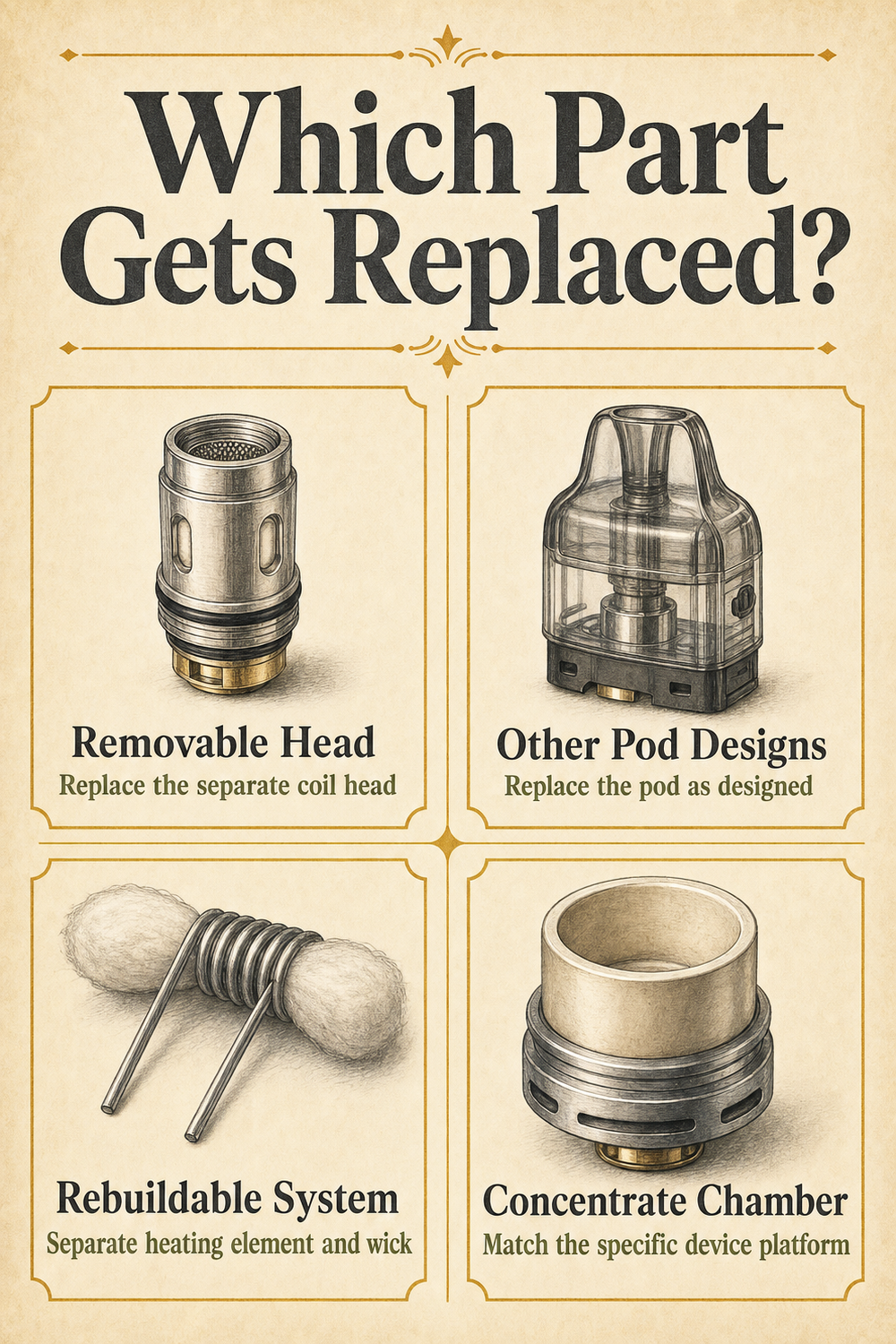
The device design decides what gets replaced. A tank with a removable coil head may keep its tank body while you change the head. Some pods also accept removable heads. Other pod designs require replacing the pod itself. Do not pull at a built-in part just because another device has a removable version. [2] [3] [4]
Rebuildable systems are a separate category. Their heating elements and wicks are installed as separate parts rather than exchanged as a sealed replacement head. Identifying that design is useful, but it does not make a standard coil-head replacement guide a rebuilding guide. Use instructions written for the actual system. [4]
A concentrate chamber is different again. Puffco lists separate chambers for different device platforms, so a shared brand name does not establish compatibility. A chamber for one platform is not a substitute for an e-liquid coil head, and a similar shape is not proof that two parts share a connection. [6]
Before browsing Accessories, write down the name of the part you need. That small step keeps a replacement purchase focused instead of turning it into a search through unrelated attachments. For broader context on how these parts fit into a setup, read What Are the Different Types of Vape Accessories and How Do I Choose Them?.
Identify the replaceable part before deciding how much of the device to keep. A worn removable head does not always call for a new tank, while a pod with a built-in head may need replacing as a unit. Confirm the design in your manual:
- Removable coil head: replace the specified head while retaining the tank or pod parts the instructions say to keep.
- Pod with an integrated head: replace the pod as designed rather than assuming its heating part can be removed.
- Rebuildable system: identify the separate heating element and wick; follow that system’s own instructions rather than sealed-head steps.
- Dedicated concentrate chamber: choose the assembly listed for the exact device platform and generation.
| Device design | Replacement unit | What to confirm |
|---|---|---|
| Tank or pod with a removable head | Specified coil head | Exact head compatibility and fitting |
| Pod with an integrated head | Complete pod | The pod listed for your device |
| Rebuildable system | Separate element and wick | Instructions for that particular system |
| Concentrate device | Model-specific chamber | Device platform and generation |
How can you tell when an e-liquid atomizer needs replacing?
For e-liquid heads, fading or changed flavor and a persistent burnt taste are manufacturer-described replacement signs. Innokin points to residue on the heating surface and damage to the wick as reasons a coil loses performance. These clues concern the condition of the head and its wick. [2]
Residue and wick damage are not the same thing. A deposit on the heating element is a buildup problem. Burnt cotton is damage to the wick itself. Removing some residue does not restore cotton that has already burnt, so washing a head is not a reliable answer to a persistent burnt taste. [2]
An enclosed head also limits access. Its absorbent wick is fixed inside the assembly, which makes thorough cleaning different from cleaning an empty tank part. Vaporesso discusses this limit when explaining coil care. Do not assume that a rinse reaches every surface or returns a used head to its original condition. [4]
These e-liquid warning signs should not become a replacement rule for every concentrate component. A product such as Dr. Dabber Switch GO(TM) Quartz Insert belongs to a different device context; its care and fit need to be checked against the named device’s instructions. Do not use cotton-wick advice as a shortcut for an insert or chamber.
Separate wear from a screen message. Changed flavor calls for checking the e-liquid head and its use conditions. No Atomizer calls for checking resistance detection and connections. A replacement may not fix a connection fault. If the wick is damaged, replace the intended part rather than continuing to use it. Use these clues to sort the issue:
- Fading or changed flavor: consider head wear, especially when the change persists rather than appearing only with a different liquid.
- Persistent burnt taste: stop using the suspect head and follow the model’s replacement instructions.
- Residue buildup: distinguish deposits on the heating surface from damage to the wick; cleaning cannot solve every kind of wear.
- Damaged cotton wick: cleaning does not repair the burnt material inside the head.
- Enclosed construction: fixed absorbent material limits cleaning access, so washing is not a universal substitute for replacement.
How long does a vape atomizer last, and what affects coil life?
There is no single interval for replacing a vape atomizer. Vaporesso gives roughly one to two weeks as general guidance for e-liquid coils. Innokin describes several days to a few weeks, depending on conditions. These are separate manufacturer estimates, not a guaranteed lifespan or a deadline that applies to every device. [4] [2]
The calendar cannot tell the full story. Frequency of use changes how often the head heats and draws liquid through its wick. Liquid residue also matters. Sweetened e-liquids can contribute to deposits on the heating surface, so two people using the same head may not see the same replacement interval. [2] [4]
Liquid supply and power are part of the picture too. A wick that is not sufficiently saturated and power above the head’s recommended range can shorten its useful life. Follow the installed head’s own wattage guidance rather than copying a setting from another device. Innokin notes that recommended power ranges are marked on coils. [1] [2]
Note when you installed a head, which liquid you used, and when wear signs first appeared. That record helps you plan for your own setup without adopting someone else’s schedule. Keep the liquid supply at the level your model requires, and review its filling instructions when changing parts.
Do not carry the e-liquid estimate over to a concentrate chamber. The cited Peak Pro support page does not establish a calendar replacement interval for its chamber. Its guidance focuses on component care and connection checks. A two-week coil estimate does not prove that a chamber needs replacement after two weeks. [5]
- Liquid residue: deposits can build on the heating surface, and sweetened liquids may contribute to that buildup.
- Wick saturation: the head needs the liquid supply described in its instructions, including proper preparation when new.
- Power setting: use the installed head’s specified range rather than a generic wattage recommendation.
- Frequency of use: more frequent heating changes how much use a head receives within the same calendar period.
Does a no-atomizer message mean you need a new coil?
Not necessarily. No Atomizer or Check Atomizer means the device cannot read the installed coil’s resistance, or the resistance is outside the range it expects. It is not automatic proof that the head has worn out or that the entire tank is broken. Innokin lists connection and installation issues among the possible causes. [3]
Dirty accessible contacts, poor seating, or liquid at the connection can affect detection. The device itself can also be the source of the fault. That is why replacing the head without checking the connection may produce the same message, even when the new head is the correct model. [3]
Start with the basic checks the manufacturer allows, with the device turned off as directed. Stay with accessible parts. Do not adjust pins, open the battery base, or try to revive liquid-damaged electronics. If the instructions do not cover the issue, ask support rather than guessing at an internal repair.
When another compatible tank or pod is available, a comparison can help separate an attachment problem from a device problem. If the fault remains across different compatible attachments, buying another head for the original tank may not solve it. Innokin includes this distinction in its troubleshooting guidance. [3]
Error signals also vary by model. Puffco identifies red-white flashing on the Peak Pro as a chamber connection error; that is not a universal light code for other devices. Its instructions lead through chamber cleaning, complete drying, and reattachment before support for a persistent issue. [5]
For a broader maintenance checklist, see How Do You Set Up a Care Routine for New Smoking Accessories?, but let your device manual decide the cleaning method. Keep this diagnostic sequence separate from the routine replacement of a worn wick:
- Confirm the exact model and message. Read what that manufacturer says the warning means before ordering a part.
- Inspect accessible contacts with the device off as directed. Follow the model’s cleaning instructions and check for liquid at the connection.
- Check coil or pod seating. Refit only the parts the instructions allow, using the correct installation mechanism.
- Try another compatible tank or pod when available. Note whether the error stays with one attachment or appears across attachments.
- Contact manufacturer support if the fault remains. Do not move from basic checks into pin changes or internal electronic repairs.
How do you choose a replacement atomizer that fits your vape?
Begin with the exact device name, including its generation when relevant. Then identify whether the replacement is a coil head, complete pod, separate rebuildable part, or concentrate chamber. A product photo can help you recognize a part, but appearance alone does not establish that it fits or works with your device.
Use the manufacturer’s compatibility statement as the deciding information. Puffco’s chamber listings separate platforms such as Peak Pro, Proxy, and Pivot. That platform-specific naming is a reason to check carefully, not permission to substitute one chamber for another because both are called atomizers. [6]
For an e-liquid head, read the power instructions on the replacement itself or its packaging. A setting you used with a previous head is not a substitute for the new head’s marked range. Innokin explains that recommended wattage ranges are specified on coils. Match the part first, then follow the instructions for that particular head. [1]
Some device-specific changes also have a software requirement. Puffco’s Peak Pro support guidance includes a firmware-update check for a new 3DXL chamber. That is a named example, not a rule that all atomizer replacements need an update. Check whether the support page for your own model mentions a required step. [5]
For a repeat order, compare the listing with your current device manual and the part you used. An old order title or the word coil is not enough. If the fit is unclear, ask before buying, especially when related models share a brand name. Check these details in order:
- Identify the device’s exact model and generation from its label, packaging, or manual.
- Name the replaceable assembly and confirm whether the head, pod, chamber, or separate part is the intended purchase.
- Check the manufacturer’s stated compatibility against that exact model; do not infer a fit from similar looks.
- Read the replacement head’s own power guidance and confirm that your device supports the specified setup.
- Review any documented firmware or setup requirement for that model before installing the new part.
How do you install and prepare a new e-liquid coil?
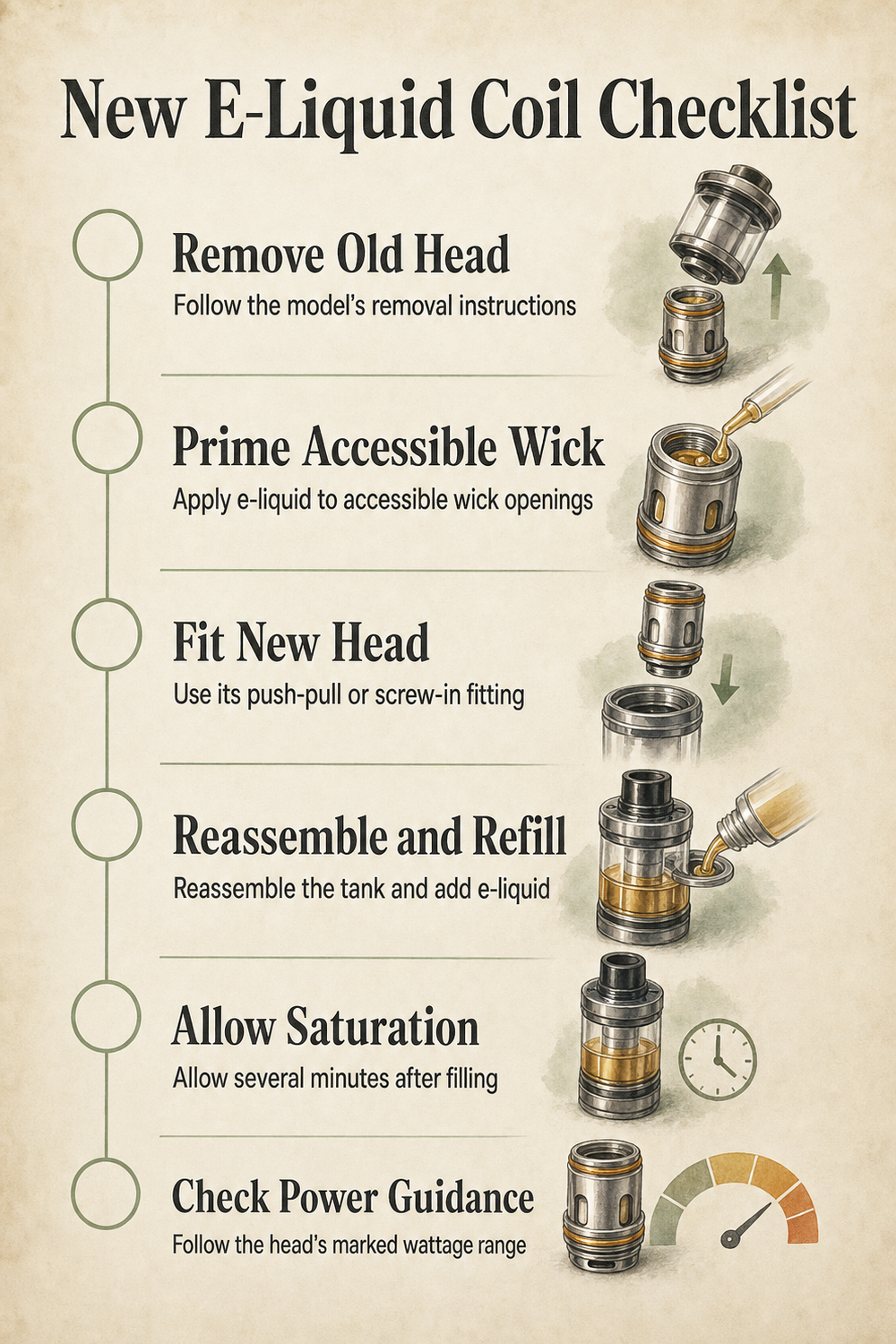
Use your model’s instructions for disassembly and replacement. Innokin describes both push-pull and screw-in coil systems, so there is no single removal motion that works for every tank. Identify the fitting before applying force. This sequence is a planning checklist, not a replacement for the manual’s directions. [2]
Preparation matters because a new e-liquid head needs a saturated wick before heating. Innokin recommends applying e-liquid to accessible wick openings and allowing several minutes after filling. Follow the specific head’s instructions for priming and waiting rather than choosing a fixed time for every model. [1] [2]
Priming means preparing the wick with the intended e-liquid; it does not mean switching on the device while the wick is dry. If the wick openings are not accessible or the manual gives a different preparation process, follow that design’s directions. Do not poke into a sealed head to reach cotton that the manufacturer has not made accessible.
Once the head is fitted, check the assembly against the manual before refilling. Installation and saturation are separate steps: a seated head may still need time to absorb liquid. Follow the waiting guidance for your model rather than a timer intended for another device.
After saturation, use the new head’s marked power range. Do not assume that the previous head’s setting is right. These steps apply to cotton-wick e-liquid heads, not concentrate chambers. Puffco’s dedicated chambers are a different device assembly; this checklist does not mean adding e-liquid to them. [1] [6]
- Check the manual and turn the device off as directed. Identify whether the head uses a push-pull or screw-in fitting before disassembly.
- Remove the old head using that model’s stated method. Keep track of the tank parts that the instructions say to retain.
- Prime accessible wick openings with e-liquid as instructed for the replacement head. Do not improvise access to a sealed wick.
- Fit the new head with its actual installation mechanism, then reassemble the tank or pod according to the manual.
- Refill as directed and allow the wick to saturate. Follow the manufacturer’s waiting guidance rather than a universal timer.
- Check the head’s specified power range before use. Apply the instructions for this replacement, not a remembered setting from another head.
Can you clean a concentrate chamber like an e-liquid tank?
No. Cleaning instructions depend on both the component and the device. An empty tank part, an enclosed e-liquid head, a concentrate chamber, and a battery base are not interchangeable cleaning jobs. Even parts from the same setup may have different rules.
The Peak Pro provides a clear example. Puffco’s support page permits the removed chamber to soak in 90%+ isopropyl alcohol for 20 minutes and explicitly says not to use water in that chamber. It also calls for thorough air-drying before reattachment. These are Peak Pro chamber instructions, not a general recipe for every atomizer. [5]
The same support page gives separate instructions for the glass that allow a water rinse. That difference matters: permission to rinse the glass does not mean permission to rinse the chamber. Likewise, a chamber soak does not give permission to immerse a battery base or an unidentified electronic assembly. [5]
For a Peak Pro chamber connection error, follow the named support path: remove and clean the chamber, let it dry thoroughly, and reattach it. If the problem continues, consult support or the warranty process. Do not turn that troubleshooting sequence into a monthly replacement schedule; the cited support page does not set one. [5]
Keep three issues separate when deciding what to do next. Routine deposits may call for the component’s approved cleaning process. Burnt cotton in an e-liquid head calls for replacement because cleaning does not repair it. A connection fault that remains after allowed checks calls for further support, not more guessing about wash methods. [2]
- Enclosed e-liquid head: its fixed wick limits cleaning access, and cleaning cannot repair burnt cotton.
- Removed Peak Pro chamber: apply only the named manufacturer’s alcohol, no-water, and complete-drying instructions for that component.
- Separate Peak Pro glass: follow its separate cleaning guidance; a permitted glass rinse does not extend to the chamber.
- Battery base or unidentified assembly: do not copy a tank rinse or chamber soak onto it. Find the instructions for the exact component first.
Frequently Asked Questions
Is an atomizer the same thing as a coil?
Sometimes the names refer to the same complete head. More precisely, the coil can mean the heating element inside a head that also contains a wick and casing. Concentrate brands may use atomizer for a dedicated chamber instead. Check the part name and diagram in your device’s instructions before ordering; the word alone does not establish fit. [1] [6]
Can cleaning fix a burnt e-liquid coil?
No. Cleaning cannot repair burnt cotton. Deposits on the heating surface and damage to the wick are different problems, and an enclosed head’s fixed wick limits cleaning access. Do not assume that washing restores a worn head. If a persistent burnt taste points to wick damage, replace the part your model is designed to accept. [2] [4]
Do all vape pods have replaceable coils?
No. Some pods accept a removable coil head, while other designs require replacing the pod. Check the instructions for your specific model before trying to pull a head out. A removable head in one pod does not prove that another pod has the same design, even if the two devices look similar. [2] [3] [4]
Should you replace a Puffco chamber every two weeks?
The cited Peak Pro support guidance does not set that interval. General e-liquid coil estimates do not establish concentrate chamber life. Follow the instructions for the specific Puffco platform and component, including its cleaning and connection checks. If a fault remains after those checks, consult support rather than inventing a calendar rule for buying another chamber. [4] [5]
Why does a new coil still show a no-atomizer error?
The message can come from seating, contacts, resistance detection, or a device fault instead of coil wear. Confirm compatibility and check accessible connections according to the manual. Another compatible tank or pod, when available, can help separate an attachment problem from a device problem. A new head alone will not resolve every cause of the message. [3]
What should you check before replacing your atomizer?
Name the device and its replaceable assembly first. Then decide whether the problem looks like e-liquid head wear or a connection fault. Persistent burnt taste and damaged cotton call for a different response from a resistance-detection warning. That distinction helps you avoid buying a whole tank when only a head needs replacement, or buying a head for a problem it cannot solve.
Match any purchase to the manufacturer’s exact model and compatibility guidance. Prepare an e-liquid wick as instructed, use the head’s own power range, and keep concentrate chamber care separate from tank care. Follow documented cleaning and support steps rather than assuming every atomizer needs replacement on the same schedule.
Use the accessory guide linked above for the wider setup, then narrow your replacement search to the part your device actually accepts. A clear part name and a checked compatibility statement are more useful than an approximate lifespan or a familiar-looking product photo.
Sources
- Innokin: Vape Coils Explained: The Ultimate Guide for Beginners
- Innokin: When to Change a Vape Coil?
- Innokin: Why Does My Vape Say No Atomizer?
- Vaporesso: How Long Do Vape Coils Last And How To Make Them Last Longer
- Puffco: Peak Pro 3DXL Support, Settings & Help
- Puffco: Puffco Chambers for Peak Pro, Proxy, Plus & Pivot