

A Vessel battery can cost more for its body, cartridge enclosure, or controls—not necessarily longer runtime. Core already offers USB-C and the same four voltage settings as standard Compass. Compass adds an enclosure and larger listed capacity; Rise and Pro offer different construction and controls. Compare cartridge fit and the features you need before paying extra. [1] [2]
What are you paying for with a Vessel battery?
Judge the price by the features you will use, not just the brand name. A cartridge enclosure, different casing, or extra control option gives you something concrete to compare. This guide uses manufacturer specifications, not independent performance tests. Those specifications show model differences but do not reveal Vessel’s production costs or prove that every upgrade performs better.
At research retrieval, Vessel’s Core Black page showed $28 with $35 crossed out. Compass Mojave showed $45, and Compass Pro Gunmetal showed $64. These were manufacturer-page snapshots, not verified Treehouse prices or promises about what you will pay today. A promotion or different finish can change the comparison. [1] [2] [5]
Those prices are useful as examples of a step up in spending. They are not proof that each step brings a feature you need. If Core’s pen-style body, four settings, and USB-C connection already suit you, a higher-priced model needs another reason to earn its place in your cart.
This comparison concerns batteries for compatible 510-thread oil cartridges. Vessel states that its products are not intended for nicotine, e-juice, or e-liquids. Do not choose one as a dry-herb vaporizer or a universal device for any liquid. [1]
For the wider cartridge-matching decision, start with How Do You Choose the Right Vape Battery for Your Cartridge?. This guide focuses on which Vessel features justify extra spending. If you are comparing accessory types instead, Hand Pipes is a separate category—not a source of Vessel battery parts.
- Body construction: compare the materials listed for the exact model, rather than assuming every Vessel has the same casing.
- Cartridge enclosure: decide whether you want a pen-style format or a cartridge seated inside a palm-style body.
- Controls: check the actual voltage choices and any preheat option, not just the number of settings.
- Capacity and charging: compare the listed mAh figure and charging connection as separate features.
- Accessory fit: check whether your case or dock works with the new model before counting it as money saved.
How do Vessel Core, Compass, Rise, and Pro compare?
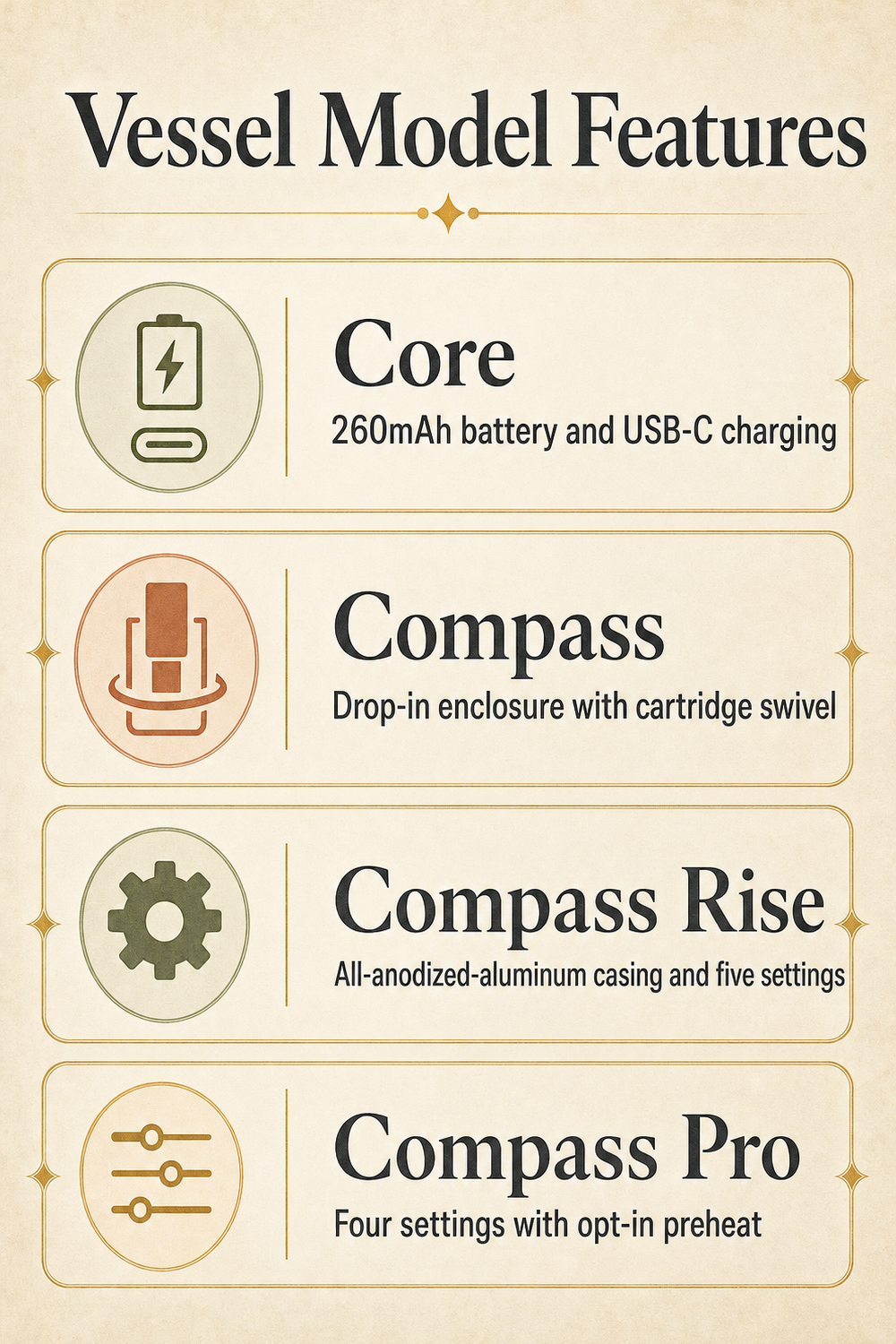
Vessel Core is the starting comparison if you want a light pen-style device. Core Black lists a 260mAh battery, a wide 510 crown, three LEDs, and USB-C charging with a cable. Its four settings are 2.4V, 2.8V, 3.2V, and 3.6V. The listing gives a weight of 23g and dimensions of 3.3 inches long by 0.55 inches in diameter. [1]
Standard Compass changes the format more than the voltage menu. Compass Mojave lists the same four settings, but it has a 550mAh battery, a drop-in enclosure, and a mouthpiece swivel in a palm-style body. Its page lists USB-C with a cable and recommends a 1g cartridge; the cartridge is not included. [2]
Compass Rise has an upright body and an all-anodized-aluminum casing. It lists 550mAh, USB-C with a cable, preheat, and five settings: 1.9V, 2.4V, 2.8V, 3.2V, and 3.6V. Its listed weight is 100g. The reason to choose it is that you want those materials, shape, or settings. [3]
Compass Pro is not another name for Rise. Pro Gunmetal lists a zinc-aluminum alloy back cover and an ABS polymer faceplate, with a weight of 69g. Its 550mAh battery powers four listed settings: 1.9V, 2.4V, 2.8V, and 3.2V. Its opt-in 1.6V preheat is separate from that menu. [5]
Pro also lists a self-standing body, a 180-degree mouthpiece swivel, a 15-second maximum draw, and shutoff after 30 minutes. Vessel describes its Dynamic Voltage system as regulating power during a draw to maintain a more stable cartridge temperature. That is the manufacturer’s description of the system and its intended result, not an independent finding that Pro outperforms every other battery. [5]
The older Expedition series adds useful context: it lists 240mAh, a cartridge transition module, four settings from 2.4V to 3.6V, and magnetic USB charging. Its premium pen-style positioning does not mean it has more capacity than Core. The series page also does not establish current Treehouse stock or a current price. [4]
For a wider view of the setup, read What Are the Different Types of Vape Accessories and How Do I Choose Them?. You can also compare a separate-brand listing such as Pulsar 510 DL 5.0 Precision Voltage Control LCD Screen Vape Bar | Design Series | 1000mAh, but use its own specifications. A different brand’s product name does not establish that it shares Vessel’s cartridge fit, accessories, or controls.
- Core: pen-style body, 260mAh, USB-C, and four settings from 2.4V through 3.6V.
- Compass: drop-in enclosure, cartridge swivel, 550mAh, USB-C, and the same four listed settings as Core.
- Rise: upright all-anodized-aluminum body, 550mAh, preheat, and five settings that include 1.9V.
- Pro: mixed-material casing, 550mAh, four settings from 1.9V through 3.2V, and separate opt-in preheat.
- Expedition: older pen-style series with 240mAh and a magnetic charging cable; check any exact listing separately.
| Model | Listed capacity | Voltage settings | Charging |
|---|---|---|---|
| Core | 260mAh | 2.4V / 2.8V / 3.2V / 3.6V | USB-C |
| Compass | 550mAh | 2.4V / 2.8V / 3.2V / 3.6V | USB-C |
| Compass Rise | 550mAh | 1.9V / 2.4V / 2.8V / 3.2V / 3.6V; preheat listed | USB-C |
| Compass Pro | 550mAh | 1.9V / 2.4V / 2.8V / 3.2V; opt-in 1.6V preheat | USB-C |
Will your cartridge fit the Vessel battery you want?
A matching 510 thread answers only part of the fit question. The cartridge also needs enough room in the body around the connection. That matters when a device has a recessed or drop-in enclosure. A cartridge can share the thread type while having dimensions that do not suit a particular battery.
Compass Pro’s current listing says it fits most 0.5g and 1g 510-thread cartridges up to 11mm in diameter. Keep all parts of that description together. The word most is not a promise of universal fit, and the cartridge’s stated fill amount does not replace a diameter check. [5]
Vessel’s older compatibility guide uses different limits for different generations: under 10.8mm for Gen1 and under 11.5mm for Gen2 ‘+’ versions. Do not apply that Gen2 number to Pro, whose own listing says up to 11mm. The exact model’s current specifications should guide your purchase. [7] [5]
Standard Compass Mojave says most 510-thread cartridges fit and recommends a 1g cartridge. That recommendation is useful, but it is not a universal size guarantee. Do not borrow a diameter figure from another Compass model to fill a gap in the listing. The supplied Rise source does not establish a cartridge diameter limit for this guide. [2]
The older compatibility page also discusses pen-style transition modules and differences in connection geometry. It is not a reason to remove parts from every Compass model or force a cartridge into an enclosure. Ask about your exact battery and cartridge when the available information leaves room for doubt. [7]
The same model-by-model approach applies when comparing alternatives such as Pulsar 510 DL Lite Auto-Draw Vape Pen | Black | 300mAh | 8ct Display. Read the full listing, including its pack format, rather than treating any product with 510 in its name as a direct one-device substitute.
- Identify the exact battery model and generation. Keep Compass, Rise, Pro, and older ‘+’ naming separate.
- Identify your cartridge’s dimensions. Look for the diameter and any other fit information supplied by its maker.
- Compare those dimensions with the exact battery’s current listing. Do not substitute another model’s limit.
- Resolve unclear fit before ordering. Ask for confirmation instead of planning to force the connection or remove parts.
Which Vessel charger, dock, and case do you need?
Not all Vessel batteries need a magnetic charging cable. The supplied Core, standard Compass, Rise, and Pro pages list USB-C. The Expedition series page lists a magnetic USB port and cable. Check the model first, particularly when comparing an older premium pen with a current USB-C device. [1] [2] [3] [4] [5]
The charging connection and optional charging dock are two separate questions. Seeing USB-C on a product page does not tell you whether a dock from another Vessel model will work. A familiar family name is also not enough to establish case fit.
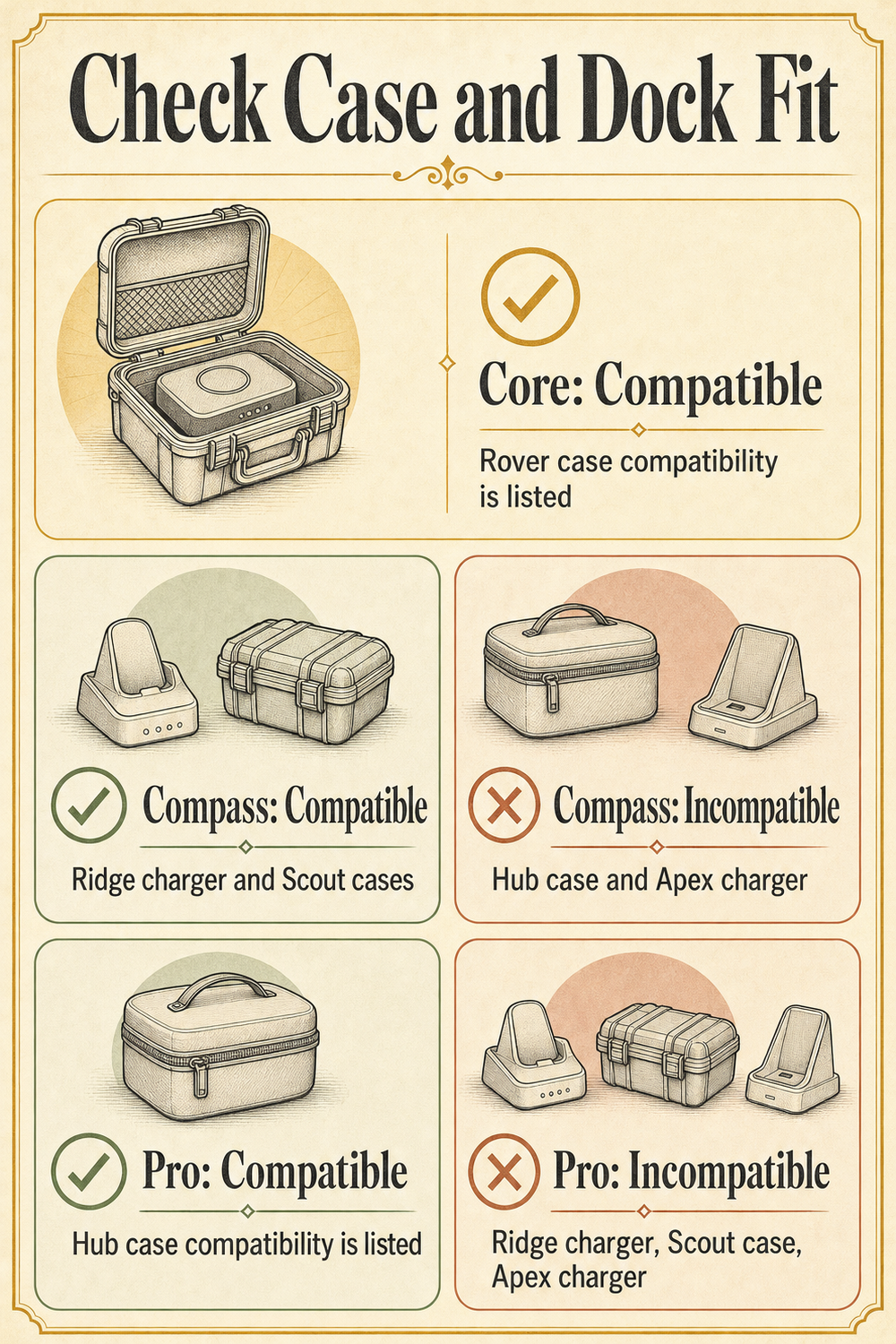
Compass Mojave lists the Ridge charger and Scout cases as compatible. It lists the Hub case and Apex charger as incompatible. Pro makes a different set of pairings: its page lists Hub case compatibility and excludes Ridge, Scout, and Apex. Moving from Compass to Pro therefore requires a fresh accessory check. [2] [5]
Core lists Rover case compatibility. For Rise, do not guess from another Compass page or regard dated accessory-launch wording as proof of current availability. If you need a particular case or dock, get an exact-model compatibility statement before buying it. [1] [3]
Include any needed cable, dock, or case in your total budget without assuming a price. A battery upgrade may not look as attractive once you discover that your existing case cannot move with it. On the other hand, you may not need an optional dock at all if the documented cable setup covers your routine.
Browse Accessories with a specific model in mind. A broad accessories category is a place to look, not a guarantee that every item there fits Vessel. Check the individual product details before adding a charging item or case to the order.
- Core: USB-C charging is listed, along with Rover case compatibility.
- Standard Compass Mojave: USB-C, Ridge charger, and Scout cases are listed; Hub and Apex are excluded.
- Compass Pro: USB-C and Hub case compatibility are listed; Ridge, Scout, and Apex are excluded.
- Compass Rise: USB-C is documented; confirm any optional case or dock for Rise specifically.
- Expedition series: the documented connection uses a magnetic USB cable rather than the USB-C setup above.
Does paying more get you more battery life?
No, not automatically. Expedition’s documented capacity is 240mAh, while Core lists 260mAh. Standard Compass, Rise, and Pro each list 550mAh. Those figures show why price and premium positioning are poor shortcuts for capacity. Read the number for the exact model instead. [4] [1] [2] [3] [5]
Capacity is a specification, while runtime describes how long a device operates under particular conditions. The three Compass models sharing a 550mAh rating does not establish identical runtime. It also does not give you a verified number of hours or draws between charges.
Vessel’s older battery-life support article says runtime varies with the user and weather or temperature. It discusses a 240mAh device, so its day or week estimates should not become promises for Core or the newer Compass family. The supplied sources contain no standardized runtime test that establishes a brand-wide winner. [9]
For buying purposes, compare the documented capacity with the charging setup you can actually use. If the larger listed capacity is your reason to leave Core, standard Compass already offers the same 550mAh figure as Rise and Pro. Their other features need to justify any further spending; the shared number alone cannot do it.
If you are comparing cartridge batteries with a different type of portable device, read How Do You Choose the Right Portable Vaporizer? as a separate buying guide. Do not transfer its device comparisons into a Vessel runtime promise. Keep the device type and the evidence behind each specification clear.
- Check the exact model’s listed mAh capacity. Do not use the brand name or price tier as a substitute.
- Separate capacity from measured runtime. Ask what conditions support any hours, days, or draw-count claim.
- Set aside estimates borrowed from older devices. A support article about 240mAh does not test a 550mAh model.
- Compare the charging connection and other needed features. Choose based on documented differences, not a guessed runtime advantage.
What does Vessel’s warranty cover, and how do you maintain the connection?
Vessel’s published limited warranty covers defects in materials and workmanship under normal use for six months from retail purchase. It applies to the original end-user and is not transferable. That is narrower than a promise to replace a device for any problem that occurs in the first six months. [6]
The policy also sets purchase requirements involving authorized retailers serviced by authorized distributors. Do not assume a seller qualifies just because it carries the brand. This guide does not verify Treehouse’s authorization status. Confirm warranty eligibility for your planned purchase if that coverage is part of your buying decision. [6]
Keep your proof of purchase. Vessel may request it, along with a picture or video showing the defect. Having the receipt and exact model information gives you a clearer starting point when asking about a claim, but it does not guarantee approval. The written policy and the nature of the issue still matter.
Normal battery performance degradation is excluded, as are accidental damage, cosmetic damage, misuse, failure to follow cleaning instructions, and unauthorized modification. Disassembly voids coverage. A future drop in capacity is therefore not automatically a covered defect simply because you paid more for the battery. [6]
Connection maintenance is a separate, practical task. Vessel’s support guidance recommends keeping power connection points free of oil residue and particles. It describes gently cleaning the connection area with a cotton swab lightly moistened with isopropyl alcohol. Follow the instructions for your exact model; this guidance is not an instruction to soak the device. [8]
The supplied maintenance source does not establish a cleaning schedule for every owner. Focus on the connection guidance it actually gives, rather than inventing a weekly routine or assuming that a wipe will solve every cartridge problem. If an issue remains, use model-specific support instead of taking the battery apart.
- Coverage: qualifying defects in materials and workmanship under normal use, within six months of retail purchase.
- Eligibility: the original purchaser and the policy’s authorized-retailer and distributor requirements.
- Claim records: proof of purchase and a defect photo or video may be requested.
- Exclusions: normal battery degradation, accidents, cosmetic damage, misuse, and ignored cleaning instructions.
- Modification limits: unauthorized changes are excluded, and disassembly voids coverage.
Which Vessel battery features are worth paying extra for?
Start with Core when you want its pen-style format, USB-C, and four settings. It is not automatically the wrong choice because other models cost more. If its documented features cover your needs and your cartridge fits, there is no need to invent a reason to upgrade. [1]
Compare standard Compass when the drop-in enclosure, swivel, and larger listed capacity are the features you want. It gives you a different format while keeping Core’s listed voltage menu. That makes it a more focused comparison than assuming you need Rise or Pro to get a 550mAh battery. [2]
Look at Rise if the all-anodized-aluminum casing, upright body, and five settings matter to you. Look at Pro if you want its distinct control system, opt-in preheat, and documented format. Neither is a universal next step above the other. Their construction, settings, and accessory rules differ, so compare them as separate choices. [3] [5]
Before spending more, name the extra feature you will use. If your only reason is that the expensive model must be better, return to the specifications. This is a comparison of Vessel’s documented features, not a tested ranking of all 510 batteries.
Finally, verify the exact finish’s live price and availability with the seller. Manufacturer price snapshots are not Treehouse discounts, and a source page describing a model does not establish current retailer stock. Keep warranty eligibility and any new accessory costs in the same decision so that the battery’s sticker price is not the whole story.
- Confirm cartridge fit first. Eliminate models whose current specifications do not establish the clearance you need.
- Choose the features you will use. Compare body shape, construction, capacity, and exact voltage choices.
- Verify the charging and accessory setup. Check the cable, case, and dock for the chosen model, not just its family.
- Check current price, stock, and purchase terms. Compare the exact finish and any additional items before ordering.
Frequently Asked Questions
Is Vessel Core enough if you just want adjustable voltage?
Are Compass Rise and Compass Pro the same battery?
No. Rise lists an all-anodized-aluminum casing and five voltage settings. Pro lists a zinc-aluminum alloy back, an ABS faceplate, four settings, and separate opt-in preheat. Both list 550mAh, but that shared capacity does not make their controls, construction, or accessories interchangeable. [3] [5]
Do all Vessel vape batteries use a magnetic charger?
Will every 510 cartridge fit Compass Pro?
Universal fit is not established. Vessel lists most 0.5g and 1g 510-thread cartridges up to 11mm in diameter for Pro. Confirm your cartridge’s dimensions and enclosure clearance. Do not replace that limit with the older Gen2 compatibility guide’s under-11.5mm figure; it is not Pro’s current specification. [5] [7]
Does Vessel’s warranty cover normal battery wear?
The published limited warranty excludes normal battery performance degradation. Its six-month coverage concerns qualifying defects in materials and workmanship under normal use for the original purchaser. Purchase requirements and other exclusions also apply, so a loss of capacity is not automatically covered. Keep your receipt and consult the policy for a specific claim. [6]
How can you choose a Vessel battery without paying for features you do not need?
Choose by fit first, useful features second, exact-model accessories third, and current price last. Core is a sensible starting comparison when its pen-style body, USB-C, and four settings meet your needs. Standard Compass adds an enclosure and larger listed capacity without changing that voltage menu.
Rise and Pro deserve separate comparisons, not a simple assumption that one is the next version of the other. Their construction and controls differ, and Pro has its own accessory rules. A higher price can buy those differences, but it does not prove longer runtime or universally better performance.
Before ordering, return to the cartridge-fit and broader accessories guides linked above if any part of the setup is unclear. Buy the model whose documented features solve your actual needs, rather than paying extra for a label.
Sources
- Vessel Brand: Core Series – Black
- Vessel Brand: Compass [Mojave] +
- Vessel Brand: Compass Rise
- Vessel Brand: Vessel Expedition Series | Premium 510 Thread Vape Pen Batteries
- Vessel Brand: Compass Pro [Gunmetal]
- Vessel Brand: Vessel | Warranty Policy
- Vessel Brand: Vessel – 510 Thread Cartridge Compatibility
- Vessel Support: How do I clean and maintain my Vessel?
- Vessel Support: What can I expect with battery life?