

Choosing the right vape battery comes down to matching a 510 thread battery to the cartridge you actually want to use, then picking the features that fit your routine. The "510" label refers to a thread spec — 10 threads at roughly 0.5 mm pitch — and that thread is the universal connection standard for oil cartridges [1] [2].
Start with three practical fit checks. Confirm the 510 thread on both the battery and the cartridge, match the cartridge diameter to the battery opening, and decide on the activation style (button or auto-draw). Then choose capacity (mAh), decide whether you want variable voltage, and pick the form factor — slim pen, box mod, or concealed.
Once you have a battery in hand, follow a few proper lithium-ion charging habits. Those habits are what keep the battery you picked working the way it should for as long as it should.
What Is a 510 Thread Vape Battery and Why Does the Number Matter?
A 510 thread vape battery is a rechargeable lithium-ion power unit with a threaded connector at the top that screws onto an oil cartridge. The "510" label comes from the thread itself: 10 threads per connection, with each thread at roughly 0.5 mm pitch [1].
That thread spec is why "510" became the universal connection standard for oil cartridges. A 510 battery from one manufacturer will physically connect to and power cartridges from almost any other brand, so you are not locked into buying both pieces from the same company [1] [2].
A 510 setup has two separate parts. The battery only supplies power. The cartridge contains the oil reservoir, the atomizer coil, and the mouthpiece. The two are designed to be interchangeable within the 510 ecosystem, which is what gives the standard its flexibility [1].
510 is one thread family in a wider ecosystem. An eGo battery uses a wider, older thread that does not fit most modern oil cartridges. A pod-system battery is usually sealed, brand-specific, and often magnetic, and it is not 510 compatible. If you want flexibility to swap cartridges between brands, a 510 battery is the practical choice [2].
If you are still building out your setup, our What Are the Different Types of Vape Accessories and How Do I Choose Them? walks through the wider world of vape accessories so you can see how batteries, cartridges, and chargers fit together.
- Battery: the rechargeable lithium-ion power unit with the 510 connector at the top.
- Cartridge: the oil reservoir, atomizer coil, and mouthpiece that screws onto the battery.
- Thread: the 510 male-to-female connection, 10 threads at roughly 0.5 mm pitch, that ties the two together.
- Activation system: the sensor or button that fires the coil when you take a draw.
- Charging port: usually USB-C on modern 510 batteries, sometimes older Micro-USB on entry-level devices.
Will Any 510 Cartridge Fit Any 510 Battery?
Threading alone does not guarantee a fit. Cartridges come in different diameters, lengths, and airflow designs, and batteries come with different chamber widths and activation systems. Skipping those checks is the most common reason a new battery will not seat a cartridge the way the buyer expected [2].
Run through this compatibility checklist before you pair a 510 battery with a cartridge. Each step answers a specific physical or electrical question, and a "no" on any one of them is a reason to look at a different battery or cartridge before you buy.
Also remember that the cartridge is the part that contains the heating element. The battery only supplies power, so a higher-end battery will not fix a poorly built cartridge. Match the components and then decide what features on the battery matter to you.
If you are shopping for a pen-style device and want to compare form factors, our What Is a Pen Vaporizer and How Do You Choose the Right One? covers pen vaporizers from the ground up.
- Confirm the 510 thread on both the battery and the cartridge — both must be 510 to mate.
- Check the cartridge diameter against the battery opening or chamber width — wider cartridges need a chamber that fits.
- Check cartridge length against the battery — some batteries fully conceal the cartridge, others leave it exposed.
- Confirm the cartridge airflow matches the activation type — side-vent cartridges can defeat an auto-draw sensor.
- Confirm the cartridge’s supported voltage range falls inside what the battery actually outputs.
What Is the Difference Between Button-Activated and Auto-Draw Batteries?
Button-activated and auto-draw (draw-activated) batteries fire the same cartridges, just in different ways. A button-activated battery uses a single button on the body — usually a small round button near the bottom — that you press and hold while you draw. An auto-draw battery has no fire button; it uses a small pressure sensor inside the airflow channel that detects when you pull air through the mouthpiece and fires the coil on its own [1] [2].
Button-activated batteries are usually the right pick if you want to control when the coil heats. The button lets you preheat the cartridge with one or two quick presses before a draw, change voltage with a three-click pattern, and lock the device with five clicks so it does not fire in a pocket or bag. Variable-voltage models almost always use a button for that reason.
Auto-draw batteries are usually simpler. There is no button to press, no pattern to memorize, and nothing to lock. You inhale and the device fires. The tradeoff is that the airflow sensor is the only way the device knows you are drawing, so a cartridge with side vents or a clogged mouthpiece can keep the sensor from triggering [2].
Terminology varies across the industry. "Auto-draw" and "draw-activated" describe the same airflow-sensor style of firing. "Buttonless" and "draw-to-fire" mean the same thing. "510 pen battery," "cart battery," and "oil pen battery" are also used interchangeably across retailers for the same kind of device [1] [2].
If you are weighing a 510 battery against a sealed disposable setup, our What Are Disposable Vapes and Should You Try Them? explains what disposable vapes are and how they compare on convenience and cartridge access.
- Button-activated: you press and hold to fire; usually required for variable voltage and preheat modes.
- Auto-draw (draw-activated): a pressure sensor fires the coil when you inhale; no button, simpler to use.
- Lock patterns: five-click lock on most button models keeps the device from firing in a pocket or bag.
- Preheat: a short low-power pulse on button models that loosens thick oil before a draw.
- Voltage signaling: presets on entry-level devices are shown by LED color (often green, blue, red) rather than a screen.
How Does mAh Affect How Long a Vape Battery Lasts?
mAh stands for milliamp-hours, and it describes one thing only: how much charge the battery can store. It does not describe vapor strength, flavor, or how the cartridge will perform. A higher mAh generally means more sessions per charge and a physically larger device [1] [3].
Real-world runtime also depends on coil resistance, the voltage or wattage you run at, puff length, airflow, screen and button usage, and how often you reach for the device. A small battery run at a low voltage can outlast a larger battery run at the top voltage preset, and a high-wattage session will drain any battery faster than a short, low-power draw [3].
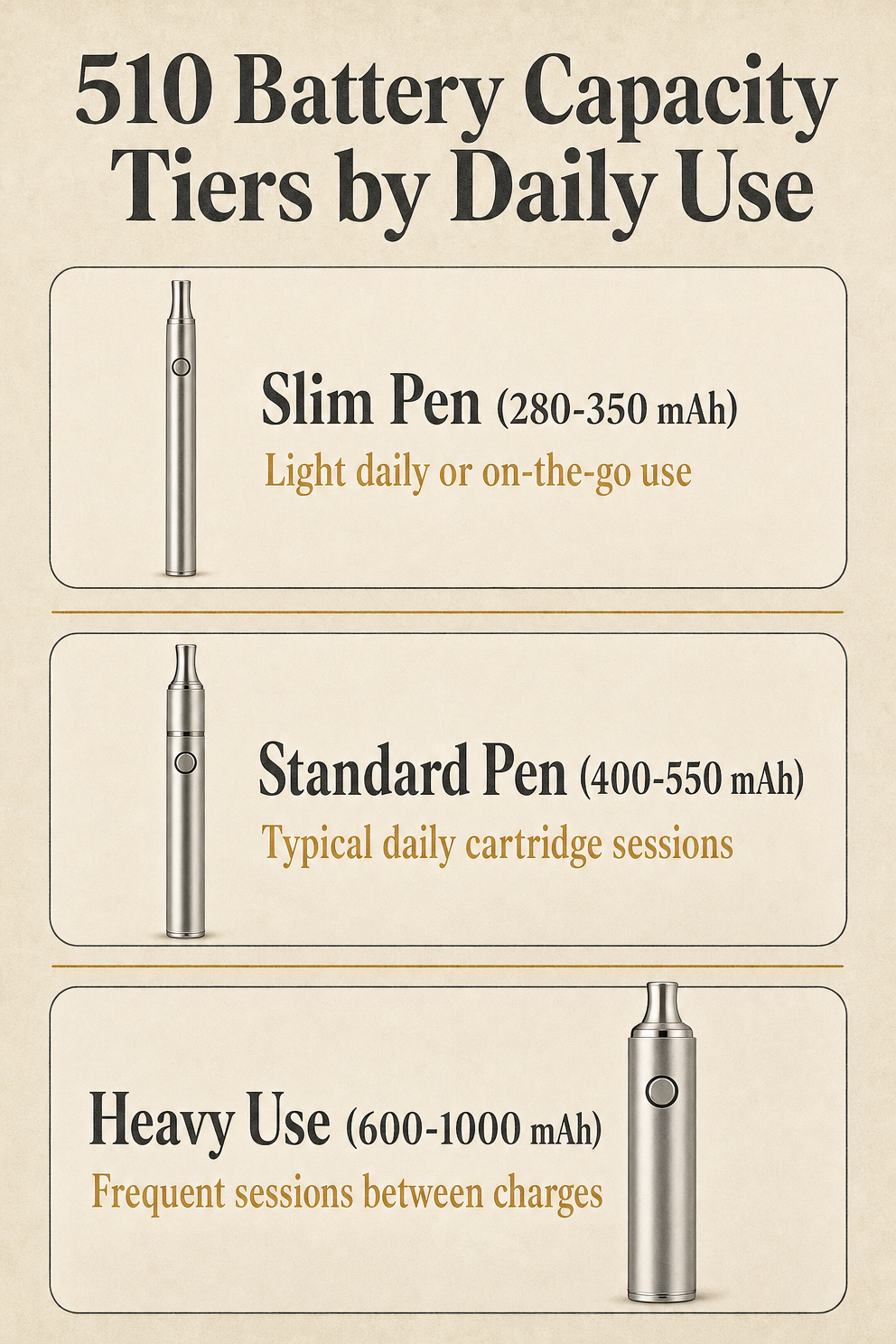
Most 510 batteries on retail shelves fall into three loose capacity tiers. Slim pens sit in the 280 to 350 mAh range and are built for light, on-the-go use. Standard pens run 400 to 550 mAh and cover a typical day of cartridge sessions. Heavy-use batteries reach 600 to 1000 mAh and are built for frequent sessions between charges [1].
If a higher mAh is what you want, our 510 Batteries subcategory lines up the larger-capacity 510 batteries in one place so you can compare sizes and prices side by side.
- Slim pen (280 to 350 mAh): light daily use or on-the-go carry, smallest form factor.
- Standard pen (400 to 550 mAh): covers a typical day of cartridge sessions for most users.
- Heavy use (600 to 1000 mAh): frequent sessions or longer days between charges, larger body.
- Capacity vs. strength: a higher mAh does not mean more vapor or better flavor.
- Capacity vs. runtime: actual runtime also depends on voltage, coil resistance, and puff length.
What Does Variable Voltage on a Vape Battery Actually Do?
Variable voltage on a 510 battery changes how much energy is delivered to the cartridge coil. The battery takes the same energy from the cell and pushes it out at the voltage you select, which is what changes how hot the coil runs per draw [1] [2].
Entry-level variable-voltage batteries do not show the voltage on a screen. They use a small LED that changes color to signal the active preset. Three tiers are the most common: roughly 2.4V, 3.2V, and 4.0V, signaled in order by green, blue, and red on most models. The battery usually cycles through the presets with a three-click pattern on the fire button.
A lower setting tends to produce a cooler, thinner draw and is a reasonable starting point for thin oils and small cartridges. A higher setting pushes more energy into the coil per draw and is the usual choice for thicker oils or larger cartridges that need more heat to keep up. Pushing voltage above the range the cartridge or its oil is designed for can stress the cartridge, so the right setting depends on the specific cartridge you are using [1] [2].
If you want to step up to a desktop or stationary setup that takes variable voltage further, our Desktop Vaporizers category collects desktop vaporizers that let you dial in temperature and wattage in much finer increments.
- Low preset (around 2.4V): cooler, thinner draw; good starting point for thin oils and small cartridges.
- Mid preset (around 3.2V): the everyday setting for most standard cartridges and oil viscosities.
- High preset (around 4.0V): more heat per draw; better for thick oils and larger cartridges, but stay within the cartridge’s range.
- LED signaling: presets are usually shown by LED color (green, blue, red) rather than a numeric screen.
- Start low: a useful rule is to start at the lowest preset and step up one notch at a time until you find the right draw for the cartridge.
How Do You Safely Charge and Care for a Vape Battery?
All modern vape batteries use lithium-ion cells, the same chemistry that powers phones, laptops, and electric vehicles. Lithium-ion cells can overheat and enter thermal runaway if they are damaged, punctured, overheated, overcharged, exposed to water, or exposed to a manufacturing defect. Safe charging is what keeps that chemistry inside its designed operating range [4] [5].
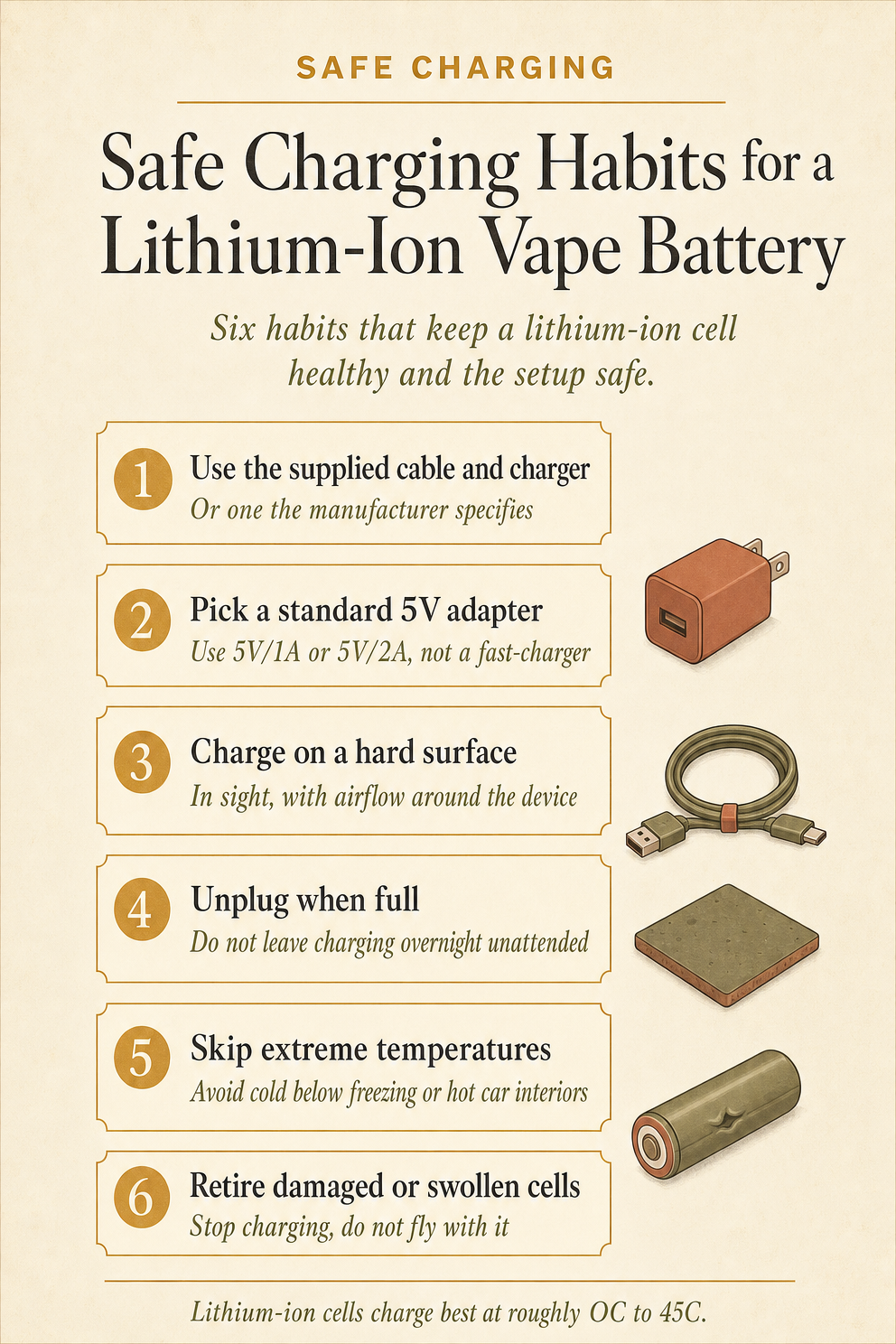
Follow this safe charging routine for any sealed 510 battery charged over USB. Each step is a small habit that, taken together, is what keeps a lithium-ion cell working the way it should [5] [6].
Also retire the battery when it shows the warning signs below. A damaged, defective, or swollen battery should not be charged and should not be flown. Damaged cells in your carry-on or checked bag are a real safety issue, not just an inconvenience [4] [5].
Under U.S. FAA Pack Safe rules, spare (uninstalled) lithium-ion batteries — including external power banks and the cells in vape devices when carried as spares — must go in carry-on baggage only and may not travel in checked baggage. Terminals must be protected from short circuit, which means retail packaging, tape over the terminals, a battery case, or a separate protective pouch [4].
Rechargeable lithium-ion batteries are limited to 100 Wh per battery for personal electronic use without airline approval. With airline approval, passengers may carry up to two spare larger lithium-ion batteries in the 101 to 160 Wh range. Batteries over 160 Wh are prohibited on passenger aircraft. To calculate Wh from a battery label, multiply voltage by amp-hours (Ah), or multiply mAh divided by 1000 by voltage [4].
If you are shopping for a replacement, our Vape Pens subcategory collects vape pens so you can pick a sealed 510 model that suits your routine.
- Use the cable and charger that came with the device, or one the manufacturer specifies.
- Pick a standard 5V/1A or 5V/2A wall adapter — do not use a fast-charge phone adapter.
- Charge on a hard surface, in a spot with airflow, in the same room you are in.
- Unplug the device once it is full — do not leave it charging overnight unattended.
- Do not charge a wet or damaged device, and avoid extreme cold or extreme heat (lithium-ion cells charge correctly across roughly 0°C to 45°C; car interiors can exceed 40°C in direct sun).
- Retire the cell if it runs hot during normal use, drains much faster than it used to, looks swollen, has a torn plastic wrap (on removable cells), or emits an unusual chemical or sweet-metallic odor.
Frequently Asked Questions
Are 510 pen battery, cart battery, and oil pen battery the same thing?
Yes. Across the industry these three terms are used interchangeably to describe a rechargeable lithium-ion battery with a 510 threaded connector at the top. What one retailer calls a "510 pen battery" another will list as a "cart battery" or an "oil pen battery".
What is the difference between a 510 battery and a pod-system battery?
A 510 battery uses a universal 10 thread x 0.5 mm pitch threaded connection that physically fits cartridges from any 510 brand. A pod-system battery is typically sealed, brand-specific, and often magnetic, and is not 510 compatible. If you want flexibility to swap cartridges between brands, a 510 battery is the practical choice.
How many voltage settings does a typical variable-voltage 510 battery have?
Most entry-level variable-voltage 510 batteries offer three preset tiers, commonly around 2.4V, 3.2V, and 4.0V, with the active setting signaled by an LED color (often green, blue, and red) rather than a screen. The right setting depends on the specific cartridge and the oil inside it.
Can you bring a spare vape battery on a plane?
Under U.S. FAA Pack Safe rules, spare (uninstalled) lithium-ion batteries, including vape device spare cells and external power banks, must go in carry-on baggage only and may not travel in checked baggage, with terminals protected from short circuit. Rechargeable lithium-ion batteries are limited to 100 Wh per battery without airline approval, larger spares of 101 to 160 Wh require airline approval with a limit of two per passenger, and batteries over 160 Wh are prohibited on passenger aircraft.
What are the warning signs a vape battery should be retired?
Retire the cell if it runs noticeably hot during normal use, drains much faster than it used to, looks swollen or misshapen, has a torn or nicked plastic wrap (on removable cells), or emits an unusual chemical or sweet-metallic odor. A damaged, defective, or swollen battery should not be charged or flown.
Does a higher mAh rating mean more vapor or better flavor?
No. mAh (milliamp-hours) only describes how much charge the battery can store, not vapor strength or flavor. A higher mAh generally means more sessions per charge and a physically larger device. Actual flavor and vapor depend on coil resistance, voltage or wattage, puff length, airflow, and wick saturation.
What Is the Easiest Way to Pick a Vape Battery You Will Actually Use?
The fastest path to the right vape battery is a short compatibility check, not a spec sheet. Confirm the 510 thread, match the cartridge diameter to the battery opening, and pick an activation style that fits how you actually draw (button for control, auto-draw for simplicity). Then match mAh and form factor to your daily routine — slim for carry, standard for typical days, larger for frequent sessions — and choose variable voltage if you swap between thick and thin oils.
Once the battery is in hand, the habits that protect it are simple. Use the supplied cable and a standard 5V adapter, charge on a hard surface in sight, unplug when full, and never charge overnight unattended. Carry spare cells in a case, follow the FAA Pack Safe rules for carry-on only, and retire any battery that runs hot, swells, drains fast, or smells off.
Those few checks up front and a handful of safe charging habits are what turn a 510 battery from a generic-looking stick into a setup that fits your cartridge, your routine, and your travel plans.
Sources
- AOVAPE (vape hardware manufacturer and OEM): Vape Battery 510: The Complete Technical Guide (2026)
- AOVAPE (vape hardware manufacturer and OEM): Auto-Draw 510 Battery: Airflow and Compatibility
- Vape-product reference publisher (specialist guide): How Long Does a 2000mAh Vape Battery Last?
- U.S. Federal Aviation Administration (FAA) — Pack Safe program: Lithium Batteries (PackSafe)
- 888Vapour (established UK vape retailer / specialist publication): Vape Battery Safety: The Complete UK Guide (2026)
- 42degrees (specialist vape retailer publication): Vape Battery Safety, Device Care & E-Liquid Guide