
A pen vaporizer is a small, battery-powered tube-shaped device that combines a heating element, a cartridge or chamber, and a mouthpiece in one body. This pen vaporizer guide walks through the main formats — pre-filled 510-thread oil cartridges, refillable pens, dry herb pens, concentrate pens, dual-use pens, and disposables — and the features that actually matter when you choose one.
What Is a Pen Vaporizer and How Is It Different From Other Vaporizer Formats?
A pen vaporizer is one shape within the larger vaporizer family. It is narrow, portable, and powered by a rechargeable or built-in battery. Most models combine a battery with a small cartridge, tank, or chamber and a mouthpiece. The slim body makes the device easy to carry, but it also limits battery size and chamber space.
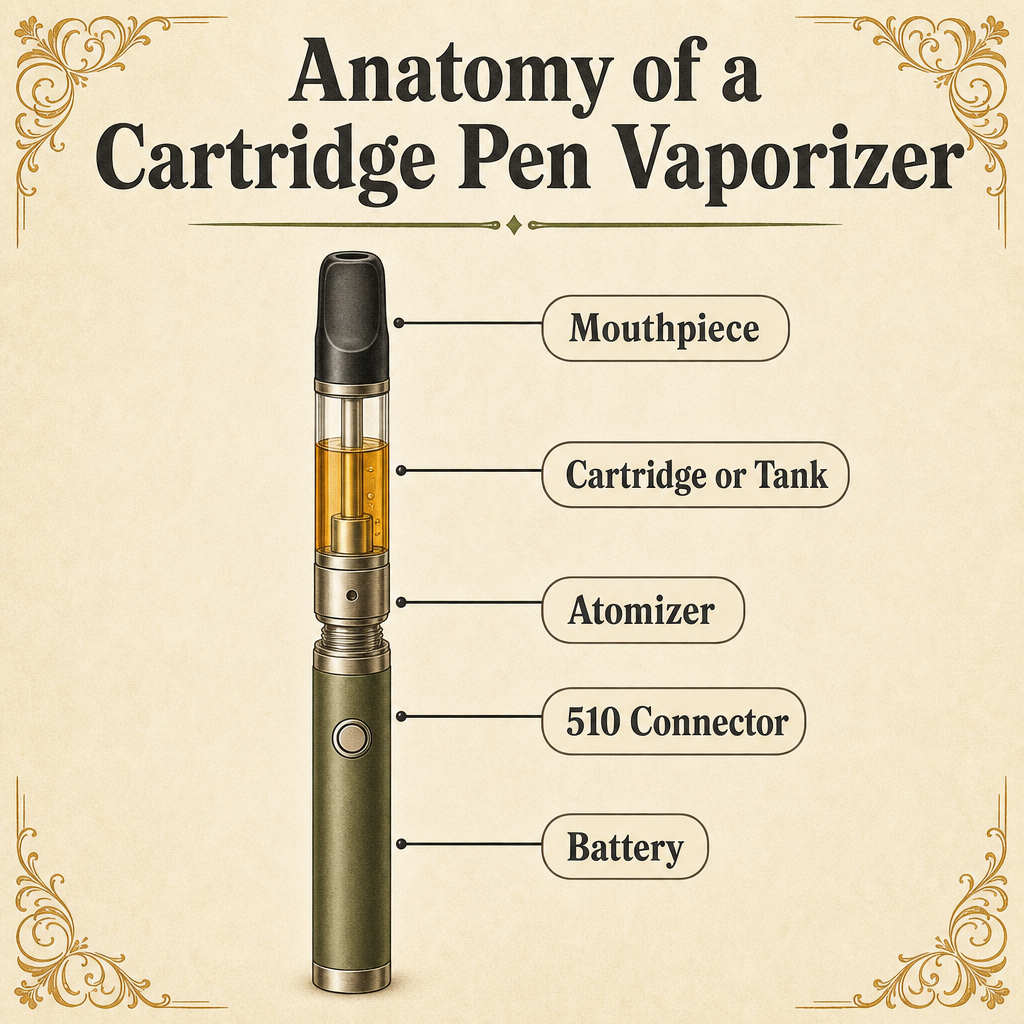
The three basic parts are a power source, an atomizer, and a container. The atomizer is the heating element. The container may be a pre-filled cartridge, a refillable tank, or a chamber made for dry herb or concentrate. An e-cigarette-style device uses the same broad arrangement: a battery powers an atomizer that heats material held in a cartridge or tank. [7]
A larger portable vaporizer may have a bigger chamber, a screen, and more temperature settings. A desktop vaporizer stays in one place and may offer more power and longer sessions. A pen trades those extras for a smaller body and simpler controls. That makes it useful for people who value easy storage and quick setup.
The word pen does not tell you what goes inside. Two devices can look almost identical while being built for completely different materials. One may accept oil cartridges, while another has a chamber for concentrate. Always check the maker’s instructions before loading or attaching anything.
A concentrate pen is also different from a full-size dab rig. If you are comparing those setups, What Size Dab Rig Should You Choose? explains how rig size changes the equipment you need. The better choice is not the most complex device. It is the format that matches your material and routine.
- Atomizer: the small heating element that receives power from the battery.
- Battery: the power source, which may be rechargeable or sealed inside the device.
- Cartridge, tank, or chamber: the part that holds the material made for that model.
- Mouthpiece: the top section connected to the device’s internal vapor path.
What Are the Main Types of Pen Vaporizers?
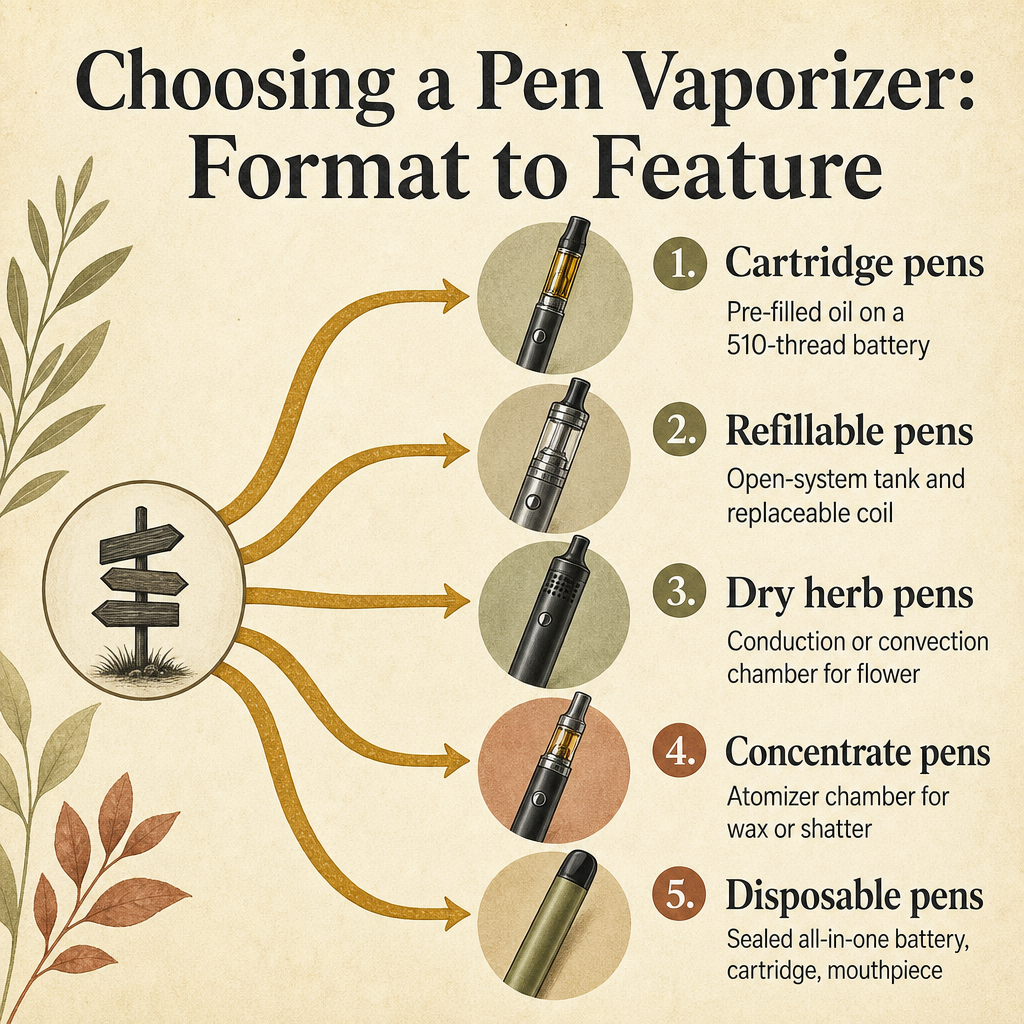
Pen vaporizers are grouped mainly by material and construction. The most familiar setup pairs a slim battery with a pre-filled oil cartridge. Many of these parts use a 510-thread connection, a common screw-style standard that lets compatible batteries and cartridges from different makers physically connect. [2]
A physical fit does not guarantee that every cartridge should run at every voltage. Thick oil, coil design, and maker instructions still matter. Start with the cartridge maker’s recommended range when one is supplied. If the battery has several settings, begin low and adjust only as directed.
Refillable or open-system pens use a tank or cartridge that can be filled again. They offer more choice but need more upkeep. Users must watch the coil, seals, and fill level. A disposable pen puts the battery, reservoir, atomizer, and mouthpiece into one sealed body. It is generally replaced when the oil or battery is finished. [2]
Dry herb pens use a chamber for ground botanical material. Concentrate pens, also called dab pens or wax pens, use a chamber or atomizer made for extracts such as wax, badder, or shatter. A concentrate pen is a portable alternative to a larger rig setup, but its chamber is much smaller. [3]
Dual-use pens claim to support both dry herb and concentrate, often through separate chambers or inserts. That flexibility can be useful, but it does not mean both modes work equally well. Read the exact loading and cleaning steps for each attachment. For a broader comparison, How Do Dry Herb Vaporizers Differ from Concentrate Vaporizers? covers the practical differences between those materials.
If you want the larger picture before choosing a format, start with What Is a Vaporizer and How Does It Work?. Shoppers who already know they want a pen can also use What Are the Different Types of Vape Accessories and How Do I Choose Them? to see how chargers, cases, cartridges, and other accessories fit around the device.
- Pre-filled cartridge pen: a reusable battery paired with a filled, replaceable oil cartridge.
- Refillable cartridge pen: an open tank or cartridge that can be filled again and may use replaceable coils.
- Dry herb pen: a chamber designed for ground botanical material rather than an oil cartridge.
- Concentrate pen: a small chamber or atomizer designed for wax and other extracts.
- Dual-use pen: a device with separate parts or modes for dry herb and concentrate.
- Disposable pen: a sealed all-in-one unit with its battery, reservoir, atomizer, and mouthpiece together.
How Does a Pen Vaporizer Actually Work?
A cartridge-style pen works through a short chain of parts. The battery supplies electricity to the atomizer. The atomizer heats the contents held in the cartridge or tank. The resulting aerosol then moves through the internal path to the mouthpiece. [7]
The process begins when the device is activated. On a button model, pressing the control closes the circuit. On a draw model, a sensor responds to airflow. Either system tells the battery to send power to the heating element.
The atomizer may include a coil, ceramic part, or another heated surface. Its design and the power setting affect how quickly it warms. The cartridge and atomizer may be one replaceable unit, or the coil may be a separate service part in a refillable system.
Air enters through small intake openings. Those holes can be easy to block with fingers or debris, so grip and basic cleaning matter. The air moves past the heated area and through the center path. The mouthpiece is the final section of that route.
Not every pen can be opened or repaired. Many cartridge batteries separate from the cartridge at the threaded connector, while a disposable model may be sealed. Do not force a sealed body apart. If the device behaves oddly, stop using it and follow the maker’s support steps.
The route is much shorter than the airway in a long hand pipe, though shape still affects how a device feels and handles. For an example of how a curved airway changes another portable format, see What Is a Sherlock Pipe and How Does the Curved Shape Work?.
- Activate the pen by pressing its button or drawing through the mouthpiece.
- The battery sends power to the atomizer or heating element.
- The atomizer heats the oil, herb, or concentrate made for that chamber.
- Incoming air passes through or beside the heated area and enters the center path.
- The aerosol travels through the device and exits through the mouthpiece.
Conduction vs Convection Heating in Pen Vaporizers: Which Is Better?
Conduction and convection describe how heat reaches the material. In a conduction device, the material touches a hot metal or ceramic surface. This direct contact usually gives the device a quick start and allows a small chamber, which is why conduction appears often in compact pens. [5]
Direct contact can make the area nearest the heated surface warm first. With dry herb, that may mean the chamber needs a stir if the maker recommends it. With concentrate, the material is placed on or near the heated part made for that device. Many concentrate pens use this direct style. [4]
Convection uses hot air moving through the material instead of relying mainly on direct contact. It can warm the load more evenly, but the heater and airflow system often need more space and power. For that reason, true convection is less common in very slim pens than in larger portable vaporizers. [5]
Hybrid heating combines direct surface heat with moving hot air. The label alone does not tell you how much each method contributes. Product manuals, chamber shape, warm-up time, and temperature controls give a better picture than marketing terms by themselves.
Neither method is best for every buyer. Conduction makes sense when compact size and quick warm-up matter. Convection may fit a person who values even heating and accepts a larger body or longer start. A hybrid can sit between them, though its performance depends on the actual design.
When comparing models in the Vaporizers collection, check whether the heating claim matches the device size and instructions. A very slim product advertised with broad claims deserves a closer look at its manual and chamber design.
- Conduction: direct surface contact, quick warm-up, compact chamber, and common use in concentrate pens.
- Convection: heated air moves through the material, usually with more space and power needs.
- Hybrid: combines surface heat and hot airflow, with the balance changing from model to model.
- Best fit: choose by material, device size, warm-up time, and the control you actually plan to use.
| Factor | Conduction | Convection |
|---|---|---|
| Heat-up time | Fast, often near-instant | Slower, depends on airflow |
| Chamber size | Compact, fits slim pens | Larger, less common in pens |
| Extraction | Direct contact | Hot air through material |
| Flavor | Can char near the surface | Usually cleaner flavor |
| Common use | Most concentrate pens | More common in larger portables |
| Hybrid option | Combines both in one device | Combines both in one device |
Button-Activated vs Draw-Activated Pen Vaporizers: Which Style Fits You?
A button-activated pen starts heating when you press its control. Many models use a quick series of clicks to turn the battery on or off. Some also let you change voltage or start a preheat cycle. The exact click pattern is not universal, so keep the instructions instead of guessing.
Draw-activated pens use an airflow sensor. When the user draws through the mouthpiece, the sensor tells the battery to heat. There is no button sequence to learn, which makes the design simple. It also reduces the chance of a button being pressed inside a pocket, although the device should still be stored as its maker directs.
The main trade-off is control versus simplicity. A button model may let you preheat thick oil or select a lower voltage. A draw model usually makes those choices automatically. Some draw batteries still offer voltage options through a switch or dial, so check the controls rather than relying on the label alone.
A button is useful when you want to see and control exactly when heating begins. A draw sensor is useful when you want fewer steps. Neither style tells you the quality of the battery, cartridge connection, or atomizer. Those parts still need their own comparison.
Think about where the pen will be carried and how often settings will change. A person who uses one compatible cartridge at one setting may not need a menu of controls. Someone switching among cartridges may value adjustable voltage and a visible indicator.
The Vape Pens section groups pen-style options in one place. Compare activation style alongside connector type, charging method, and voltage range rather than choosing only by appearance.
- Button control: direct start and stop control, often with voltage or preheat options.
- Draw control: automatic activation with fewer steps and no main button to press.
- Travel fit: look for a lock or power-off method and follow the maker’s storage directions.
- Best choice: use button models for more control and draw models for a simpler routine.
| Factor | Button-activated | Draw-activated |
|---|---|---|
| Activation | Press the power button | Inhale to trigger sensor |
| Variable voltage | Usually available | Sometimes, via switch or dial |
| Preheat | Common on button models | Usually not available |
| Ease of use | Learn the click pattern | Fewer steps, no sequence |
| Discretion | Visible button press | Quieter, no button needed |
| Pocket risk | Lock or off switch recommended | Lower, but still follow storage guide |
What Features Should You Compare When Choosing a Pen Vaporizer?
Start with compatibility, not color or shape. Confirm the material type, connector, cartridge width, and voltage range. A 510-thread cartridge may screw onto a 510 battery, but size and power needs can still vary. The maker’s instructions should settle any doubt.
Battery capacity is commonly shown in milliamp-hours, or mAh. A larger number often means more time between charges, but it can also mean a thicker or longer device. Your real runtime also depends on voltage, heater resistance, session length, and battery age.
Variable voltage changes how much power reaches the atomizer. Lower settings warm more gently, while higher settings warm faster and use more battery. Stay within the stated range for the cartridge or chamber. More power is not automatically better, and pushing beyond directions can damage parts.
Preheat sends power for a short set time before regular use. It can help a cartridge respond when its contents are thick or cool. An LED may show power, voltage, or charge state. A screen can provide more detail, but it also adds size and controls.
USB-C is common on newer devices, while older pens may use micro-USB or a threaded USB adapter. The port shape does not tell you that every charger is suitable. Use the charging equipment and power guidance supplied by the manufacturer.
Finally, check which parts can be replaced. A built-in coil or sealed battery makes the device simple but limits repair. A replaceable coil, tank, or battery can extend the useful life, though it adds cleaning and parts to track. The Concentrate Vaporizers collection is useful when concentrate is your chosen format.
- Confirm the material, connector, cartridge size, and stated voltage range.
- Compare battery capacity with the size and weight you are willing to carry.
- Decide whether you need variable voltage, preheat, or only one simple setting.
- Check the indicator system, charging port, included cable, and charging instructions.
- Find out whether the atomizer, coil, cartridge, mouthpiece, and battery are replaceable.
- Review cleaning steps and the cost and availability of replacement parts.
How Do You Charge and Maintain a Pen Vaporizer Safely?
Battery care starts with the instructions for the exact device. Use the charger and batteries recommended by the manufacturer. Do not mix battery brands, sizes, or charge levels in devices that use removable cells. The FDA also advises users not to charge vape-style devices unattended or overnight. [9]
Charge on a clean, flat surface away from material that can catch fire. Keep the device away from extreme heat and cold, including a parked car on a hot or freezing day. Stop charging if the battery becomes unusually hot, swells, leaks, smells odd, or shows other unexpected behavior. Contact the manufacturer when instructions are missing or the device acts strangely. [9]
Keep the connector dry and free of debris. A cotton swab can remove loose residue when the device is off and disconnected, but follow the maker’s cleaning method before using any liquid. Do not scrape contacts with metal tools. Damaged threads or a bent center contact can cause a poor connection.
For refillable or concentrate chambers, avoid overfilling. Material in the airway can block airflow and reach the mouthpiece. Let cleaned parts dry fully before putting the device back together. Replace worn seals, cracked tanks, or damaged mouthpieces with compatible parts.
Storage matters too. Turn off or lock a button model if that feature exists. Keep loose removable batteries in a proper case, never beside keys or coins. Do not carry a device in a way that can press its button or strain the cartridge connection.
A little routine care prevents many common problems, but a damaged battery is not a home repair project. If a device has been crushed, soaked, punctured, or dropped hard enough to damage its case, stop using it and follow local battery disposal guidance.
- Read the manual and use only the recommended charger and battery setup.
- Charge on a clean, flat surface while you are present, not overnight.
- Keep the device away from extreme temperatures and flammable materials.
- Clean dry connectors and air paths according to the maker’s directions.
- Inspect the case, cable, cartridge, and removable cells for visible damage.
- Stop using a device that overheats, swells, leaks, or behaves unexpectedly.
Frequently Asked Questions
What does 510 thread mean on a pen vaporizer?
510 thread is a common screw-style connection used by many oil cartridges and pen batteries. If both parts use the standard, they may physically connect, but you should still confirm cartridge size and the maker’s recommended voltage.
Is a dab pen the same thing as a wax pen?
Yes. A dab pen and a wax pen are two names for the same kind of portable concentrate vaporizer. It has a battery, a small chamber or atomizer made for concentrate, and a mouthpiece.
What is the difference between a disposable vape pen and a refillable pen?
A disposable pen combines its battery, reservoir, atomizer, and mouthpiece in one sealed body. A refillable pen has a tank or cartridge that can be filled again and may also use a replaceable coil.
Are pen vaporizers dry herb, concentrate, or oil devices?
They can be built for any of those materials, but most models are designed for one specific type. Check the chamber and instructions before buying or loading the device.
Do pen vaporizers use conduction or convection heating?
Both methods exist. Conduction uses direct contact with a heated surface, while convection moves hot air through the material. Some devices combine both methods in a hybrid design.
What is the right way to charge a pen vaporizer battery?
Use the manufacturer-recommended charger, stay nearby while it charges, place it on a clean and flat surface, and do not charge it overnight. Stop if the battery becomes unusually hot or damaged.
Which Pen Vaporizer Fits Your Routine Best?
Choose the material first: oil cartridge, refillable liquid, dry herb, or concentrate. Then compare the connector, heating method, activation style, battery capacity, voltage range, charging setup, and replaceable parts. A simple pen that matches your routine is usually a better buy than a feature-heavy model you will not use.
Read the instructions before loading, charging, or cleaning any pen. Confirm compatibility instead of assuming that similar-looking parts belong together. Treehouse Lifestyle carries vaporizer formats and accessories for shoppers who want to compare practical options, with free shipping on orders $150+.
Sources
- Wikipedia: Vaporizer (inhalation device)
- Leafly: A guide to the different types of cannabis vape carts
- Leafwell: What Are Dab Pens, And How Do They Work?
- Puffco: The Dry Herb Vape vs Concentrate Device Debate
- DynaVap: Conduction vs Convection Vaporizers: What’s the Real Difference?
- Smoke Cartel: Dry Herb vs. Concentrate Vaporizers: How to Choose the Right Vape
- Wikipedia: Electronic cigarette
- Leafly: Vaporizer
- U.S. Food and Drug Administration: Tips to Help Avoid Vape Battery Fires or Explosions