
A practical guide comparing heating methods, maintenance, portability, and everyday use.
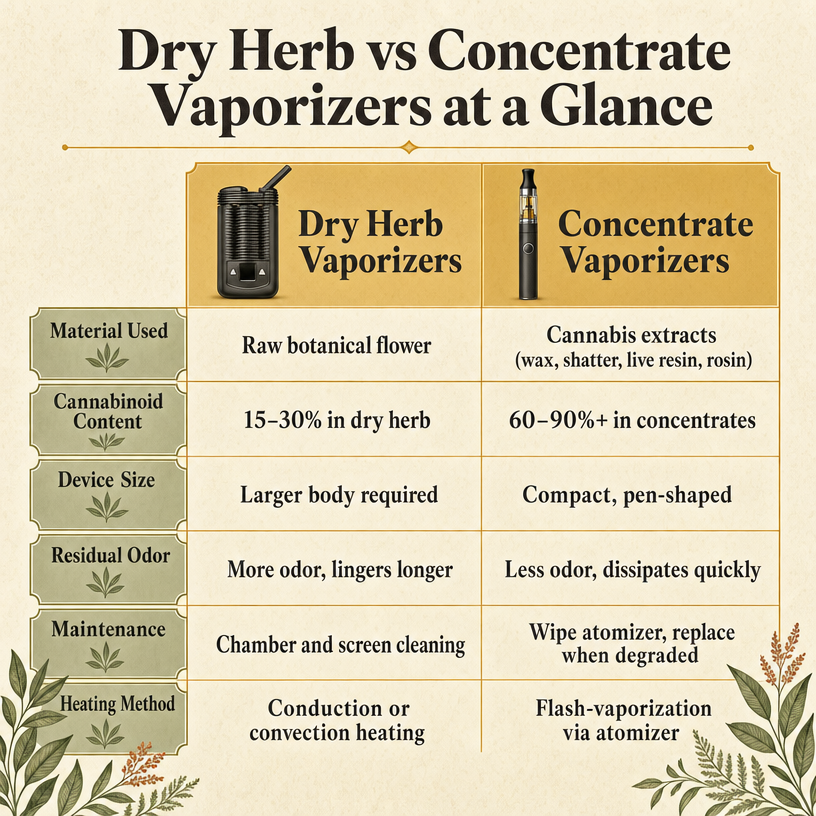
The core difference between a dry herb vaporizer and a concentrate vaporizer is the material each device is designed to heat. Dry herb vaporizers vaporize raw cannabis flower that typically contains 15–30% cannabinoids. Concentrate vaporizers are built for refined cannabis extracts such as wax, shatter, live resin, or rosin, which commonly test at 60–90%+ cannabinoids. That difference in starting material shapes nearly everything else about the two categories: device size and shape, heat-up speed, odor profile, maintenance needs, and the overall experience each produces. Both types avoid combustion by heating material below approximately 180°C, well below the point where smoke and ash are produced.
What Are Dry Herb Vaporizers and Concentrate Vaporizers?
A dry herb vaporizer is a device built to heat raw botanical flower. The flower is ground up and placed in a chamber where a heating source warms it without reaching combustion. The resulting vapor passes through a personal airway and is drawn through a mouthpiece. Most Dry Herb Vaporizers have an adjustable temperature setting so you can control how hot the chamber gets. [1]
- A heating chamber where ground dry herb is placed
- A personal airway and mouthpiece through which vapor is drawn
- A battery-powered heating element with adjustable temperature
- Compatible with dried botanical flower only
- Coil, convection, or hybrid heating systems depending on the model
- Atomizer-based heating instead of a herb chamber
- A glass or ceramic chamber holding the concentrate
- More compact, pen-shaped body for portability
- Battery-powered atomizer that vaporizes on contact
A concentrate vaporizer is designed for refined cannabis extracts. These products—wax, shatter, live resin, and rosin—have a very different texture and cannabinoid density compared to dry herb. Concentrate Vaporizers use an atomizer instead of a herb chamber. The atomizer is a heating element encased in glass or ceramic. When you place a small amount of concentrate into the chamber and the atomizer heats up, the material vaporizes on contact. [1]
Both device types fall under the broader category of vaporization, which means heating material at temperatures that release active compounds as vapor while avoiding the smoke and ash that come from burning. [5]
One of the most practical differences is device shape. Dry herb vaporizers need room for a herb chamber and a longer vapor path, so the body is typically larger and more elongated. Concentrate vaporizers—especially pens designed for wax or rosin—can be much more compact because the atomizer chamber is small. [1]
Read What Is a Dry Herb Vaporizer and How Does It Work? for more detail.
How Does Conduction Heating Differ from Convection Heating?
Both dry herb and concentrate vaporizers use one of two main heating technologies, with some devices combining the two. Understanding how each works helps you interpret manufacturer claims and compare models more effectively. [4]
- Conduction: direct contact between heating surface and material—faster heat-up, lower cost, potentially uneven
- Convection: hot air circulated through material—more even vaporization, better flavor, higher price and slower heat-up
- Hybrid systems use conduction for start-up and convection for the session body
- Conduction is more common in budget and mid-range herb vaporizers
- True convection units generally carry a higher price tag
- Temperature settings affect both methods, influencing vapor output and flavor
Conduction heating works through direct contact between the material and a heated surface. A metal plate, coil, or other heating element warms up, and whatever touches it heats as well. Conduction units tend to be less expensive and heat up faster. The trade-off is that material closest to the heating surface can reach higher temperatures than the rest, which may lead to uneven vaporization and slightly less flavor complexity. [4]
Convection heating passes hot air through the material rather than pressing a hot surface against it. A heating element warms air first, and that hot air then circulates through the chamber to vaporize the material evenly. Convection generally produces more consistent vaporization and preserves more of the aromatic compounds that contribute to flavor. The downside is higher cost and potentially slower heat-up times. [4]
Conduction heating is common in both dry herb and concentrate vaporizers, particularly at lower price points. Many affordable herb vaporizers use conduction-based systems. True convection units tend to be premium-priced. Some vaporizers combine both methods—using conduction to reach temperature quickly and convection to maintain even vaporization through the rest of the session. Temperature control affects vapor output and flavor in both heating types, and approximately 180°C is a useful reference point for efficient vaporization of key cannabis compounds. [5]
Read What Is a Vaporizer and How Does It Work? for more detail.
Read E-Rig vs Traditional Dab Rig: Which Should You Choose? for more detail.
Read What Is the Difference Between Conduction and Convection Vaporizers? for more detail.
Which Type Is Easier to Clean and Maintain?
Both vaporizer types need regular cleaning to keep performing well, but the maintenance profile is different for each. Knowing what you are signing up for before you buy can prevent frustration later. [1]
- Allow the device to cool completely before any cleaning
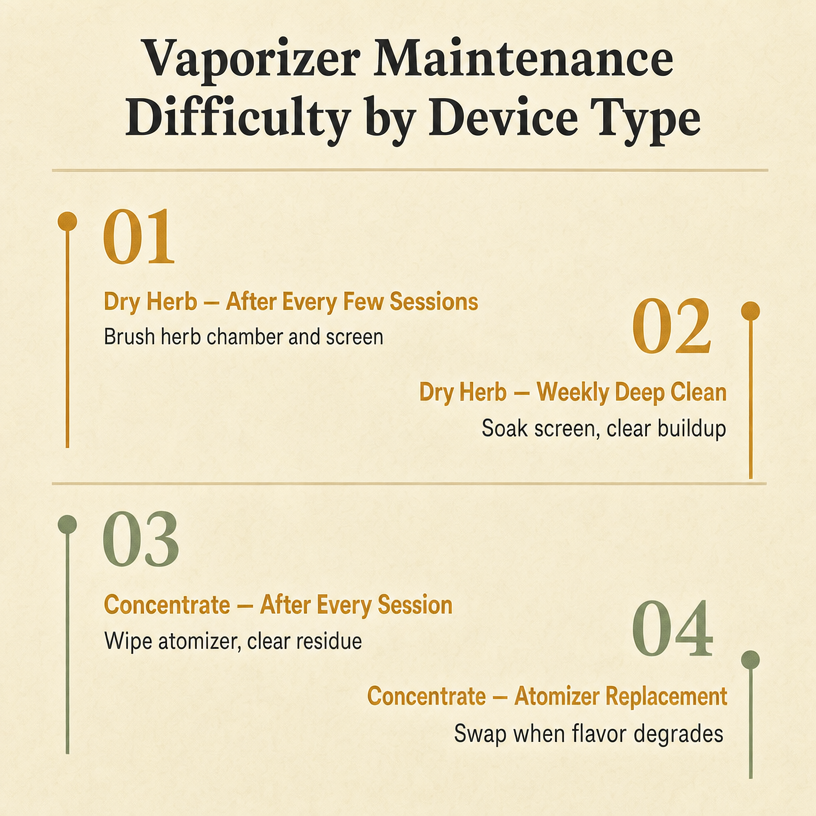
- Brush or wipe the herb chamber after every few sessions
- Soak the screen in isopropyl alcohol weekly for deep cleaning
- Replace screens when they show signs of wear or clogging
- Wipe the atomizer with a cotton swab after each concentrate session
- Replace atomizers when flavor or vapor production noticeably declines
- Keep spare atomizers on hand for quick swaps
- Concentrate device atomizer replacement is a recurring cost to budget for
Dry herb vaporizers accumulate residue from botanical material inside the heating chamber and on the screen that separates the herb chamber from the airway. After each session, brushing out the herb chamber with a small brush clears loose particles and prevents buildup. Wiping the screen with a cotton swab keeps it clear between deeper cleans. On a weekly or bi-weekly schedule depending on use, the screen can be removed and soaked in isopropyl alcohol for a few minutes, then rinsed and reinstalled. Some buildup in the chamber itself can be loosened by running a short, no-herb heating cycle to warm the residue, then wiping it clean. Screens wear out over time and need replacement. The specific steps and disassembly requirements vary by model, so checking your device manual is always worthwhile. [1]
Concentrate vaporizers develop residue on the atomizer and inside the glass or ceramic chamber where concentrate sits during use. After each session, wiping the atomizer with a cotton swab clears most residue and keeps heating performance consistent. The glass or ceramic chamber can be wiped or given a quick rinse as needed. Atomizers in concentrate devices do wear out and lose effectiveness over time. When flavor starts to decline or vapor production drops noticeably, the atomizer needs replacing rather than cleaning. Replacement schedules vary widely depending on how often you use the device and the type of concentrate. Wax and shatter tend to leave heavier residue than live resin or rosin. [3]
Ongoing maintenance costs are worth noting. Dry herb vaporizers require infrequent purchases of replacement screens and cleaning supplies. Concentrate vaporizers require atomizer replacements, which are a recurring consumable expense. [3]
Read How Do I Maintain My Vaporizer for Best Performance? for more detail.
What Are the Key Differences in Size, Portability, and Odor?
Physical size and portability are among the most noticeable practical differences between the two categories. These factors often drive the purchasing decision for people who plan to use their vaporizer away from home. [1]
- Dry herb vaporizers require more internal space for an herb chamber and longer vapor path
- Concentrate vaporizers are compact and pen-shaped for pocket carry
- Dry herb devices are less discreet due to size and stronger residual odor
- Concentrate pens fit in small pockets, bags, and wallets
- Dry herb vaporizer odor is more noticeable and lingers longer in enclosed spaces
- Concentrate vaporizer odor dissipates quickly with ventilation
- If portability and discretion are priorities, concentrate pens have a clear advantage
Dry herb vaporizers typically require a larger device body to accommodate the herb chamber and a longer vapor path. The chamber needs to hold enough ground herb for a session, and the device must manage heat effectively at that scale. As a result, even portable dry herb vaporizers tend to be bigger than a concentrate pen. Some models are designed specifically for on-the-go use and are more compact, but the minimum size is constrained by the herb chamber. [1]
Concentrate vaporizers are considerably more compact. Wax pens, dab pens, and similar devices are built around a small atomizer chamber and a battery. The result is a pen-shaped device that easily fits in a pocket, a wallet, or a small bag. Many measure just a few inches in length. Some users prefer to carry a concentrate pen as an everyday carry item precisely because it takes up so little space. [2]
Odor is another practical differentiator. Dry herb vaporizers produce a smell that is less intense than smoke but clearly noticeable, particularly during and immediately after a session. The scent fades faster than smoke odor but can linger in a small room. Concentrate vaporizers produce less residual odor overall, and what scent is produced dissipates more quickly with ventilation. [1] [2]
What Types of Concentrates Work in Concentrate Vaporizers?
If you are considering a concentrate vaporizer, it helps to know the main types of concentrates available and how they behave in a device. Each type has distinct physical properties that influence how you load and use it. [1]
- Wax: sticky, crumbly, easy to handle, widely available
- Shatter: glass-like sheets, stable, longer shelf life when stored properly
- Live resin: flash-frozen extraction, rich terpene flavor, requires cold storage, higher price
- Rosin: solventless, heat-and-pressure extraction, clean and natural profile
- Standard coil atomizers: metal coil in direct contact with concentrate, affordable
- Coil-less ceramic atomizers: heating element separated from concentrate, better flavor purity
Wax is one of the most common concentrate types. It is made by purging cannabis oil of its solvents, resulting in a sticky, crumbly texture that is easy to handle with a tool. Wax is widely available at dispensaries and works well in most standard atomizers. [1]
Shatter is made using a similar process to wax but has a glass-like consistency when properly purged. It breaks into sheet-like pieces and is known for being relatively stable and long-lasting when stored correctly, provided it is kept away from heat and light. [1]
Live resin is made by flash-freezing fresh cannabis plants immediately after harvest and then extracting the oil at cold temperatures. This process preserves more of the aromatic terpene compounds that give each strain its distinct smell and flavor. Live resin is considered by many users to deliver superior flavor, but it requires cold storage and commands a higher price. [1]
Rosin is made without solvents. Heat and pressure are applied to cannabis material to squeeze out the oils directly. Because no chemical solvents are used, rosin is considered a clean and natural option. Flavor and potency depend on the starting material and the extraction technique used. [1]
The atomizer technology inside the vaporizer matters as much as the concentrate type. Standard atomizers use a metal coil wrapped around a wick. The coil heats up through electrical resistance and comes into direct contact with the concentrate. [3]
Coil-less ceramic atomizers work differently. The heating coil is contained inside a ceramic body, keeping it away from direct contact with the concentrate. Instead, the ceramic heats up and radiates warmth to the material surrounding it. This approach generally produces a cleaner and more consistent flavor profile, which is why many users prefer ceramic atomizers even though they cost more per replacement. [3]
How Do I Choose the Right Vaporizer for My Lifestyle?
The right vaporizer depends on your priorities in several practical categories. Here is a straightforward way to think through the decision without relying on health or potency claims. [1]
- Choose dry herb if you prefer whole flower and do not mind a larger device
- Choose concentrate vaporizers for portability and compact everyday carry
- Dry herb vaporizers produce more noticeable, lingering odor
- Concentrate pens are discreet and vapor dissipates quickly
- Dry herb maintenance involves regular brushing and screen replacement
- Concentrate device atomizer replacement is a recurring maintenance cost
- Consider how often you will use the device and where you will be using it
- Both types have a learning curve—factor in time to learn your device
The material you want to use is the biggest factor. If you prefer the natural flavor and experience of whole flower, a dry herb vaporizer is built for that. If you want something more potent in a smaller package and do not mind working with concentrates, a concentrate vaporizer is the better fit. Many people who use cannabis regularly end up owning both for different situations. [1]
Think about when and where you plan to vape. Dry herb vaporizers are larger and less discreet, so they work best at home or in settings where size is not a concern. Concentrate pens are easy to carry and use on the go, fitting into a pocket or bag without drawing attention. If your lifestyle involves a lot of moving around, this matters. [2]
Consider how much odor is acceptable in your environment. Dry herb vaporizers produce a more noticeable smell that lingers. Concentrate vaporizers are far more discreet, with vapor that clears quickly. If you live in shared housing or need to be careful about smell, this is worth weighing seriously. [2]
Be honest about your maintenance tolerance. Dry herb vaporizers need regular brushing and occasional deep cleaning. Concentrate vaporizers need wiping after each session and atomizer replacement every few weeks or months depending on use. Neither is difficult, but they are different commitments. [3]
Budget is not just the purchase price. A dry herb vaporizer is mostly a one-time purchase with occasional costs for screens and cleaning supplies. A concentrate vaporizer has a lower entry cost in many cases, but atomizer replacements add up over time. Factor in the cost of the material you plan to use as well. [2]
Treehouse Lifestyle carries a curated selection of vaporizers across multiple categories and price points. Free shipping on orders $150+ makes it easy to get everything you need in one place. Browse the full collection to find a device that matches your priorities and start exploring the differences between dry herb and concentrate vaporizers for yourself.
Browse Portable Vaporizers to explore related options.
What Are Common Questions About Smoking Accessories?
Can a dry herb vaporizer be used with concentrates?
Most dry herb vaporizers are not designed for concentrates and attempting to use extracts in a flower chamber can damage the device or produce unpleasant results. Some devices offer interchangeable components, but using the correct device for the material is the safest and most effective approach.
What is a dab pen or wax pen?
A dab pen, also called a wax pen, is a portable concentrate vaporizer that uses a battery-powered atomizer to flash-vaporize a small amount of concentrate on contact, producing a dense vapor almost instantly. These devices are compact and pen-shaped for easy portability.
Do concentrate vaporizers produce more odor than dry herb vaporizers?
The opposite is generally true. Concentrate vaporizers produce less residual odor than dry herb vaporizers, and the vapor dissipates more quickly, making concentrate devices the more discreet option in most settings.
How is temperature controlled in each vaporizer type?
Most modern vaporizers—both dry herb and concentrate—offer adjustable temperature settings. Both device types heat below the combustion point, approximately 180°C. Temperature control allows users to target different cannabinoid and terpene profiles, though this article does not make health or potency claims about specific temperature ranges.
Which Vaporizer Type Is Right for You?
The difference between a dry herb vaporizer and a concentrate vaporizer comes down to the material you choose to vaporize. Dry herb vaporizers process raw botanical flower with a moderate cannabinoid density in a larger device body. Concentrate vaporizers handle refined cannabis extracts with a far higher cannabinoid concentration in a compact, pen-style form factor. That single difference—material type—shapes the entire ownership experience across device size, heat-up speed, odor output, maintenance routines, and daily practicality.
If you value natural botanical flavor, don’t mind a larger device, and want to avoid the hassle of handling sticky concentrates, a dry herb vaporizer is likely the better fit. If portability, quick sessions, and a more discreet footprint matter more to you, a concentrate vaporizer or wax pen is worth considering. Many cannabis consumers ultimately keep both types on hand for different moments throughout the day.
For further reading, explore our guide on how vaporizers work in general, or dig deeper into the distinction between conduction and convection heating systems. If you are leaning toward concentrates and weighing between an e-rig and a traditional dab rig, that comparison is covered as well.
Where Does This Smoking Accessory Information Come From?
- Puffco: The Dry Herb Vape vs Concentrate Device Debate
- Smoke Cartel: Dry Herb vs. Concentrate Vaporizers: How to Choose the Right Vape
- Leafwell: What Are Dab Pens, And How Do They Work?
- Vaping360: Convection vs Conduction: Is it a Heated Debate?
- National Institutes of Health / NCBI: Vapor Pressure, Vaping, and Corrections to Misconceptions Related to Medical Cannabis’ Active Pharmaceutical Ingredients’ Physical Properties and Compositions