
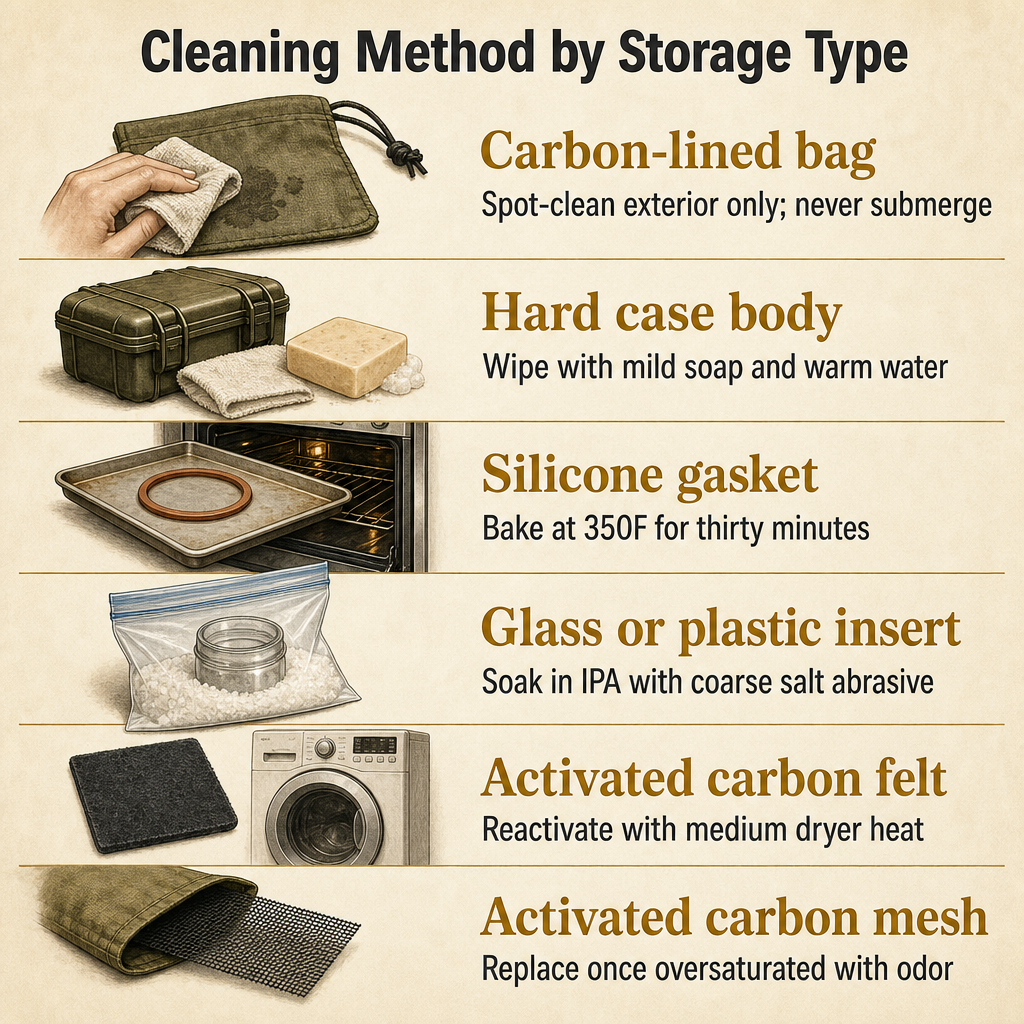
To clean a smell proof bag, spot-clean the outside with mild soap and a damp cloth, never submerge it, and refresh the carbon lining with medium dryer heat for 10-15 minutes [1] [2]. For a hard case with a silicone gasket, wipe it with mild soapy water and bake smelly seals at 350°F for 30 minutes [5] [6] [7].
Between deep cleanings, let bags air out inside-out in a ventilated spot and use a separate inner liner so moisture never reaches the carbon layer [1].
What Are Smell-Proof Bags and Storage Cases Actually Made Of?
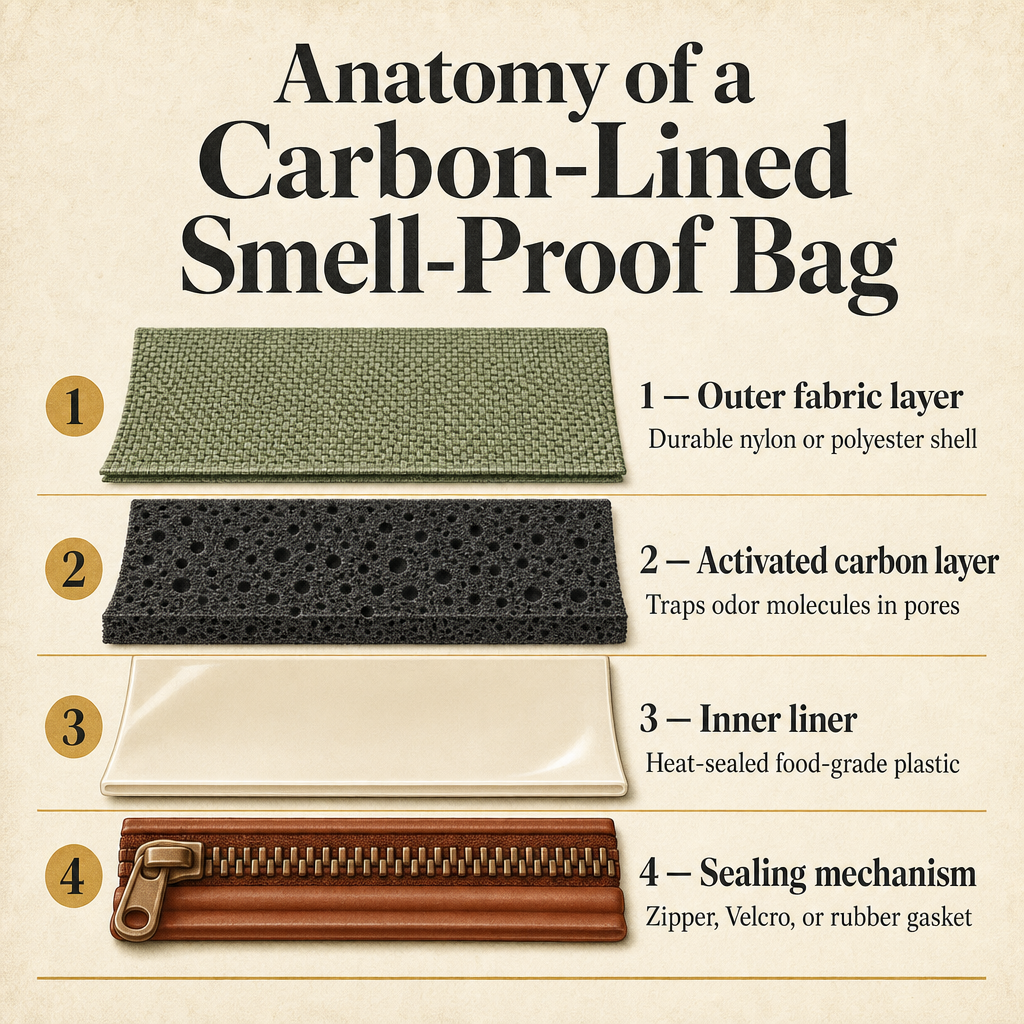
A smell-proof bag is built from three main layers stacked on top of each other [3] [4]. The outside is a tough fabric, usually nylon or polyester, that holds up to daily wear. The middle layer is activated carbon, and that is the part that actually traps odor. The inside is a heat-sealed food-grade plastic liner that keeps contents from touching the carbon directly. Without that middle layer, the bag is just a soft pouch. Without the inner liner, the carbon would soak up whatever was inside on the first day.
Hard storage cases use a different set of parts to do the same job [4]. The body is usually a rigid plastic, metal, or thick fabric wrapped over a stiff frame. Instead of carbon felt, the smell-blocking work happens at the seal: a silicone gasket runs around the rim where the lid meets the case, and one or more latches press the gasket tight when the case is closed. Many cases also add a foam insert or molded tray inside so the contents do not shift and scrape against the lid.
Knowing which part does the odor-blocking work is the key to cleaning without ruining it. On a carbon-lined bag, the part to protect is the middle carbon layer. On a hard case, the part to protect is the silicone gasket. Both parts are sensitive to different things, which is why the cleaning routines below look different for each format. To browse the full range of storage products in one place, the Treehouse Lifestyle bags and cases collection Bags / Cases is a useful starting point, and the cleaning supplies section Cleaning Supplies covers the brushes, salt, and isopropyl alcohol used in the steps that follow. The smell-proof bags subcategory Smell-Proof Bags also groups the carbon-lined options together if you want to compare styles.
- Outer fabric layer — A durable nylon or polyester shell that takes the daily wear and shields the inner layers underneath [4].
- Activated carbon layer — The middle layer that traps odor molecules in tiny pores; the part that actually does the smell-blocking work [2] [3].
- Heat-sealed inner liner — A food-grade plastic liner that keeps contents from touching the carbon directly [4].
- Sealing mechanism — A zipper, Velcro strip, or rubber gasket that closes the bag or case and keeps odor from leaking out [3].
How Do You Clean a Carbon-Lined Smell-Proof Bag Step by Step?
Cleaning a carbon-lined bag is a short routine, but the order matters. The biggest rule is that water and the carbon layer do not mix [1] [2]. A bag that gets soaked, run through a washing machine, or even left out in a heavy rain can lose a noticeable amount of odor-blocking ability because the water damages the carbon’s pore structure. The routine below keeps water on the outside of the bag only and uses heat later to refresh the lining.
Before getting into the steps, it helps to know why each one is there. Spot-cleaning handles the dirt and oils that show up on the outside fabric. Dry-cleaning lifts any loose debris from the inside without introducing moisture. The heat pass at the end releases the odor molecules the carbon has been holding, which is what restores the smell-blocking ability. Skipping the heat pass leaves a clean bag that still smells, and skipping the dry-clean step leaves grit pressed into the liner. For a deeper look at how to store these bags between cleanings, our guide to storing smoking accessories the right way How Do I Store My Smoking Accessories the Right Way? walks through the day-to-day habits. For the wider cleaning context across pipes, bongs, and rigs, the complete guide to cleaning smoking accessories The Complete Guide to Cleaning Smoking Accessories is a good companion. If you also use a vaporizer and want to clean that without damaging it, our vaporizer cleaning guide How Do You Clean a Vaporizer Without Damaging It? uses the same spot-clean philosophy.
- Step 1 — Empty the bag and unzip it fully. Pull out the contents and shake the bag upside down to dislodge any loose debris from the corners and seams [1].
- Step 2 — Spot-clean the outside. Dampen a soft cloth with warm water and a small amount of mild, non-abrasive soap. Wipe the exterior fabric in small circles. Do not scrub hard, and do not let the cloth drip into the zipper or seams [1].
- Step 3 — Dry-clean the inside. Use a soft brush (a clean makeup brush works well) or a vacuum cleaner with a brush attachment to lift any dust or residue from the inner liner. Do not use a wet wipe or spray anything inside [1].
- Step 4 — Air-dry the bag. Stand it open in a well-ventilated spot, turned inside-out if possible. Allow it to dry fully before the heat pass so moisture does not get trapped against the carbon layer [1].
- Step 5 — Reactivate the carbon with heat. Turn the bag inside-out and place it in a clothes dryer on medium heat for ten to fifteen minutes, or warm it evenly with a hair dryer on medium. The heat releases the trapped odor molecules from the carbon and refreshes the lining [1] [2].
- Step 6 — Cool and store. Let the bag cool to room temperature before closing it. Fold it loosely and store it somewhere dry until the next use.
How Do You Reactivate the Activated Carbon Lining to Refresh Odor Blocking?
Reactivation is the step that actually brings the odor-blocking performance back. The trick is that not every carbon lining responds to heat the same way. Manufacturers describe two common formats: activated carbon felt (ACF) and activated carbon mesh (ACM) [2]. ACF is a soft, fabric-like layer that holds odor molecules in its pores. ACM is a more open, mesh-like layer with carbon bonded to it. The two feel different in the hand, and the brand label sometimes lists the type in the product specs. If the spec does not say which one it is, ACF tends to feel like felt cloth and ACM tends to feel stiffer and slightly rough.
The type matters because ACF releases its trapped odor molecules when heated, while ACM does not. For ACF linings, the medium-heat dryer pass or hair dryer pass in step five above is what brings performance back. For ACM linings, the same heat pass does very little. Once an ACM lining has filled its pores, the bag itself starts to smell like whatever has been stored in it [2]. At that point the lining has reached the end of its useful life and the bag should be replaced.
If you are not sure which type you have, try the heat pass first. An ACF bag will smell noticeably less after a medium-heat run, and you can repeat the pass a few times over the life of the bag. If a heat pass does nothing and the bag still smells, you are probably looking at an ACM lining and it is time for a new bag. The useful life of a quality carbon-lined bag is roughly one to two years with regular use and proper care [3]. Once cleaning and reactivation stop bringing the odor blocking back, the bag is at the end of that window. For a broader look at how bag size and shape fit different setups, our guide to picking a bong size What Bong Size Should You Get? covers the matching-piece logic in plain language.
- Lining type — Check the product page or tag for ‘ACF’ (activated carbon felt) or ‘ACM’ (activated carbon mesh). ACF feels like fabric; ACM feels stiffer and slightly rough [2].
- Heat method for ACF — Clothes dryer on medium heat for ten to fifteen minutes with the bag turned inside-out, or a hair dryer on medium held a few inches from the lining [1] [2].
- Heat method for ACM — Do not use heat. ACM linings cannot be reactivated, and additional heat will not bring the odor blocking back [2].
- What to do if reactivation does not work — If a heat pass does not noticeably reduce the smell, the lining is likely saturated past the point of recovery and the bag should be replaced [2] [3].
How Do You Clean a Hard Storage Case With a Silicone Gasket?
A hard storage case is built to take more abuse than a soft bag, which is why it can handle a wet cleaning routine. The case body, the latches, and the silicone gasket are all made from materials that tolerate mild soap and warm water. The cleaning goal is to lift dirt, oils, and any sticky residue that has built up along the seal line, since that is where smells tend to hide. The steps below run through the whole case from the body to the gasket to any inserts, so nothing is missed.
The gasket deserves extra attention because it is the part that actually does the odor-blocking work on a hard case. Debris, lint, and a thin film of residue tend to collect right where the gasket meets the rim. That buildup keeps the gasket from seating evenly, which is what lets odor leak out [5] [7]. A soft cloth, a small brush (an old toothbrush works), and a little patience will lift most of it. For the inserts inside the case, the isopropyl alcohol method is a tested way to get glass and hard-plastic pieces clean without scratching them [5]. For a parallel cleaning routine that covers the water-pipe side of a kit, our guide to cleaning a bong the right way How Do You Clean a Bong the Right Way? walks through the same soap-and-water plus alcohol rinse steps.
- Step 1 — Empty the case and remove any foam insert, tray, or glass inserts. Set inserts aside for separate cleaning so the case interior can be reached on all sides [5] [7].
- Step 2 — Wipe the case body. Use a soft cloth dampened with warm water and a small amount of mild soap. Wipe the outside and inside of the case in smooth strokes, and dry with a clean cloth [7].
- Step 3 — Scrub the gasket. Run a soft cloth or small brush along the silicone gasket, lifting the debris and residue that collect at the seal line. Pay extra attention to the corners where buildup tends to hide [5] [7].
- Step 4 — Clean the latches. Wipe the latches and any hinge points with the same damp cloth. Dry them thoroughly so moisture does not sit against the metal parts.
- Step 5 — Soak glass or hard-plastic inserts. Place inserts in a sealable plastic bag, pour in isopropyl alcohol at ninety-one percent or higher, and add a tablespoon of coarse salt or a handful of uncooked rice as an abrasive. Seal the bag, shake it for one to two minutes, then let it sit for at least thirty minutes [5].
- Step 6 — Rinse, scrub, and dry inserts. Rinse inserts under warm water, scrub any stubborn spots with a pipe cleaner or cotton swab, and air-dry fully before putting them back in the case [5].
Smell-Proof Bag vs Hard Storage Case: Which Needs a Different Cleaning Method?
A smell-proof bag and a hard storage case both trap odor, but the parts doing the work are different, and that is why the cleaning routines are different. A bag relies on a carbon layer that water can damage. A hard case relies on a silicone gasket that water does not bother. Picking the wrong routine for the wrong product is the most common way people accidentally shorten the life of their storage.
The table below puts the two formats side by side so it is easy to match the product on your shelf to the right routine. The same comparison logic applies to the inserts inside either product: glass and hard-plastic pieces can handle isopropyl alcohol, while a carbon liner cannot. When in doubt, look at which part of the product does the odor-blocking work and protect that part first.
- Outer material — Soft fabric (nylon or polyester) on a carbon-lined bag versus rigid plastic, metal, or wrapped frame on a hard case [3] [4].
- Odor-blocking part — A middle activated carbon layer on a bag versus a silicone gasket around the rim of a hard case [3] [4].
- Sealing mechanism — Zipper, Velcro, or built-in closure on a bag versus reinforced latches that press the gasket tight on a hard case [3] [4].
- Water tolerance — Bags should never be submerged or machine-washed, since water damages the carbon [1] [2]. Hard cases can be wiped with mild soap and warm water without damage [5] [7].
- Cleaning method — Spot-clean outside, dry-clean inside, and reactivate with heat for bags [1]. Wipe body and gasket with mild soapy water, scrub the seal line, and bake or boil the gasket if odor lingers for hard cases [5] [6] [7].
- Typical useful life — Roughly one to two years for a quality carbon-lined bag with regular care [3]. Hard cases can last much longer as long as the gasket stays intact and the latches still close evenly.
| Feature | Carbon-Lined Bag | Hard Storage Case |
|---|---|---|
| Odor-blocking part | Activated carbon middle layer | Silicone gasket around the rim |
| Outer material | Nylon or polyester fabric | Rigid plastic, metal, or wrapped frame |
| Sealing mechanism | Zipper, Velcro, or built-in closure | Reinforced latches pressing on gasket |
| Water tolerance | Do not submerge or machine-wash | Wipe with mild soap and warm water |
| Cleaning method | Spot-clean outside, dry-clean inside, reactivate with heat | Wipe body and gasket, scrub seal line, soak inserts in alcohol |
| Typical useful life | Roughly 1–2 years with regular care | Several years with gasket and latch care |
How Do You Remove Odors From Silicone Gaskets and Seals?
Silicone gaskets are tough against soap and water, but they are also slightly porous, which means strong odors can work their way into the silicone over time. Wiping the gasket removes surface dirt, but it does not pull odors out of the rubber itself. That is where heat comes in. Two tested methods use heat to release the absorbed odor molecules from silicone [6], and either one works on a gasket that has been removed from the case.
Before applying heat, confirm that the gasket is actually silicone and not a softer rubber that would melt. Most gaskets on hard storage cases are labeled food-grade silicone, which tolerates oven and boiling-water temperatures. If the gasket does not come off, the bake method will not work and you will need to rely on the boil method or a longer soak in warm soapy water. Either way, the goal is the same: get enough heat into the silicone so the trapped odor molecules release.
- Step 1 — Remove the gasket from the case if the design allows it. Most hard cases have a gasket that pulls out of a groove around the rim, and removing it makes the next steps easier and more even [6].
- Step 2 — Wash the gasket. Wash the silicone in warm water with mild dish soap to remove any surface oils and residue. Rinse and pat dry with a clean cloth.
- Step 3 — Try the lower-heat method first. Place the gasket in a pot of boiling water and let it simmer for ten to fifteen minutes. The heat drives odor molecules out of the silicone [6].
- Step 4 — Move to the higher-heat method if odor remains. Place the gasket on a baking sheet lined with parchment and bake at three hundred fifty degrees Fahrenheit for roughly thirty minutes. The dry oven heat pulls odors that boiling water did not [6].
- Step 5 — Cool and reinstall. Let the gasket cool to room temperature before putting it back into the case groove. Press it into place so the seal line is even all the way around.
How Do You Keep a Bag or Case From Smelling Stale Between Deep Cleanings?
A few small habits between deep cleanings will keep a bag or case fresher for longer and stretch the time between full cleanouts. The biggest source of stale smell on a soft bag is moisture that reaches the carbon layer. The biggest source on a hard case is residue that builds up at the gasket line. Both problems are easier to prevent than to fix, which is why a short daily and weekly routine pays off.
The routines below are split by frequency so it is easy to slot them into a normal week. None of them take more than a couple of minutes. The same hygiene logic that the CDC lays out for kitchen food storage — wash hands and surfaces often, keep raw items separate from other items, store items in sealed containers — applies here too [7]. Handle the storage case the way you would a small food container, and the routine will feel familiar right away.
- After each use — Wash hands before handling the storage container, and wipe the rim of a hard case with a dry cloth to catch any small debris before it reaches the gasket [7].
- After each use — Store any wet or sweaty items in a separate inner liner so moisture never reaches the carbon layer of a bag [1].
- Weekly — Let a bag air out turned inside-out in a well-ventilated area for an hour or so. This lets any trapped odor molecules drift away from the lining [1].
- Weekly — Wipe the inside of a hard case with a dry cloth, and pay attention to the gasket line where debris tends to settle [7].
- Monthly — Run the heat reactivation pass on a carbon-lined bag to refresh the lining before odors build up. This is the same ten to fifteen minute dryer pass from the cleaning routine above [1] [2].
- Monthly — Inspect the gasket on a hard case for cracks, flattening, or sticky spots. A gasket that has lost its shape will not seal evenly, and odor will leak through the gaps [5] [7].
- Always — Keep the storage container separate from raw foods, cleaning chemicals, or other contaminants so cross-contamination does not become an issue [7].
When Should You Replace a Smell-Proof Bag Instead of Cleaning It Again?
There is a point where cleaning stops helping and a replacement is the right call. The signal is simple: if a bag has been cleaned and reactivated following the steps above and still smells, the carbon lining has reached the end of its useful life. Continuing to use a bag that smells is not a problem on its own, but it does mean the bag is no longer doing the smell-blocking job it was bought for.
The general rule from specialty sources is that a quality carbon-lined bag keeps its odor-blocking effectiveness for about one to two years with regular use and proper care [3]. Bags that see daily use tend to land at the shorter end of that range. Bags that see occasional use can stretch past the longer end. The signals below are the practical shortcuts for deciding where a specific bag sits on that timeline.
- Odor returns immediately after cleaning — A bag that smells again within hours of a full cleaning and heat reactivation has a saturated lining and should be replaced [2] [3].
- Bag itself starts to smell — An ACM-lined bag that has absorbed so much odor that the outside of the bag now smells like the stored material cannot be revived and should be replaced [2].
- Lining looks visibly worn — A carbon layer that is patchy, flaking, or thin in spots has lost carbon coverage and the smell-blocking work is no longer consistent [3].
- Zipper or closure no longer seals — A bag whose zipper track or Velcro no longer closes fully will leak odor regardless of the carbon lining and should be replaced [3].
- Beyond the one-to-two-year mark — A quality bag past the typical useful life range is at higher risk of failing the cleaning test, so plan a replacement rather than waiting for odor to leak [3].
Frequently Asked Questions
Can you machine wash a smell-proof bag?
No. Submerging a carbon-lined smell-proof bag or putting it through a washing machine can damage the activated carbon layer and reduce odor-blocking performance [1] [2]. Spot-clean the outside with a damp cloth and mild soap, dry-clean the inside with a soft brush, and reactivate the lining with medium dryer heat instead.
How long does a carbon-lined smell-proof bag last before it needs to be replaced?
A quality carbon-lined bag generally keeps its odor-blocking effectiveness for about one to two years with regular use and proper care [3]. After that point, cleaning and heat reactivation no longer fully restore performance, and the bag should be replaced.
How do you reactivate the activated carbon lining when it stops working?
If the lining is activated carbon felt (ACF), turn the bag inside-out and place it in a clothes dryer on medium heat for ten to fifteen minutes, or warm it with a hair dryer on medium, and the heat releases trapped odor molecules from the carbon [1] [2]. Activated carbon mesh (ACM) linings cannot be reactivated with heat, and once oversaturated the bag itself starts to smell like the stored material, which means it is time to replace it [2].
How do you clean the silicone gasket on a hard storage case?
Wipe the gasket with a soft cloth dampened with mild soap and warm water, since debris and biofilm tend to collect at the seal line [5] [7]. If a stale odor remains in the silicone, bake the gasket at three hundred fifty degrees Fahrenheit for about thirty minutes or boil it in water; the heat releases the absorbed odor molecules [6].
What is the difference between smell-proof bags and odor-proof bags?
Industry terminology varies, and the same product may be marketed as smell-proof, odor-proof, or scent-proof [4]. Odor-proof bags typically add airtight zippers, double-sealed seams, and a heat-sealed inner liner beyond what a basic smell-proof bag offers, but the cleaning routine is the same: spot-clean the exterior, never submerge, dry-clean the interior, and reactivate the carbon with heat.
How do you keep a stash case from smelling stale between cleanings?
Let the bag or case air out turned inside-out in a well-ventilated area, store any wet or sweaty items in a separate inner liner so moisture does not reach the carbon lining, wash hands before handling the storage container, and keep the container separate from raw foods or other contaminants [1] [7]. The same hygiene principle used in food storage applies here.
How Do You Pick the Right Cleaning Routine for the Storage Product You Own?
Pick the routine based on which part of the product does the odor-blocking work. If it is a carbon-lined bag, the rule is to keep water on the outside only, dry-clean the inside, and refresh the carbon with medium heat. If it is a hard case with a silicone gasket, the rule is to wipe the body and gasket with mild soapy water, scrub the seal line, soak glass or hard-plastic inserts in isopropyl alcohol with a coarse abrasive, and bake or boil the gasket if a stale odor lingers.
Either way, a small daily and weekly routine — washing hands before handling the case, using an inner liner for anything wet, airing the bag out inside-out once a week — will stretch the time between deep cleanings and keep the odor-blocking parts working longer. When cleaning and reactivation stop bringing performance back, that is the signal to replace the bag rather than clean it again. Treehouse Lifestyle carries a range of smell-proof bags and storage cases plus the cleaning supplies used in the steps above, with free shipping on orders $150+.
Sources
- Skunk Bags: The Ultimate Guide to Cleaning and Maintaining Your Skunk Bag
- Abscent: Do Smell Proof Bags Really Work? How Activated Carbon Adsorbs Strong Odors
- Gorilla Grow Tent: Smell Proof Bags: Essential Storage Solutions for Discreet Indoor Growers (2025)
- ONGROK: How Do Smell Proof Bags Work? Learn from ONGROK
- High Profile Cannabis: Cleaning Your Glassware – The Ultimate Guide
- Wirecutter (The New York Times): How to Get Smells Out of Silicone Kitchenware
- Centers for Disease Control and Prevention (CDC): Preventing Food Poisoning