

The best discreet smoking accessories for apartments keep your setup small, organized, easy to clean, and respectful of the space around you. Start by checking your lease, building rules, and roommate expectations. Then build a simple kit with compact gear, sealed storage, quick cleanup supplies, and, when useful, a personal filter.
This guide focuses on discreet smoking accessories for shared homes, small rooms, and apartment living. It is not about hiding problems from neighbors or breaking rules. It is about choosing practical gear, understanding the limits of odor-control tools, and keeping your accessories from taking over your space.
What should you check before smoking in an apartment?
Before you shop for any accessory, check the rules that apply to your home. The EPA advises apartment residents to review leases, condo agreements, and local rules when smoke from or inside an apartment becomes an issue. That matters because a private room is not always as private as it feels. Smoke and odor can move through doorways, light fixtures, electrical outlets, crawl spaces, shared halls, and building systems. [2]
The CDC also explains that smoke can move through multi-unit housing by building pathways and HVAC operation. That is why a discreet setup should begin with permission, respect, and realistic expectations, not just a shopping list. Gear can help you stay organized, but it cannot change your lease or keep every smell inside one room. [1]
If you are also choosing larger gear, size affects where it can live when not in use. A compact setup may be easier to store than the kind of piece discussed in What Bong Size Should You Get?, but the same rule applies: if it cannot be put away quickly, it may not be apartment-friendly.
- Read your lease or condo agreement before buying gear for apartment use.
- Check local rules and building policies, especially if you live in shared or multi-unit housing.
- Talk through expectations with roommates before smell, ash, or storage becomes a conflict.
- Notice shared pathways such as hallways, vents, doors, fixtures, and outlets.
- Decide where every accessory will be stored after use, not just where it will be used.
Which discreet smoking accessories are easiest to keep out of sight?
The easiest accessories to keep discreet are small, sturdy, and simple. Look for pieces that do not need a large table, a special stand, or a long cleanup process. A compact item that fits in a pouch, drawer, or case is usually better for apartment life than bulky gear that sits out in the open.
The broad Accessories category is a good place to think about everyday add-ons: small tools, compact pieces, rolling items, storage helpers, and replacement parts. The goal is not to make smoking invisible. The goal is to reduce visual clutter, limit loose items, and make your setup easier to reset after use. Treehouse Lifestyle’s live catalog connects this topic to a broad accessories category with many synced products. [7]
Dugout-style organization can also make sense for people who want fewer loose parts. A small all-in-one setup is easier to move, close, and put away than a pile of separate pieces. If you want more gift-style ideas, What Are the Best Discreet Smoking Accessory Gifts for Home and Travel? can help you compare small, practical accessories without turning your whole room into storage for gear.
Storage thinking belongs here too. The best compact accessory still needs a home when you are done with it. If you want a deeper storage-first guide, What Makes a Storage Container Smell Proof? explains what makes a container smell proof and why ordinary storage can fall short.
- Small footprint: choose gear that fits in a drawer, pouch, tray, or box.
- Easy cleanup: avoid setups with too many tiny pieces or hard-to-reach corners.
- Simple storage: pick accessories that fit inside a sealed case or stash box.
- Fewer loose parts: keep tools, tips, papers, and lighters grouped together.
- Low visual clutter: avoid leaving trays, jars, ash, or used items in shared areas.
How do personal smoke filters fit into an apartment setup?
Personal smoke filters are handheld accessories made for exhaled air. They can be useful as one layer in an apartment setup, especially for people who are trying to reduce lingering odor in a small room. They should not be treated as a complete answer. The EPA and CDC both warn that ventilation and air cleaning cannot fully control smoke exposure in apartments, so personal filters should be framed as reduction tools, not guarantees. [1] [2]
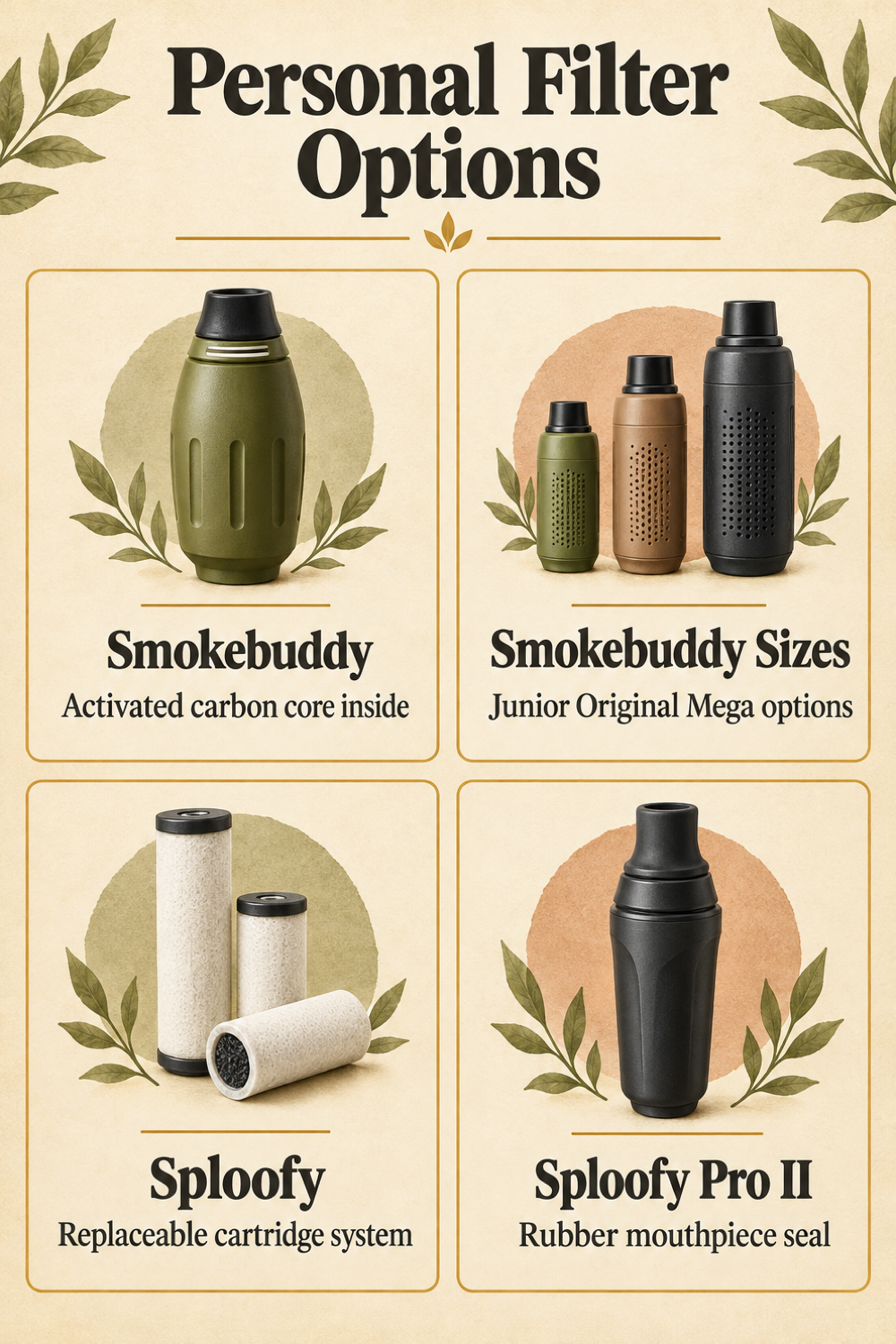
Smokebuddy describes its filter as a handheld device that filters exhaled air directly through the unit. The company describes an activated carbon core, ceramic bead technology, and HEPA filter technology, with Junior, Original, and Mega size options. That gives shoppers a simple way to compare size, lifespan, and portability. [4]
Sploofy describes a different approach with replaceable cartridges, HEPA filtration, odor absorption through the filter, and a Pro II model with a rubber mouthpiece. Replaceable cartridge designs may appeal to people who want a reusable shell with parts that can be changed over time. [5]
If you are reading other vapor or portable-device guides, such as What Are Disposable Vapes and Should You Try Them?, keep the same apartment rule in mind: no single product solves the whole shared-space problem. Pair any personal filter with storage, cleanup, and rule-checking.
- Handheld use: the filter is meant to be used directly when exhaling.
- Filter media: brands may describe carbon, HEPA-style, ceramic, or other filter parts.
- Replaceable cartridge options: some designs let you change cartridges instead of replacing the whole unit.
- Mouthpiece design: a better seal may make the accessory easier to use correctly.
- Size choices: smaller models are easier to store, while larger models may last longer.
What helps with smoke smell in an apartment besides a gadget?
Odor control starts with source control. In plain English, that means reducing the things that create and hold smell in the first place. Used accessories, ash, residue, open jars, and loose materials can all make a room smell long after the moment has passed. An air cleaner may help as a supplement, but it should not be your only plan.
The EPA says source control and clean outdoor-air ventilation are the most effective ways to improve indoor air, with filtration as a supplement. It also says no air cleaner removes all pollutants. For air cleaners, particle filtering and odor filtering are different jobs: CADR is about particles, while gases and odors require activated carbon or another gas-focused filter. Filters also need regular replacement. [3]
That is why the best apartment routine is boring in the best way. Put items away, clean residue, manage ash, close containers, and replace filters on schedule. If outdoor-air ventilation is allowed and makes sense for your building, use it as part of a broader routine. If your building rules do not allow smoking, a gadget does not make that rule disappear.
Small replacement items can still matter. For example, Filters / Tips may be useful for people who keep rolling supplies organized, but accessories like tips and filters are not a substitute for cleanup or sealed storage. Think of them as part of a tidy kit, not a magic answer.
- Reduce odor sources first by closing containers and not leaving used items out.
- Clean ash, sticky residue, and trays soon after use so they do not sit in shared areas.
- Ventilate with clean outdoor air when it is allowed, practical, and respectful of neighbors.
- Use filtration as a supplement, choosing the right filter type for particles or odors.
- Replace filters on the schedule recommended for your device or room air cleaner.
How should you store smoking gear in a shared apartment?
Storage is where many apartment setups succeed or fail. Odor does not only come from active use. It can also come from used accessories, sticky residue, loose materials, ash, and containers that do not seal well. A good storage plan keeps items grouped, closed, and easy to move out of shared spaces.
Formline positions smell-proof bags, jars, pucks, backpacks, and lockable cases around odor-control storage. It also notes that ordinary sandwich bags are not designed to be smell proof because odor can escape over time. That is a useful reminder: the cheapest bag in the kitchen drawer is not the same as purpose-built storage. [6]
Treehouse Lifestyle’s Storage category is the right place to look when you want storage-first gear instead of another loose accessory. The synced catalog also includes a public Storage category with five products in the current snapshot. [8] If you know you specifically want pouches or bags, Smell-Proof Bags narrows the path even more.
For roommates, storage is also about courtesy. A lockable case may make sense if you share cabinets, host guests, or want to keep personal items separate. A travel-size pouch can help if you move between rooms, but it should still be cleaned out regularly. Sealed storage works best when the items going into it are not covered in fresh ash or residue.
- Use a sealed container for materials and accessories that may hold odor.
- Separate clean items from used items so residue does not spread across the whole kit.
- Wipe or clean tools before storing them for more than a short time.
- Choose a lockable option if roommates, guests, or shared cabinets are part of your home.
- Keep a travel-size pouch for small items that should not sit loose in a drawer or bag.
- Schedule a regular cleanout so old scraps, ash, and wrappers do not build up.
How can you build a simple discreet smoking kit for an apartment?
A simple apartment kit should be small enough to store, useful enough to reach for, and easy enough to reset. Do not start by buying every accessory that looks clever. Start with the problems you actually have: clutter, odor from stored items, ash, cleanup, or a lack of one clear place for your gear.
A practical kit often includes compact gear from the accessories side, sealed storage from the storage side, cleanup supplies, and possibly a personal filter. Treehouse Lifestyle’s Accessories and Storage paths are natural starting points because the guide topic connects to both catalog areas. [7] [8] If your cart qualifies, free shipping on orders $150+ can be useful when you are buying several pieces at once.
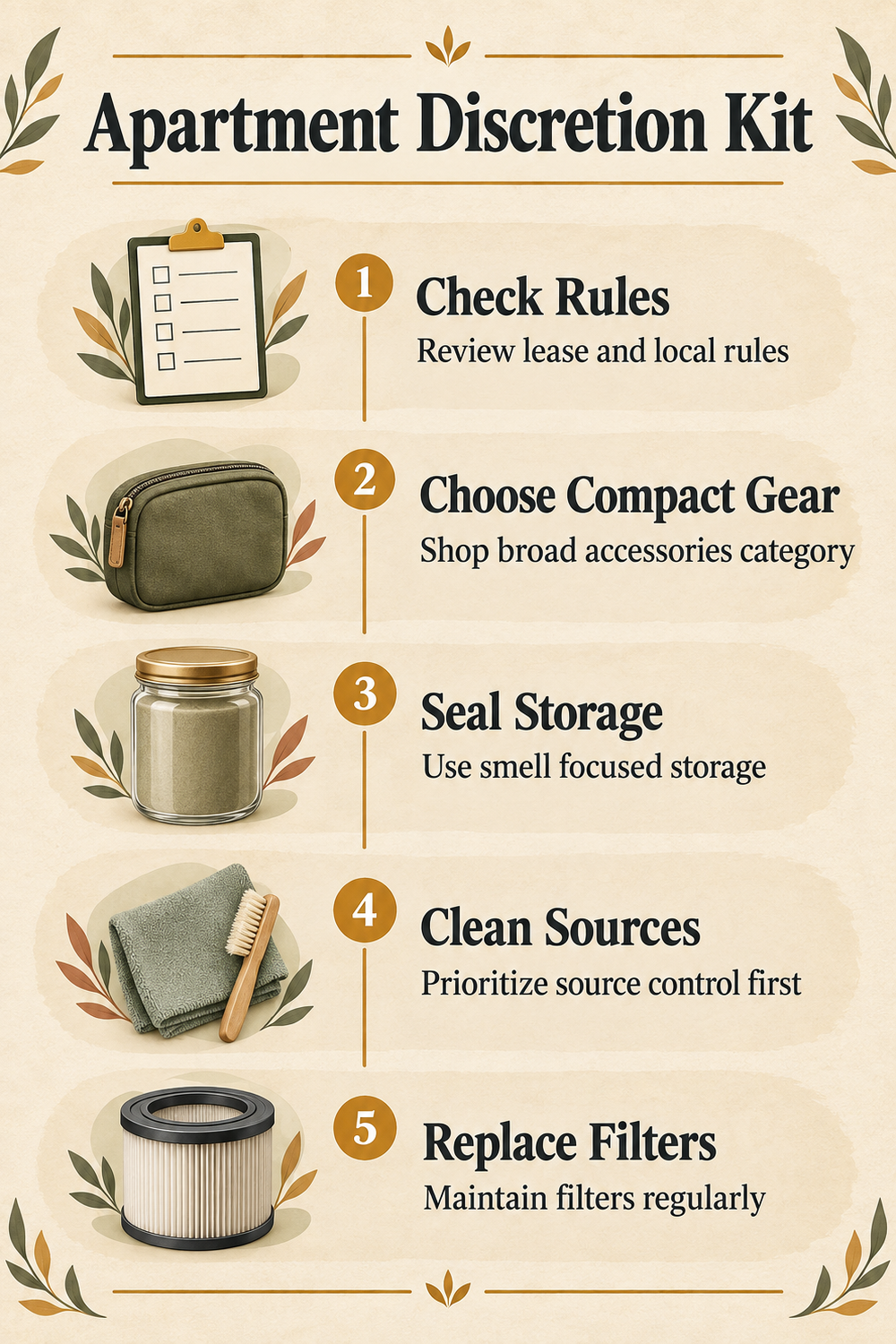
Build the kit in layers. First, choose the smallest setup that still fits your routine. Second, add a tray or cleanup tool so ash and residue are not left out. Third, pick sealed storage that fits the gear, not the other way around. Fourth, consider a personal filter if it fits your routine. Fifth, set a reset habit so the kit goes back into storage after use.
The main idea is simple: a discreet kit is not just what you use. It is what happens after you use it. If your gear has a home, your room is easier to reset. If used items are cleaned and closed, fewer odor sources sit around. If you know the rules, you avoid buying gear that creates a problem before it solves one.
For shared apartments, keep the kit boring on purpose. A small tray, one storage spot, and a five-minute reset habit are easier to follow than a big setup with many parts. Put the same items back in the same order each time: gear, lighter, cleaning tool, pouch, then sealed container. That routine helps you notice when something needs attention before smell, clutter, or a roommate complaint turns into the real problem.
Keep the kit boring, labeled, and repeatable so cleanup happens before shared surfaces collect ash, wrappers, or loose tools. A simple checklist on the inside of a storage lid can remind you to close containers, wipe the tray, and put every item back before the room resets.
For a small apartment, build the kit around simple habits that work together. Keep the main piece small enough to clean at a sink. Store flower, papers, tips, and tools in one sealed box so nothing sits open on a table. Empty ash right away, wipe sticky tools before they harden, and give each item a home before guests arrive. If you share walls, use short sessions, fresh airflow, and a small cleanup routine instead of relying on one gadget to do all the work. This keeps the setup easier to use, easier to hide, and easier to maintain over time.
- Choose compact gear that fits your space and can be put away quickly.
- Add cleanup supplies such as a tray, wipes, small brush, or ash-control item.
- Pick sealed storage that holds both materials and accessories without cramming.
- Consider a personal filter as one optional layer, not the whole odor plan.
- Set a reset routine: close containers, wipe tools, empty ash, and store the kit.
Frequently Asked Questions
Are air purifiers enough for smoke smell in an apartment?
No. Air cleaners can be a helpful supplement, but they should not be presented as removing all smoke, pollutants, or odor. The EPA says source control and clean outdoor-air ventilation are the most effective steps, while filtration is only one part of the plan. Particle filtering and odor filtering are also different jobs. [3]
What is the most discreet smoking accessory for a shared space?
There is no single best item for every home. A compact accessory that cleans easily and fits into sealed storage is usually more practical than bulky gear that creates clutter or stays in plain view.
Do personal smoke filters remove all smell?
No. Personal filters can be useful exhale-filter accessories, but they should not be treated as total odor removal tools. They work best as one layer beside cleanup, sealed storage, and rule-checking.
Why does stored gear still make an apartment smell?
Residue, used accessories, ash, and stored materials can hold odor after use. That is why sealed storage, regular cleanup, and separating clean and used items belong in an apartment-friendly setup.
Where should shoppers start on Treehouse Lifestyle?
Start with Accessories for compact add-ons and everyday gear, then check Storage for smell-aware organization options such as sealed bags, jars, pouches, and cases.
What is the smartest apartment-friendly smoking setup?
The smartest setup is layered and realistic. Check the rules first, choose compact accessories, keep cleanup supplies nearby, store everything in sealed containers, and use personal filters or room filters only as supplements. That approach helps reduce clutter and odor sources without pretending any product can make smoke vanish.
For most apartment shoppers, the best next step is simple: build a small kit around your actual space. If you share your home, make it easy to put away. If odor is the main concern, focus on source control and storage before gadgets. If you are unsure, start with fewer pieces and upgrade only when you know what your routine needs.
Sources
- Centers for Disease Control and Prevention: Smokefree Policies Can Protect Everyone
- U.S. Environmental Protection Agency: What can I do about secondhand smoke coming from my neighbor’s apartment?
- U.S. Environmental Protection Agency: Guide to Air Cleaners in the Home
- Smokebuddy: The Smokebuddy Story
- Sploofy: Sploofy Personal Smoke Filter
- Formline Supply: 100% Smell Proof Bags – 2X The Odor Proof Technology
- Treehouse Lifestyle catalog: Accessories category
- Treehouse Lifestyle catalog: Storage category