

Discreet smoking accessory gifts are discreet for two reasons working together. A small-format tier — one-hitters, dugouts, chillums, mini hand pipes, and pocket rolling kits — keeps the kit pocket-sized and low-profile. A containment tier — activated-carbon smell-proof bags, lockable stash pouches, airtight jars, and diversion-style containers — keeps odor and contents from announcing the kit. Match one piece from each tier and you get a complete gift that travels cleanly and stores quietly at home.
The rest of this guide walks through what actually makes a gift discreet, the small-format formats that work best, how activated-carbon bags trap odor, a five-step way to match a gift to home storage versus travel, and the federal rules a buyer should check before wrapping anything up.
What makes a smoking accessory gift ‘discreet’ rather than just small?
Small is only part of the story. A truly discreet smoking accessory gift does two things at once: it carries a low visual profile, and it keeps odor from drifting. Industry guides for the category sort discreet gear into two tiers that work together — a small-format tier of pocket-friendly pieces, and a containment tier of bags, pouches, and jars that hold odor in [3] [4].
Visual profile covers size, shape, and surface finish. A pocket-friendly piece should not look like a smoking accessory when it sits on a counter or rides in a bag. Pieces that read as everyday objects — slim metal tubes, compact wooden boxes, glass pieces shaped like flashlights or lip balm — draw less attention than tall, brightly colored, or heavily decorated items. Finish matters too: matte, neutral colors blend into a bag or desk better than glossy or patterned surfaces.
Odor containment is the second half. A small pipe that lets smell leak out of a coat pocket is not really discreet, no matter how small it is. Most discreet kits pair a small-format pipe with a containment piece — a small activated-carbon pouch, a lockable stash bag, or a sealed jar. A compact personal filter such as the Smokebuddy Original Personal Air Filter can sit alongside a kit as a small add-on that keeps exhaled clouds low-profile Smokebuddy Original Personal Air Filter.
A softer third trait is quiet use. A lighter that clicks loudly, a one-hitter that scrapes on a table, or a rolling tray that clinks will be heard before it is seen. Gift buyers who care about discretion tend to pick silent or soft-butane lighters, dugouts with felt-lined chambers, and rolling kits with built-in trays so nothing rattles.
- Low visual profile: pocket-sized, neutral finish, shaped to look like an everyday object.
- Odor containment: a paired pouch, bag, or jar that holds scent in rather than letting it leak.
- Quiet use: soft lighters, lined chambers, and rolling kits that do not click, scrape, or rattle.
- Travel-ready construction: lidded or sealed so pieces cannot spill inside a bag or glove box.
- Adult framing: intended for adult tobacco or accessory use, not marketed in a way that points at minors.
Which small-format pipes and pocket kits make the best discreet gifts?
Small-format pipes and pocket kits are the working end of a discreet gift. The common formats in this tier are one-hitters, chillums, dugouts, mini hand pipes, pocket bubblers, rolling papers, dugout tins, and silent lighters [4]. Each one solves a different carry problem, so the right pick depends on how the recipient plans to use it.
A one-hitter — sometimes called a bat or taster — is a short, slim pipe shaped to hold a single small serving. It is the smallest piece in the category and slides into a pocket or keychain pouch easily. For a beginner or a frequent traveler, a one-hitter is usually the lowest-friction gift to give and to use.
A chillum is a small, straight, conical pipe that has been used for tobacco for a long time. Federal statute 21 U.S.C. § 863 lists chillums among the items the law considers when defining drug paraphernalia, but subsection (f)(2) of the same statute exempts any item that is traditionally intended for use with tobacco products, including any pipe, paper, or accessory [5] [8]. That exemption is the legal reason retail smoke shops can sell chillums, hand pipes, and rolling papers openly.
A dugout is the carrying case for a one-hitter — a compact wooden or metal box with two chambers, one for ground material and one for the one-hitter pipe, forming a complete portable kit for travel and everyday carry [4]. For a gift, a dugout often solves the packaging problem on its own: the recipient gets the pipe and the storage in one box.
Mini hand pipes are scaled-down versions of the classic hand-pipe shape — small enough to fit in a closed fist. They come in glass, metal, ceramic, and wood. A pocket bubbler adds a small water chamber for a cooler draw at the cost of a larger profile. Pocket rolling kits bundle papers, a rolling tray, and a small grinder into a case sized for a coat pocket.
For shoppers who want a complete starter, a dugout plus a small activated-carbon pouch is the most popular two-piece gift in the category — small-format on one side, containment on the other. To round out a guide, point the recipient to a broader write-up of cannabis lifestyle gifts and accessories and to a deeper look at what makes a storage container smell proof What Are the Best Cannabis Lifestyle Gifts and Accessories? What Makes a Storage Container Smell Proof?. For a specific mini hand-pipe option, a piece like the GRAV® Mini Spoon fits the pocket-sized brief Hand Pipes GRAV® Mini Spoon.
- One-hitter (bat, taster): the smallest format, holds a single serving, slips into a pocket or keychain.
- Chillum: a small straight conical pipe, traditional tobacco format, often sold in glass or stone.
- Dugout: a two-chamber box that holds both a one-hitter pipe and ground material in one piece.
- Mini hand pipe: scaled-down hand-pipe shape in glass, metal, ceramic, or wood — fits in a closed fist.
- Pocket rolling kit: rolling papers, mini tray, and small grinder bundled into a coat-pocket case.
How do activated-carbon smell-proof bags actually contain odor?
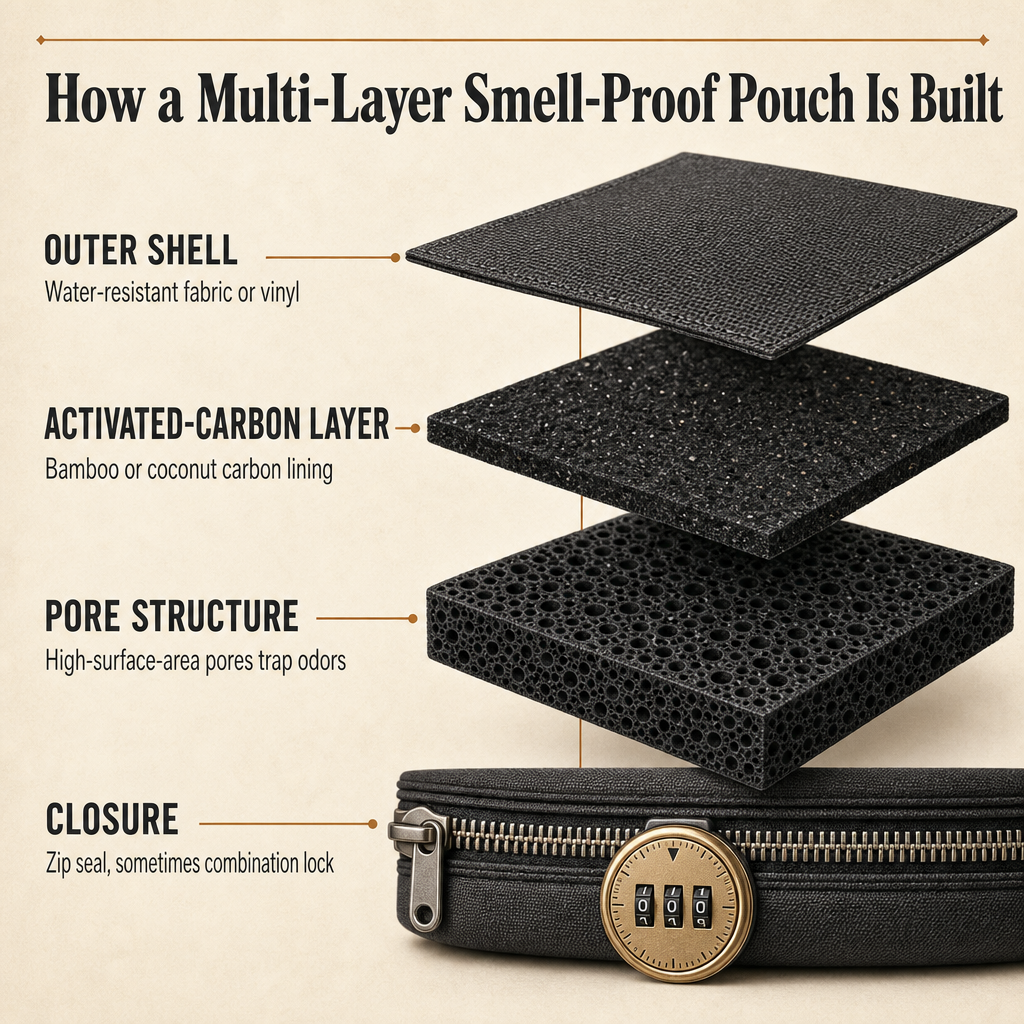
Activated-carbon smell-proof bags contain odor through adsorption, not through sealing the bag airtight. The lining inside the bag is filled with activated charcoal — most commonly bamboo or coconut carbon — and that charcoal is full of tiny pores [2]. EPA Victoria describes carbon filters as containing activated charcoal pellets that form countless tiny pores; as air passes through the carbon, pollutants, allergens, and odorous substances stick to the surface of the carbon [1].
The word adsorption is the key idea. Odor molecules ride on air that moves through the bag’s lining, and they get caught on the surface of the carbon instead of escaping out the other side. The carbon does not absorb the smell the way a sponge absorbs water — it holds the molecules on its surface. As more pores fill up, the lining stops working as well, which is why performance depends on surface area, how often the lining is replaced, and how much odorous air is being filtered [1].
Most travel-ready bags stack multiple layers. A typical build pairs an outer water-resistant fabric or vinyl shell, an activated-carbon lining in bamboo or coconut form, a moisture barrier, and a closure — often a zip seal, sometimes a combination lock [2] [3]. The carbon does the odor work; the zip or lock keeps the bag sealed long enough for air to actually pass through the lining rather than leak out the gap.
There are real limits. EPA Victoria notes that carbon filters do not remove all fine particles such as mould, dust, or pollen, and that performance drops as the carbon ages [1]. A smell-proof bag is a controlled filter, not a vacuum chamber — strong odor reduction on a fresh lining, weaker performance after months of daily use.
For shoppers building a kit around an activated-carbon bag, pick a bag sized to the pieces it needs to hold, replace the lining on the maker’s recommended schedule, and pair the bag with a hard-sided container if the kit will ride in a suitcase. A targeted browse of smell-proof bags by size and closure style narrows the field to pieces that fit the recipient’s use case Smell-Proof Bags.
- Adsorption, not absorption: odor molecules stick to the surface of activated-carbon pores as air passes through.
- Carbon type: most smell-proof bags use bamboo or coconut activated carbon for high surface area.
- Layered build: outer shell (water-resistant) + activated-carbon lining + moisture barrier + zip or lock closure.
- Replacement matters: performance drops as pores fill up, so follow the maker’s replacement schedule.
- Realistic limits: carbon filters do not remove every fine particle, and a worn lining will let more odor through.
How should you match a discreet gift to home storage versus travel use?
Matching a discreet gift to the recipient starts with one question: where will the kit live? A kit that mostly stays on a shelf at home has different needs from a kit that rides in a backpack or a carry-on. A five-step checklist walks through the decision and helps avoid buying a piece the recipient will not actually use [4] [3].
Step one is identifying the primary use case. Is the recipient a home user who keeps a kit on a desk or in a drawer, or a frequent flyer who needs something that fits in a personal item? Home users can usually afford a slightly larger piece and a hard-sided stash box. Travelers need pocket-sized gear that survives being jostled in a bag.
Step two is picking the right format. For home use, a mini hand pipe, a pocket bubbler, or a small rolling kit is comfortable. For travel, a one-hitter, a chillum, or a compact dugout is the better fit because it slides into a coat pocket or a small pouch without printing its shape through the fabric.
Step three is choosing a containment tier. Home users often want a lockable stash box, an airtight jar, or a diversion-style container. Travelers usually want a multi-layer activated-carbon pouch that closes flat and fits inside a backpack or carry-on. For a more elaborate home setup, a piece like a dedicated dab-rig station can serve as a centerpiece for a more complete gift The Puffco Enthusiast’s Dab Rig Station for All Things Puffco – Main Cannabis Gifts.
Step four is confirming travel-legal pieces. If the recipient flies, TSA allows disposable and Zippo lighters in carry-on bags; in checked bags, lighters are allowed without fuel, while fueled lighters are prohibited in checked bags unless they are carried in a Department of Transportation approved case under the DOT exemption that allows up to two fueled lighters. Final screening decisions remain with the TSA officer at the checkpoint [6].
Step five is verifying age. Under the federal Tobacco 21 law signed December 20, 2019 and effective immediately, it is unlawful for any retailer to sell any tobacco product, including e-cigarettes, to any person younger than 21, with no exceptions. FDA’s August 2024 final rule, effective September 30, 2024, requires retailers to use a photo ID to verify the age of anyone under 30 attempting to purchase covered tobacco products [7]. Confirm the recipient is 21 or older before placing the order.
- Use case first — home shelf vs. frequent travel sets the size and durability budget.
- Pick the format — mini hand pipe or bubbler for home; one-hitter, chillum, or dugout for travel.
- Choose containment — lockable box or airtight jar at home; multi-layer carbon pouch on the road.
- Check travel rules — lighters in carry-on are easy; fueled lighters in checked bags need a DOT case.
- Verify age — Tobacco 21 means no sales to anyone under 21, and ID is required for under-30 buyers.
| Use case | Format | Containment | Travel notes |
|---|---|---|---|
| Home shelf | Mini hand pipe, pocket bubbler, small rolling kit | Lockable stash box, airtight jar with carbon insert, diversion container | Lighters at home only; no TSA concern |
| Frequent travel | One-hitter, chillum, compact dugout | Multi-layer activated-carbon pouch, flat zip pouch | Disposable or Zippo lighter in carry-on only; fueled lighters in checked bags need a DOT-approved case |
| Mixed / gift set | Dugout (two-chamber) | Mid-size carbon pouch sized to the dugout | Verify recipient’s age; remind about TSA lighter rule |
Which containment accessories pair best with a small-format pipe as a gift set?
The right containment piece turns a single pipe into a complete, giftable kit. Multi-layer carbon pouches, lockable stash pouches, airtight jars, and diversion-style stash containers are the four most common pairings for small-format pipes, and each one fits a different carry and storage situation [2] [3].
Multi-layer carbon pouches are the most popular pair. They combine an activated-carbon lining with a water-resistant outer shell and a zip or combination-lock closure, and they are sized to fit a one-hitter, a dugout, or a small hand pipe plus a grinder. They are the most flexible pick because they work equally well for home storage in a drawer and for travel in a backpack.
Lockable stash pouches add a small combination lock to a fabric or vinyl pouch. The lock discourages casual access and adds a layer of organization, but the carbon lining is still what handles odor. For a recipient who keeps a kit in a shared space, a lockable pouch is a useful upgrade.
Airtight jars are hard-sided containers with a rubber-gasket lid. They keep humidity out and keep small pieces from rattling around, though they do not contain odor by themselves. Pairing an airtight jar with a separate activated-carbon insert gives the recipient a hard storage box that also holds odor — a tidy solution for home storage on a shelf or in a drawer.
Diversion-style stash containers look like everyday objects — a hollowed-out book, a faux soda can, a hollow candle — and hide a small pipe inside. They are popular gifts because they blend into a bookshelf or a desk, and they are best for home use since their shapes do not always hold up to being packed in a suitcase. For shoppers building a gift set around everyday carry, it also helps to browse bags and cases that pair naturally with a small-format pipe Bags / Cases.
- Multi-layer carbon pouch — activated-carbon lining plus water-resistant shell and zip closure; the most flexible pairing.
- Lockable stash pouch — adds a combination lock to a fabric pouch for shared-space storage; carbon lining still does the odor work.
- Airtight jar — hard-sided rubber-gasket container; pair with a carbon insert for odor control on a shelf.
- Diversion-style stash container — disguised as an everyday object; best for home, less ideal for travel.
- Combination gift set — pair a dugout with a small carbon pouch for a complete, travel-ready two-piece kit.
What travel rules and federal laws apply to giving a smoking accessory as a gift?
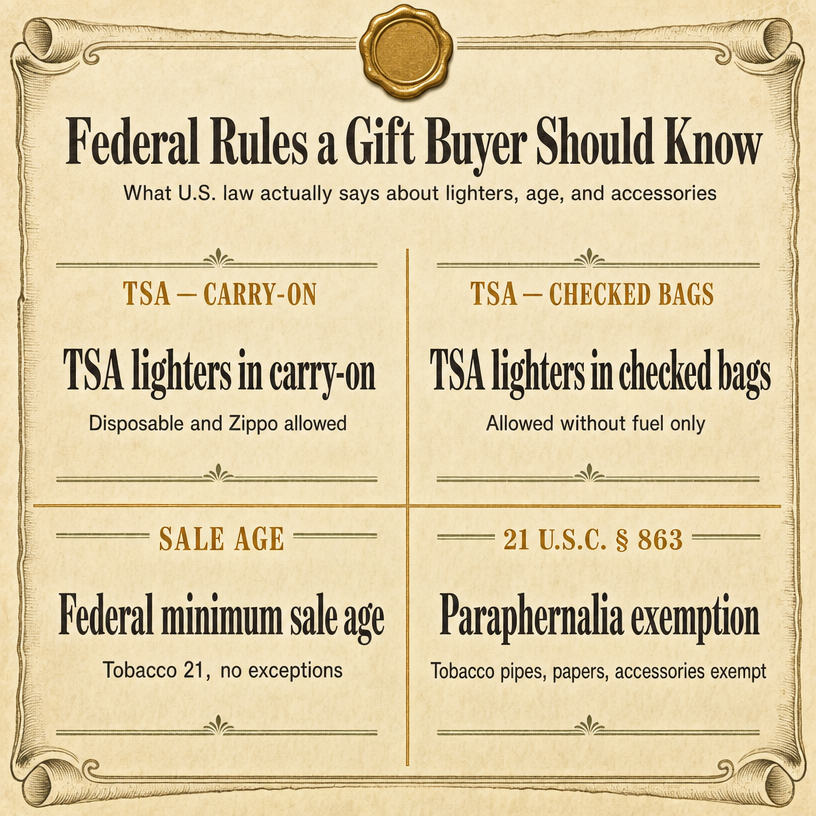
Three federal rules come up most often when a buyer is wrapping up a smoking accessory gift. The first is TSA’s lighter rule for travelers, the second is the federal Tobacco 21 minimum sale age, and the third is the federal drug-paraphernalia statute and its tobacco-product exemption. Knowing each one ahead of time keeps the gift on the right side of the law [6] [7] [8] [5].
On TSA lighter rules: TSA allows disposable and Zippo lighters in carry-on bags. In checked bags, lighters are allowed without fuel, while fueled lighters are prohibited in checked bags unless they are carried inside a Department of Transportation approved case under the DOT exemption that allows up to two fueled lighters. Final screening decisions remain with the TSA officer at the checkpoint, so a recipient who flies often should be reminded that the officer has the final say [6].
On Tobacco 21: under the federal Tobacco 21 law signed December 20, 2019, it has been unlawful for any retailer to sell any tobacco product, including e-cigarettes, to any person younger than 21, with no exceptions. FDA’s August 2024 final rule, effective September 30, 2024, requires retailers to use a photo ID to verify the age of anyone under 30 attempting to purchase covered tobacco products. The rule applies to retail sales; it does not change a private gift between adults, but it does mean the buyer should confirm the recipient is 21 or older before placing the order [7].
On paraphernalia: federal statute 21 U.S.C. § 863 defines ‘drug paraphernalia’ and lists metal, wooden, acrylic, glass, stone, plastic, or ceramic pipes, water pipes, bongs, chillums, carburetion tubes, and similar items among the enumerated examples [8]. Subsection (f)(2) of the same statute, however, explicitly exempts any item that, in the normal lawful course of business, is imported, exported, transported, or sold through the mail or by any other means, and traditionally intended for use with tobacco products, including any pipe, paper, or accessory [5] [8]. That exemption is the reason pipes, papers, rolling trays, dugouts, and similar accessories are sold openly by retail smoke shops.
Putting the three rules together: pick a recipient who is 21 or older, choose pieces that are clearly traditional tobacco or accessory items, and remind the recipient that if they are flying, fueled lighters belong in a carry-on or a DOT-approved case — not in a checked bag. For travel-ready gifts, a one-hitter, a dugout, a small hand pipe, or a chillum fits comfortably inside a carry-on alongside a silent lighter. With those rules in mind, a discreet smoking accessory gift is a straightforward, age-appropriate, and travel-friendly present.
- TSA: disposable and Zippo lighters allowed in carry-on; fueled lighters in checked bags need a DOT-approved case.
- Tobacco 21: federal law makes it unlawful to sell any tobacco product to anyone under 21, with no exceptions.
- FDA photo-ID rule: retailers must verify age with a photo ID for anyone under 30 buying covered tobacco products.
- Paraphernalia exemption: 21 U.S.C. § 863(f)(2) exempts pipes, papers, and accessories traditionally intended for tobacco.
- Practical takeaway: confirm the recipient’s age, pick a traditional tobacco-format piece, and follow lighter rules at the airport.
Frequently Asked Questions
What makes a smoking accessory gift ‘discreet’ rather than just small?
Discreet means two things working together: a small, pocket-friendly form factor that does not draw visual attention, and odor containment so the kit does not announce itself. Industry guides segment the category accordingly — small-format gear such as one-hitters, chillums, dugouts, and mini pipes, paired with containment pieces like activated-carbon smell-proof bags, lockable stash pouches, airtight jars, and diversion-style containers.
Are activated-carbon smell-proof bags actually effective at containing odor?
Yes — activated-carbon linings adsorb volatile odor compounds as air passes through the lining. The carbon used in these bags is typically activated charcoal in bamboo or coconut carbon forms, whose high-surface-area pores trap odor molecules on the carbon surface. Performance depends on the carbon’s surface area, how often the lining is replaced, and how much odorous air is being filtered.
What pocket-friendly formats are typical in the discreet-gift category?
The common pocket-friendly formats are one-hitters, chillums, mini hand pipes, pocket bubblers, rolling papers, dugout tins, and silent lighters. A dugout is a compact case that holds both a one-hitter pipe and ground material in two chambers, forming a self-contained portable kit for travel and everyday carry.
Are there TSA or airline rules that affect how a discreet accessory gift can be packed for travel?
TSA allows disposable and Zippo lighters in carry-on bags. In checked bags, lighters are allowed without fuel; lighters with fuel are prohibited in checked bags unless they are carried inside a Department of Transportation approved case under the DOT exemption that allows up to two fueled lighters. Final screening decisions remain with the TSA officer at the checkpoint.
What federal age and paraphernalia rules apply to giving smoking accessories as a gift in the United States?
Under the federal Tobacco 21 law signed December 20, 2019, it is unlawful for any retailer to sell a tobacco product, including e-cigarettes, to any person younger than 21, with no exceptions. FDA’s August 2024 final rule, effective September 30, 2024, requires retailers to verify the age of anyone under 30 attempting to purchase covered tobacco products with a photo ID. Federal statute 21 U.S.C. § 863 defines ‘drug paraphernalia’ but subsection (f)(2) explicitly exempts any item that, in the normal lawful course of business, is traditionally intended for use with tobacco products, including any pipe, paper, or accessory.
How should a buyer match a discreet gift to a recipient’s home setup versus frequent-travel use?
Start with the primary use case. For someone who mostly uses accessories at home, prioritize a containment piece such as an activated-carbon smell-proof pouch or a lockable stash container. For frequent travelers, prioritize a pocket-friendly small-format piece such as a one-hitter, chillum, or dugout, paired with a travel-ready multi-layer carbon pouch. Confirm any travel gear against TSA rules for lighters and verify the recipient is 21 or older before purchasing.
What is the easiest way to pick a discreet smoking accessory gift the recipient will actually use?
The easiest way to pick a discreet smoking accessory gift is to match two tiers instead of one. A small-format piece — a one-hitter, a chillum, a dugout, or a mini hand pipe — covers the pocket-friendly half of the brief. A containment piece — a multi-layer activated-carbon pouch, a lockable stash pouch, an airtight jar, or a diversion-style container — covers the odor-control half. Together they form a kit that travels and stores cleanly, which is the practical definition of discreet.
Before wrapping, run through the same five checks a buyer would use at the register. Identify the primary use case. Pick a format that fits it. Choose a containment tier that matches where the kit will live. Confirm any travel piece against TSA lighter rules. Verify the recipient is 21 or older so the Tobacco 21 minimum sale age and the paraphernalia tobacco-product exemption both apply cleanly. With those boxes checked, the gift is age-appropriate, travel-friendly, and ready to wrap.
Sources
- EPA Victoria (Environment Protection Authority Victoria, Australia): Carbon filtration to control odour
- Herb Guard: Smell Proof Bags from Premium Materials
- Discreet Smoker: Smell Proof Bags – Odor-Locking Storage
- Discreet Smoker: One Hitters & Tasters – Best Bat Pipes, Glass & Metal
- Legal Information Institute, Cornell Law School: 21 U.S. Code § 863 – Drug paraphernalia
- U.S. Transportation Security Administration (TSA): Lighters (Disposable and Zippo) – What Can I Bring?
- U.S. Food and Drug Administration (FDA): Tobacco 21
- U.S. Government Publishing Office (Office of the Law Revision Counsel): 21 U.S.C. § 863 — Drug paraphernalia (official code)