
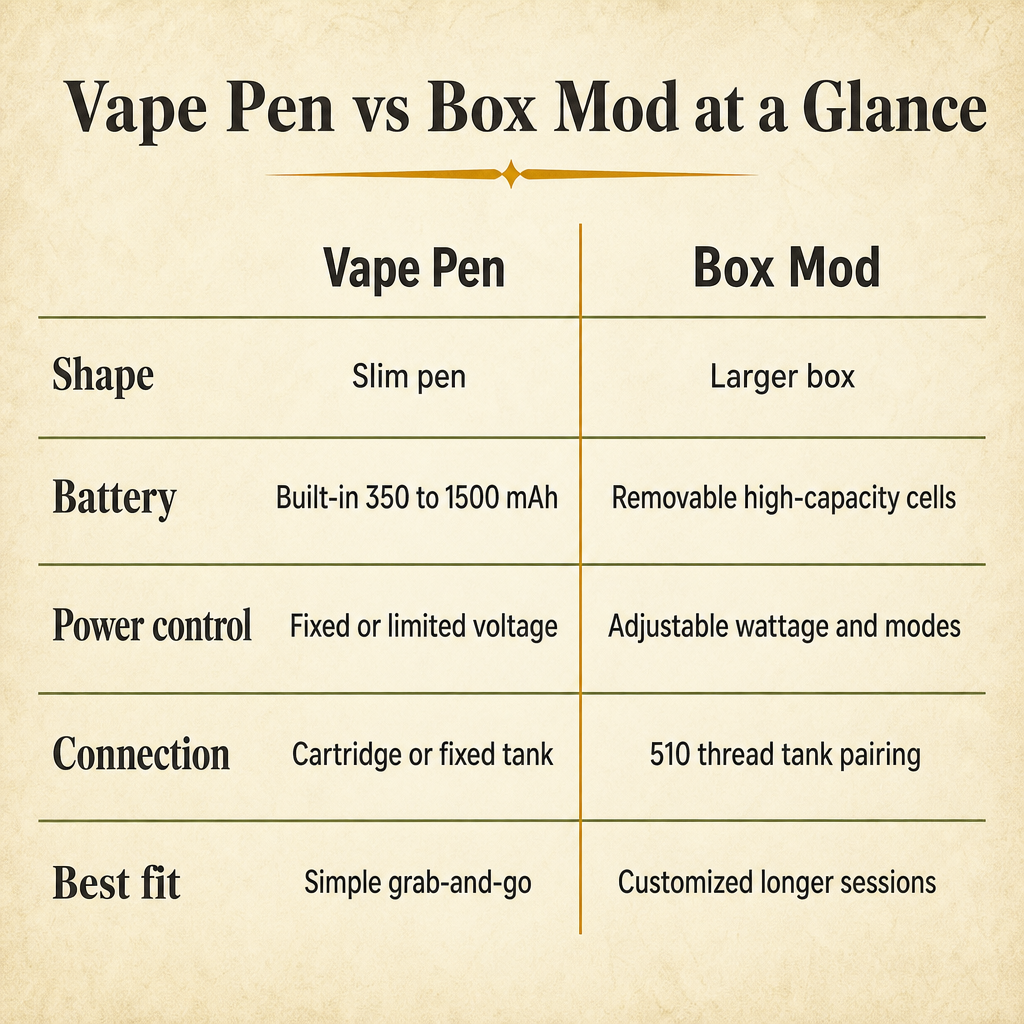
A vape pen is a slim, three-part device (battery, tank or cartridge, and mouthpiece) built for simple, grab-and-go sessions with limited power control [2]. A box mod is a larger, screen-equipped unit that pairs with many tanks and atomizers through a 510 thread, runs on swappable high-capacity batteries, and lets you adjust wattage and other settings [3].
Vape pens suit beginners and shoppers who want a pocket-size, low-fuss setup. Box mods suit users who want longer battery life, more vapor output, and finer control over how they vape. The right pick depends on the size of the device you want to carry, how much battery life you need, and how much control you want over how the vapor is produced.
What Is a Vape Pen and What Is a Box Mod?
A vape pen is a slim, simplified vaporizer. Most pens are built from three parts: a rechargeable battery body, a small tank or pre-filled cartridge that holds the material, and a mouthpiece at the top [2]. The whole unit is usually a single piece that looks like a thick pen or a small tube. Many pens fire with a single button, and some fire automatically when you draw on the mouthpiece.
A box mod is a larger, box-shaped device. Inside the box you will find a bigger battery (often one or two removable 18650, 20700, or 21700 cells), a control chipset, and a small display screen. On top of the box is a screw-on connection called a 510 thread, which lets the mod pair with many different tanks and atomizers [2] [3] [5]. If you are shopping for a 510 battery body, a dedicated 510 Batteries gives you the most cartridge and tank options on a single platform.
Both names are widely used, but the words are not always used the same way across brands. "Vape pen" can mean a cartridge-style oil device, a slim dry-herb unit, or just any pen-shaped vaporizer. "Box mod" almost always means the larger, screen-equipped 510-thread battery body, but some small mods come in tube or stick shapes too. When you compare devices, the parts list and the connection type tell you more than the name does.
- Vape pen: a slim tube with a battery, a small tank or cartridge, and a mouthpiece.
- Vape pen: usually one button or draw-activated, with little setup.
- Box mod: a boxy body with a larger battery, a control chipset, and a display screen.
- Box mod: a 510-thread top that screws onto a wide range of tanks and atomizers.
How Do Form Factor, Size, and Portability Compare?
Vape pens are compact and pocketable. Their slim, tube-like shape slips into a pocket, a small pouch, or a purse without much fuss, and a typical pen weighs only a few ounces [2].
Box mods are larger and heavier. The extra bulk is not a design flaw; it is what allows the mod to hold a bigger battery and the screen electronics that adjust wattage and other settings. A typical mod is closer in size to a small candy bar than to a pen, and you will usually feel that weight in a jacket pocket or a bag [3].
Think about where you will carry the device. A pen is the easier pick if you want something that disappears in a pocket and weighs almost nothing. A mod is the better pick if you do not mind the extra mass in exchange for longer battery life, a screen you can read, and a top that accepts many different atomizers. If you tend to leave the house with a small bag or a jacket, both shapes are easy to carry; if you travel light, a pen is friendlier. The way you dress and pack for the day shapes the call as much as the spec sheet does, and the same carry trade-off shows up in any gear guide, including one on How Should You Choose Cannabis Apparel for Fit and Everyday Wear?.
- Pen shape: slim, tube-like, and similar in size to a marker or a thick pen.
- Pen weight: a few ounces, with a low profile in a pocket or small bag.
- Mod shape: boxy, closer to a small candy bar, with a screen on the side.
- Mod weight: noticeably heavier because of the larger battery and electronics.
- Carrying trade-off: a pen is easier to pocket; a mod asks for a jacket or a bag.
How Does Battery Life Differ Between Pens and Box Mods?
Vape pens run on a built-in battery that is usually not removable. Common pen-battery sizes range from about 350 mAh in compact units to 1500 mAh or more in higher-capacity pen batteries [1]. Smaller pens are good for short sessions, while larger pen batteries can last through a full day of light use.
Box mods use larger batteries, and most use removable cells. The most common cell sizes are 18650, 20700, and 21700, and a mod will hold one or two of them. Because the cells are bigger, a mod typically lasts longer between charges than a pen does, and you can swap in a fresh cell instead of waiting for a recharge [3].
Battery life in real life depends on how much power you push through the device and how often you use it. A pen at low settings on a small tank will easily outlast a mod at the highest wattage, so the numbers below are starting points rather than fixed rules.
If you travel, want longer sessions away from a charger, or simply do not want to charge every day, a box mod is usually the longer-lasting pick. If most of your sessions are short, happen near a charger, and fit inside a single battery cycle, a pen will probably keep up. The same idea of pairing a small heater with a high-capacity power source shows up across vaporizer formats, including the What Is a Hybrid Dab Rig and How Does It Work? style of modular rigs.
- Pen battery: built-in, usually between 350 mAh and 1500 mAh or more [1].
- Pen charging: recharged through a USB cable on the device itself.
- Mod battery: one or two removable 18650, 20700, or 21700 cells [3].
- Mod swap-out: a drained cell can be replaced with a charged spare in seconds.
- Real-world trade-off: mods run longer per charge, but pens are easier to top off overnight.
Which Gives You More Control: Wattage, Voltage, and Modes?
Most vape pens are made for simple, fixed-power sessions. The battery sends a steady voltage to the coil, the coil heats up, and you draw. Some pens do let you pick from a small set of voltage levels, often covering about 2.0 V to 4.8 V on adjustable models [1]. That range is enough to nudge the warmth of a session up or down, but it is not a full control panel.
Box mods are built around the idea that you want to choose your settings. Variable wattage is the most common adjustment, and most mods let you set the wattage anywhere within the device’s range. Many mods add temperature control, which lets you cap the temperature of the coil, and bypass, which lets the mod act more like a mechanical mod without a full control board [2] [3].
Extra control comes with extra setup. On a mod, you usually have to choose a wattage that matches the coil in your tank, lock the resistance of the coil, and on some mods, choose the right mode for the material you are using. If you like to tinker, that freedom is the point. If you want to press a button and go, a pen keeps things simpler [2].
A useful rule of thumb: pick a pen if you want a small set of fixed or near-fixed power levels. Pick a mod if you want to dial in wattage, try different tanks, and adjust how each session runs. Choosing the right portable vaporizer comes down to the same kind of matching exercise, and the How Do You Choose the Right Portable Vaporizer? guide walks through the same trade-offs in more depth.
- Pen power: fixed output, or a small set of voltage presets, often about 2.0 V to 4.8 V on adjustable pens [1].
- Mod power: variable wattage across a wide range, set from the screen [3].
- Mod extras: temperature control and bypass on many models [2].
- Learning curve: a pen is one button; a mod asks you to read the screen and pick settings.
- Best match: pick a pen for simplicity, a mod for fine control.
What Is the 510 Thread and Why Does It Matter?
The 510 thread is the standard connection between vape batteries and the tanks or cartridges that screw onto them. The name comes from the spec itself: roughly a 5 mm thread diameter and 10 threads of pitch, which is what makes the screw-on fit feel the same across brands [1] [5].
That shared standard is the reason one battery can run many different atomizers. A 510-thread cartridge from one brand usually screws onto a 510-thread pen battery from another brand, and a 510-thread tank will usually fit on a box mod. The same 5 mm and 10-thread spec lines up mechanically and electrically, so power flows the same way each time [5].
In the dry herb space, the 510 thread shows up in a slightly different pattern. Instead of a sealed pen-style dry herb unit, most dry herb 510 setups pair a box mod as the power source with a separate dry herb atomizer tank [5]. That is also the main reason a dedicated Dry Herb Vaporizers collection usually pairs a mod with a dry herb tank rather than a sealed pen.
When you shop, the 510 thread is what lets you mix and match. A 510-thread cartridge or tank will physically fit on most modern pen batteries and box mods. The trade-off is that "510 compatible" is a wide umbrella, and you still want to check the wattage range and the supported coil type before you pair a tank with a mod.
- 510 spec: about 5 mm thread diameter, 10 threads of pitch [1] [5].
- Cross-brand fit: one battery can run cartridges and tanks from many makers.
- Dry herb pairing: in dry herb setups, a box mod usually powers a 510 dry herb atomizer tank [5].
- Cartridge pairing: most 510 oil cartridges fit on most modern 510 pen batteries.
- Shopping check: confirm the wattage range and the coil type before pairing a tank with a mod.
Conduction vs Convection: Which Heating Style Goes With Which Device?
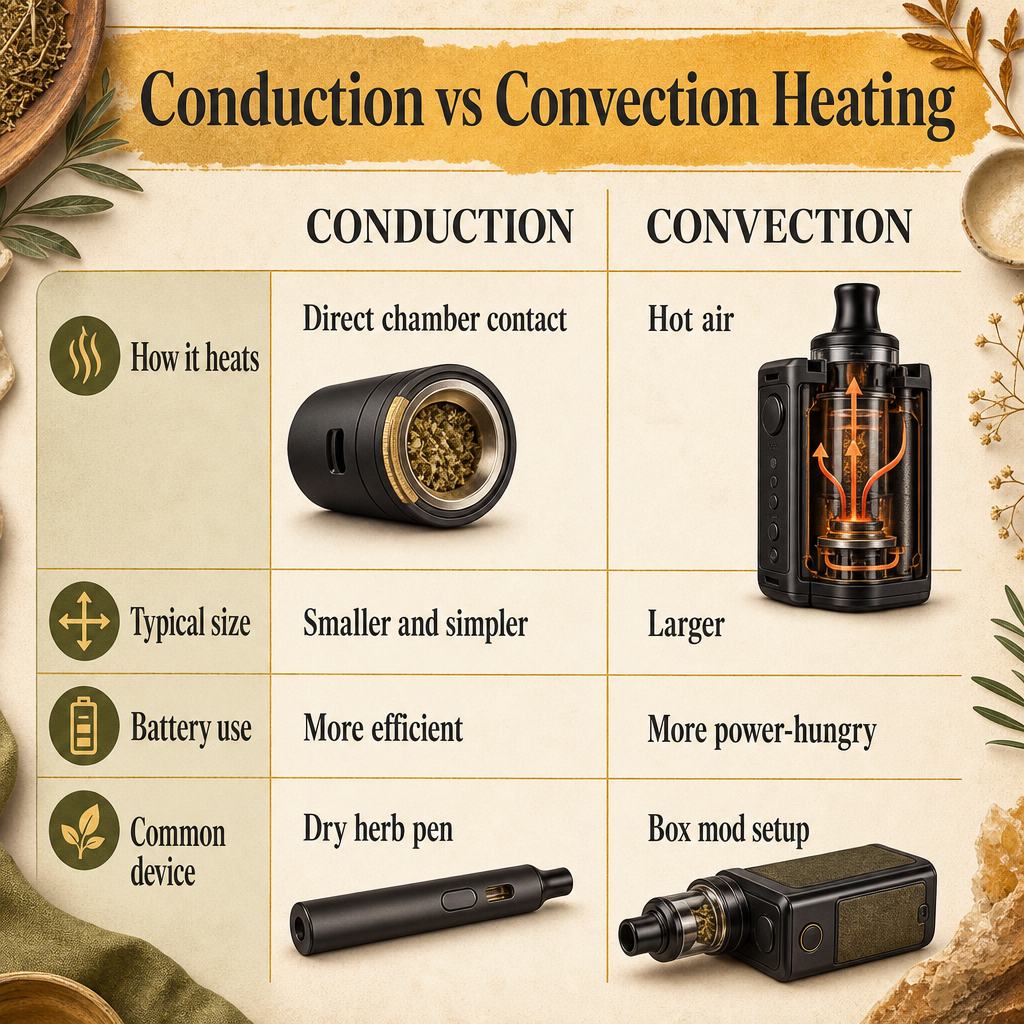
Vaporizers heat material in one of two main ways. Conduction vaporizers heat material by direct contact with a hot chamber wall, the way a pan heats what sits on it. Convection vaporizers push hot air through the material, the way an oven circulates heat around food [4].
Conduction units tend to be smaller, simpler, and easier on the battery, because the heater only has to warm a small chamber. Convection units tend to be larger and more power-hungry, because the heater has to warm the air that flows through the chamber, and that takes more energy [4].
In the dry herb space, conduction is the more common style inside pen-shaped dry herb units and many entry-level portable vaporizers. Convection is more common in higher-end portable dry herb units and in larger desktop-style devices that plug into the wall. The connection to form factor is simple: the smaller and more battery-efficient a device is, the more likely it is to use conduction; the larger and more power-hungry it is, the more likely it is to use convection [4].
Both styles can produce vapor. The difference is in how the heat reaches the material and how much hardware the device needs to do it. Conduction is a good match for compact pens because the chamber is small and the heat is local. Convection is a better match for box mod setups and larger portables because the device has room for a fan, more airflow, and a bigger battery. The same chamber-versus-airflow split shows up in electrified dab setups, where a desktop-style Electric Rigs rig uses an internal heater in a much larger body.
- Conduction: heats material by direct contact with a hot chamber wall [4].
- Convection: passes hot air through the material from a separate heater [4].
- Size pattern: conduction units tend to be smaller and simpler.
- Power pattern: convection units tend to be larger and more power-hungry.
- Device match: pen-shaped dry herb units are often conduction; larger portable setups lean convection.
How Fast Do Pens and Box Mods Heat Up, and How Much Do They Hold?
Heat-up time is one of the bigger practical differences between a portable device and a desktop unit. Most portable vaporizers, including many pen-style units, are ready to draw in roughly 15 to 60 seconds from a cold start. Desktop vaporizers that plug into mains power usually take longer, often 60 to 180 seconds, because the heater is bigger and the air path is longer [6].
Chamber size is the other big practical difference. Most portable dry herb vaporizers hold about 0.1 to 0.3 g of ground material per load, which is enough for a short solo session or a small group. Larger setups, including desktop units and some box-mod-based dry herb atomizer setups, accept bigger chamber loads that suit longer or group sessions [6].
For a pen versus box mod comparison, the heat-up time is usually similar (both are portable, both warm up in under a minute in most cases), while chamber size depends on the atomizer you attach, not on the battery body. A pen with a small cartridge or a small dry herb chamber will hold less than a mod paired with a larger dry herb tank. When you shop, the chamber size and the supported load weight matter more than the device class by itself.
If you mostly take short, solo sessions, a pen with a small chamber is plenty. If you share sessions or want fewer reloads, a mod paired with a larger atomizer or a mains-powered Desktop Vaporizers unit will save you time.
- Portable heat-up: most portable vaporizers, including pens, reach temperature in 15 to 60 seconds [6].
- Desktop heat-up: mains-powered units typically take 60 to 180 seconds.
- Portable chamber: about 0.1 to 0.3 g of ground material per load in most portable dry herb units [6].
- Larger chamber: bigger atomizer tanks and desktop units support bigger loads.
- Practical match: a pen is enough for a short solo session; a mod setup suits longer or shared sessions.
Who Should Pick a Vape Pen and Who Should Pick a Box Mod?
A vape pen is a good fit for shoppers who want a simple, pocketable device and do not want to learn a control panel. The strongest case for a pen is when you want short, grab-and-go sessions, a single button or draw-activation, and a device that disappears in a pocket. If you are new to vaporizers, a pen keeps the learning curve short [2].
A box mod is a good fit for shoppers who want longer battery life, swappable batteries, and the ability to dial in power. The strongest case for a mod is when you want to swap tanks and atomizers, run higher wattage, or use modes like temperature control. If you already know the wattage range you like, or you want to experiment with it, a mod gives you the headroom [3] [5].
Think about your routine, not the spec sheet. A pen is the easier pick if you take one or two short sessions a day and charge the device at night. A mod is the better pick if you go through several sessions a day, do not always have a charger nearby, or want to pair the same battery with more than one atomizer. A modular box-mod setup like the Stündenglass Modül + Dok Deluxe Travel Set – Green Glass is a good example of a mod-first build that swaps parts for different routines.
There is also a middle path. Many people start with a pen to learn what wattage and chamber size they like, then move to a mod once they know the routine. The 510 thread means a pen and a mod from the same standard can share cartridges and tanks, so upgrading does not mean starting over.
- Pick a pen if you want a slim, pocketable device with a single button or draw-activation [2].
- Pick a pen if your sessions are short, your routine is simple, and you do not need to adjust wattage.
- Pick a mod if you want longer battery life, swappable cells, and a screen for settings [3].
- Pick a mod if you want to swap tanks and atomizers through a 510 connection [5].
- Pick a mod if you want variable wattage, temperature control, or higher output for shared sessions.
Frequently Asked Questions
Are box mods only for nicotine e-liquids or do they work with dry herb too?
Box mods are most often associated with e-liquid tanks, but the 510 thread is also used in dry herb setups by pairing a mod as the power source with a separate dry herb atomizer tank. The mod itself is format-agnostic; what it vapes depends on the atomizer you attach.
Do box mods produce more vapor than pen-style vaporizers?
Box mods usually output more vapor because they pack higher-capacity batteries and let you raise wattage, while most pens cap power at a fixed level or a narrow voltage range. Output still depends on the atomizer and the material, but at the same settings a mod gives you more headroom.
Is a vape pen easier to use than a box mod?
Yes for most people. Pens typically use a single button or draw-activation with little to no setup, while box mods require choosing wattage, understanding coil resistance, and sometimes pairing a third-party tank or atomizer. The mod’s extra capability comes with a steeper learning curve.
What is a 510 thread and why does it matter?
The 510 thread is the dominant connection standard between vape batteries and atomizers. It specifies roughly a 5 mm thread diameter and 10 threads of pitch, which lets cartridges, tanks, and batteries from different brands screw together mechanically and electrically. That cross-brand fit is the reason the same mod can run many different atomizers.
How does conduction heating differ from convection heating, and which device type uses which?
Conduction heats material by direct contact with a hot chamber and tends to live in smaller, simpler, more battery-efficient devices. Convection passes hot air through the material and tends to need the larger battery and electronics that a box mod provides. Dry herb pens and many portable dry herb units are usually conduction-based, while higher-end dry herb vaporizers often use convection.
Who should buy a vape pen, and who should buy a box mod?
A vape pen fits buyers who want a slim, pocketable device with simple controls and a grab-and-go routine. A box mod fits buyers who want longer battery life, swappable batteries, adjustable wattage, and the ability to swap tanks or atomizers for different materials. If you only need quick sessions and minimal setup, a pen is the easier pick; if you want flexibility and headroom, a mod is worth the extra size.
So Which One Is Right for You?
A vape pen and a box mod are both portable vaporizers, but they aim at different routines. The pen is the simpler device: slim, light, one button or draw-activated, and built around a small tank or cartridge. The mod is the more capable device: larger, heavier, screen-equipped, and built around a 510 thread that pairs with many atomizers and lets you adjust wattage and other settings.
If your sessions are short and your priority is a device that fits in a pocket with no setup, a pen is the right pick. If your priority is longer battery life, swappable tanks, and the ability to dial in power, a box mod is the right pick. The 510 thread standard means the two worlds overlap, so the same cartridge or tank can move from a pen to a mod as your routine changes.
Sources
- Grenco Science (G Pen): Vape Cartridge & 510 Battery Explained | Beginner’s Guide
- Vaporesso: Vape Pens vs Box Mods | Which Device Is Right?
- Innokin Technology: What Is a Box Mod?
- TVape: Conduction vs Convection Vaporizers – Learn the Difference
- VapoChecker: 510 Thread: What Is It? History, How It Works
- Azarius: Portable vs Desktop Vaporizers: Buyer’s Guide