

An ashtray does three jobs: it catches ash, it holds a lit joint, blunt, or cigar between draws, and it keeps embers off the table [1] [3]. Buy around those jobs rather than the finish, because a light, shallow tray with no rests fails two of them. From there you have four choices: material, weight and footprint, rest count, and lid style [16].
What Does an Ashtray Actually Need to Do?
Most shoppers start with color and finish. Start with function instead. Ash falls, a lit item needs a place to sit, and hot material needs to stay on the tray rather than roll onto a table or a cushion.
Federal fire-safety guidance is consistent about what that means in practice. Use a deep, sturdy tray with a wide, stable base that is hard to tip over. Set it on something sturdy and hard to ignite, and never set it on a chair, a sofa, or a bed [1] [2] [3].
Read that list again and you will notice it is mostly about weight and footprint. A light dish with a narrow base slides when a joint is set down on the rim. A heavier tray with a wide footprint stays where you put it. That difference is what the guidance is pointing at, and it matters more than the pattern on the glass.
The second job, holding the lit item, is where rests come in. A rest is the groove or notch worked into the rim so a joint can sit at an angle above the basin. A tray with no rests leaves you balancing a burning joint on the edge or laying it flat in the ash, and neither works for long [5] [16].
The third job is containing embers, and it is also where the most common mistake happens, because people use a full ashtray like a trash can. USFA, NFPA, and the National Park Service say the same thing. Make sure ashes and butts are fully out, soak them in water or smother them in sand, and never empty hot material straight into a trash can [1] [2] [3]. An ashtray is a holding vessel, not a disposal bin.
If you are building a first setup from scratch, the Accessories category is the simplest place to see these trays next to the pieces they pair with. A tray is also one of the few items you will touch every single session [13].
If the ash problem you are solving sits further up the line, inside a water piece rather than on a table, What Are Ash Catchers and Do You Actually Need One? covers that accessory instead. This guide stays on table trays.
- Catch ash before it lands on a table, a cushion, or the floor [1] [3].
- Hold a lit joint, blunt, or cigar between draws so it is not balanced on an edge [5] [16].
- Contain embers on a stable surface instead of on something that can burn [2] [3].
- Provide a wide, stable base and a deep basin that is hard to tip over [1] [2].
- Act as a holding vessel rather than a trash can, with ashes and butts soaked or smothered before they go anywhere else [1] [3].
Which Ashtray Material Is Right for Your Setup?
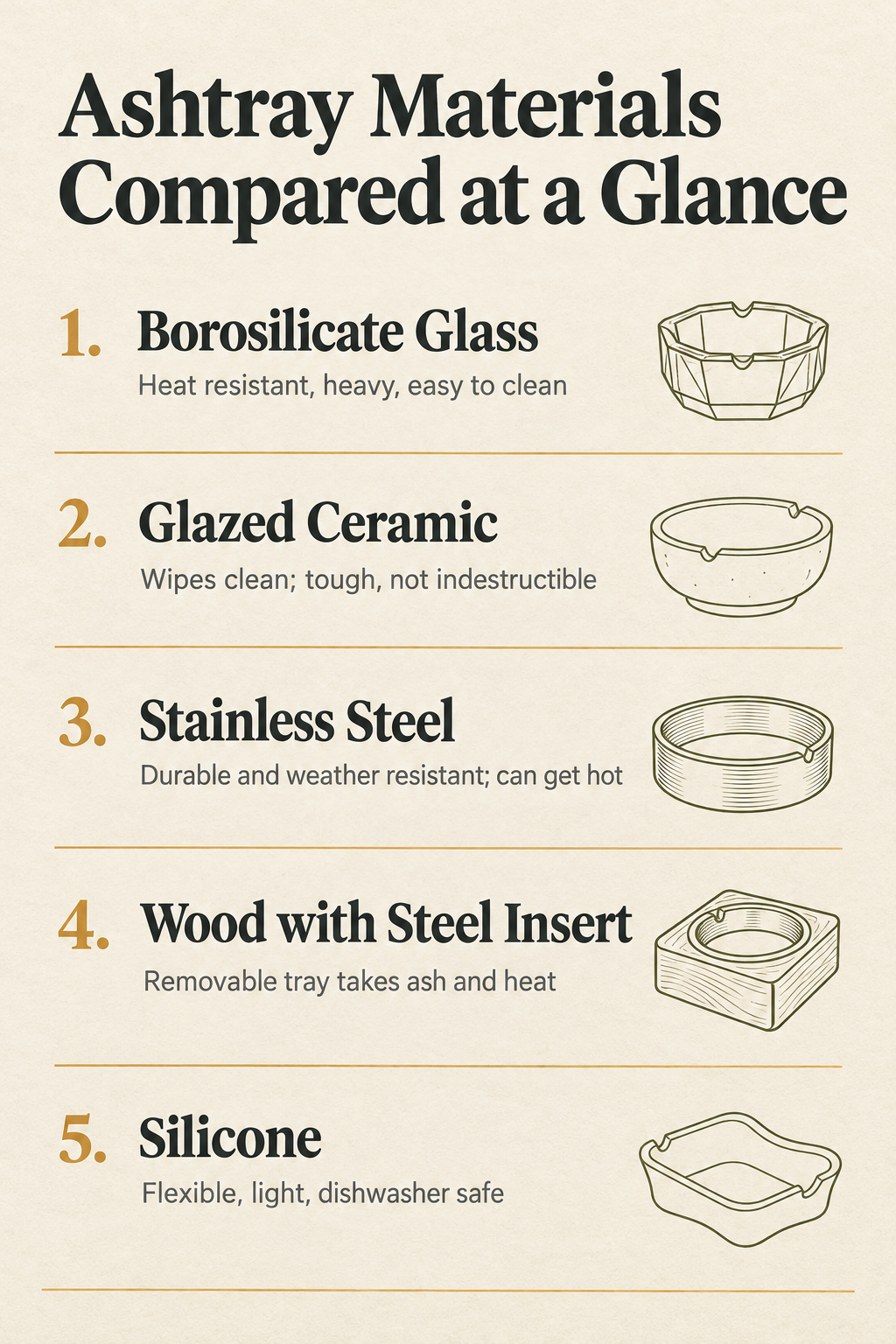
Five materials show up in this category: borosilicate glass, glazed ceramic, metal, wood built around a steel insert, and silicone. None of them wins everywhere. Material is really a question of where the tray lives and how much handling it takes, so read each one as a trade-off rather than a ranking [11].
Borosilicate is the material named on the glass trays highlighted here. Jane West lists hand-finished borosilicate with a 5 in (127 mm) width and a 2 in (51 mm) height, and MJ Arsenal lists a wide square basin with two notches and a sandblasted underside [4] [5]. The appeal is heat tolerance. SCHOTT states that borosilicate begins to soften above 525 °C and is stable below 500 °C [8]. That does not make a tray unbreakable. Drop it and it shatters, which is the documented downside of glass [11].
Glass is also the easiest of the group to clean, which is why it ends up indoors on most tables. If you are still deciding what belongs on the table at all, What Smoking Accessories Do Beginners Need? is a sensible starting point before you commit to a material.
Ceramic splits into two versions that behave very differently. A glazed tray wipes clean, while an unglazed or porous one takes in stains that can become permanent [12]. A stoneware care page adds a useful caveat. Stoneware is tough but not indestructible, it is not for open flame or a stovetop, and it should not go from freezer to oven or take cold water while hot [14]. If you want the look of ceramic without the upkeep, glazed is the version to pick, and What Smoking Accessories Do Beginners Need to Buy First? covers the rest of a first kit if you are assembling one.
Metal trays are usually stainless steel, aluminum, or brass. The real strengths are durability, weather resistance, and portability, which is why they turn up on balconies and in bags [11] [13]. The trade-offs are just as real: metal can become hot to the touch, uncoated metal can rust or oxidize, and painted or powder-coated finishes want mild soap and no abrasives [11] [12]. Design can also solve one specific problem. The RAW Magnetic Ashtray does that with a 5.5 in diameter, three notches, and a strong magnet that holds it to a metal surface [6]. If you are still choosing the piece that will rest in the tray, What Is the Best Smoking Piece for a Beginner? covers that decision separately.
Wood trays are usually built around a removable stainless-steel insert, and that insert is the part that takes the ash and the heat. The acacia model sold in this category pairs a wood body and a wood lid with a removable steel tray. The maker is upfront that the lid is not airtight and a small gap may remain [10] [18]. Think of the wood as the body and the lid, not as a heat barrier. Wood also needs its own routine: a barely damp cloth, no soaking, no dishwasher, and a thin coat of tung or Danish oil along the grain now and then [15].
Silicone is the travel option. It flexes, it does not shatter in normal use, it can go in the dishwasher, and it weighs almost nothing, which suits a bag or a camping box [11] [13]. The trade-offs are that it looks casual and can discolor with heavy use. Plastic is the one material to skip outright, because it can melt and it holds odor [13].
Whichever material you land on, two habits stretch its life. Clean it on a schedule instead of waiting for a visible crust, which The Complete Guide to Cleaning Smoking Accessories walks through step by step, and put it somewhere it will not slide off a shelf. If you are weighing glass against silicone for a piece you plan to carry, Glass vs Silicone Smoking Accessories: Which Should You Choose? compares those directly, and How Do I Store My Smoking Accessories the Right Way? covers storage for the rest of the kit.
- Borosilicate glass: heat tolerant and easy to clean, but it shatters when dropped and a chipped tray should be retired [5] [8] [11].
- Glazed ceramic: wipes clean and keeps its finish, though stoneware is tough rather than indestructible and dislikes sudden temperature change [12] [14].
- Unglazed or porous ceramic: absorbs stains that may never come out, so it is the harder version to live with [12].
- Metal: durable, weather resistant, and portable, but it can get hot, uncoated metal can rust, and coated finishes want mild soap only [11] [12].
- Wood with a steel insert: the removable steel tray takes the ash and heat, and the maker may note the lid is not airtight [10] [18].
- Silicone: light, flexible, and fine in the dishwasher, but casual looking and prone to discoloring with heavy use [11] [13].
- Plastic: skip it, because it can melt and hold odor [13].
What Size Ashtray Do You Need for Joints, Blunts, and Cigars?
No universal ashtray size standard appears in any source behind this guide, so a size chart would be invented rather than reported. What you can do is work through the published numbers on the models in front of you, then check them against the table the tray will sit on.
The verified numbers are specific rather than general. Jane West publishes 5 in (127 mm) wide by 2 in (51 mm) tall. RAW publishes 5.5 in in diameter for the Magnetic Ashtray. The teak tray listed here is 10 by 10 cm [5] [6] [18]. Those figures land in a similar band, which is a realistic starting point for a one-person tray. None of them comes with a claim about how much ash the basin holds.
Weight is the number buyers skip and later regret. RAW states its crystal tray was designed to weigh 3.5 lb, explicitly modeled on a 3.3 lb antique [7]. Jane West describes its piece as heavy, heat-resistant solid glass [5]. A wide tray that weighs almost nothing still slides, so weigh it as part of the size question rather than a separate spec.
- Measure the spot first: the width and depth of the table, shelf, or armrest the tray will live on, since a tray that overhangs gets knocked.
- Match the published width rather than the photo, because a 5 in tray and a 5.5 in tray look identical on a product page [5] [6].
- Check the height, since a 2 in tall tray clears a low shelf and a taller lidded tray may not [5].
- Weigh the stability question, because heavier and wider is harder to tip and that is the property fire-safety guidance keeps naming [1] [2] [7].
- Check basin depth against how much ash builds up in one session, since deep and sturdy is the named requirement [2].
- Check rest length against what you smoke, because Jane West lists its tray for pre-rolls, joints, and cigars, and a long cigar needs a longer rest than a short joint [5].
- Confirm anything the listing does not publish with the seller, since heat ratings, capacity, and lifespan are not standardized across this category [5] [6] [7].
How Many Rests or Notches Does a Shared Ashtray Need?
Rest count is the spec most product pages bury, and it is the one that decides whether a shared table works. Two people cannot share one notch without one of them holding a joint the whole time.
The published counts on named models run from two to four. MJ Arsenal lists two notches on the Pegasus, Jane West lists three custom notches, RAW lists three on the Magnetic Ashtray, and several glass trays in this category list four [4] [5] [6] [16].
Terminology varies by maker and region, so do not read too much into the label. The groove that holds a lit item gets called a rest, a notch, or a groove depending on who wrote the page [4] [9] [16]. Count the grooves in the photos instead of trusting the word.
Rest count maps fairly directly to use. Two or three suits one person keeping a joint or blunt in place between draws. Four or more suits a table where several people set things down at once. One round-up puts the practical range at three to seven, with three for a single person and seven for a shared table [16].
A deep basin can partly cover for a low rest count, because the well itself holds an item that is set down inside it. It cannot cover for two people and one notch. If your table usually has two or more people at it, count rests first and look at styling second.
- Count the grooves in the listing photos, since rest, notch, and groove all describe the same feature [4] [16].
- Two notches on the MJ Arsenal Pegasus is a one-person count [4].
- Three notches on the Jane West tray and the RAW Magnetic Ashtray suits one person comfortably or two people taking turns [5] [6].
- Four notches on the glass trays in this category starts to suit a small shared table [16].
- One round-up puts the range at three to seven, with three for a single person and seven for a shared table [16].
- A deep well can hold an item set down inside it, but it does not replace a second notch for a second person.
Do You Need a Covered Ashtray or Just a Deep Well?
The word windproof means two different things on an ashtray, and sellers use it for both [16]. One meaning is an open tray with a deep well, a heavy body, and a narrow opening. The other is a tray with a lid that covers the contents. They solve the same problem in different ways and suit different settings.
The deep well version is the indoor answer. Contents sit below the rim, so ash stays put when the tray is bumped, and a heavy body keeps the whole thing from sliding. A wide basin with several rests also lets more than one person use it without passing it around, which is why this shape shows up on shared tables [16].
The lid version is the outdoor answer. A hinged or lift-off cover keeps ash from blowing across a balcony or patio table, and it reduces odor while it is shut. That matters when the tray sits near a door [9] [16]. That is a containment feature, not a promise about the room. The acacia wood model here pairs a wood lid with a steel insert, and the maker states plainly that the lid is not airtight and a small gap may remain [10].
Indoors, a lid can become a nuisance, because you lift it on every draw and set it back down again. The same design write-up that argues for a covered tray also argues against turning it into a multi-tool. It names hiding the ash and containing odor between sessions as the two jobs worth solving [9].
What decides whether a covered tray is pleasant to empty is the interior, not the styling. Smooth surfaces and removable parts clean out quickly, while texture, grooves, and tight corners hold residue [9] [10]. At commercial scale the same principle shows up in a safety catalog. That smoking receptacle uses a wide base, a covered head, and a narrow opening that accepts butts while discouraging other waste [17]. It is a scaled-up version of the idea, not a standard for a tabletop tray.
- A deep well with a heavy body and a narrow opening suits an indoor shared table where the tray gets bumped [16].
- A hinged or lifting lid suits a balcony or patio, where a cover keeps ash from blowing away and reduces odor while shut [9] [16].
- A lid is not airtight on the wood-and-steel model sold here, and the maker says a small gap may remain [10].
- A lid lifted on every draw becomes a nuisance indoors, while an open deep well does not [16].
- Smooth interiors and removable inserts matter more than groove texture, because texture and corners hold residue [9] [10].
- Commercial receptacles use a wide base, a covered head, and a narrow opening, which is the same contain-the-contents idea scaled up [17].
| Choice | Covered lid | Open deep well |
|---|---|---|
| Where it fits | Balcony, patio, or a table near a door | Indoor shared table |
| Ash and wind | The cover keeps ash from blowing away [16] | A deep basin holds ash when the tray is bumped [16] |
| Odor between uses | Reduced while the lid is shut [9] | No cover, so nothing holds the smell in |
| Emptying | Depends on smooth interiors and removable parts [10] | Tips out easily, with fewer corners to clean |
| Main trade-off | You lift the lid on every draw [16] | Nothing covers the contents outdoors |
What Does a Debowler Spike Do, and Do You Need One?
A debowler is a spike or post standing up from the tray, used to knock spent material out of a bowl [9]. Instead of tapping the bowl against the rim and scattering ash, you turn the bowl over the spike and the material drops into the basin.
The spike and the lid fight each other by design, because a tall post cannot sit under a cover. The verified solution makes the spike removable and holsters it in the lid, so the tray carries both features without the spike blocking the close [9]. At the low end, a simpler 4 in tray with a fixed cleaning spike does the same job with no lid at all.
Whether you need one depends on how you smoke. If you pack bowls in a pipe or a water piece and empty them at the table, a spike is genuinely convenient. If you mostly smoke pre-rolls, a rest does the same job and the spike just takes up basin space. Consider it a convenience feature rather than a requirement [9].
- A debowler is a spike or post used to knock spent material out of a bowl into the tray [9].
- A tall spike cannot sit under a lid, which is why the verified design makes the spike removable and stores it in the cover [9].
- A fixed spike on a simple open tray is the low-cost version of the same feature [9].
- The spike suits pipe, bong, and joint users who empty bowls at the table, and it is not needed if you only smoke pre-rolls [9].
How Do You Clean Glass, Metal, Ceramic, and Wood Ashtrays?
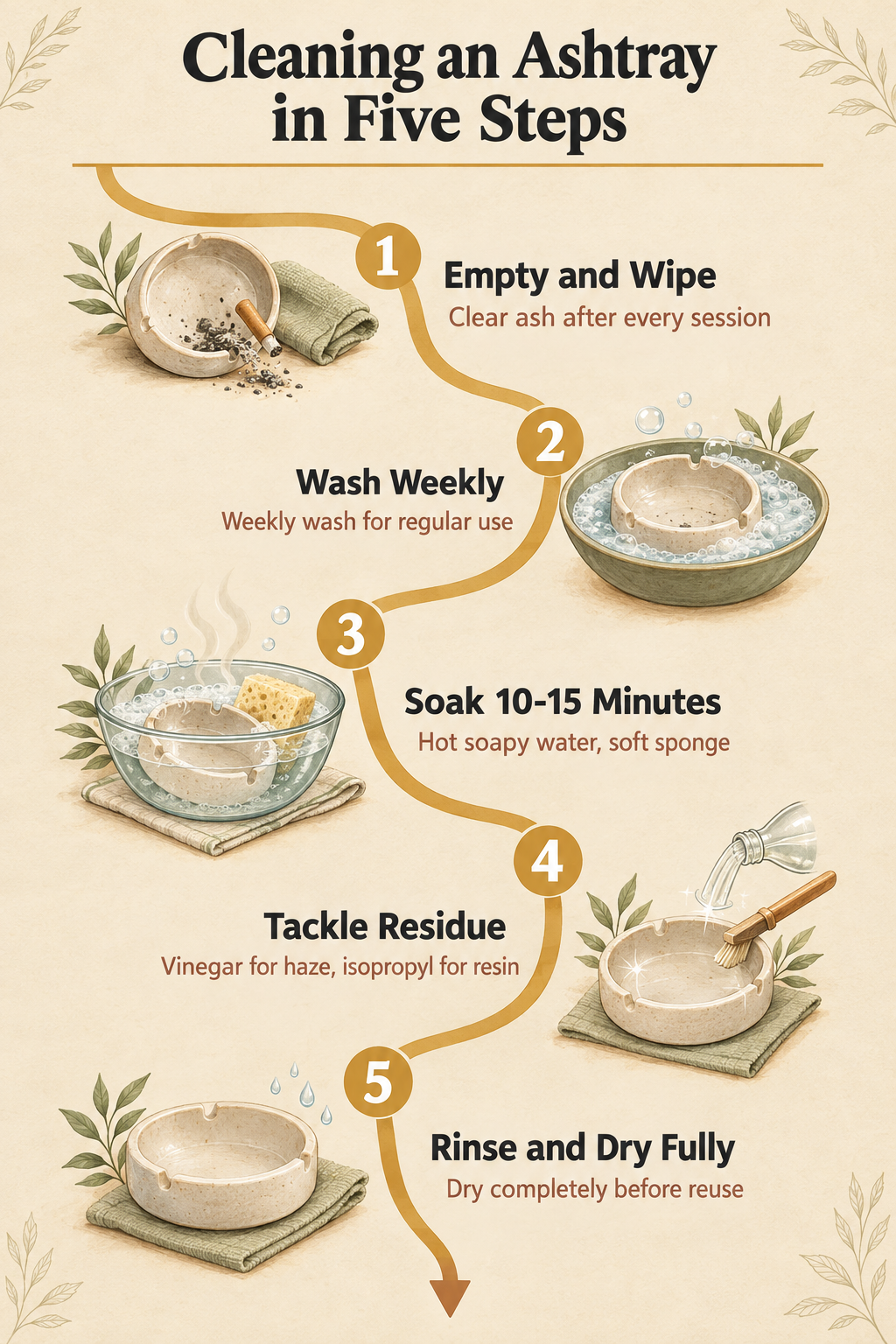
Cleaning cadence matters more than cleaning method. Empty and wipe the tray after use, wash it weekly if you use it daily, and give it a full soak when residue starts to build up [12]. A tray emptied before it is full spills far less ash onto the table.
One rule applies across every material: avoid sudden temperature change. Do not move a cold piece into hot water, and do not run cold water into a piece that is still warm. That shock is what cracks glass and stoneware [12] [14].
Glass and glazed ceramic take a soft sponge and no abrasive pad, which keeps the surface clear [12]. Metal takes a non-scratch pad, and coated finishes want mild soap only [11] [12]. Wood is the odd one out. It never gets soaked or washed in a machine, and it gets re-oiled when the surface starts to look dry [15]. Stoneware is tougher than it looks but still dislikes a sudden temperature swing [14].
The order below works for any material. The swap is in the tools and the residue step.
- Empty the tray before it fills, so ash does not spill over the rim onto the table [12].
- Make sure nothing in the tray is still burning, and that ashes and butts are fully out before they leave it [1].
- Soak for 10 to 15 minutes in hot soapy water, which loosens the ash that has stuck to the basin [12].
- Use a soft sponge on glass and ceramic and a non-scratch pad on metal, and keep abrasive pads away from glass [11] [12].
- Tackle residue by material: white vinegar for haze, 91% isopropyl alcohol for resin on glass, and a baking soda paste on ceramic [12].
- Rinse fully and dry completely before the tray goes back into service [12].
- Handle wood differently: wipe with a barely damp cloth, never soak it or put it in a dishwasher, and re-oil sparingly with tung or Danish oil along the grain when the surface dulls [15].
- Retire chipped or cracked glass instead of gluing it, because a damaged tray is not worth handling around heat [5] [11].
What Should You Avoid When Buying an Ashtray?
Most disappointing ashtray purchases fail for one of a few predictable reasons, and every one of them is visible before checkout if you know what to look for.
The first is a tray that is light and shallow. It looks fine on a desk and slides the first time someone sets a joint on the rim, which is exactly the failure the fire-safety guidance warns about [1] [3]. The second is a tray with no rests at all, which forces a burning item to lie in the basin.
The third is plastic, which can melt and holds odor [13]. The fourth is a lid sold as airtight when the maker’s own copy says otherwise, as the acacia model does [10]. The fifth is a listing full of styling words and empty of numbers.
Before you check out, confirm the dimensions, the rest count, and anything the page claims about the lid. Price should be confirmed at the seller rather than assumed from another listing, since the figures quoted in a guide go stale [5] [6] [7].
- Skip light, shallow trays that slide when something is set on the rim [1] [3].
- Skip trays with no rests or notches, since there is nowhere to park a lit item [16].
- Skip plastic bodies, which can melt and hold odor [13].
- Do not accept an airtight claim for a lid the maker describes as not airtight [10].
- Do not buy from a listing with no published dimensions or rest count, and confirm the missing numbers with the seller [5] [6].
- Confirm price and current stock at the seller instead of trusting a number quoted in a guide [7].
Frequently Asked Questions
What is the difference between a glass, metal, and wood ashtray?
Glass is easy to clean and heat tolerant but shatters if dropped, so a chipped tray should be retired [5] [11]. Metal is durable and weather resistant, though it can become hot to the touch and uncoated metal can rust [11]. Wood usually wraps a removable stainless-steel insert, and the maker may note the lid is not airtight [10].
What size ashtray do I need?
There is no universal ashtray size standard, so work from the published dimensions on the model you are considering. Verified examples range from a 5 in by 2 in glass tray to a 5.5 in diameter magnetic tray and a 10 by 10 cm wooden tray [5] [6] [18]. Weight matters as much as width, and a 3.5 lb tray is a published example of a deliberately heavy piece [7].
How many rests or notches should an ashtray have?
Two or three rests suit one person keeping a joint, blunt, or cigar in place. A shared table benefits from more. Published counts on named models include two, three, and four, and one round-up puts the range at three to seven [4] [5] [6] [16]. Count the rests on the tray you are buying rather than assuming.
Is a covered ashtray worth it?
A lid helps when the tray sits outdoors on a balcony or patio, because it covers the contents so ash does not blow away and odor is reduced while it is shut [16]. Indoors, a lid you lift on every draw becomes a nuisance. Note that makers of wood-and-steel covered trays say the lid is not airtight [10].
How often should you clean an ashtray?
Empty and wipe the tray after use, and wash it weekly with regular use. A full soak runs about 10 to 15 minutes in hot soapy water, followed by a full rinse and a complete dry before the tray goes back into service [12]. A tray emptied before it is full spills less ash onto the table.
Can you empty an ashtray straight into the trash?
Which Ashtray Should You Choose for Your Setup?
Work through the three jobs first, then pick a material. If the tray lives on an indoor table and you want the least fuss, borosilicate glass or glazed ceramic gives you a basin that wipes clean and rests you can count [5] [8] [12]. If it lives on a balcony or travels in a bag, metal or silicone handles the knockabout better, and a lid starts to earn its keep [11] [13] [16]. If you want wood on the table, buy the version with a removable steel insert and expect to oil it [10] [15].
Then check the two numbers that decide whether the tray behaves: weight and rest count. A heavy tray with a wide footprint stays where you put it, which is the property fire-safety guidance keeps naming [1] [2]. Rest count follows the table, with two or three for one person and more for a group [16].
Finally, plan the emptying routine before you need it. Ash and butts get soaked or smothered rather than tipped into a bin, and the tray gets washed before residue hardens into something that needs an overnight soak [1] [12].
Treehouse Lifestyle ships free on orders $150+, so a tray, a spare insert, and a cleaning kit can travel in one box if you are outfitting a table from scratch.
Sources
- U.S. Fire Administration (FEMA): Smoking Fire Safety
- National Fire Protection Association: NFPA Educational Messages Desk Reference for the Fire Service (Chapter 11, Smoking)
- U.S. National Park Service: Fire Prevention 52: Cigarette Butts
- MJ Arsenal: Pegasus Ashtray
- Jane West: Twenties Ashtray | Clear
- RAW (RAWthentic): RAW Magnetic Ashtray
- RAW (RAWthentic): RAW Crystal Ashtray
- SCHOTT: Heat-resistant glass
- Heir: The Covered Ashtray: A Better Ashtray, by Design
- Ashtray Planet: Covered Acacia Wood Ashtray with Stainless Steel Insert
- Paykoc Pipes: Choosing the Right Ashtray: Comparing Popular Materials
- MunchMakers: How to Clean Your Ashtray: Complete Cleaning Guide by Material
- MunchMakers: Choosing the Best Ashtrays for Weed
- Mrid Cera: Care & Use
- Craobh Woodwork: Product Care
- Thomas Acres: Lid or Deep Well: What Windproof Means on an Ashtray
- Justrite: Smoking Receptacles catalog (Smoker’s Cease Fire)
- WoodRose: Solid Teak Wood Ashtray