

Borosilicate glass and soda-lime glass are two different recipes, and the gap comes down to thermal expansion. Borosilicate glass 3.3 expands at about 3.3 x 10⁻⁶ per kelvin, roughly one-third the rate of ordinary soda-lime glass at about 8.3 x 10⁻⁶ per degree Celsius. [5] [4] It builds less internal stress when one part of a piece heats before another, and that is most of what the higher price buys. [11]
What Is the Difference Between Borosilicate and Soda-Lime Glass?
Borosilicate glass is a family of glasses whose main glass-forming ingredients are silica and boron trioxide. The grade used for laboratory glassware and most quality smoking accessories, called borosilicate glass 3.3, is about 81% silicon dioxide, 13% boron trioxide, 4% sodium and potassium oxides, and 2% aluminium oxide by weight. [1] [5]
Soda-lime glass is the most common type of manufactured glass, accounting for roughly 90% of world production. Its typical recipe is 69-74% silicon dioxide, 12-16% sodium oxide, and 5-12% calcium oxide. [3] [4] [6] It is the glass in windows, bottles, and jars.
You can meet both recipes on the same shelf. Pieces in the Bongs and Hand Pipes sections of a shop are often made from different recipes, and two pieces that look identical can sit at very different prices because of it. A brand page is another place the material sometimes gets named outright, as in What Is LA Pipes and Are Its Pieces Made in the USA?.
The property that separates the two is expansion, and the boron trioxide in the borosilicate recipe is what lowers it. That one change alters how a piece behaves when part of it warms before the rest. The two recipes are also not interchangeable in the kiln — soft glass cannot be fused to borosilicate — so a maker chooses one and stays with it. [9] [10]
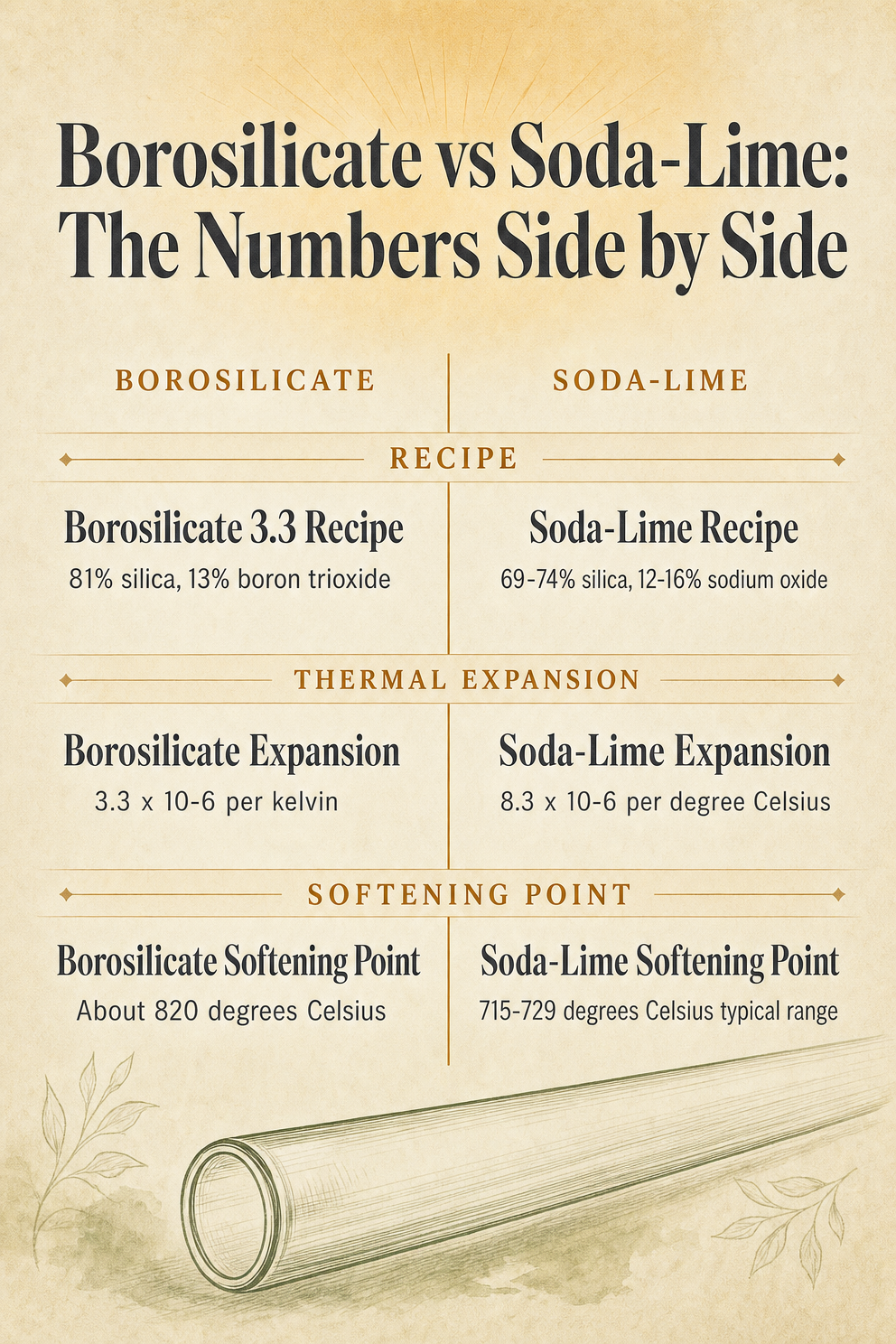
The table below sets the two recipes side by side, so the numbers that follow have somewhere to sit.
- Borosilicate glass 3.3: about 81% silicon dioxide, 13% boron trioxide, 4% sodium and potassium oxides, and 2% aluminium oxide. [1]
- Soda-lime glass: typically 69-74% silicon dioxide, 12-16% sodium oxide, and 5-12% calcium oxide. [4]
- Soda-lime is the default recipe, making up about 90% of all manufactured glass worldwide. [6]
- What the boron buys: a lower coefficient of thermal expansion, which changes how the glass responds to heat. [5]
- Not interchangeable: soft glass in the COE 90-104 range cannot be fused to borosilicate. [10]
| Property | Borosilicate Glass 3.3 | Soda-Lime Glass |
|---|---|---|
| Typical recipe | About 81% silica, 13% boron trioxide | 69-74% silica, 12-16% sodium oxide |
| Thermal expansion | About 3.3 x 10⁻⁶ per kelvin | About 8.3 x 10⁻⁶ per degree Celsius |
| Softening point | About 820 degrees Celsius | 715-729 degrees Celsius typical |
| Share of production | Specialty runs | About 90% of manufactured glass |
| Common uses | Lab glassware and quality accessories | Windows, bottles, and jars |
Why Does Borosilicate Glass Cost More Than Soda-Lime?
The price gap starts at the furnace, not at the product page. Borosilicate glass 3.3 has a reported softening point of about 820 degrees Celsius in the type 7740 formulation, while typical soda-lime float glass softens in the 715-729 degrees Celsius range. [5] [4] Glass that has to be melted and worked at a higher temperature takes more fuel, more time, and costlier equipment to produce.
Soda-lime is the cheaper and easier recipe. Soda acts as a flux that lowers the melting temperature of silica, and the resulting glass is soft, workable, and can be re-softened again and again during forming — which suits windows, bottles, jars, and other high-volume glassware. [3] [6]
Suppliers put borosilicate at roughly 20-30% more than soda-lime per piece at the factory gate. [11] That production premium is the honest part of a retail markup, and it is worth weighing against the build of the piece itself, which is the question behind How Can You Tell If a Glass Smoking Piece Is Well Made?. The same material trade-off shows up outside glass entirely, as covered in Glass vs Silicone Smoking Accessories: Which Should You Choose?.
Not every piece in a higher price band is glass at all. A device such as the DAVINCI IQ3 Vaporizer uses a different set of materials, and its price reflects its own parts and build rather than the glass recipe debate.
- Borosilicate 3.3 softens at about 820 degrees Celsius in the type 7740 formulation; typical soda-lime float glass softens at 715-729 degrees Celsius. [5] [4]
- Higher melting and working temperatures mean more fuel and slower production runs per piece.
- Soda acts as a flux that lowers the melting temperature of silica, which is why the soda-lime recipe is cheap to make. [3]
- Soda-lime can be re-softened repeatedly during forming, which suits high-volume items like windows, bottles, and jars. [3]
- Supplier-side figure: borosilicate runs roughly 20-30% more per piece at the factory gate. [11]
What Does Thermal Expansion Have to Do With a Glass Pipe?
Thermal expansion is how much a material changes size when its temperature changes. Every part of a glass piece expands as it warms. If one section warms before another, the two sections want to change size by different amounts, and the glass in between has to absorb that mismatch as internal stress. [1]
That lower expansion is the reason borosilicate became the standard material for laboratory glassware, and it is why the same family of glass shows up in reusable heat-resistant cookware. [2] It is a real engineering advantage rather than a marketing word, and it is what the factory premium is paying for. [11]
Because borosilicate expands and contracts less for a given temperature change, it builds less of that stress. The numbers carry the whole argument, so here is the chain in order.
- Borosilicate glass 3.3 has a coefficient of linear thermal expansion of about 3.3 x 10⁻⁶ per kelvin. [5]
- Ordinary soda-lime glass runs about 8.3 x 10⁻⁶ per degree Celsius. [4]
- The gap: borosilicate moves roughly one-third as much as soda-lime for the same temperature change. [7]
- Why that matters: when one end of a piece heats before the other, the mismatch has to go somewhere, and it goes into the glass as internal stress.
- Where the property is already trusted: laboratory glassware and reusable heat-resistant cookware are both built on it. [2]
- What it means in daily use: a piece tolerates faster temperature changes than one made from soda-lime glass, whether it is a plain piece or something decorative such as Glow in the Dark Bongs: Do They Work and Are They Safe?.
Can Borosilicate Glass Still Crack or Break?
Yes. Borosilicate is not immune to thermal shock. Corning publishes a maximum allowable temperature difference of 160 degrees Celsius between the glass and the air, liquid, or solid touching it, measured on a 3.2 mm thick sample. [2] Supplier-side guidance cites roughly 165 degrees Celsius for a comparable figure. [11] Reference material notes plainly that borosilicate can still crack or shatter when it faces rapid or uneven temperature changes. [5]
Where failures collect is more useful than the headline number. Most impact and heat-cycle breaks happen at the joint, the downstem area, the base edge, and other transitions where the shape or the wall thickness changes. [8] A piece can be made from the better recipe and still fail at a transition that was never given a chance to settle.
That is also why the two recipes often look the same at the counter: many low-cost imported pipes are made from soda-lime glass, and the difference rarely shows up until a piece fails under repeated heating and cooling. [9] If a brand’s material story matters to you, that is exactly the kind of claim worth checking rather than assuming — Is Human Grade Glass Worth It, or Is It Just a Brand Name? takes a close look at how one of those labels holds up.
- Published limit: a maximum allowable temperature difference of 160 degrees Celsius between the glass and whatever touches it, on a 3.2 mm thick sample. [2]
- Supplier-side guidance: borosilicate is described as handling temperature changes of roughly 165 degrees Celsius. [11]
- Still breakable: borosilicate can crack or shatter under rapid or uneven temperature change. [5]
- Failure points collect at joints, downstem areas, base edges, and other transitions where the shape changes. [8]
- Uneven wall thickness concentrates stress at those transitions, and no recipe offsets it. [8]
Is the Glass Recipe or the Annealing More Important?
The recipe sets the ceiling; annealing decides whether a piece reaches it. Annealing is a controlled kiln cooling step that lets internal stress dissipate instead of locking itself into the glass. Manufacturer and supplier guidance both point to it as the determinant of impact resistance. [8] [9]
Even wall thickness matters for the same reason as annealing. A thin section and a thick section cool at different rates, and each pulls on the other as it shrinks, which is what creates stress concentration points at the transitions of a piece. [8] A well-annealed soda-lime piece can outlast a poorly annealed borosilicate one, so the material question and the build question have to be asked together.
The process runs in a fixed order, and each stage removes a specific kind of trouble.
- Forming: the piece is shaped at high heat, and stress starts to build as the glass cools unevenly in open air.
- Kiln annealing: the piece goes into a kiln held at a high, even temperature so that internal stress can dissipate. [8]
- Controlled cooling: the kiln ramps down slowly, so the piece never cools fast enough to lock new stress back into the glass. [8]
- Wall thickness: even walls matter because thin and thick sections cool at different rates and pull against each other. [8]
- The payoff: annealing, not the recipe, is what manufacturers point to as the determinant of how a piece handles impact. [9]
How Can You Tell Whether a Piece Is Really Borosilicate?
Glass type is genuinely hard to confirm by eye, which is why the question keeps coming up. Supplier-side guidance is that the reliable route is to ask the maker or seller for a written material specification rather than judging the piece visually. [9]
Reported field checks exist, and comparative weight and tap sound are the two you will hear about most, but they are hints rather than proof. [11] Many low-cost imported pipes are made from soda-lime glass, and the gap rarely appears at the moment of purchase; it tends to surface later, when a piece fails under repeated heating and cooling. [9]
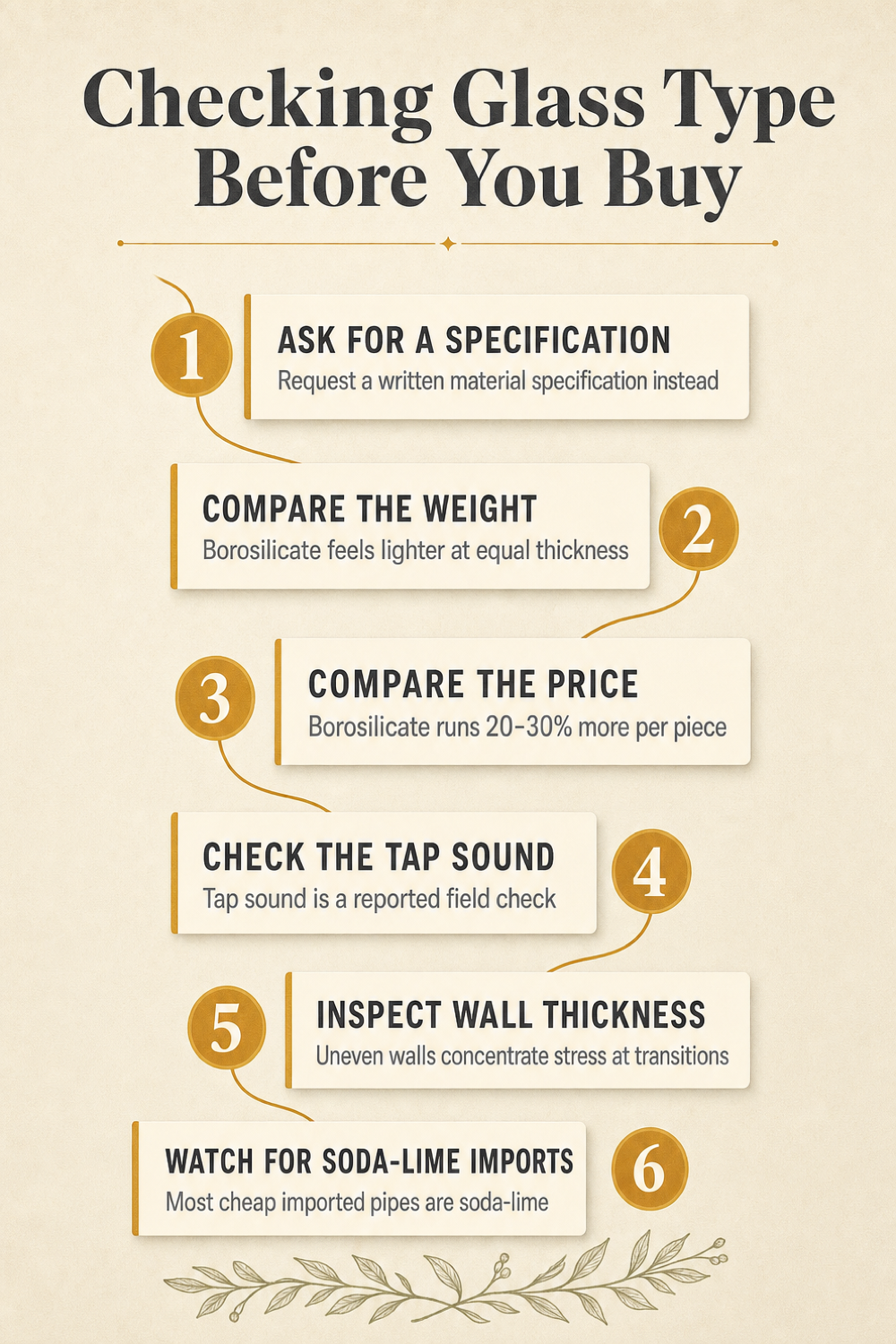
That is why the spec sheet and the price signal carry more weight than a quick visual once-over. When you buy online, free shipping on orders $150+ applies at checkout, which at least makes a spec-sheet-first approach easier to act on. The checks below are ordered from most to least reliable.
- Start with the seller: ask for a written material specification instead of a vague phrase like “quality glass.” [9]
- Compare the weight: borosilicate feels lighter than soda-lime at the same wall thickness. [11]
- Compare the price: a piece priced far below the rest of the market is usually soda-lime. [11]
- Test the tap sound: a reported field check, useful as a hint and not as a verdict. [11]
- Inspect the walls: uneven thickness concentrates stress at the transitions, whatever the recipe. [8]
- Watch for the import pattern: many low-cost imported pipes are clear soda-lime glass. [9]
What Do COE 33, Hard Glass, and Pyrex Actually Mean?
The words on product pages cause about as much confusion as the science. “Borosilicate,” “hard glass,” “scientific glass,” “COE 33,” and “Pyrex” all get used to point at the same low-expansion family, but they mean different kinds of things. [10]
COE 33 is the one worth understanding. It names the expansion-coefficient specification — the “33” is shorthand for the 3.3 x 10⁻⁶ range — rather than a brand or a single factory. Clear COE 33 glass from different makers is treated as mutually compatible when fused. [10]
Then there is the Pyrex trap. Corning ceased manufacturing cookware in 1998, and consumer Pyrex cookware sold in the United States has since been made from tempered soda-lime glass, while European Pyrex cookware and Corning’s laboratory PYREX glassware remain borosilicate. [2] [6] A familiar brand name is not a material guarantee.
- Same family, different words: “borosilicate,” “hard glass,” “scientific glass,” “COE 33,” and “Pyrex” are all used for the low-expansion family. [10]
- COE 33 is a specification, not a brand — it names the expansion-coefficient range the glass is made to. [10]
- Compatible formulations: Simax, Schott DURAN, Kimble KG-33, and the original Corning 7740 recipe can be fused to each other. [10]
- Soft glass does not mix: the COE 90-104 family cannot be fused to COE 33. [10]
- The Pyrex trap: consumer Pyrex cookware in the US became tempered soda-lime after Corning stopped making cookware in 1998. [2] [6]
- Still borosilicate: European Pyrex cookware and Corning’s laboratory PYREX glassware. [6]
Is Borosilicate Glass Worth Paying More For?
Here is the honest answer: sometimes. The premium buys a lower coefficient of thermal expansion, a higher softening point, and a glass that is harder and less dense than ordinary glass. [7] Those properties matter most on pieces that see repeated heat cycles, on lab-pattern glassware, and on anything a buyer intends to keep and maintain for years.
They matter least on a piece with uneven walls or a skipped annealing step. In that case the material cannot rescue the build, and a well-made piece in the cheaper recipe is the better buy. [8]
It also helps to place the choice next to the wider material question rather than treating the recipe as the only variable that counts. [6] [11] Buyers who start with how a piece is built and then check what it is made from tend to end up with the piece they actually wanted.
- What the premium buys: lower thermal expansion, a higher softening point, and a glass that is harder and less dense than ordinary glass. [7]
- Where the recipe matters most: pieces that see repeated heat cycles and anything you plan to keep and maintain for years.
- Where it matters least: a piece with uneven walls or a skipped annealing step, where the material cannot rescue the build. [8]
- What you still owe the piece: borosilicate can crack or shatter under rapid or uneven temperature change, so avoid fast swings. [2]
- The wider context: the same price-versus-chemistry trade-off shows up across accessory materials. [6] [11]
Frequently Asked Questions
What is borosilicate glass made of?
Borosilicate glass is a family of glasses whose main glass-forming ingredients are silica and boron trioxide. The grade used for laboratory glassware and most quality smoking accessories, borosilicate glass 3.3, is roughly 81% silicon dioxide, 13% boron trioxide, 4% sodium and potassium oxides, and 2% aluminium oxide by weight. The boron trioxide content is what lowers its thermal expansion compared with ordinary glass. [1] [5]
Is borosilicate better than soda-lime glass?
Borosilicate expands about one-third as much as ordinary soda-lime glass for the same temperature change, has a higher softening point, and is harder and less dense. It also costs roughly 20-30% more per piece at the factory gate. The recipe is not the whole story, though: annealing, the controlled kiln cooling that lets internal stress dissipate, is what determines whether a finished piece handles temperature swings and impacts. [7] [8] [11]
How can I tell if a glass pipe is really borosilicate?
It is difficult to confirm by eye. Reported field checks include weight, since borosilicate feels lighter at the same wall thickness, and tap sound, but supplier guidance is that the reliable route is to ask the maker or seller for a written material specification. Many low-cost imported pipes are made from soda-lime glass, and the difference rarely shows up until a piece fails under repeated heating and cooling. [9] [11]
Can borosilicate glass still break from heat?
Yes. Borosilicate is not immune to thermal shock. Corning publishes a maximum allowable temperature difference of 160 degrees Celsius between the glass and the air, liquid, or solid touching it, measured on a 3.2 mm thick sample, and reference material notes it can still crack or shatter under rapid or uneven temperature changes. Uneven wall thickness and un-annealed stress push failures toward joints, bases, and other transitions. [2] [5] [8]
Does the Pyrex name mean a piece is borosilicate?
No. Corning ceased manufacturing cookware in 1998, and consumer Pyrex cookware sold in the United States has since been made from tempered soda-lime glass. European Pyrex cookware and Corning’s laboratory PYREX glassware are still borosilicate. The brand name alone does not tell you which material you are holding. [2] [6]
Why does borosilicate cost more than soda-lime glass?
Borosilicate 3.3 has a reported softening point of about 820 degrees Celsius, against roughly 715-729 degrees Celsius for typical soda-lime float glass, so it has to be melted and worked at higher temperatures. Soda-lime is cheaper and easier to produce because soda acts as a flux that lowers the melting temperature of silica, and the glass can be re-softened repeatedly during forming. Suppliers put the borosilicate premium at roughly 20-30% per piece at the factory gate. [3] [4] [5] [11]
What Should You Take Away From Borosilicate vs Soda-Lime?
Borosilicate and soda-lime are two recipes with different glass chemistry, and the difference shows up as expansion: about 3.3 x 10⁻⁶ per kelvin against about 8.3 x 10⁻⁶ per degree Celsius. [5] [4] Less expansion means less internal stress when a piece heats unevenly, which is why borosilicate became the standard for laboratory glassware and why it costs roughly 20-30% more per piece at the factory gate. [11]
None of that makes it indestructible. Published limits cap the temperature difference a borosilicate sample can take, and annealing is what decides how a finished piece handles real use. [2] [8] Ask two questions before you buy: what is this made of, and how was it built? A piece that answers both is worth more than one that only answers the first.
Sources
- DWK Life Sciences: The role of DURAN borosilicate glass 3.3 in laboratory applications (whitepaper page)
- Corning Incorporated: PYREX Brand Glass Products
- Encyclopaedia Britannica: soda-lime glass
- National Glass Association (NGA): Physical and Mechanical Properties of Typical Soda Lime Float Glass (Glass Technical Paper FM05-12)
- Wikipedia: Borosilicate glass
- Thomasnet (reviewed by Phillip Keane): Soda Lime Glass vs. Borosilicate Glass – What’s the Difference?
- Westlab: What is the Difference Between Soda-lime Glass & Borosilicate Glass?
- Thick Ass Glass: Does Borosilicate Glass Break Easily When Used for a Bong?
- Chameleon Glass: How to Spot a High-Quality Glass Pipe Before Buying
- BoroMastery: Borosilicate Glass Sizes: Buying Tubing & Rod for Pipe Making
- Elfglass (Glass Pipe Sourcing): Borosilicate vs Soda-Lime: Glass Pipe Materials Guide