

Human grade glass is a brand name, not a certification [6]. The Human Grade line is described by dealers as borosilicate glass, priced in the budget to mid tier, and marketed as thicker and tougher than standard glass [7] [9] [13]. This guide separates what you can verify about human grade bongs from what you are simply being told.
What Does "Human Grade" Actually Mean on a Glass Piece?
The phrase sounds like a grade stamped on a material. On smoking accessories it is a brand name that belongs to a product line rather than to a standard. No certification body issues a human grade rating for water pipes, and none of the brand or dealer pages reviewed for this line names a testing standard or a certificate [13].
The words do have a formal definition somewhere, just not here. In pet food labeling, AAFCO’s human grade guidelines allow the claim only for the product as a whole, and they require every ingredient and the finished product to be stored, handled, processed and transported in a way that is consistent with 21 CFR part 117 [5]. Those guidelines are written for pet and specialty pet food. No matching published standard covers smoking accessories.
That contrast is the point. A defined term comes with paperwork, an audit trail and a rule about who may use it. A brand name comes with none of that, and the company that owns the line can put it on a box without asking anyone.
What a brand name can still do is set expectations for a lineup’s shape and price. Human Grade spans beaker and straight-tube water pipes, matrix percolator rigs, recyclers, sidecar bubblers, hand pipes, ash catchers, downstems, bowls, bangers, carb caps and 4-piece aluminum grinders [7] [11]. To see how those shapes are grouped in a store, browse the Bongs and Dab Rigs sections, or look at a piece built around a different material, like the SILICONE BEAKER BONG WITH REMOVABLE GLASS BOWL.
So read the label as a name on a box, not a seal on a certificate. The useful question is not whether the name is official, but whether the piece in front of you has the material, the thickness and the joints you actually want.
- A defined term: in pet food labeling, human grade applies only to the whole product, and the maker has to be able to document the claim [5].
- A brand name: on smoking accessories the same two words identify a product line, with no published standard behind them.
- What a brand name can tell you: the shape of the lineup, its typical build, and the price tier it plays in [7].
- What it cannot tell you: where the glass was made, which material grade was used, or what testing the piece passed [13].
- What to do with it: use the name to find the parts family you want, then judge the individual piece on its own specs.
Is Human Grade Glass Really the Same Glass Labs Use?
Borosilicate is a real family of glass, and the material side of the claim is the easiest part to check. Its headline property is how little it grows when it heats up. The coefficient of thermal expansion is about 3 x 10⁻⁶ per kelvin at 20 C, a low number, and low expansion is why borosilicate handles a fast temperature change better than other common glasses [1].
The alternative is soda-lime glass, which is what windowpanes, bottles and jars are made from. Soda-lime accounts for roughly 90 percent of all manufactured glass, and borosilicate is the more heat-tolerant of the two [2]. That is the comparison behind the phrase about lab glass, since reagent bottles and flasks are commonly made of borosilicate [1].
There is also a named grade, and this is where a buyer gets real traction. Borosilicate 3.3 is defined by DIN ISO 3585 and is typically about 81 percent silicon dioxide and 13 percent boron trioxide [3]. That grade number is what a material specification refers to. The phrase lab-grade on a product page is not a grade number.
One qualification matters when lab figures meet a water pipe. Published thermal shock figures for laboratory borosilicate reach a temperature difference of up to 100 K, and the same specification notes that the value depends on the wall thickness and the geometry of the product [3]. A thick-walled water pipe is a different shape from a flask, so the figure describes the material rather than promising the same result in a piece that sits on a shelf.
Brand copy for this line describes the pieces as made from the same material used in scientific laboratories and calls them thicker, tougher and far more heat resistant than standard glass [13]. What the reviewed pages do not carry is a published materials or emissions test report for the pieces themselves. If you want to compare shapes and build quality across the category first, How Do I Choose the Right Glass Bong for My Needs? and How Can You Tell If a Glass Smoking Piece Is Well Made? work through those same questions from the store’s side, and a compact option like the MJ Arsenal Time Turner Mini Dab Rig shows how much can fit into a small piece.
- Borosilicate’s low thermal expansion, about 3 x 10⁻⁶ per kelvin at 20 C, is why it is the heat-tolerant choice next to soda-lime glass [1].
- Soda-lime makes up about 90 percent of manufactured glass and is the material behind windowpanes, bottles and jars [2].
- Borosilicate 3.3 is the named grade defined by DIN ISO 3585, typically about 81 percent silicon dioxide and 13 percent boron trioxide [3].
- A lab thermal shock figure of up to 100 K depends on wall thickness and geometry, so it does not carry across directly to a thick-walled pipe [3].
- What is missing: no reviewed page for this line cites a published materials or emissions test report for the pieces [13].
Where Is Human Grade Glass Made?
A dealer spec table answers this better than marketing copy does. One published table for a Human Grade piece lists the brand as Human Grade, the manufacturer headquarters as USA, the materials as glass, and the country of production as CN, all on the same row [6]. The brand field is not the origin field, even when the two sit side by side.
That setup is normal in this category. Brand ownership and manufacturing location are two separate facts, and a line can be designed and owned in one country while being produced in another. Reading the production row as a verdict on quality is where shoppers go wrong. Origin is a sourcing fact, and sourcing facts tell you who to contact about a warranty, not how even the wall of the base is.
The useful habit is to scroll past the headline and find the spec block. Look for the row that names production separately from the brand, and notice which fields the page leaves blank. Pages that list joint size, bowl diameter, height and included parts give you something to compare against another piece. Pages that list only adjectives do not.
Height and finish make a good test case. A hand pipe listed at 4.5 inches, in borosilicate glass, with a 15 mm bowl and a left-side carb hands you three measurements to compare, while a fumed finish line such as the Fumed Galaxy Spoon speaks to the visual treatment and leaves the dimensions to the rest of the listing [14].
- Brand: who owns the line and stands behind it, which is not the same as where the piece was produced [6].
- Manufacturer HQ: where the company that runs the brand is based, listed as USA for this line.
- Country of production: where the piece was actually made, listed as CN on the spec table reviewed here [6].
- Materials: usually just the word glass, which names the family but not the grade.
- Measurements and included parts: the rows worth comparing between two pieces, since they describe the build [11].
Does Thicker Glass Mean Better Glass?
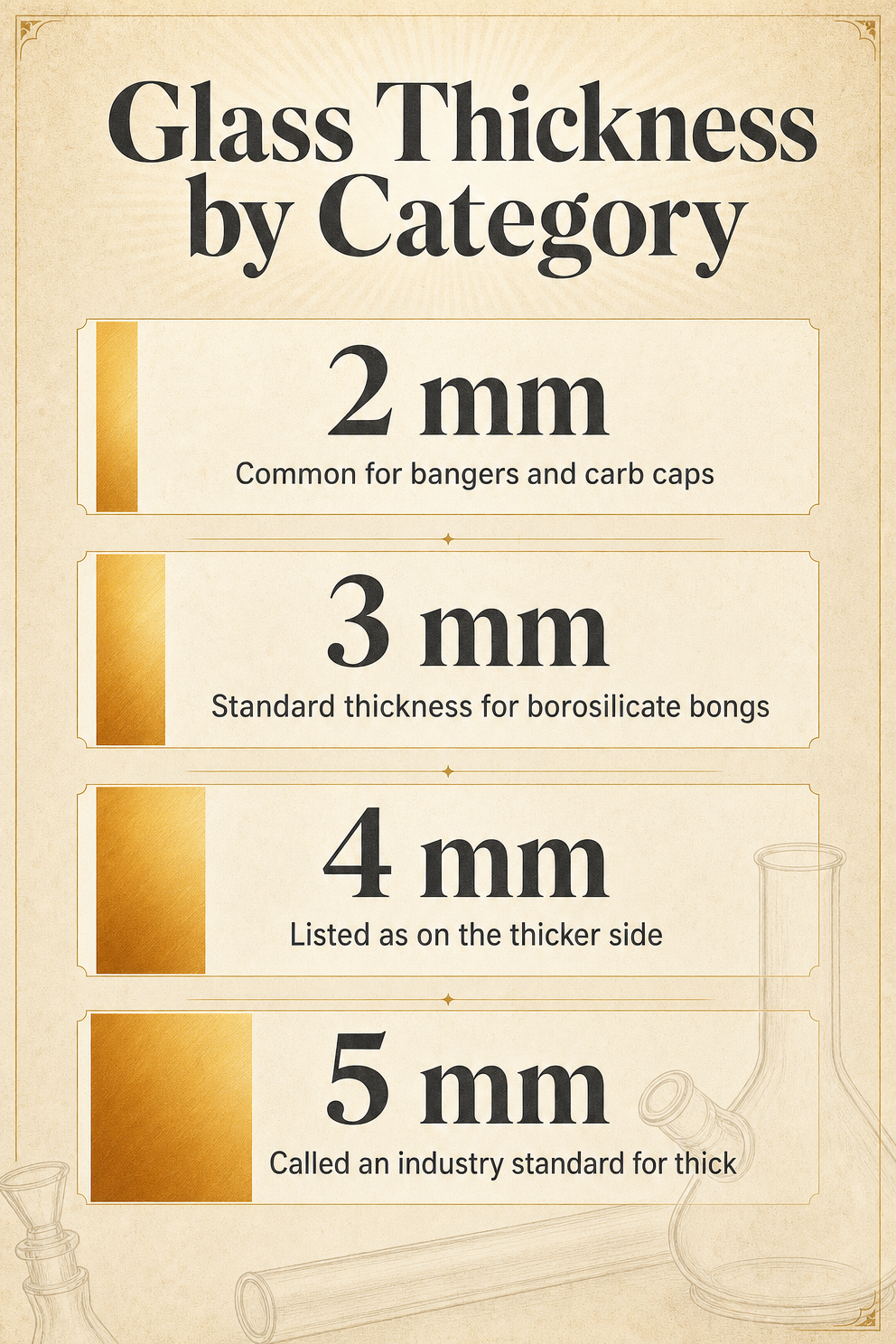
Thickness gets used as a shortcut for quality, and the category has a rough vocabulary for it. Glass thickness is measured in millimeters, and the range you will run into goes from about 2 mm to 9 mm depending on the part [8].
The common labels are simple. Around 2 mm is where small accessories such as bangers and carb caps sit. About 3 mm is called the standard thickness for borosilicate bongs. About 4 mm is described as on the thicker side, and 5 mm is called an industry standard for thick glass [8]. Each step adds weight, and a thicker wall usually raises the price for the same height.
Here is the part the shorthand hides. Retailers in the category say glass quality comes from the material and the skill of the blower, and that clean joint welds are the sign of skilled work. Their guidance is that higher quality glass beats merely thicker glass [8]. A 5 mm wall with a rough, poorly fitted joint is not a better piece than a 3 mm wall with an even weld.
So use thickness as one input, not as the verdict. Check the joints for even seams, look at the wall down the length of the tube, and ask whether the extra weight solves a problem you actually have or just adds grams to the shelf.
- 2 mm: the range dealers use for small accessories such as bangers and carb caps, where a thin profile is the point [8].
- 3 mm: the standard thickness cited for borosilicate bongs, and the baseline most pieces are compared against [8].
- 4 mm: called the thicker side, a step up in weight and often in price for the same shape [8].
- 5 mm: described as an industry standard for thick glass, and the point where a piece feels noticeably heavier in the hand [8].
- Past the number: check that the joint welds are even and the wall is consistent, because quality comes from material and workmanship rather than thickness alone [8].
| Thickness | What the category calls it | What it tells a buyer |
|---|---|---|
| About 2 mm | Accessory territory | Where bangers and carb caps sit, since a thin profile is the point [8] |
| About 3 mm | The standard for borosilicate bongs | The baseline most pieces in the category are compared against [8] |
| About 4 mm | On the thicker side | A step up in weight, and often in price for the same height [8] |
| 5 mm | An industry standard for thick glass | Noticeably heavier in the hand, but not automatically better made [8] |
What Joint Sizes and Parts Do Human Grade Pieces Use?
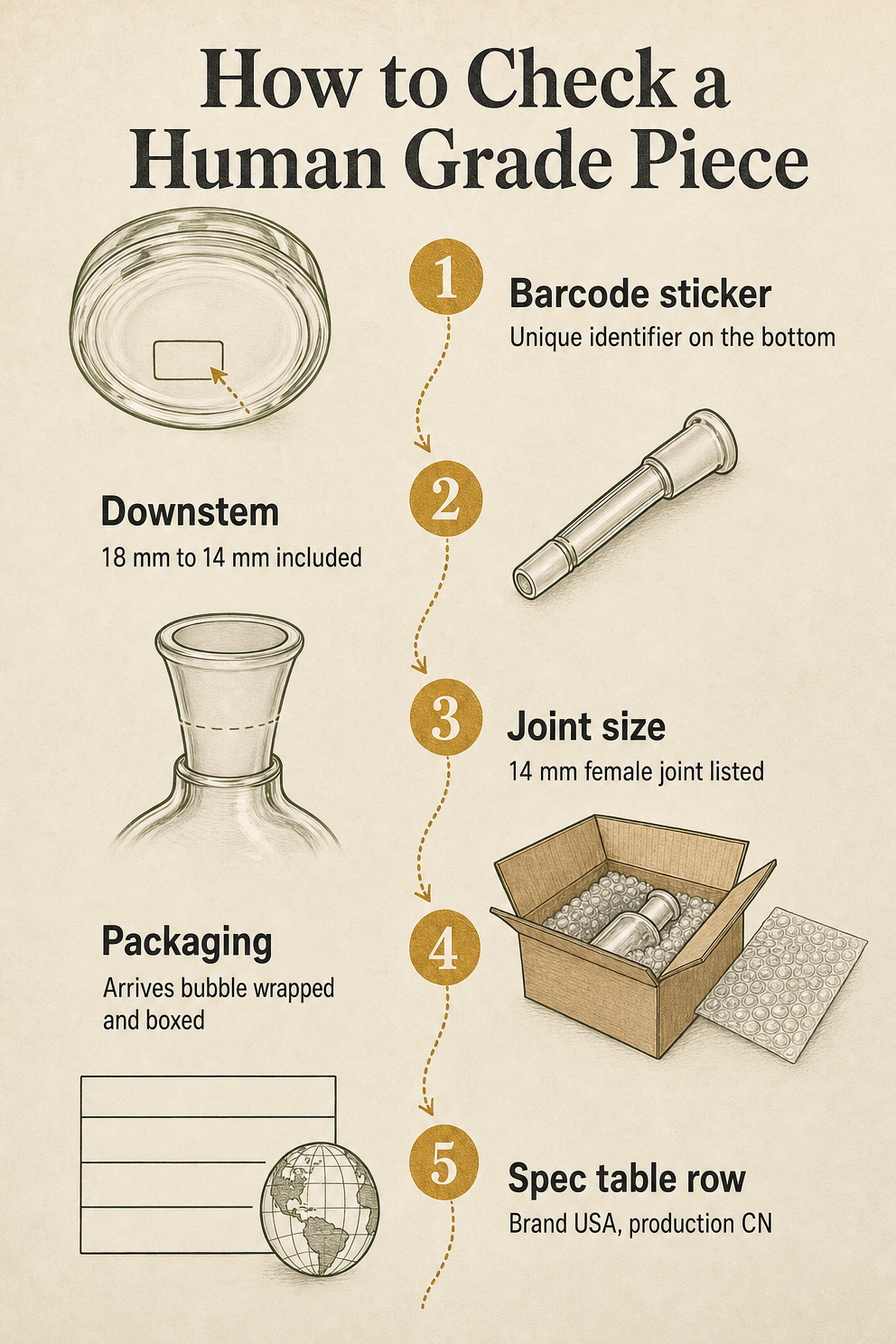
The published specs for the line are consistent and easy to plan around. A Human Grade beaker lists a 14 mm female joint, a 4.5 inch downstem and borosilicate construction, and it ships with an 18 mm to 14 mm downstem so the setup can be changed later [15]. A hand pipe in the same line lists a 15 mm bowl and a left-side carb [14].
It helps to know that laboratory glassware does not use those numbers. Lab glass joins with tapered ground joints sold by code, such as ISO 14/23, 19/26 and 24/29, or the US sizes 14/20, 19/22 and 24/40, and that standardization is what makes parts from different makers interchangeable [4]. Water pipes are sold by nominal joint diameter instead: 10 mm, 14 mm and 18 mm. It is the same idea expressed in two naming systems.
In practice, if a piece says 14 mm female, you want a 14 mm male accessory, and the included 18 mm to 14 mm downstem lets a larger joint accept a smaller bowl or banger. The 8 inch bent neck rig sold under the brand is listed with a 14 mm joint as well, compatible with the brand’s bangers [6].
Before ordering a replacement part, check three things: the joint diameter, whether the joint is male or female, and the downstem length. Match all three and the part drops straight in.
- Joint size first: the water pipes in this line are listed with a 14 mm female joint [15].
- Bowl size next: the hand pipes list a 15 mm bowl, which tells you which replacement bowls will fit [14].
- Check the downstem: an 18 mm to 14 mm downstem is included, so a larger joint can accept standard 14 mm parts [15].
- Match the accessory: 14 mm fittings pair with the brand’s bangers, and rigs in the line list the same joint size [6].
- Plan the extras: ash catchers, replacement bowls and downstems are part of the line, so replacements stay easy to find [7].
Why Does Some Human Grade Glass Change Color?
A piece that changes color is not made of color-changing glass. The effect usually comes from a thin layer of metal fumed onto the glass, and the color you see is light interacting with that layer rather than a pigment inside the material [10].
Silver fuming reads yellow-gold against a light background and pale blue against a dark one, so the same piece can look like two different colors depending on where it sits. As buildup forms behind the layer, the tone deepens toward purple and burnt sienna [10]. Gold fuming runs pink, peach and orange, and deepens toward burnt sienna as well.
Cleaning shifts the appearance back toward the lighter tones, because the metal layer itself has not changed; what was in front of it has [10]. That is why a fumed pipe looks different on day one, at month six, and after a soak. One retailer listing for this line describes a hand pipe as silver fumed borosilicate that changes color with use [7].
None of that says anything about thickness or build. A fumed finish is a visual treatment and a buying preference, not a signal of quality. If you like the effect, buy it for the effect. If you are comparing two pieces on construction, set the finish aside and read the measurements.
- Silver fuming reads yellow-gold on light backgrounds and pale blue on dark ones [10].
- Colors deepen toward purple and burnt sienna as buildup forms behind the metal layer [10].
- Gold fuming produces pinks, peach and orange tones that also deepen with use [10].
- Cleaning moves the appearance back toward the lighter tones, since the layer itself is unchanged [10].
- The finish is a visual choice, not a signal of a thicker wall or a better weld [7].
How Can You Tell a Real Human Grade Piece From a Copy?
There is no registry to look up, so the honest answer is that you verify what you can see. Dealers in this line point to a specific set of markers, and the same markers repeat across listings, which makes them useful even though they are not an official certification.
The clearest marker is on the bottom of the piece. One listing states that the piece arrives bubble wrapped and boxed with a unique barcode and a color identifier sticker at the bottom, and the retailer presents that sticker as the authenticity marker for the line [15].
The rest comes from the paper trail more than from the glass. Check the joint size the listing states, the bowl diameter, the included downstem, and the spec row that separates the brand from the country of production [6]. Then check who is selling it: the dealers reviewed describe themselves as authorized resellers or dealers for the products they sell [14].
One honest limit: a copy can reproduce a sticker. Verification here lowers risk; it does not prove origin. What you can confirm is that the piece matches the published spec and that the seller stands behind the sale.
- Look for the barcode sticker: listings describe a unique barcode and color identifier on the bottom of the piece [15].
- Check the packaging: the pieces are described as arriving bubble wrapped and boxed rather than loose [15].
- Confirm the included downstem: an 18 mm to 14 mm downstem is part of the beaker spec, and its absence is a mismatch [15].
- Read the numbers against the listing: a 14 mm female joint on the water pipes and a 15 mm bowl on the hand pipes [15] [14].
- Check the spec table row: brand, materials, manufacturer HQ and country of production answer four different questions [6].
- Buy from a seller that describes itself as an authorized reseller or dealer for the products it sells [14].
What Does the Human Grade Line Cover, and What Does It Cost?
The line is broad for a single brand, which is most of its appeal. It runs from small parts up to full-size water pipes, so you can build a setup or replace one piece without switching brands halfway through.
Dealer pages put hand pipes from about 13 to 26 dollars and water pipes and rigs from roughly 25 to 100 dollars, which lands the line in the budget to mid tier rather than the collector tier [7] [9] [11]. Brand copy frames it as gear that performs like high-end glass without the high-end budget [9]. On treehouse.lifestyle, a Human Grade 15 inch tube water pipe is listed at 46.99 dollars and filed under the store’s Human Grade brand page [12]. Free shipping on orders $150+ applies.
For a first piece, the Hand Pipes and spoon pipes are the low-cost entry, and beaker or straight-tube water pipes are the mid-step. For dab setups, the matrix percolator rigs and recyclers sit at the top of the line’s range, with bangers and carb caps sold as separate parts. Replacement downstems and bowls mean one cracked part does not retire the whole piece.
That spread is the real argument for the brand. You are not buying a certification; you are buying a consistent parts family at a price that keeps a full setup affordable. Check the joint, the wall and the spec row before you buy, and the name on the box becomes a convenience instead of a claim.
- Hand pipes: spoon and sherlock shapes from about 13 to 26 dollars, the entry point to the line [7].
- Water pipes: beaker and straight tubes from about 25 to 100 dollars, including a 15 inch tube at 46.99 dollars on treehouse.lifestyle [12].
- Rigs: matrix percolator rigs, recyclers and oil cans for dab setups, plus bangers and carb caps [9].
- Bubblers and ash catchers: sidecar bubblers and ash catchers that extend a piece you already own [7].
- Parts and tools: replacement downstems, bowls and 4-piece aluminum grinders round out the lineup [11].
- Shipping: free shipping on orders $150+.
| Piece type | Typical price | Notes |
|---|---|---|
| Hand pipes (spoon and sherlock) | About 13 to 26 dollars | The entry point to the line, including fumed colorways listed at 20 dollars [14] |
| Water pipes (beaker and straight tube) | About 25 to 100 dollars | A 15 inch tube is listed at 46.99 dollars on treehouse.lifestyle [12] |
| Dab rigs (matrix perc, recycler, oil can) | About 25 to 100 dollars | Bangers and carb caps are sold as separate parts [9] |
| Parts and accessories (downstems, bowls, grinders) | From about 4 dollars | Replacement parts keep one cracked piece from retiring the setup [9] |
Frequently Asked Questions
Is human grade a regulated standard for smoking accessories?
No published standard of that kind exists for smoking accessories. The two words are formally defined in pet food labeling, where AAFCO’s human grade guidelines allow the claim only for the product as a whole and require every ingredient and the finished product to be handled under 21 CFR part 117 [5]. In this category the same two words appear as a brand name, so read them as a label rather than a certification.
Where is Human Grade glass actually made?
The dealer spec tables reviewed for this line list the brand as Human Grade and the manufacturer headquarters as USA, while listing the country of production as CN on the same row [6]. That row is the clearest available answer, and it is why a brand name should not be read as a statement about origin.
Is Human Grade glass really borosilicate, and what does borosilicate 3.3 mean?
Brand and dealer pages describe the line as borosilicate glass, and borosilicate 3.3 is a real named material grade defined by DIN ISO 3585, typically composed of about 81 percent silicon dioxide and 13 percent boron trioxide [3]. That grade number is what a material specification refers to, and none of the pages reviewed for this line cites a published test report for the pieces themselves.
Do Human Grade pieces use laboratory joint sizes?
No. Laboratory glassware joins with coded tapered ground joints such as ISO 14/23, 19/26 and 24/29, or the US codes 14/20, 19/22 and 24/40 [4]. Water pipes are sold by nominal joint diameter instead, such as 10 mm, 14 mm and 18 mm. Human Grade pieces are listed with a 14 mm female joint and an included 18 mm to 14 mm downstem, which follows the water pipe convention [15].
How much does Human Grade glass cost compared with other options?
Across dealers the hand pipes list from about 13 to 26 dollars and the water pipes and rigs from roughly 25 to 100 dollars, which puts the line in the budget to mid tier rather than the collector or heady glass tier [7] [9]. A Human Grade 15 inch tube water pipe is listed on treehouse.lifestyle at 46.99 dollars [12].
So Is Human Grade Glass Worth It?
It is worth it if you read the name correctly. Human Grade is a brand, not a certification, and the spec tables carrying the line say so plainly by listing the brand as Human Grade and the country of production as CN on the same row [6].
The material claim holds up as far as it goes. Borosilicate is genuinely the heat-tolerant glass of the two common types, and borosilicate 3.3 is a real named grade under DIN ISO 3585 with a typical composition of about 81 percent silicon dioxide [3].
What you should not expect is a lab certificate. Neither the brand pages nor the dealer listings reviewed for this line cites a published materials or emissions test report, so the honest verdict rests on what you can check in your hands: even joint welds, a consistent wall, a listed joint size that matches your parts, and the spec row that separates brand from origin.
At about 13 to 26 dollars for hand pipes and roughly 25 to 100 dollars for water pipes and rigs, the line competes on price and parts availability rather than on prestige [7]. Read it as a budget to mid tier parts family. If you want a certificate, you will not find one here, and you will not find one for most of this category either.
Start with the piece you will actually use. Check the joint, check the wall, check the seller, and read the name on the box as a label rather than a promise.
Sources
- Wikimedia Foundation (Wikipedia): Borosilicate glass
- Wikimedia Foundation (Wikipedia): Soda-lime glass
- Lenz Laborglas (DURAN borosilicate 3.3 technical information): Information about DURAN
- Wikimedia Foundation (Wikipedia): Ground glass joint
- Association of American Feed Control Officials (AAFCO): Guidelines for "Human Grade" Pet and Specialty Pet Food Claims
- TVape: Human Grade 8 inch Bent Neck Dab Rig
- DankGeek: Human Grade Sherlock Model D
- Smoke Cartel: Glass Thickness And Quality
- DiscreetSmoker.com: Human Grade collection
- Boro Mastery: Fuming Metals: Silver, Gold & Platinum for Color-Changing Glass
- Headshop.com: Human Grade Glass & Accessories
- Treehouse Lifestyle: Human Grade 15 inch Tube Glass Water Pipe
- Aqua Lab Technologies: Human Grade Glass
- VGEAR: Human Grade Fleur Hand Pipe
- DiscreetSmoker.com: Human Grade 6 inch Beaker Water Pipe