
Yes, glow in the dark bongs really work. The glow comes from phosphorescent pigments, usually strontium aluminate, embedded in borosilicate glass that charges from ordinary light and keeps glowing for minutes or hours after the lights go out. The piece is still a working water pipe, and a modern borosilicate build with non-radioactive strontium aluminate is suitable for everyday use.
There is also a common mix-up in the marketplace. Many people call any piece that lights up in a dark room a glow in the dark bong, but sellers do not always use the two main labels, glow in the dark versus UV reactive, the same way. The next two sections sort out the difference and the science behind it, so the rest of the guide can focus on materials, generations of pigment, and what to check before you spend money.
How Does a Glow in the Dark Bong Actually Work?
The glow in a true glow in the dark bong comes from phosphors. A phosphor is a material that absorbs energy from light and then slowly releases that energy as visible light over time. The bright flash you see in the room, then the slow fade over the next few minutes, is the phosphor giving back the energy it stored while you had the lights on. Phosphorescence is the name for this delayed release, and it is the same basic effect you see on a glow in the dark watch face or a star sticker on a bedroom ceiling. The pipe, the bong, and the pigment inside the glass are all running the same trick [1] [7].
This is different from fluorescence, which is the other way glass can appear to glow. A fluorescent material only gives off light while a UV or blacklight source is shining on it. The instant you turn the blacklight off, a fluorescent piece goes dark. Phosphorescent glass keeps glowing on its own for a while. That is the simple test you can do at home: charge the piece in normal light, kill the lights, and watch what happens. If the piece fades out within a second or two, it was reacting to a UV source. If it keeps glowing for minutes, the pigment is doing the work on its own [7].
What charges the pigment matters just as much as what the pigment is made of. Sunlight is the strongest everyday charger, and a few minutes in a sunny window is often enough to get a strong afterglow. Bright LED room lights and halogen lamps also work well. Soft warm light from a lamp will still charge a phosphor, but it takes longer and the glow is usually weaker. Once a piece has been charged, the length of the visible glow depends on the pigment grade, how thick the pigment layer is, and how much energy the glass absorbed. Higher grade strontium aluminate pigments can stay visible for several hours in a totally dark room, while older zinc sulfide pigments fade out much faster [1] [2].
If you are new to glowing glass and want to read more about how water pipes work in general, our guide on the different What Are the Different Types of Bongs? types of bongs is a good place to start.
- Phosphorescence is a delayed release of light: the pigment stores energy from a light source and keeps glowing after the light is removed.
- Fluorescence only works while a UV or blacklight source is shining on the glass. Turn the UV light off and the effect stops.
- Sunlight, bright LED room lights, and halogen lamps all charge phosphorescent pigments. Stronger and bluer light charges them faster.
- Modern strontium aluminate pigments can glow visibly for several hours, while older zinc sulfide pigments fade out in minutes.
What Is the Difference Between Glow in the Dark and UV Reactive Glass?
Glow in the dark and UV reactive are two labels for two different effects, but the marketplace does not always use them cleanly. A piece that is truly glow in the dark will charge from ordinary light and keep glowing in a dark room. A piece that is UV reactive will only light up while a UV or blacklight source is pointed at it. The confusion starts when a single piece does both, and sellers use whichever label sounds more appealing in the listing. Knowing the difference helps you avoid buying a piece that only does the trick you did not actually want [1] [2].
The science on the user side is simple. Phosphorescence keeps emitting light on its own after the charger is removed, because the pigment stores energy and slowly releases it. Fluorescence does not store energy in the same way. It only re-emits light while energy is being pumped in, which is why a UV reactive piece goes dark the moment you turn the blacklight off [7].
What you see in person is different too. UV reactive glass often looks much more dramatic in the moment because the UV source is dumping energy straight into the pigment. A phosphorescent piece looks gentler at first, because the pigment is only releasing what it already stored, but the effect lasts. If you are choosing between the two for everyday novelty, true phosphorescent glass usually gives you more flexibility, because you do not need a blacklight on hand to enjoy the effect. If you want the bright, in-the-moment pop at a party, UV reactive glass does that better.
The labels get muddied in listings, and a single piece can fall into both camps. For a closer look at how bubbler and bong glass differ in everyday use, our piece on the difference between a What Is the Difference Between a Bubbler and a Bong? bubbler and a bong walks through the practical side of glass choice.
- Glow in the dark = phosphorescent glass that charges from ordinary light and keeps glowing in the dark for minutes to hours.
- UV reactive = fluorescent glass that only glows while a blacklight or UV source is shining on it.
- A single piece can use pigments that do both, which is why sellers sometimes use either label.
- UV reactive glass looks brighter in the moment under a blacklight. Glow in the dark glass is more flexible because no special light is needed.
| Feature | Glow in the Dark (Phosphorescent) | UV Reactive (Fluorescent) |
|---|---|---|
| Charges from | Sunlight and ordinary room light | UV or blacklight source |
| Glows without the light on? | Yes, for minutes to hours | No, goes dark immediately |
| Visible duration | Minutes to several hours | Only while UV source shines |
| Best for | Everyday novelty, no extra gear | Bright party pop with a blacklight |
What Are Glow in the Dark Bongs Made Of?
Almost every modern glow in the dark bong starts as a piece of borosilicate glass. Borosilicate is the same family of glass used in lab beakers, kitchenware, and most quality water pipes, because it handles heat and cold much better than regular soda lime glass. That matters for a water pipe, since the glass goes through warm water, cold rinses, and the small temperature swings of normal use without cracking. Corning’s own technical background on borosilicate glass describes this resistance to thermal shock, which is one of the reasons glass artists prefer it for functional pieces [8].
The glow itself comes from a phosphor powder, almost always strontium aluminate in a modern piece. The glassblower gathers a small amount of molten borosilicate on the end of a rod, then rolls that gather in the phosphor powder so the powder sticks to the outside of the hot glass. The piece is then re-fused and shaped, which traps a layer of phosphor inside the glass or fuses it to the surface. Doing this at glassblowing temperatures is a balancing act. The pigment has to survive the heat, the glass has to stay clear, and the two have to bond well enough that the pigment does not just rub off later. Skilled makers match the pigment grade to their torch setup so the finished piece glows evenly and stays intact [1] [3].
After the shape is set, the piece goes into a kiln for annealing. Annealing is a slow, controlled cool down that removes stress from the glass. Without it, the piece can crack days or weeks later from internal tension. The final steps are grinding the joint, polishing the mouthpiece, and any decorative work the maker adds. A well-made glow bong is a layered build: a borosilicate body, a phosphor layer, and careful annealing on top.
To see the full range of bong styles and shapes that use this kind of construction, you can browse our Bongs bongs category, which covers everything from simple beaker bases to more elaborate recycler designs.
- Start with a borosilicate base glass gathered on the end of a glassblower’s rod.
- Roll the hot gather in phosphor powder so the pigment sticks to the outside of the molten glass.
- Re-fuse and shape the piece so the pigment is sealed into or onto the surface of the glass.
- Anneal the finished piece in a kiln to remove internal stress before the final grinding and polishing.
Which Generation of Glow Pigment Is in Your Glass?
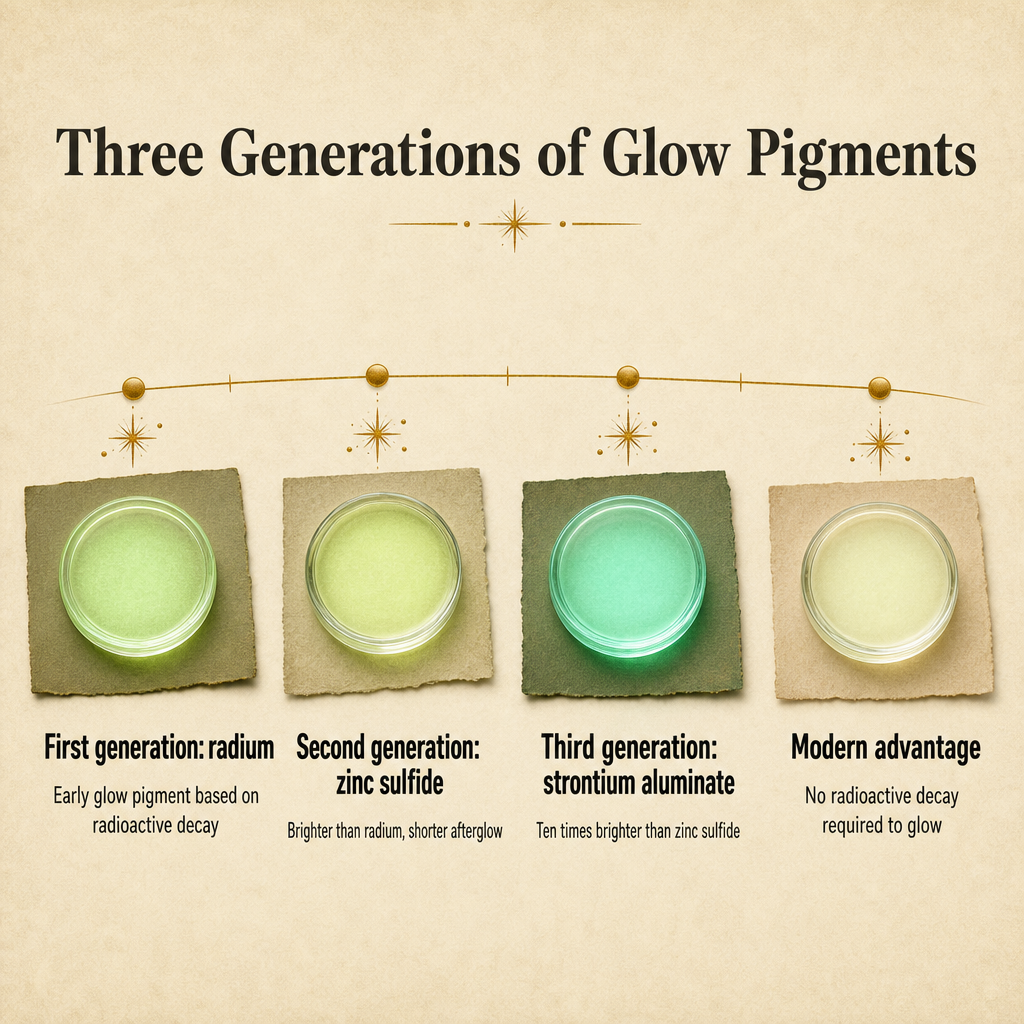
Glow pigments have gone through three rough generations, and which one is in a piece of glass tells you a lot about how it will perform. The first generation relied on radium, which is radioactive. The second generation moved to zinc sulfide, which is non-radioactive but only glows for a short time. The third generation is strontium aluminate, which is non-radioactive, much brighter, and holds its afterglow far longer. Modern glow in the dark glass is almost always the third generation, but the older generations still show up in vintage pieces and curiosities [3] [6].
The shift away from radium was driven by safety. Radium glows because it is constantly breaking down and giving off radiation, which is also why it is dangerous to handle. Promethium, another radioactive element, was used for a while in specialty applications for the same reason. The pigment industry moved away from these materials once the health risks were understood, and the modern era of glow materials is built on safer chemistry that does not depend on radioactive decay at all.
The jump from zinc sulfide to strontium aluminate is the one most shoppers will actually feel. Strontium aluminate pigments are roughly ten times brighter and last far longer in the dark than zinc sulfide, which is why a modern piece can stay visible for hours while an older piece fades in minutes. Both are non-radioactive, so the question is not safety but performance. If a vintage piece in your collection glows for only a few minutes, that is the pigment talking, not a defect [6].
For a wider look at how glass compares to other water pipe materials, our guide on Glass vs Silicone Bong: Which Material Should You Actually Buy? glass vs silicone bong walks through the practical differences between the two.
- First generation: radium-based pigments, now considered unsafe and not used in modern functional glass.
- Second generation: zinc sulfide pigments, non-radioactive but with a short afterglow measured in minutes.
- Third generation: strontium aluminate pigments, non-radioactive, roughly ten times brighter, and visible for hours.
- Modern advantage: the afterglow comes from stored light energy, not from radioactive decay, so the material is safe for everyday handling.
What Materials Should You Look for in a Glow in the Dark Bong?
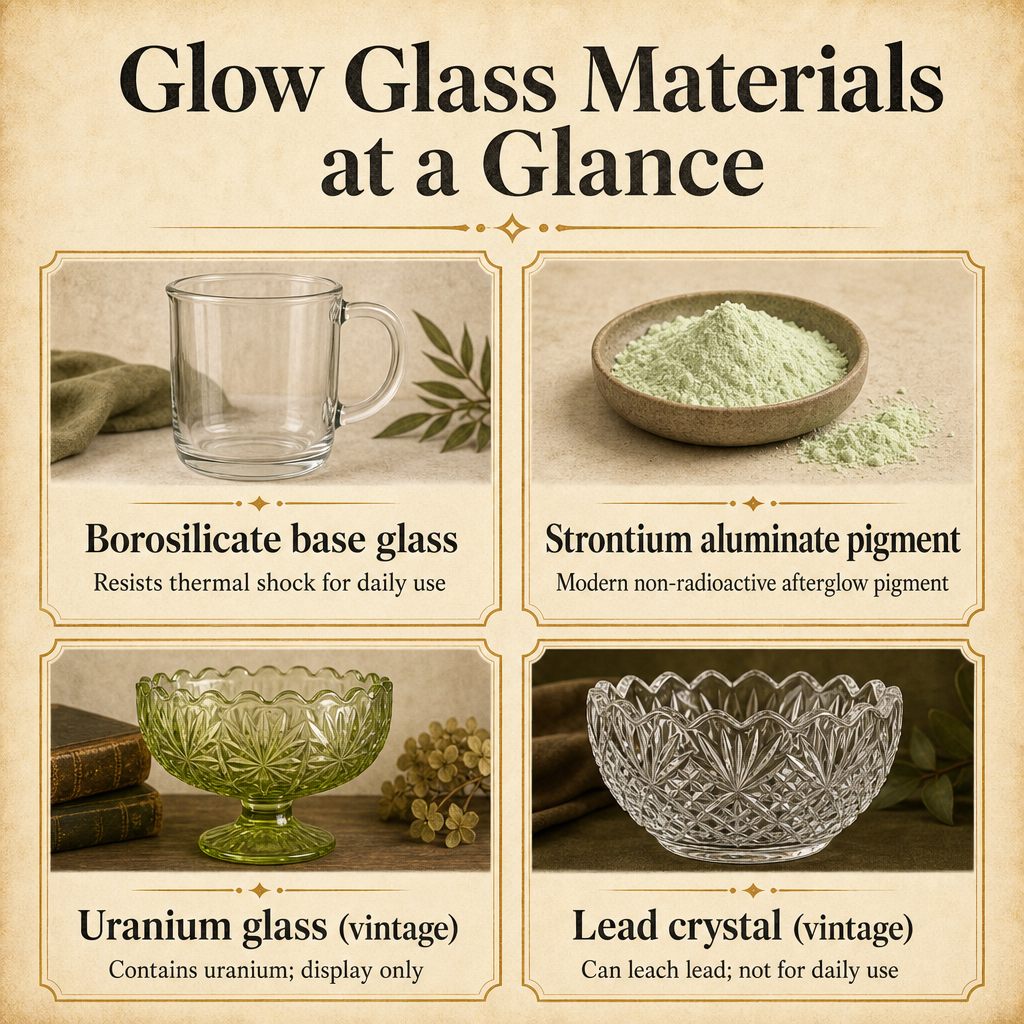
The buying question for any glow in the dark bong is really a materials question. The piece has two materials that matter: the base glass that makes up the body, and the phosphor that creates the glow. A modern piece should pair borosilicate glass with a strontium aluminate pigment. That combination gives you the thermal shock resistance you want from a daily water pipe, and the long-lasting afterglow that makes the novelty worth the money. If a listing does not name the base glass or the pigment, that is a fair question to ask before you buy [1] [8].
Borosilicate has been the standard for quality water pipes for years because it holds up to temperature swings, daily handling, and routine cleaning. Strontium aluminate has become the standard for glow pigments because it does not rely on radioactive decay, it is brighter than older zinc sulfide, and it keeps glowing for hours. Together they make a piece that you can use like a normal bong and still enjoy the glow effect when the lights go down. The pigment is fused into the glass, not painted on, so a well-made piece does not lose its glow to scrubbing [1] [3].
The materials to be more careful with are older or vintage pieces, especially anything that might be made from leaded glass or uranium glass. Uranium glass was a popular collectible for decades, and it does glow under UV light, but experts recommend keeping these pieces as display items rather than functional water pipes. The same caution applies to lead crystal, where the FDA notes there is no known safe level of lead exposure from foodware and similar surfaces, which is why decorated glass with lead content is generally kept away from anything that gets regular handling [4] [5].
For shoppers who want a piece they can actually use, sticking to a labeled borosilicate build with a modern pigment keeps things simple. If you want to compare what is available in borosilicate form, our Glass Bongs glass bongs subcategory has a range of options that all use the same base glass family.
- Look for borosilicate as the base glass, which resists thermal shock and is the standard for quality water pipes.
- Look for strontium aluminate as the phosphor, since it is non-radioactive, brighter, and longer-lasting than older pigments.
- Avoid vintage uranium glass, lead crystal, and similar materials for active use, and keep those pieces as display only.
- Follow the individual maker’s cleaning instructions, because the pigment layer can be sensitive to harsh abrasives or extended soaking in strong solvents.
What About Vintage Glow Glass With Lead or Uranium?
Vintage glowing glass is a separate category from modern glow in the dark bongs, and the materials matter. The four main categories that show up in collector circles are uranium glass, vaseline glass, lead crystal, and cadmium glass. All of them can glow under the right light, and all of them come with handling notes that suggest display rather than daily use. House Digest’s rundown of vintage glowing glass walks through these categories and the caution that goes with each one [4].
Uranium glass is the most famous of the group. It contains actual uranium oxide, which is what gives it the greenish glow under UV light. It is collectible and genuinely beautiful in the right light, but the radioactivity is real even if it is low. Vaseline glass is a related category with a similar yellow-green glow, sometimes also containing uranium. Lead crystal is a broader category of decorative glass that can leach lead over time, and the FDA’s guidance on lead in foodware is clear that there is no known safe level of lead exposure from surfaces that get regular contact [5].
Cadmium glass is the fourth category, prized for its warm yellow and orange tones. Cadmium is a heavy metal with its own handling notes, which is why older cadmium pieces are also generally kept as collectibles rather than functional ware. The common thread across all four categories is that the materials that make them glow are the same materials that make them worth keeping out of daily rotation. If you own or inherit a piece like this, the safest move is to enjoy the glow in a display case and not load it up for use [4].
Modern pieces do not have these tradeoffs, since the pigments and base glasses are chosen specifically to avoid them. If you want the glow effect without the vintage concerns, a contemporary borosilicate build is the simpler path. The Hemper Alien Glass Water Pipe | 14mm F Hemper Alien Glass Water Pipe is a good example of a modern borosilicate piece that keeps the materials straightforward.
- Uranium glass: contains uranium oxide, glows green under UV, and is generally treated as a collectible rather than a functional piece.
- Vaseline glass: a related yellow-green glass, sometimes also containing uranium, with the same display-only recommendation.
- Lead crystal: a broader decorative category that can leach lead, and the FDA notes there is no known safe level of lead exposure from foodware.
- Cadmium glass: prized for warm yellow and orange tones, but the cadmium content means it is also typically kept as a display piece.
How Do You Pick and Care for a Glow in the Dark Bong?
Picking the right glow in the dark bong comes down to a small checklist. Confirm the base glass is borosilicate. Confirm the pigment is a modern non-radioactive strontium aluminate. Match the size and shape to how you actually plan to use it, since a tall straight tube and a small beaker base feel very different in the hand. If the listing does not say, ask. A maker who is proud of their materials will usually answer quickly, and a seller who cannot tell you what is in the piece is a reason to look elsewhere [1].
Caring for a glow piece is mostly the same as caring for any borosilicate water pipe, with one extra step for the glow. Standard cleaning routines work on the base glass, and borosilicate handles thermal shock well enough for the usual isopropyl alcohol and salt routine, or a mild cleaning solution designed for glassware. The extra step is the charging routine. A few minutes under a bright light before you want to see the glow will make the effect much stronger, and the pigment will hold that energy for hours [8].
Storage matters too. Direct sunlight will keep a phosphor topped up, but it can also slowly degrade the pigment over the years, which is why long term display cases usually keep glowing glass out of bright light. A drawer or a shelf away from the window is a better home for a glow piece you want to keep looking good. The same goes for extreme heat, which is one more reason to keep the piece somewhere with stable room temperature rather than in a hot car or near a heater.
If you are looking for a piece that is built to be used, the Pulsar Greatest Hits Series Glow Herb Pipe Duo / 10" / 14mm F Pulsar Greatest Hits Series Glow Herb Pipe Duo is an example of a modern glow piece designed for everyday handling. Picking well and caring for the piece goes hand in hand: the better the materials on day one, the more the glow keeps working on day one hundred.
- Confirm the base glass is borosilicate and the pigment is a modern non-radioactive strontium aluminate.
- Match the size and shape to your use case, since a tall tube and a small beaker base feel very different.
- Charge the piece under a strong light for a few minutes before you want to see the glow at its best.
- Follow the maker’s cleaning instructions and store the piece away from direct sunlight and extreme heat to keep the pigment in good shape.
Frequently Asked Questions
How long does the glow last on a glow in the dark bong?
Modern strontium aluminate pigments can keep glowing visibly for minutes to several hours after a strong light charge, which is roughly ten times longer than older zinc sulfide pigments. The exact duration depends on the pigment grade, how thick it is layered into the glass, and how much light it absorbed.
Do glow in the dark bongs need a UV light to glow?
No. True phosphorescent glow in the dark glass charges from ordinary light, including sunlight and room lighting, and then keeps glowing after the light is removed. UV reactive or blacklight glass only lights up while a UV source is shining on it.
Are glow in the dark bongs radioactive?
Modern glow in the dark glass uses strontium aluminate pigments that are not radioactive and were developed specifically to replace older luminescent materials that relied on radioactive elements like radium and promethium. Only some vintage glowing glass, such as certain uranium glass pieces, contains radioactive material.
Can you clean a glow in the dark bong like a regular bong?
Yes, the borosilicate base glass handles standard cleaning routines and resists thermal shock, but you should follow the individual maker’s instructions because the pigment layer can be sensitive to harsh abrasives or prolonged soaking in strong solvents.
Why do some sellers call the same piece both glow in the dark and UV reactive?
Industry terminology is inconsistent. Some pieces use phosphorescent pigments that also happen to fluoresce under UV, while others only respond to UV light. When in doubt, ask the seller what pigment the piece uses and what kind of light charges it.
Is a Glow in the Dark Bong the Right Pick for You?
Glow in the dark bongs are a real, working novelty, and the science behind the effect is well understood. A modern piece built from borosilicate glass and a strontium aluminate pigment charges from ordinary light, glows for hours in a dark room, and does not rely on any radioactive material to do it. The thing to watch for is older or vintage glowing glass, which can carry materials like uranium or lead that are better kept as display pieces than as daily water pipes.
If you want the glow effect and the everyday usability, stick to modern borosilicate builds, ask the seller about the pigment if the listing is vague, and handle the piece with the same care you would give any quality water pipe. Treehouse Lifestyle carries a range of glass bongs and related glassware if you want to browse options, with free shipping on orders $150+. For a deeper look at the broader world of bongs, our guide on the different types of bongs is a good next read.
Sources
- Badass Glass: Glow in the Dark Glass Pipes: How are They Made?
- Smoke Cartel: UV Reactive Glass Pipes: Glow Under Blacklight
- GlowUp Pigment (Jolin Corporation): Why Strontium Aluminate (YGZ) Replaces Zinc Sulfide
- House Digest: 6 Types Of Vintage Glass That Can Glow In The Dark
- U.S. Food and Drug Administration: Lead in Food and Foodwares
- Wikipedia: Strontium aluminate
- Wikipedia: Phosphorescence
- Corning: PYREX Brand Glass Products