

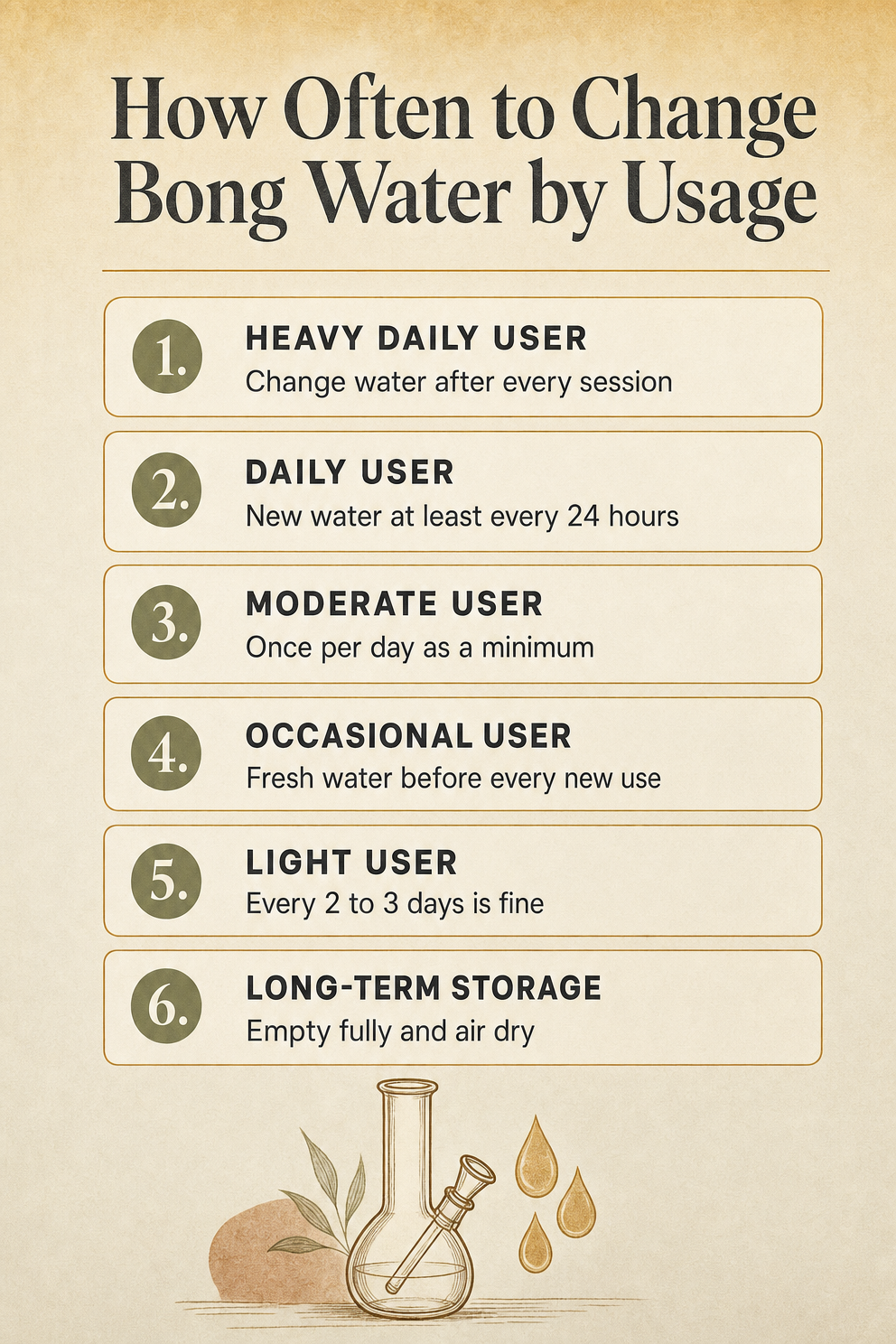
Change your bong water at least once every 24 hours, and swap it after every session if you use a water pipe daily. Occasional users can fill fresh before each new use, with two to three days as the outside limit, and a bong going into storage should be emptied completely and left to air dry.
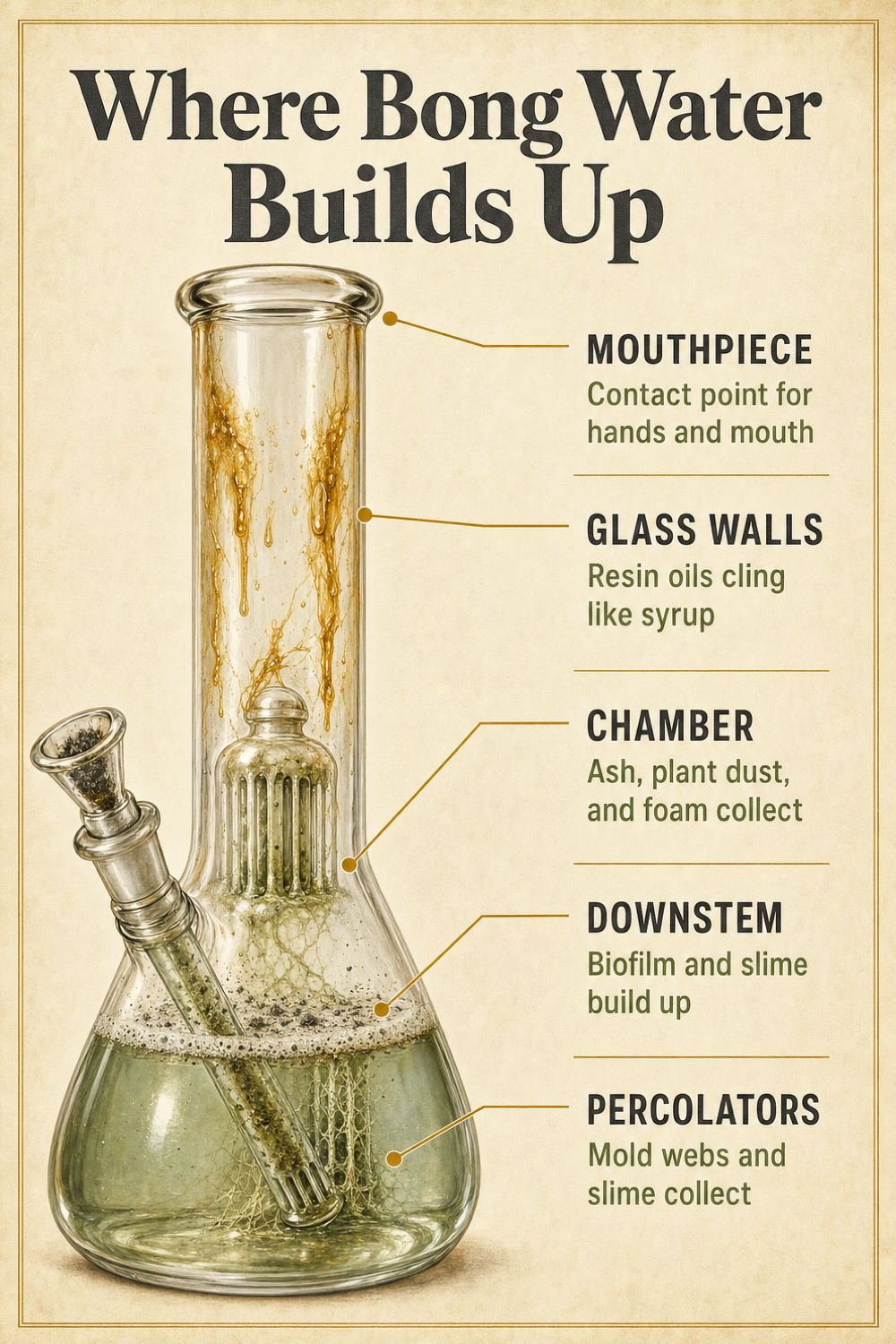
The reason is not complicated. The moment you take a draw, that water becomes a collection point. Ash and plant dust fall through the downstem, resin oils cling to the glass around the water line, and saliva, airborne mold spores, and bacteria land in the chamber. Left alone, that mix turns into biofilm, a slimy layer that sticks to the glass and works its way into percolators and downstems where a simple rinse will not reach it.
Within a day, retailer guidance states that standing water can begin harboring bacteria and mold, and the cues show up fast: a stale or sour smell, a draw that feels heavy rather than easy, floating ash, foam or a dark tint in the chamber, and mold webs in the percs. Fresh water is the cheapest maintenance habit there is, and it does not replace a proper clean of the glass.
This guide covers the cadence by usage level, what builds up in a used bong and how quickly, the signs that mean it is time, what liquids belong in the chamber, and how water changes fit alongside a weekly glass clean.
How Often Should You Change Bong Water?
The short answer is daily at minimum, and sooner if you use the piece more than once a day. Specialist retailers publish slightly different tables, but they agree on the ceiling: bong water should be changed at least once every 24 hours, and daily users are told to swap it after every session rather than once a day [5].
Heavier use gets the tightest recommendation. Moderate users are told once per day as a minimum, occasional users before every new use, and light users every two to three days [9]. Those tiers are guidance rather than a hard line, and the habit behind all of them is the same: start every session with water you would be willing to pour out and refill.
One glass specialist frames a quick rinse and refill between sessions as the easiest maintenance habit to keep, because it means the water never sits long enough to pick up a smell [6]. That is also the advice that makes the rest of this guide easier to follow. The interval shrinks the moment the water looks or smells off, no matter which tier you fall into.
A word on the ceiling itself: the 24-hour figure comes from retailer care guidance rather than a controlled study, so see it as a practical rule of thumb rather than a measured threshold. The direction of the advice is what matters, and every source points the same way — shorter intervals for heavier use, fresh water before any session you care about, and nothing left standing in the chamber when the piece goes back on the shelf.
If you are stocking up on the basics that keep the routine quick, a Cleaning Supplies kit and a spare set of screens take most of the friction out of a daily swap. If you are shopping for a second piece so one can soak while the other is in use, it helps to browse Bongs with a beaker or straight tube in mind, since wider chambers are easier to rinse and refill. Readers who want the bigger picture on how water pipe care fits with everything else in a kit should read How Often Should You Clean Smoking Accessories? before the next round.
- Heavy daily user — change the water after every session, not once a day.
- Daily user — new water at least every 24 hours.
- Moderate user — once per day as a minimum.
- Occasional user — fresh water before every new use.
- Light user — every two to three days is acceptable.
- Long-term storage — empty the piece completely and let it air dry.
| Usage Level | How Often to Change | Why the Interval Is That Short |
|---|---|---|
| Heavy daily use, several sessions a day | After every session | Each session adds ash, plant dust, resin oils, and saliva to the chamber |
| Daily use, about one session a day | At least once every 24 hours | Retailer guidance puts the point where standing water can harbor growth at about a day |
| Moderate use, a few times a week | Once per day as a minimum | Water sits between sessions long enough to pick up a smell |
| Occasional use | Fresh water before every new use | Old water may have sat for weeks, so plan a fresh fill every session |
| Light use | Every two to three days at the outside | Less material enters the water, but the chamber is never untouched |
| Long-term storage | Empty fully, then air dry | A filled chamber on a shelf is the worst case for buildup |
What Happens to Bong Water If You Leave It In?
Follow the water from a fresh fill and you can see why the cadence is tight. Right after a session the chamber holds ash and plant dust that fell through the downstem, resin oils coating the glass above and below the water line, and whatever arrived from the air, your hands, and your mouth [5].
Retailer guidance states that stagnant water can begin harboring bacteria and mold within 24 hours, and over the following days the mix thickens into biofilm — a slimy layer that sticks to the glass, the percolators, and the downstem [9]. A chamber that has been sitting for a week usually announces itself: a dark tint in the water, a ring of foam at the water line, and glass that feels tacky above the fill level.
A cannabis testing laboratory ran a small experiment that makes the point concrete. It sampled water from two water pipes every other day for two weeks — one week with the water left unchanged, one week with daily changes — plated the growth, and identified a range of fungal organisms including C. coatesiae, E. nigrum, and R. mucilaginosa [3]. The lab concluded that organisms reach bong water through routine use, whether from the material itself, from the air, or from the mouth and hands of the person using the pipe, and recommended the water be exchanged frequently, especially for immunocompromised cannabis users.
None of that requires special equipment to notice. The water itself is the instrument, and it hands you the timeline in plain view. If the buildup has already reached the percs, a dump and rinse is not going to solve it — that is a clean, and How Do You Clean a Bong the Right Way? covers the full routine.
It also helps to know what you are working with. Chambers, downstems, and percolators trap material in different places, and the SILICONE BEAKER BONG WITH REMOVABLE GLASS BOWL breaks down into removable parts that are easier to rinse than a fixed single unit.
- Session ends — ash and plant dust settle, resin oils film the glass, and saliva plus airborne spores land in the chamber.
- Within 24 hours — retailer guidance says standing water can begin harboring bacteria and mold.
- A few days in — biofilm thickens on the glass, the downstem, and the percolators, where a plain rinse will not reach.
- Around day three to day five — the water picks up a dark tint, foam forms at the water line, and the smell turns stale.
- A week or more — mold webs and slime trails show in the percs, and resin has bonded to the glass like syrup.
- Long-term storage — leaving a full chamber on the shelf for weeks is the worst version of this timeline; empty and dry it instead.
How Can You Tell When Bong Water Needs Changing?
Time to change it translates into a handful of things you can see and smell with no equipment at all. The documented cues are a stale or sour smell coming off the chamber, a draw that feels thick or heavy rather than easy, floating ash on the surface, foam or a dark tint in the water, mold webs or a slime trail in the percolators and downstem, and resin clinging to the glass [5].
Some cues appear before others. Smell usually goes first, then the tint and the foam. Mold webs and slime are the late signal, and they matter because they sit below the water line where a dump and rinse will not reach — when you see them, the weekly deep clean is already due rather than optional.
There is also a glass-side cue worth watching. Resin left to bond to the glass is far harder to remove later, which is why cleaning guides recommend lifting it before it sets and why a quick rinse and refill between sessions pays off [6]. If the glass above the water line feels tacky, you are already past a water change.
Readers who want to understand how the internal parts work — and why percs and downstems are the hardest spots to keep clear — will get more out of What Is a Percolator Bong and How Does It Work?. The wrap-up rule for anyone who genuinely cannot smell anything: if you have to ask whether the water is still good, it is not.
- Smell — a stale or sour note coming off the chamber instead of nothing at all.
- Draw feel — thicker or heavier than a fresh fill, a sign the airway is restricted.
- Surface — floating ash, a film, or foam sitting at the water line.
- Colour — a dark tint in water that was clear when you poured it in.
- Percs and downstem — visible mold webs or a slime trail below the water line.
- Glass — resin clinging to the walls like syrup, or a tacky feel above the fill level.
Does Changing the Water Replace a Deep Clean of the Glass?
No. A water change only swaps the liquid, and it cannot touch the resin and plant material that harden onto the glass walls, the downstem, and the percolator. Those deposits are on a different schedule, commonly recommended weekly — or once to twice a week for regular users — using isopropyl alcohol and coarse salt or a dedicated cleaning solution [5].
The standard sequence is straightforward, and it is worth working through properly rather than rushing:
The two habits that keep the weekly job short are worth naming. First, rinse and refill between sessions so resin never gets a chance to bond. Second, never let a water change stand in for a clean once the glass above the water line starts to feel tacky — at that point the deposit is already there and a refill will not lift it. A piece with a wider chamber and a removable bowl is easier to work through, which is part of why designs like the Pulsar Gravity Fed Bong are popular for daily use [9].
One more thing worth checking while the piece dries: look at the bowl and the downstem joints. Resin collects there first because those are the narrowest points, and a clogged downstem is usually the reason a piece starts drawing hard rather than the water itself. If airflow only improves after a clean, that was the problem all along.
Frequent water changes and regular deep cleans solve different problems, and you need both. The water change handles what is suspended in the liquid; the deep clean handles what has already stuck to the glass.
- Dump the old water and rinse the loose material out of the chamber while it is still soft.
- Add isopropyl alcohol and coarse salt — or a dedicated cleaning solution — through the mouthpiece.
- Seal the openings and shake so the abrasive reaches the percolators and downstem.
- Let it sit if the buildup is heavy, then shake again to work the resin loose.
- Rinse thoroughly until no residue or smell remains in the chamber.
- Air dry the piece before refilling, so nothing from the clean is left behind.
| Task | What It Removes | How Often | What It Uses |
|---|---|---|---|
| Water change | Whatever is suspended in the liquid: ash, plant dust, and stale water | After every session, or every 24 hours at the outside | Fresh water and a rinse of the chamber |
| Deep clean | Resin and plant material bonded to the glass, downstem, and percolators | Weekly, or once to twice a week for regular users | Isopropyl alcohol and coarse salt, or a dedicated cleaner |
| Between-session rinse | Loose material before it has a chance to set on the glass | After a session, when the piece is still wet | Warm water and a short shake |
| Bowl and downstem check | Resin collecting at the narrowest points, where a clog starts | While the piece dries after a clean | A brush or a pipe cleaner |
What Liquids Should You Put in a Bong?
Plain cold water is the standard fill, and most guides accept tap water for everyday use. Distilled or filtered water is often suggested instead because it cuts down on the mineral content that leaves spots and scale on glass over time [6].
Flavoured and alternative liquids are consistently discouraged, and the reasons are practical rather than fussy. Soda and juice break down quickly, the sugars invite bacterial growth, acids can damage glass, and additives leave residue behind that can speed up mold growth [5]. Milk is on that same list.
A flavoured fill does not buy you a longer interval — it shortens one. Everything added to the chamber is something else for growth to feed on, so the cadence from the first section still applies, with an earlier swap if the water has picked up colour or smell. If you want flavour, keep it out of the chamber.
The upside of a clean fill is maintenance. Less mineral content means less scale to scrub out of the percs later, which keeps the weekly clean short. If your routine runs on smaller water pieces, the same logic applies to something like the MJ Arsenal Time Turner Mini Dab Rig — smaller chambers need the same fresh-water habit, just with less volume to pour out.
- Plain cold water — the standard fill and the baseline for the cadence above.
- Distilled or filtered water — suggested to cut down the minerals that leave spots and scale.
- Tap water — what most people use, and what care guides accept for everyday filling.
- Soda and juice — sugars invite bacterial growth, and acids can damage glass.
- Milk — on the discouraged list alongside soda and juice.
- Flavour drops and additives — leave residue behind and can speed up mold growth.
| Liquid | What It Leaves Behind | Verdict |
|---|---|---|
| Plain cold water | Nothing beyond the ash and resin the session itself adds | The standard fill |
| Distilled or filtered water | Less mineral content, so less spotting and scale on glass | Often suggested instead of tap water |
| Tap water | Minerals that can build up as spots and scale over time | What most people use for everyday filling |
| Soda or juice | Sugars that invite growth, acids that can harm glass, and sticky residue | Keep it out of the chamber |
| Milk | Residue that lingers in the chamber and downstem | On the same discouraged list |
| Flavour drops or additives | Residue that stays behind and can speed up mold growth | Not recommended |
What Have Labs and Researchers Actually Found in Bong Water?
This is the question underneath the question: is used bong water only a chore, or is it worth taking seriously? The honest answer is to stay with what has actually been tested and published, and to keep every finding attached to its source.
A cannabis testing laboratory plated water from two used water pipes and identified a range of fungal organisms, then recommended the water be exchanged frequently, especially for immunocompromised cannabis users [3]. A manufacturer-run study using an ATP monitoring system reported high levels of biological contamination on cannabis pipes and vaporizers compared with neutral objects; that test was run by the company itself, measured devices generally rather than bong water, and is not peer-reviewed [4].
Two cannabis industry professionals quoted in a mainstream outlet say bacteria, mold, fungi, and viruses can grow inside a bong quickly — one of them saying overnight — and one compares reusing bong water to reusing a paper filter [7]. Those are expert opinions cited by a publication rather than controlled findings, but they line up with the lab work.
Peer-reviewed research adds two more pieces. A case report describes a 23-year-old man who used a water pipe daily for four years and developed a severe Pseudomonas aeruginosa infection, with the same bacterium cultured from him and from swabs taken from the water pipe itself; the authors concluded he had inhaled contaminated water aerosol through the device. That is a single case, not evidence that water pipe use causes infection in general, and P. aeruginosa is a common environmental bacterium that mostly affects people already at higher risk [1] [2].
A case-control study from southern Thailand found that smoking and sharing a bong of cannabis was associated with higher odds of active pulmonary tuberculosis, with an adjusted odds ratio of 4.22, and attributes the shared-instrument risk to droplets from a contaminated mouthpiece — in a setting where TB is already highly prevalent [8]. The practical reading across all of it is consistent: used water is a growth medium, sharing a piece adds a contact point, and the cadence in the first section is the response.
- Lab plating of used water — a range of fungal organisms grew, and the lab recommended frequent exchanges.
- Manufacturer ATP testing — high contamination readings on cannabis devices, but a company-run test of devices generally, not of bong water.
- Industry experts — bacteria, mold, fungi, and viruses described as growing quickly, one of them saying overnight.
- Case report — a heavy water pipe user with a severe Pseudomonas aeruginosa infection, with the same organism found in the device.
- CDC reference — P. aeruginosa is common in soil and water and mostly affects people already at higher risk.
- Case-control study — sharing a bong of cannabis associated with higher odds of active pulmonary tuberculosis.
Is a Bong the Same Thing as a Water Pipe?
Yes — for care purposes they are the same device. The same piece is widely called a bong, a water pipe, or a water pipe bong, and smaller water pieces are often called bubblers. Specialist retailers use the terms interchangeably inside a single article, so the difference is a naming convention rather than a product category [6].
That matters practically. Care guidance written for a water pipe applies to a bong, and cleaning advice for a bubbler uses the same water-change logic on a smaller chamber. Nobody should assume the cadence in the first section applies to only one of the names.
If the routine above means you need supplies on hand, it pays to keep a cleaner, coarse salt, and a brush or two in one place so a weekly clean does not turn into a shopping trip. Orders at Treehouse Lifestyle ship with free shipping on orders $150+, which makes it easy to stock everything the routine calls for in one go.
- Bong — the common everyday name for a water pipe.
- Water pipe — the same device, and the term most care guides use in headings.
- Water pipe bong — a combined form, used interchangeably with the other two.
- Bubbler — a smaller water piece with the same water-change logic and less volume.
- Care instructions — guidance written for any one of these names applies to all of them.
Frequently Asked Questions
Do I really need to change bong water after every session?
If you use a water pipe daily, yes — that is the recommendation across the care guides. They put it in tiers: heavy daily users change the water after every session, moderate users at least once per day, occasional users before every new use, and light users every two to three days. Every session adds ash, plant dust, resin oils, and saliva to the chamber, and all of it stays in the water until you dump it.
What happens if I leave bong water in for a few days?
It stops being water. Ash and plant dust settle, resin oils film the glass, and retailer guidance says stagnant water can begin harboring bacteria and mold within 24 hours. Over several days the mix thickens into biofilm, a slimy layer that sticks to the glass, percolators, and downstem, and you will usually notice a stale or sour smell, a dark tint, or foam sitting in the chamber.
Can bacteria or mold actually grow in bong water?
That is what testing has shown. A cannabis testing laboratory sampled water from two water pipes every other day for two weeks and identified a range of fungal organisms, including C. coatesiae, E. nigrum, and R. mucilaginosa. The lab concluded that organisms reach the water through routine use, whether from the material, the air, or the hands and mouth of the person using the pipe, and recommended frequent water exchanges.
Is it OK to use tap water in a bong?
Tap water is what most people use, and care guides accept it for everyday filling. Distilled or filtered water is often suggested instead because it cuts down on the mineral content that leaves spots and scale on glass over time. What guides do not suggest is soda, juice, or milk, since the sugars invite bacterial growth, acids can damage glass, and additives leave residue that can speed up mold growth.
Does changing the water mean I can skip cleaning the glass?
No. A water change only swaps the liquid, and it cannot remove the resin and plant material that harden onto the glass walls, downstem, and percolator. Guides commonly call for a full clean weekly, or once to twice a week for regular users, using isopropyl alcohol and coarse salt or a dedicated cleaner. A quick rinse and refill between sessions makes that weekly job much shorter.
Why do people call it a bong and a water pipe?
Both terms describe the same device, and the industry uses them interchangeably. You will find bong, water pipe, and water pipe bong in the same care article, and smaller water pieces are often called bubblers. It is a naming convention rather than a product difference, so care instructions written for a water pipe apply to a bong and the other way around.
What Is the Right Bong Water Habit to Keep?
If you take one rule from this guide, make it this: change the water at least once every 24 hours, and after every session if you use the piece daily. Nothing else in a water pipe routine is as cheap or as quick, and it is the habit that stops the chamber from turning into a growth medium between cleanings.
The rest fits around it. Watch for the cues — a stale smell, a dark tint, foam, mold webs in the percs — and read them as the signal to swap and, if the glass is tacky, to clean. Keep flavoured liquids out of the chamber, use plain or distilled water, and hold the weekly deep clean on its own schedule with isopropyl alcohol and coarse salt.
Lastly, do not skip the habit because the water still looks clear. Clear water is not the same as fresh water, and the timeline above is measured in hours, not days.
A bong, a water pipe, a bubbler — whatever you call it, the water inside has a shorter shelf life than most people assume. Swap it before every session, clean the glass once a week, and the rest takes care of itself.
Sources
- Respirology Case Reports (Wiley) / PubMed Central, National Library of Medicine: Marijuana "bong" pseudomonas lung infection: a detrimental recreational experience
- U.S. Centers for Disease Control and Prevention (CDC), National Center for Emerging and Zoonotic Infectious Diseases: About Pseudomonas aeruginosa
- MCR Labs (ISO-accredited cannabis testing laboratory): Bo(n)g Water — The Cannabis Science Fair Project
- Moose Labs (manufacturer-run study): Bacterial Contamination of Cannabis Pipes & How to Avoid Sharing Germs
- Thick Ass Glass (specialist glass retailer): Why Bong Water Needs Replacing More Than You Think
- Tako Glass (specialist glass retailer): How Often Should You Clean Your Glass Pipe or Bong?
- Rolling Stone: How to Clean a Bong: Best Ways to Clean and Disinfect Your Water Pipe
- Frontiers in Public Health (peer-reviewed): Increased active pulmonary tuberculosis risk from sharing bong of cannabis: a case–control study from Thailand
- SnowTree (specialist glass retailer): How Often Should You Change Bong Water? The Science Behind It