

A Klein recycler is a multi-chamber water pipe built around a recycling loop. During a draw, water is lifted out of the base chamber and into a second chamber, where it separates from the smoke or vapor, then drains back down to the percolator and repeats for as long as the pull continues.
What makes the Klein layout its own family is the way that return path is routed back through the body so the drain does not interfere with the percolator. That routing is why the glasswork looks like it loops through itself, and it is where the name comes from. The Klein bottle is a mathematical surface famous for passing through its own side, and functional glass artists adapted that visual logic into recycler rigs.
Below, we walk the parts of the loop, separate what the loop really does from what marketing copy claims, and then cover water level, size, joint fit, cleaning, and who this shape is actually worth the money for. If you have two product pages open in separate tabs and cannot tell what you are looking at, this should settle it.
What Parts Make Up a Klein Recycler’s Recycling Loop?
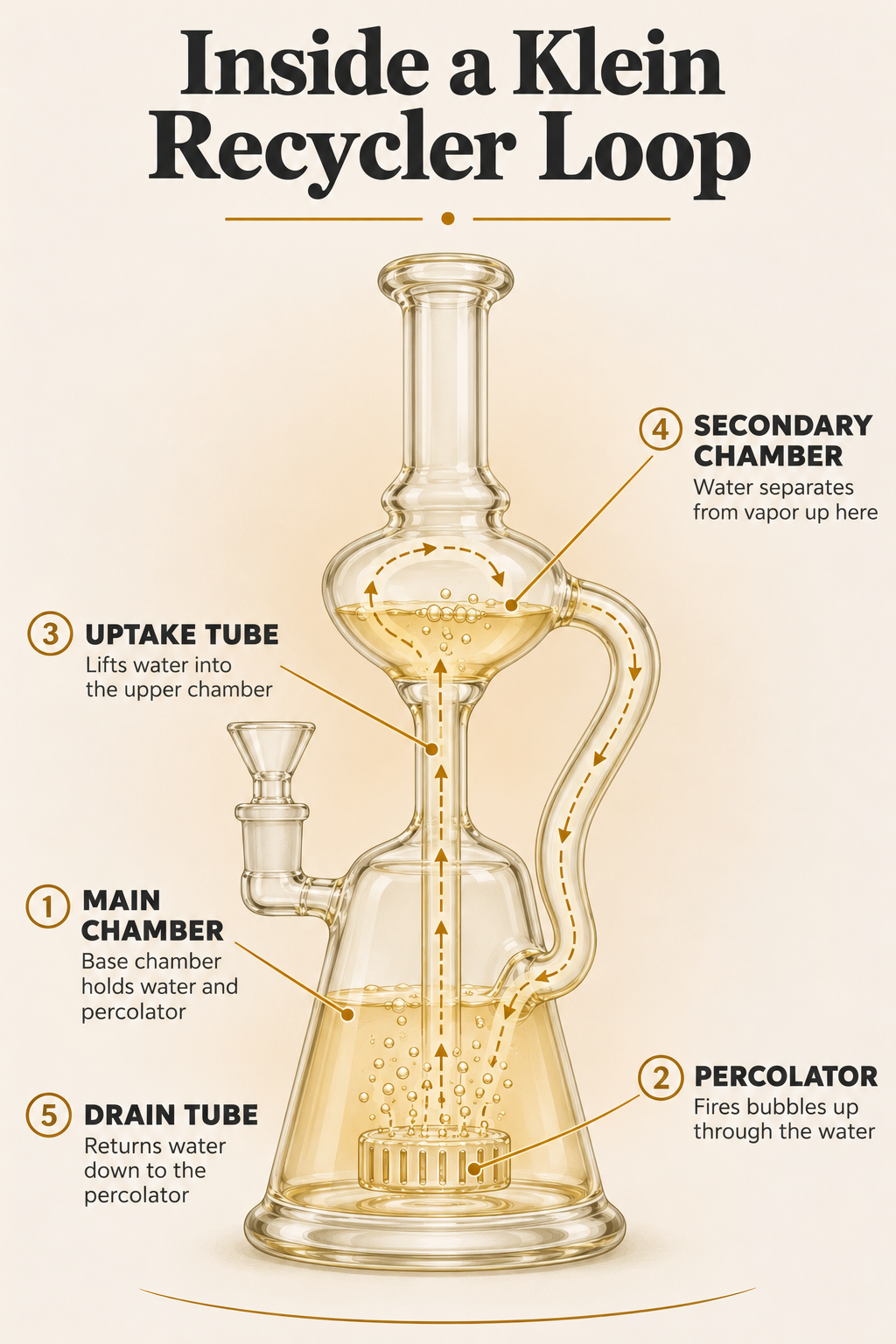
A recycler is easier to understand if you follow one drop of water through a single pull. The parts are not complicated on their own, but the order matters, because each stage depends on the one before it. Here is that path in the order water travels.
The cycle repeats for as long as the draw continues, which is the part people miss the first time they look at one. A recycler is not a one-way path from bowl to mouthpiece. It is a water-management system that keeps moving the same water around while you pull, which is why it needs a return line at all.
The Klein-specific move sits in the routing. The recycling path is brought back through the body so the drain stays separate from the airflow. On one common description of the Klein weld, the drain first exits the can and then loops back inside so it does not interfere with the percolator [2]. Makers vary the exact plumbing inside that idea, which is why two Kleins from two brands can look quite different side by side [1].
If you want to see the wider family this shape belongs to, the Recycler Bongs collection covers the flower-side version of the same idea, while Glass Dab Rigs and Recycler Dab Rigs cover the concentrate side. The same five-part loop shows up in all of them. What changes between pieces is how much of that plumbing the maker leaves visible on the outside and how much is tucked into the body.
- Main chamber — the base section that holds the water and houses the percolator. Everything the loop lifts up drains back into this reservoir.
- Percolator — the diffuser that fires bubbles up through the water on a draw. It is the point the cycle keeps returning to, which is why a recycler can keep firing instead of running dry.
- Uptake tube — the line that lifts water out of the base and up into the second chamber as the pull creates suction. On a Klein this is often the part you can see running up the side.
- Secondary chamber — the upper chamber where the water separates from the smoke or vapor before the vapor continues to the mouthpiece.
- Drain tube — the return line that carries water back down to the percolator so the cycle can start over. On a Klein the drain is routed so it does not cross the percolator’s path.
How Is a Klein Recycler Different From a Standard Recycler and an Incycler?
Shops use three words for what can look like one idea, and the difference comes down to where the plumbing sits and how much of it you can see. That is also why the same photo can be labelled two different ways depending on who is selling it.
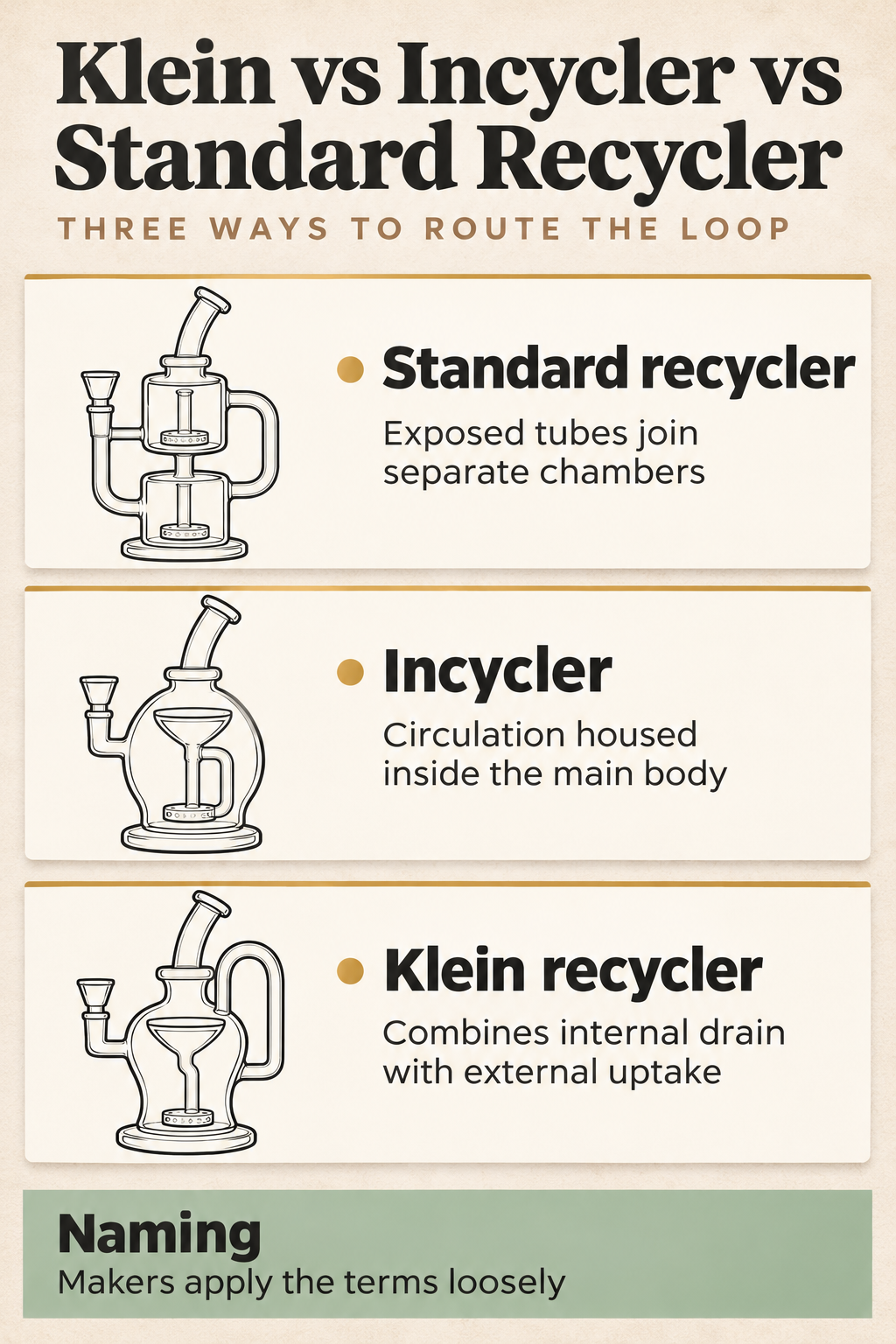
A standard recycler is generally described by visible external uptake and return paths that connect separate chambers. An incycler houses that same circulation inside the main body, so the loop is hidden and the outer silhouette stays close to a simple rig. A Klein is treated as a hybrid of the two [4].
The name itself is a giveaway. The Klein bottle is a mathematical surface known for looping through itself, and glass versions are physical approximations of that form, with a neck that passes through the side of the vessel and reconnects to the body. Functional glass artists took that visual logic and applied it to recycler rigs [4].
Be ready for the terminology to move under you. Layout language is not standardised across the trade, and the accounts do not line up perfectly. One brand explainer describes an external loop that routes the drain outside the main chamber to bypass the percolator and throw a visible vortex on each inhale [3], while a retailer explainer describes a side-mounted uptake arm that loops water back down [5]. Both describe a Klein. They are not describing identical glass.
In practice that means you read the photos rather than the label. Trace one line from the base to the upper chamber and back again. If you can follow that path with your eye, you know where the uptake and the drain are, and you know whether the piece is closer to an exposed recycler or a housed one. For background on the wider category, see What Is a Recycler Bong and How Does It Work? and What Are the Different Types of Dab Rigs?, and if you want the short version of why recycling matters at all, What Are Recycler Bongs and Why Do They Matter? covers it.
- Standard recycler — exposed tubes generally connect separate chambers, so the uptake and return lines read clearly from the outside and the loop is easy to trace.
- Incycler — circulation is housed inside the main body, so the loop is internal and the piece keeps a compact outer shape with fewer arms to catch on anything.
- Klein recycler — a hybrid that can mean an internal drain, an external uptake, intersecting-looking pathways, or a mix of internal and external circulation depending on the maker.
- Naming — ‘Klein recycler’ and ‘Klein incycler’ are both used for the same general family, so the product label will not reliably tell you which plumbing you are buying.
- Trade accounts — brand explainers tend to describe an external drain loop and a visible vortex, while retailer explainers describe a side-mounted uptake arm; that gap reflects how loosely the terms travel.
| Layout | Where the plumbing sits | What it looks like outside |
|---|---|---|
| Standard recycler | External uptake and return tubes joining separate chambers | Loop reads clearly from the outside |
| Incycler | Circulation housed inside the main body | Compact silhouette, few external arms |
| Klein recycler | Hybrid: internal drain, external uptake, or a mix by maker | Glass that appears to loop through itself |
Does the Recycling Loop Really Filter the Vapor More Than Once?
This is the most repeated line in recycler marketing, and it deserves a slow read. Retailer and brand copy commonly describes recyclers as filtering repeatedly, or as being filtered more than once, and that framing is what sells the extra glass. The mechanism does not match it.
A glass manufacturer describes the loop as doing three specific jobs, none of which is a second pass through water [1]. Those three jobs are the honest case for the design.
That same manufacturer states plainly that the smoke or vapor is not run through the water a second time. The water cycles. The smoke separates from the water in the upper chamber and heads to the mouthpiece. The loop moves liquid, not the vapor path, and the two part company at the top of the piece.
So what is the vortex you can watch through the glass? It is water moving. It shows that the loop is cycling, that the uptake is pulling and the drain is returning, and that the water level sits in a usable range. That is a useful visual gauge and a satisfying thing to watch. It is not evidence of a second filtration stage.
None of that makes the design pointless. The loop still earns its place as water management: it keeps water off the mouthpiece, keeps returning water to the percolator so the diffuser keeps firing instead of running dry, and keeps each bubble in contact with water for longer before the two separate [1]. For how that compares with a plain single-chamber piece, What Is a Bong and How Does It Work? walks through the basic water pipe layout.
- Splashguard — the loop keeps water out of the mouthpiece by giving it somewhere to go other than straight up the neck.
- Steady perc supply — because the water pushed up keeps draining back down, the percolator does not run dry partway through a draw.
- Longer bubble contact — each bubble stays surrounded by water for longer before the water and vapor separate.
- Not supported — that the vapor passes through the water a second time; the manufacturer description of the mechanism says it does not, even though retailer and brand copy often implies it does.
How Much Water Does a Klein Recycler Need to Cycle Properly?
Water level matters more on a recycler than on a simple bong, because the loop has to actually cycle rather than just sit there. Too much water can flood the upper chamber, stall the cycle, or send water toward the mouthpiece. Too little breaks the loop and lets the draw run dry [3].
The reliable way to find the level is to tune it rather than guess at it. Run the same sequence every time you set the piece up, and it stops being a matter of feel.
Draw cadence is the other half of the equation. Longer, steadier pulls let the vortex develop in the upper chamber, while fast, aggressive inhales can collapse the cycle and stop the water moving. A very gentle pull can also fail to start a recycler cycling at all, so pieces are normally tested with a normal, steady draw rather than a timid one [1].
Uptake layout changes how wide that tuning window is. Dual uptake creates two parallel recycling paths that cycle quickly, stay open, and are described as more forgiving when pull speed varies. Six-loop designs need a firmer, steadier inhale to keep every path cycling [1]. If you are not sure which you have, look at the top of the piece and count the lines coming out of the base.
- Start with less water than you think you need — well below the level that looks right, so you have room to add.
- Pull with a normal, steady draw rather than a short hard rip, because that is the cadence the piece will see in use.
- Watch the percolator fire: it should bubble evenly all the way around rather than firing hard on one side only.
- Add water in small amounts and re-test after each addition instead of topping it up in one go.
- Stop when water returns to the base without pooling in the upper chamber and the loop keeps cycling through the whole draw.
- Back off immediately if water climbs toward the mouthpiece or the cycle stalls mid-pull, since both mean you have gone past the working level.
What Size Klein Recycler Fits Your Setup?
Size is the decision most shoppers make on looks, and it is the one with the clearest guidance attached. One manufacturer bands pieces by height, and the reasoning behind each band is practical rather than aesthetic [1].
Then reconcile that rule with what is actually for sale. Listings spread the Klein format across a much wider band than the rule implies: 4-inch micro Kleins with 10mm joints at one end, 8.5-inch pieces and 9-to-10-inch models at the other, with a 14mm female joint the most commonly listed connection on full-size pieces [5] [6]. Some shops list the taller ones as a Klein recycler bong rather than a dab rig, which is the same glass under a different shelf label. Four inches is not a scaled-down nine-inch piece; it is a different proposition entirely.
Joint fit is where buyers get caught out. Match the banger or bowl to the joint size and angle on the piece you are buying rather than assuming 14mm, because a 10mm micro takes a different banger and a fixed-angle joint will not accept an accessory built for a different angle. That detail decides whether a new piece is usable on arrival.
One more trade-off worth knowing before you pick a layout: a tighter internal loop recycles faster but adds a little more drag, so a buyer who wants an easy pull and a buyer who wants a fast cycle are optimising for different things [6]. Neither is wrong. They are different priorities, and you cannot max out both on the same piece. If you are building out the rest of the setup, Terp Pearls is the accessory layer that pairs with the banger end.
- Under 8 inches — suits concentrate use, since the vapor path is shorter, there is less water mass to move, and clears are fast.
- 8 to 10 inches — suits mixed use, sitting between a compact concentrate piece and a larger chamber.
- Over 10 inches — adds chamber volume and water capacity for slower, longer draws.
- Joint size — listings range from 10mm on micro Kleins to 14mm female on most full-size models, so check the actual spec rather than assuming.
- Uptake layout — dual uptake cycles quickly and is more forgiving when pull speed varies, while multi-loop designs need a firmer, steadier inhale.
- Drag — a tighter internal loop recycles faster but adds restriction, so decide whether an easy pull or a fast cycle matters more to you.
How Do You Clean a Klein Recycler Without Clogging the Loop?
Recyclers need more upkeep than single-chamber pieces, and the reason is structural rather than a matter of discipline. The extra bends, narrow passages, and internal surface give resin and reclaim more places to collect, and external arms and tight passages are the known traps [4]. Cold water or packed ice can also leave a film in the tightest parts of the pathway.
The routine that works is the standard glass routine, run in order and not rushed. Skipping the soak is the most common reason a recycler stays cloudy in the passages a brush cannot reach.
Handle the solvent itself with some respect. Isopropyl alcohol is listed by NIH PubChem with primary hazards of flammable and irritant, a NIOSH immediately dangerous to life or health value of 2000 ppm, and a permissible exposure limit of 400 ppm as an 8-hour time-weighted average [9]. That means ventilation while you work, no open flame nearby, and a piece that is fully dry before it goes back into use.
If you run ice, plan on the full soak rather than a quick rinse, because the film cold water leaves sits exactly where the loop is narrowest. A recycler that stops cycling cleanly is usually a dirty recycler before it is a badly made one.
- Empty the piece and rinse it with warm water to clear loose material before the solvent goes in.
- Use isopropyl alcohol at 90 percent or higher with coarse salt, which acts as a gentle abrasive without scratching the glass [8].
- Soak for at least 30 minutes so the solvent can break down resin in the passages a brush cannot reach.
- Scrub the high-resin areas — percolator, downstem, and bowl — then work the loop itself by tilting the piece and letting the salt-and-solvent mix travel the drain path.
- Rinse completely several times until no lingering smell or residue is left in the water.
- Dry fully before reassembling or using the piece, both for the glass and because residual solvent should not be sealed in a chamber.
Who Is a Klein Recycler Actually Worth It For?
Kleins are built around concentrates. Retailers describe them as a fit for concentrate sessions, and they note that running flower means fitting a bowl instead of a banger. That works, and plenty of people do it, but it does not use the design the way it was engineered [3] [5].
The trade-offs are worth stating plainly rather than burying. A Klein means more intricate glasswork that takes more attention to clean, and the design can be touchy about water level when the engineering is poor. On top of that, recyclers in general cost you more glass to clean, more tubing and welds that need careful handling, and a little more draw resistance than a simple bong [1].
The catalogue makes the decision concrete. Treehouse Lifestyle lists five Klein recyclers under the Calibear brand. Three are in stock: the Sandblasted Showerhead Klein Recycler at $149.99, the Cascade Flower Of Life Klein Recycler Bong at $199.99, and the Infinity Loop Seed Of Life Klein Recycler at $159.00. Two more, the Flower Of Life Klein Recycler and the Pillar Flower Of Life Klein Bong, are currently out of stock [7]. All three in-stock pieces clear the free shipping on orders $150+ threshold on their own.
One detail from that catalogue is instructive. The same Klein form is filed under different categories: the Sandblasted Showerhead and Cascade models sit in bongs, while the Infinity Loop model sits in dab rigs [7]. That reflects how loosely the trade applies ‘bong’ and ‘dab rig’ to one recycler shape, and it is a reason to read the spec sheet rather than the breadcrumb.
One note on scope: Treehouse Lifestyle sells smoking accessories, not cannabis. The CDC describes cannabis as the most commonly used federally illegal drug in the United States, and rules vary by state, so nothing here is legal or health advice [10].
- Buy a Klein if — you mostly run concentrates, you want to watch the cycle work, and you are willing to tune the water level and soak the piece regularly.
- Buy a Klein if — you want one piece that covers concentrate sessions and the occasional flower bowl, and the extra glasswork is part of the appeal.
- Skip it if — you are flower-first, because a bowl in a Klein works but wastes the engineering you paid for.
- Skip it if — you want low upkeep; a single-chamber piece takes less soaking and has fewer bends to keep clear.
- Skip it if — you want the easiest possible pull, since a tighter loop that cycles fast adds a little drag.
- Skip it if — you are shopping on price alone; a simpler rig at the same money buys more glass quality than a complex one.
Frequently Asked Questions
Is a Klein recycler the same thing as a Klein incycler?
Often, yes, at least in the way shops use the words. Layout terminology is not standardised across the trade, and both terms get used for the same general family. Depending on the maker, a Klein may run an internal drain, an external uptake, intersecting-looking pathways, or a combination of internal and external circulation. Read the photos and the joint placement rather than trusting the label alone.
Do you need a banger for a Klein recycler?
The format is built around concentrates, so a banger is the usual pairing and most full-size listings ship with quartz. You can run flower by fitting a bowl instead, and it will work, but the design was engineered around concentrate use, so you are not getting the layout the glass was built for. Match whichever you choose to the joint size and angle rather than assuming a 14mm connection.
How tall should a Klein recycler be for dabs?
One manufacturer bands it simply: pieces under 8 inches suit concentrate use because the vapor path is shorter, there is less water mass to move and clears are fast, while 8 to 10 inches suits mixed use and anything over 10 inches adds chamber volume and water capacity for slower, longer draws. Listings also include 4-inch micro Kleins with 10mm joints, so the practical band is wider than the rule suggests.
Why does my Klein recycler stop recycling mid-draw?
Two usual suspects. Water level is the first: too much can flood the upper chamber and stall the cycle or send water toward the mouthpiece, and too little breaks the loop and lets the draw run dry. Draw cadence is the second, because fast, aggressive inhales can collapse the cycle, and a very gentle pull can fail to start it at all. Test with a normal, steady draw.
Can you pack ice in a Klein recycler?
You can, but it works against the design. Cold water or packed ice can leave a film in the tightest parts of the pathway, and a recycler already has more bends, narrow passages and internal surface for resin and reclaim to collect than a single-chamber piece. If you do use ice, plan on the full isopropyl and coarse salt soak rather than a quick rinse.
Is a Klein Recycler the Right Piece for Your Setup?
A Klein recycler is a water-management design, not a second filter. Once you know that, the purchase decision gets simpler, because you are no longer paying for a filtration claim the mechanism does not support. You are paying for routing that keeps the percolator fed, keeps water off the mouthpiece, and puts a visible cycle on the outside of the glass where you can watch it work.
If you run concentrates, like the idea of a piece you tune rather than just fill, and do not mind soaking it properly, a Klein is a satisfying buy. On a $149 to $199 piece from the Treehouse catalogue, the engineering is doing something you can see. If you run flower mostly, want low upkeep, or want the easiest pull you can get, a simpler recycler or a single-chamber rig will serve you better for the same money.
Check three things before you order: the joint size and angle so your banger actually fits, the height band that matches how you plan to use it, and the uptake layout if pull resistance matters to you. Get those three right and the rest comes down to how the piece looks on your shelf, which is a perfectly good reason to pick one too.
Sources
- Thick Ass Glass (glass manufacturer): What Is a Recycler Bong? How Recyclers Work, Types & Care
- The Dab Lab (specialist retailer): What is a Recycler Rig? | Types of Recycler Dab Rigs
- Mood: What Is a Klein Recycler? How It Differs from Standard Rigs
- 710 Pipes: Klein Recyclers vs. Incyclers vs. Standard Recyclers: What’s the Difference?
- Encore Collection (glass manufacturer and distributor): What Is a Klein Recycler? Dab Rig Guide
- Smoke Cartel: Klein Recycler Rigs: Looping Recycler Glass
- Treehouse Lifestyle (WooCommerce Store API): Treehouse Lifestyle store API — ‘klein’ product search
- Calgary Co-op Cannabis (licensed retailer): How to Clean a Bong with Isopropyl Alcohol and Salt
- NIH PubChem (Isopropanol, CID 3776): Isopropanol | CH3CHOHCH3 | CID 3776
- Centers for Disease Control and Prevention: About Cannabis