

A torch lighter is useful when you need a straight jet flame, but it is not the right tool for every smoking accessory. Most shoppers should use a pocket lighter for simple flower-accessory tasks, a wand lighter when reach matters, and a larger butane torch only when a dab rig setup calls for focused heat.
What is the difference between a lighter, torch lighter, and butane torch?
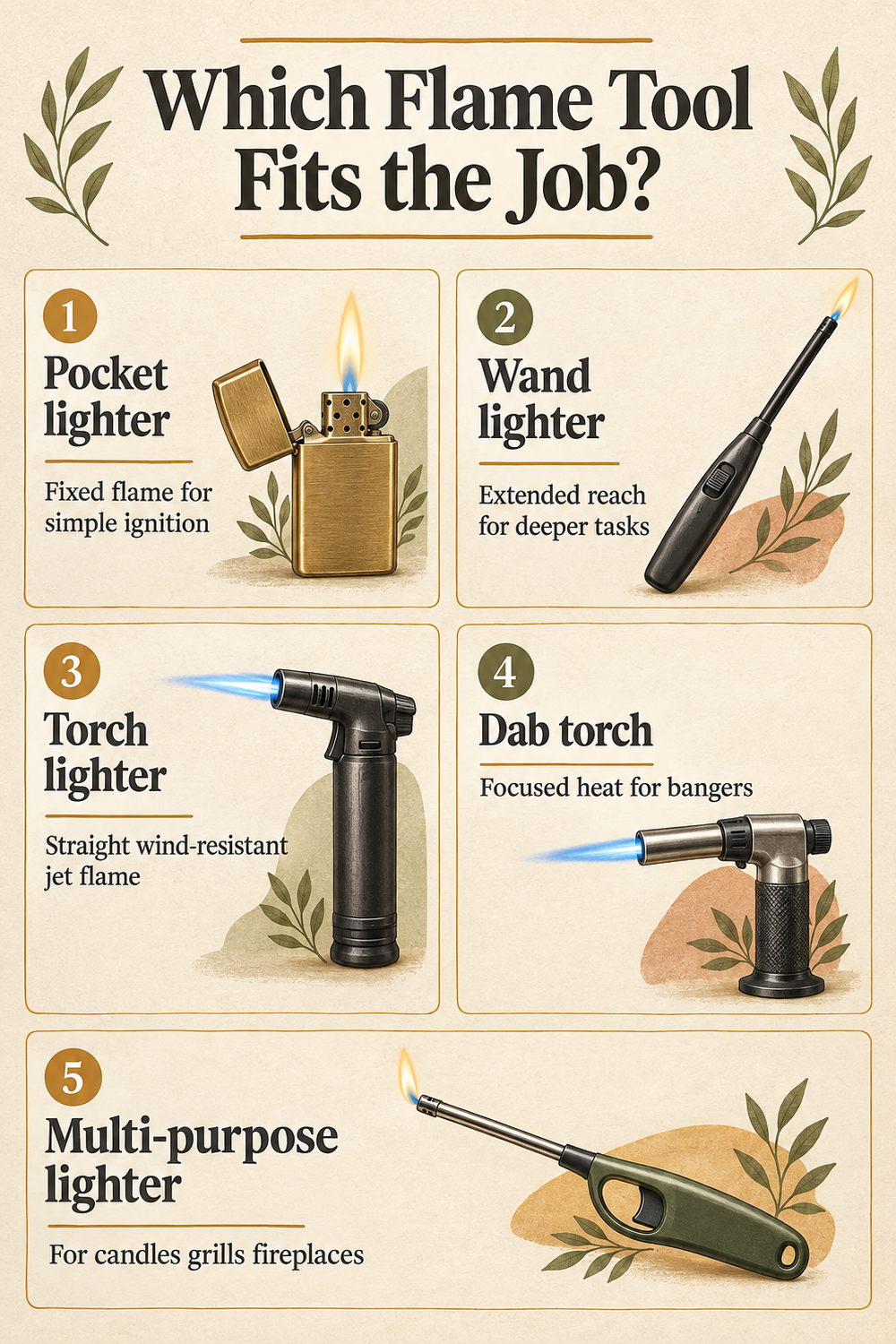
A regular lighter, a torch lighter, and a butane torch all make flame, but they are built for different jobs. The U.S. Consumer Product Safety Commission separates cigarette-style lighters from multi-purpose lighters. Cigarette-style lighters are commonly used for cigarettes, cigars, and pipes. Multi-purpose lighters are made for jobs like candles, grills, fireplaces, camp gear, pilot lights, soldering, and similar tasks. [1]
A common pocket lighter is usually small, simple, and easy to carry. BIC describes many of its pocket models as fixed-flame, non-refillable butane lighters, and it points shoppers toward consistent ignition, a fixed flame, child-resistant features, and a durable body for everyday pocket use. [3] That makes the pocket format easy to understand: small body, simple flame, simple job.
A torch lighter works differently because of how the flame is made. Cricket explains that a torch or turbo lighter mixes fuel gas with air through an orifice. That mixture leaves faster through the burner hole, creating a straighter, wind-resistant jet flame compared with a normal soft-flame lighter. [4] If you are browsing Lighters, this difference matters because flame type changes what the tool is best suited for.
A butane torch is usually a larger tool with more control, more fuel capacity, or a wider base than a pocket-size torch lighter. In a smoking-accessory setup, the butane torch category often comes up around dab rigs, bangers, and nails. That does not make it better for every job. It means it is built for a different task than a soft-flame lighter or a long-wand lighter.
Some shoppers also compare flame tools with battery-powered devices. For example, an e-rig such as Dr Dabber XS e-Rig Portable Vaporizer is a different category from a lighter or torch because it is not a handheld flame tool. That matters when you are deciding whether you need flame accessories, replacement fuel, or a complete electric setup.
- Pocket lighter: compact tool with a simple fixed flame for basic ignition jobs.
- Wand lighter: longer multi-purpose lighter that creates more distance between hand and flame.
- Torch lighter: smaller flame tool with a straight jet flame.
- Butane torch: larger focused-heat tool often linked with dab setups and banger use.
- Dab Tools: a useful category to check when your setup uses dab accessories instead of basic flower accessories.
Which lighter works best for bowls, bongs, candles, and daily use?
For daily use, start with the job in front of you. A bowl, a bong, a candle, and a grill are not the same task. They may all involve a flame, but reach, hand position, and flame control can change what feels practical.
For many everyday flower-accessory setups, a pocket lighter is the simple first pick. Smoke Cartel frames standard pocket lighters as appropriate for flower-accessory ignition, while butane torches belong in the accessory category used when a dab setup needs focused heat for a quartz banger or similar nail. [8] That is the big split: pocket lighter for simple ignition, torch for dab hardware.
A long-wand lighter makes sense when the flame needs to reach into a deeper spot. BIC says long-wand multi-purpose lighters are useful for candles, grills, fireplaces, firepits, and deep jars because the extended wand creates distance between the user’s hand and the flame. [3] This is why a wand lighter can feel easier than a tiny pocket lighter when the item is tall, deep, or awkwardly shaped.
If you are building a starter kit, read the broader checklist in What Smoking Accessories Do Beginners Need to Buy First? before buying every flame tool at once. Many people only need one or two options. A daily pocket lighter, such as Treehouse Clipper Lighter • Single • Black, can cover simple use, while a wand lighter can be the reach tool for candles or deeper household tasks.
Do not let the word "best" make the choice more complicated than it needs to be. A good lighter choice is the one that matches the task, is easy for you to handle, and follows the product’s own instructions. If the job changes, the tool may change too.
- Bowls and many bong setups: start with a basic pocket lighter unless the shape makes reach difficult.
- Candles and deep jars: choose a wand-style multi-purpose lighter for extra distance.
- Grills, fireplaces, and firepits: use a multi-purpose lighter built for those household tasks.
- Dab rigs: look at a butane torch or dedicated dab setup instead of a pocket lighter.
- Daily carry: keep the tool simple, durable, and easy to store when not in use.
When should you choose a torch lighter instead of a regular lighter?
Choose a torch lighter when a straight jet flame is more useful than a regular soft flame. That may matter outdoors, around certain accessory shapes, or when the user wants a more focused flame pattern. Cricket explains that torch lighters make their jet flame by mixing fuel gas with air and sending it through the burner hole faster than a normal lighter. [4]
A torch lighter is not always the right choice. For simple flower-accessory ignition, a standard pocket lighter may be easier, cheaper, and more familiar. BIC’s pocket lighter guidance focuses on consistent ignition, a stable fixed flame, child-resistant features, and a durable body. [3] That is the no-fuss tool many shoppers want for daily basics.
Think of a torch lighter as a middle step. It is more direct than a pocket lighter, but it is usually smaller than a full dab torch. It can be useful when wind resistance or flame direction matters, but it can be more tool than needed for quick, simple tasks.
If your question is really about dab rigs, jump from this section to How Do You Choose the Right Torch for a Dab Rig? or keep reading into the dab torch section below. If your question is about a bong setup, the accessory shape matters too. For example, airflow add-ons and glass attachments are covered in What Is an Ash Catcher and How Do You Choose the Right One for Your Bong?, but those pieces do not automatically mean you need a torch lighter.
- Use a regular pocket lighter first when the job is simple, close, and familiar.
- Move to a wand lighter when the main issue is reach, such as deep candles or awkward angles.
- Choose a torch lighter when a straight jet flame and wind resistance are useful for the task.
- Choose a larger butane torch when the setup is a dab rig with a banger or similar nail.
- Check refill, lock, and adjustment features before buying a torch-style tool.
What kind of butane torch do you need for a dab rig?
For dab rigs, the butane torch question is mostly about size, control, and where the setup will live. Smoke Cartel explains that dab torch choices often come down to portable versus home-station use, fuel capacity, single-jet versus multi-jet layout, lock features, and matching the torch size to the nail or banger size. [8] That is a practical shopping list, not a reason to buy the biggest torch on the shelf.
A smaller torch can make sense for a compact setup or occasional use. A larger torch can make sense for a stable home station where fuel capacity and grip matter more. The key is to match the tool to the hardware you actually use. If the torch feels oversized for the banger, the setup may feel clumsy. If the torch is too small for the job, refilling and handling may become annoying.
Single-jet and multi-jet designs are also worth comparing. A single jet is simple and narrow. A multi-jet layout spreads the flame pattern across more than one point. Shoppers should look at the banger size, torch base, ignition button, flame adjustment control, and whether the tool has a lock feature.
If you are still learning the parts of the setup, read What Is a Quartz Banger and How Do You Choose One? before buying around the torch alone. The banger, rig, and torch should make sense together. A torch is one part of the station, not the whole station.
- Decide where it will live: pocket, travel case, drawer, or home station.
- Match torch size to the banger or nail size instead of buying by looks alone.
- Compare fuel capacity if you want fewer refills during normal use.
- Choose single-jet or multi-jet based on the flame layout you can control best.
- Check for lock features, flame adjustment, base stability, and a comfortable grip.
How do you refill and store a butane torch lighter?
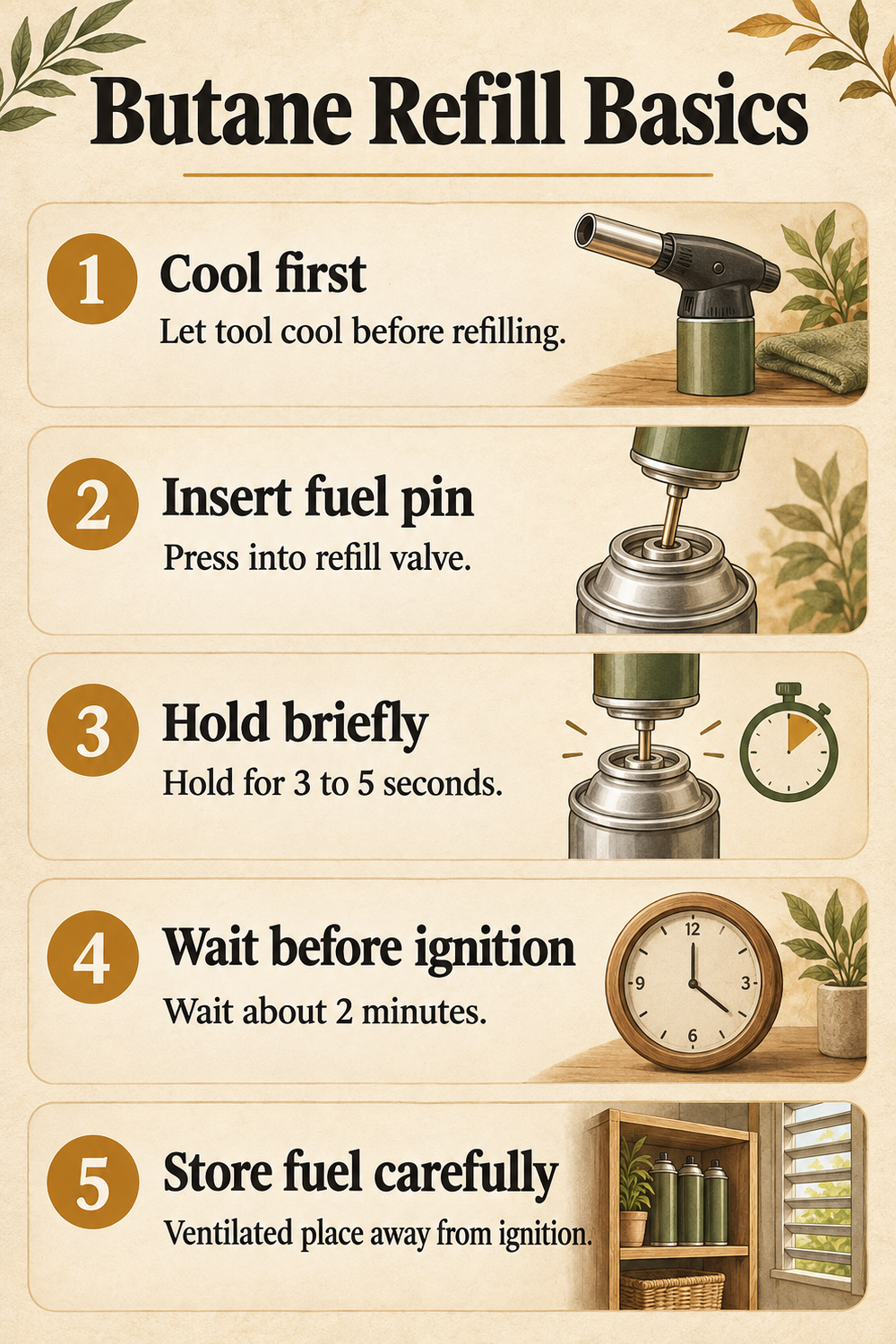
Refill steps can vary by product, so the exact tool’s instructions should always come first. Still, the source guidance gives a clear pattern: cool the tool, refill it carefully, wait before ignition, and store fuel away from heat and ignition sources. This is an area where guessing is a bad plan.
Cricket’s refill guidance for refillable torch flame lighters says to insert the butane can pin into the refill valve, hold it for 3 to 5 seconds, and wait about 2 minutes after refilling before using the lighter. [4] Bernzomatic’s microtorch instructions say to let the torch cool before refilling, never smoke while refilling, and wait 3 minutes after refilling before ignition. [9] Those times are close, but not identical, which is why the product manual matters.
Fuel storage deserves the same attention. Airgas classifies n-butane as an extremely flammable liquefied gas under pressure. Its safety data sheet says to keep it away from heat, hot surfaces, sparks, open flames, and other ignition sources, and to protect it from sunlight and store it in a well-ventilated place. [5] That is simple enough: keep fuel away from heat and do not handle the can like a random junk-drawer item.
Do not refill near open flame. Do not rush ignition right after refilling. Do not leave fuel cans in hot cars, sunny windows, or other warm spots. If a lighter or torch acts strange after a refill, stop and check the product instructions before trying again.
- Let the lighter or torch cool before refilling, following the product instructions.
- Insert the butane can pin into the refill valve as directed by the lighter maker.
- Hold briefly; Cricket gives a 3 to 5 second refill window for its torch flame lighter guidance.
- Wait before ignition; Cricket says about 2 minutes, while Bernzomatic says 3 minutes for its microtorch instructions.
- Store butane in a ventilated place away from heat, sparks, open flames, and prolonged sunlight.
Can you fly with a torch lighter or butane lighter?
Air travel rules are not the place to wing it. FAA PackSafe says ordinary absorbed-liquid and butane lighters are limited to one lighter per passenger in carry-on or on the person. The same FAA guidance says torch lighters, including blue-flame and jet-flame butane lighters, are not allowed in the cabin or checked baggage. [6]
TSA’s listing for torch lighters is just as direct: torch lighters are not allowed in carry-on bags or checked bags. TSA also notes that final checkpoint decisions rest with TSA officers. [7] So if the lighter is a torch lighter, do not pack it for a flight and hope the wording works out at the checkpoint.
The travel rule also shows why lighter type matters. A common butane pocket lighter and a torch lighter may both use butane, but travel guidance handles them differently. When in doubt, check FAA PackSafe and TSA before you pack, especially if the tool has a blue jet flame, torch-style burner, or refillable torch design.
For online shoppers, this means buying travel gear and home gear as separate decisions. A lighter that makes sense at home may be a bad airport item. If you need a tool after you land, buy or use one where you are going instead of trying to bring a torch through security.
- Ordinary absorbed-liquid and butane lighters: FAA limits them to one per passenger in carry-on or on the person.
- Torch lighters: FAA says blue-flame and jet-flame butane lighters are not allowed in cabin or checked baggage.
- TSA torch lighter listing: not allowed in carry-on bags or checked bags.
- Checkpoint decisions: TSA officers make the final call at screening.
- Best habit: check current FAA and TSA pages before packing any lighter for travel.
How should you choose your first lighter or torch setup?
Your first setup should start with the accessory you use most. If your main item is a basic flower accessory, begin with a reliable pocket lighter. If you often light candles, reach into deep jars, or need more hand distance, add a wand lighter. If your setup includes a dab rig and banger, look at a butane torch instead of trying to make a pocket lighter do the wrong job.
Refillability is another simple dividing line. Many pocket lighters are meant to be used until empty and replaced. Many torch lighters and butane torches are made to be refilled. Refillable tools can make sense when you like the body, controls, and flame style, but they also ask you to store butane and follow refill instructions.
Reach matters more than many beginners expect. A short pocket lighter is easy to carry, but it places your hand close to the flame. A wand lighter gives more distance for deep or awkward jobs. A torch gives a different flame style, not just a longer tool. That is why buying one of everything is usually less helpful than matching one tool to one job.
If you are filling a cart, keep it simple: one daily lighter, one reach tool if needed, and one dab torch only if your setup needs it. Treehouse Lifestyle may offer free shipping on orders $150+, so it can make sense to buy fuel-adjacent accessories with the rest of your setup, but do not pad your cart with tools you will not use.
- Start with your main accessory: flower setup, candle task, household task, or dab rig.
- Pick a pocket lighter when the job is simple and the flame does not need extra reach.
- Add a wand lighter when distance from the flame is the main reason to upgrade.
- Choose a torch lighter when a straight jet flame fits the job better than a soft flame.
- Choose a butane torch when your dab setup needs a dedicated torch for the banger or nail.
Frequently Asked Questions
Is a torch lighter the same thing as a butane torch?
Not exactly. A torch lighter is usually a smaller lighter with a jet-style flame, while a butane torch is often a larger tool used for focused heating tasks such as dab rig use. Both may use butane, but size, controls, and intended use can differ.
What is the best lighter for a bong?
For many everyday flower-accessory setups, a standard pocket lighter is the simple choice. If reach or distance matters, a long-wand multi-purpose lighter may be easier to position. The best choice depends on the accessory shape and how much control the shopper wants.
Why do torch lighters have a different flame?
Cricket explains that a torch or turbo lighter mixes fuel gas with air through an orifice and ejects that mixture faster through the burner hole, which creates a straighter jet flame compared with a normal soft-flame lighter. [4]
How long should you wait after refilling a torch lighter?
Can you bring a torch lighter on a plane?
Which lighter or torch should you buy first?
Buy the tool that matches your most common job first. For many shoppers, that means a pocket lighter for simple flower-accessory use. If reach is the issue, choose a wand lighter. If the setup is a dab rig with a banger or nail, compare butane torches instead of regular lighters.
The smartest setup is not the largest setup. It is the one you can use, refill or replace, store, and pack correctly. Keep the categories clear, follow the product instructions, and let the accessory decide the flame tool.
Sources
- U.S. Consumer Product Safety Commission: Lighters Business Guidance
- Electronic Code of Federal Regulations: 16 CFR Part 1210 — Safety Standard for Cigarette Lighters
- BIC: Lighter Frequently Asked Questions
- Cricket Lighters: What is a Torch Flame Lighter and How to Refill It?
- Airgas USA, LLC: Safety Data Sheet: N-Butane
- Federal Aviation Administration: PackSafe – Lighters
- Transportation Security Administration: Lighters (Torch)
- Smoke Cartel: Choosing the Right Torch for Dabbing: A Complete Guide
- Bernzomatic / Worthington Cylinders: Butane Microtorch Instruction Manual