


An ash catcher is a small glass accessory that mounts between the bowl and the bong. Its job is to trap ash and debris before they reach the main water chamber and to add a second stage of water filtration before smoke enters the bong [1] [2] [5].
Choosing the right one comes down to matching the bong on three joint specs at the same time: size (commonly 10mm, 14mm, or 18mm), gender (most bongs ship with a female joint that accepts a male ash catcher), and angle (45° or 90°). Get any of those three wrong and the ash catcher will not seat correctly, and forcing a mismatched joint can crack the glass [1] [2] [5].
Once the joints match, the next decision is the style. Dry ash catchers hold no water and add the least drag. Wet ash catchers hold a small amount of water for a second filtration stage. Percolator ash catchers add a built-in perc, such as a showerhead, honeycomb, tree, or inline design, which adds more diffusion at the cost of more resistance and more parts to clean [1] [2] [4].
The rest of this guide walks through each joint spec, the dry versus wet versus percolator decision, and the practical steps for fitting and removing an ash catcher without cracking the joint.
What Does an Ash Catcher Actually Do for a Bong?
An ash catcher is a small attachment that sits between the bowl and the bong. It has its own joint on one end that fits into the bong, and its own joint on the other end that the bowl fits into. Smoke moves through the bowl, into the ash catcher, then up into the main chamber of the bong [1] [2] [5].
The first job of an ash catcher is to catch debris. As the bowl burns, small bits of ash and plant material get pulled into the smoke. Without an ash catcher, most of that debris ends up in the bong’s main water chamber, where it builds up as residue over time [1] [4].
The second job is to add a second water stage. Many ash catchers hold a small amount of water, so smoke passes through water in the catcher and then through water in the bong. Smoke moves slower and contacts more water surface than it would in a single-chamber bong [1] [2] [5].
Because the ash catcher holds most of the loose debris, the bong’s main chamber stays cleaner for longer between deep cleans. That alone is a useful reason to add one, since less residue in the main chamber usually means the bong needs less frequent full teardowns. A simple routine that keeps residue from piling up in the first place is covered in the resin buildup guide How Do You Prevent Heavy Resin Buildup in Bongs and Pipes?.
Most quality ash catchers are made from borosilicate glass. Borosilicate is the same family of glass used in lab glassware and kitchen brands like Pyrex, and it is valued for resisting sudden temperature changes [4]. The material matters because ash catchers cycle between room temperature and the heat of smoke on every draw, and a less stable glass can crack over time.
- An ash catcher sits between the bowl and the bong and intercepts debris before it reaches the main water chamber [1] [2] [5].
- Wet ash catchers also add a second stage of water filtration before smoke enters the bong [1] [2].
- Keeping debris out of the main chamber reduces the buildup of residue and lengthens the time between deep cleans of the bong itself [1] [4].
- Three compatibility specs decide whether a given ash catcher will fit a given bong: joint size, joint gender, and joint angle [1] [2] [5].
What Size Ash Catcher Do You Need for Your Bong?
Joint size is the most common reason an ash catcher does not fit. Bong-style joints come in three standard sizes: 10mm, 14mm, and 18mm. The 14mm and 18mm sizes cover most full-size bongs, while 10mm is mostly seen on mini pieces and one-hitter attachments [1] [2] [5].
The size number does not match the exact opening. The names descend from a tapered-joint convention used in laboratory glassware, where conical ground joints follow a standard 1:10 taper. That means the joint diameter changes by about 1 millimeter for every 10 millimeters of length, and the size label refers to the wider end of the taper rather than the hole itself [6].
The rule is simple: match the ash catcher to the bong’s joint, not to the bowl. Bowls and ash catchers are sold in matching pairs because they share the same joint size, but the size you need is the one stamped or printed on the bong’s joint. If the bong does not have a size marking, a caliper or a printable joint-size chart can settle the question.
If you are not sure how a bong is built in the first place, the parent guide on bong and pipe parts walks through the joint, the downstem, the bowl, and the chamber in plain language What Are the Parts of a Bong, Rig, or Pipe and How Do They Work?. Once you know what each part does, the size question becomes a simple visual check rather than a guess.
If you are choosing between a 14mm and 18mm bong from scratch, the percolator bong guide goes into the size and joint choices that show up on retail pieces, and how each one affects the rest of the setup What Is a Percolator Bong and How Does It Work?.
- The three standard bong joint sizes are 10mm, 14mm, and 18mm, with 14mm and 18mm covering most full-size bongs and 10mm appearing mostly on mini pieces [1] [2] [5].
- Joint size numbers come from a 1: 10 tapered-joint convention used in lab glassware, not from a direct measurement of the opening [6].
- Always match the ash catcher to the bong’s existing joint rather than to the bowl, since ash catchers and bowls are sold in matching pairs but sized to the joint [1] [2].
- If the size is not marked on the bong, measure the joint with a caliper or use a printable joint-size chart to identify it before ordering How Do I Measure My Bong’s Joint Size?.
- A mismatched size will not seat, and forcing it can crack the joint, so it is worth confirming before you buy [2] [5].
45° vs 90° Ash Catcher: Which Angle Does Your Bong Need?
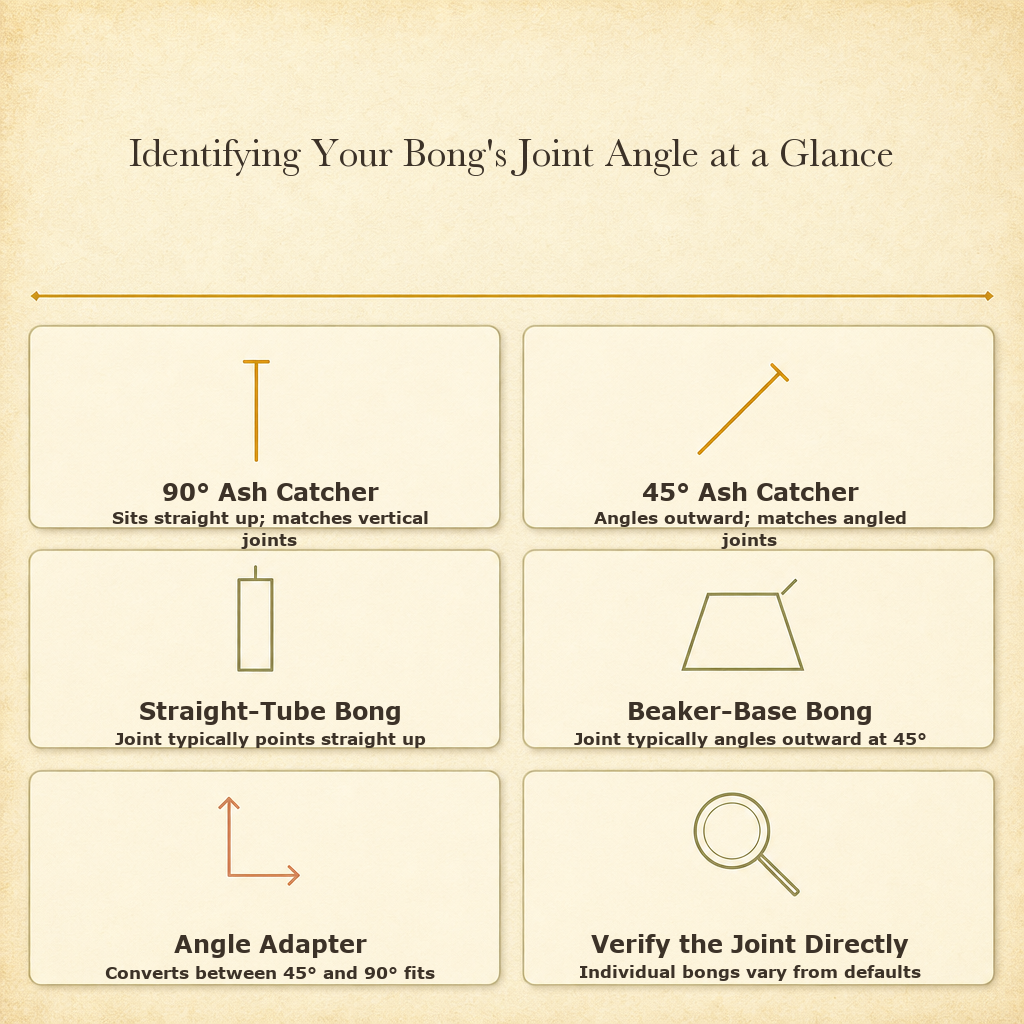
Joint angle is the second spec to match. Bongs come with the joint pointing either straight up (a 90° joint) or angled outward (a 45° joint). The ash catcher has to match that angle, or it will not sit flush against the bong [3] [4] [5].
A 90° ash catcher is the simpler shape. It sits straight up from the joint, and it matches a bong whose joint points vertically. A 45° ash catcher angles diagonally outward from the joint, and it matches a bong whose joint comes off the neck at an angle [3] [4].
Most straight-tube bongs use a 90° joint, because the tube itself is vertical and the joint simply continues that line. Most beaker bongs use a 45° joint, because the joint grows out of the wider neck of the beaker and naturally angles outward. This rule is a starting point, not a guarantee, since individual pieces vary [3] [5].
If your bong has an angled neck, a 45° ash catcher will sit flush against it without wobble. If your bong has a vertical neck, a 90° ash catcher will sit straight up the line of the tube. Picking the wrong angle leaves a visible gap between the ash catcher and the bong, which can leak air and weaken the seal. Beaker bongs in the catalog are a quick way to see how 45° fittings usually look on retail pieces.
If the angle on the bong does not match any ash catcher in stock, an angle adapter can convert between 45° and 90°. Adapters add a small extra joint to the setup, which adds one more place to keep clean, but they save a piece of glass from being returned. A directly matched ash catcher is still the cleaner choice when one is available [2] [5].
- 90° ash catchers point straight up and match bong joints that sit vertically, while 45° ash catchers angle outward to match angled joints [3] [4].
- Most straight-tube bongs use a 90° joint and most beaker bongs use a 45° joint, but individual pieces vary and the bong should be checked directly [3] [5].
- The bong’s joint angle can be identified by eye in a few seconds: a vertical line from the neck means 90°, an outward slant means 45° [3].
- An angle adapter can convert between 45° and 90° when no directly matched ash catcher is available, at the cost of one more joint to keep clean [2] [5].
- Beaker bongs in the catalog typically ship with 45° joints, so the 45° ash catcher is usually the right pick for that style Beaker Bongs.
How Do You Tell If Your Bong Joint Is Male or Female?
Joint gender is the third spec to match, and it is the easiest to check by eye. A male joint protrudes outward from the bong, like a small tube sticking out. A female joint is recessed into the bong, like a small socket opening [1] [2] [6].
Most bongs ship with a female joint. That means the bowl or downstem slides into the bong, rather than the bong sliding into the downstem. Because most bongs are female, most retail ash catchers are sold as male, so they plug into the bong and accept the bowl on the other end [1] [2].
A few bongs ship with male joints, especially pieces that were designed around a fixed downstem or a specific attachment. If the bong has a male joint, the ash catcher needs to be female. A mismatched pair will not seat at all, since neither shape can plug into the other [2].
The full ash catchers subcategory shows male fittings on the side that plugs into the bong, which is the most common configuration for a stock bong. If the bong in question has the opposite gender, a gender adapter is a small piece that flips male to female or vice versa.
- A male joint protrudes outward from the bong like a small tube, while a female joint is recessed into the bong like a socket [1] [2] [6].
- Most bongs ship with a female joint, which is why most retail ash catchers are sold as male [1] [2].
- Bongs with male joints need a female ash catcher, and a mismatched pair will not seat at all [2].
- A gender adapter can flip male to female (or vice versa) when the stock ash catcher is the wrong gender Ash Catchers.
Dry vs Wet vs Percolator Ash Catchers: Which Style Fits How You Use It?
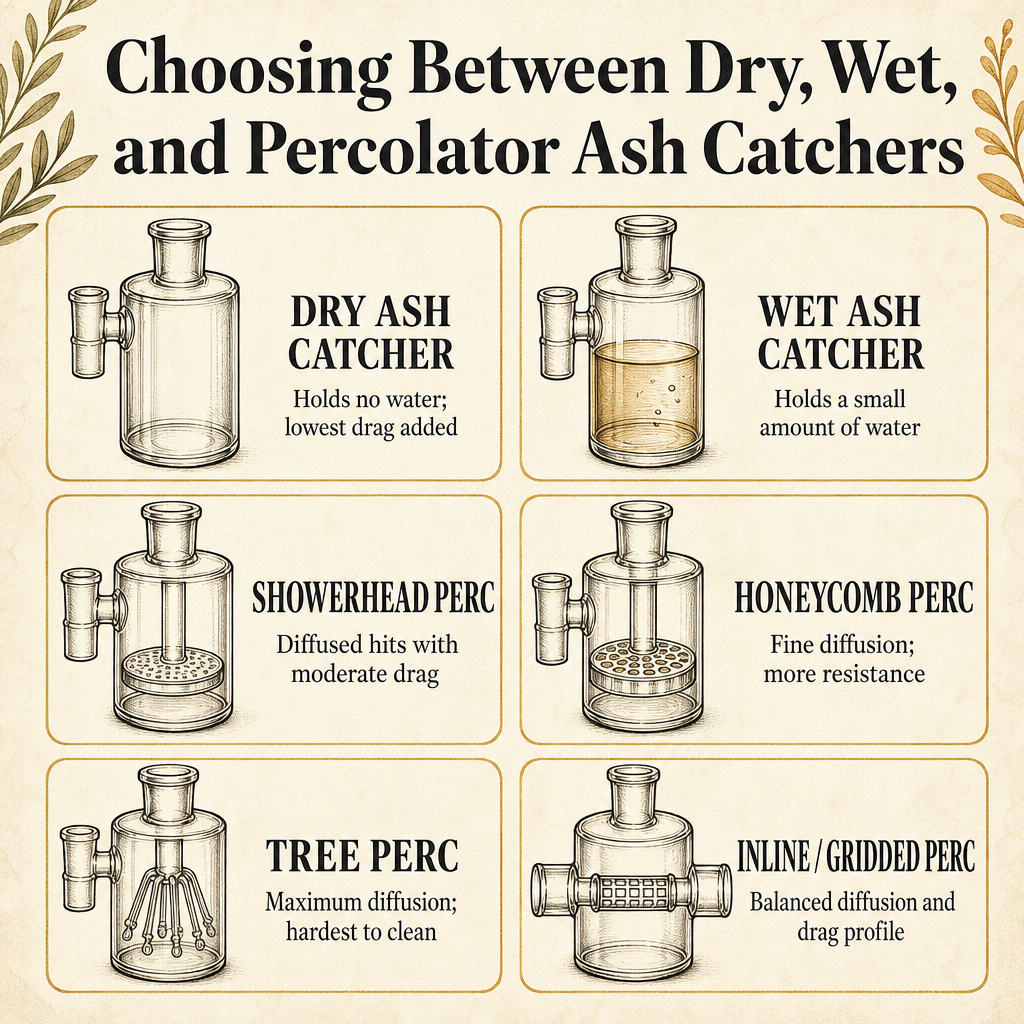
Once the size, angle, and gender match, the next decision is the style. Ash catchers come in three broad styles: dry, wet, and percolator. Each style trades drag, diffusion, and cleaning effort in a different way [1] [2] [4].
A dry ash catcher holds no water. Smoke passes through a small chamber that uses gravity and a screen or baffle to drop debris, then moves straight into the bong. This style adds the least drag and is the easiest to clean, because there is no water to change and no perc to soak [1] [2].
A wet ash catcher holds a small amount of water. Smoke bubbles through that water before moving into the bong, which adds a second filtration stage. Wet ash catchers add a small amount of drag compared to dry ones and a small amount of cleaning effort, but they are still simple compared to a full perc [1] [2] [4].
A percolator ash catcher adds a built-in perc, such as a showerhead, honeycomb, tree, or inline design. Showerheads diffuse smoke with moderate drag. Honeycomb percs use a thin disc with many small holes for finer bubbles and more resistance. Tree percs split smoke through arms for the most diffusion and the most drag, and they need the most cleaning. Inline or gridded percs sit low in the chamber and balance diffusion against drag [1] [2]. The recycler-versus-percolator comparison is a useful read if the plan is to choose between an internal perc stage and a recycling chamber Recycler Bong vs. Percolator Bong: What Is the Difference?.
A simple way to choose is to rank the three styles by what matters most: easy cleaning, low drag, or more diffusion. A dry ash catcher fits an easy-cleaning priority. A wet ash catcher fits a low-drag priority with a small diffusion boost. A percolator ash catcher fits a diffusion-first priority, with the trade-off of more resistance and a more involved cleaning routine.
- Dry ash catcher: no water held inside; the lowest drag added and the easiest cleaning, since there is no water to change or perc to soak [1] [2].
- Wet ash catcher: holds a small amount of water for a second filtration stage; modest drag and modest cleaning effort [1] [2] [4].
- Showerhead perc: flared shape with slits around the edge; moderate diffusion and moderate drag, one of the easier percs to clean [1] [2].
- Honeycomb perc: thin disc with many small holes; finer bubbles and more resistance, and the small holes can clog if cleaning is skipped [1] [2].
- Tree perc: central stem with arms ending in smaller openings; the most diffusion and the most drag, plus the most delicate parts to clean [1] [2].
- Inline or gridded perc: horizontal tube or grid near the bottom of the chamber; balanced diffusion and drag, simpler internal structure than tree percs [1] [2].
How Do You Install and Remove an Ash Catcher Without Cracking the Joint?
Installation is straightforward once the size, angle, and gender match. The ash catcher plugs into the bong’s joint with a light twist, and the bowl plugs into the other end of the ash catcher the same way. A ground glass joint should seat smoothly without force; if it sticks partway, the size, angle, or gender is wrong and forcing it will crack the joint [1] [2] [5].
Before installing, check whether the bong has a removable downstem. A removable downstem pulls out of the joint, leaving an open female joint that the ash catcher can fill. A fixed (built-in) downstem cannot be removed, which means the joint is already occupied and the bong cannot accept an ash catcher at all. If the downstem is the removable kind, the downstems subcategory carries the matching replacement parts when one wears out [1].
Removing an ash catcher that has been in place for a while takes a little more care. Resin builds up between the male and female surfaces and can glue them together over time. The standard fix is to warm a small amount of isopropyl alcohol around the joint for 10 to 15 minutes, which softens the resin. After the warm-up, twist the ash catcher gently while pulling straight up. Avoid yanking sideways, since a sudden angle change is what cracks the joint [1].
Temperature shock is another common cause of cracked joints. Running hot water over a cold ash catcher (or cold water over a warm one) creates uneven expansion in the glass, which can split it. The safer routine is to bring the glass to room temperature before running water over it, and to never alternate hot and cold on the same piece within a short window [1] [5].
- Install by plugging the ash catcher into the bong’s joint with a light twist, then plugging the bowl into the other end the same way [1] [2].
- Confirm the bong has a removable downstem before installing, since fixed downstems occupy the joint and the bong cannot accept an ash catcher [1].
- Free up a stuck ash catcher by warming isopropyl alcohol around the joint for 10 to 15 minutes, then twisting gently while pulling straight up [1].
- Avoid yanking the ash catcher sideways, since a sudden angle change is a common way to crack a ground glass joint [1].
- Avoid thermal shock on the joint, such as hot water on cold glass or cold water on warm glass, since uneven expansion can split borosilicate [1] [5].
- Replace a removable downstem with a fresh one from the downstems subcategory when the old one clogs or chips Downstems.
Frequently Asked Questions
What is an ash catcher and what does it do?
What size ash catcher do I need for my bong?
What is the difference between a 45° and 90° ash catcher, and how do I tell which my bong needs?
A 90° ash catcher points straight up and matches a vertical bong joint, while a 45° ash catcher angles outward to match a joint that comes off the bong at an angle. Most beaker bongs take 45° and most straight tubes take 90°, though individual pieces vary, so check the bong’s joint directly [3] [4] [5].
Are male and female ash catcher joints different, and which do bongs use?
Does adding an ash catcher change how hard a bong is to pull?
Yes. A dry ash catcher adds minimal drag. A wet ash catcher adds more, since smoke now passes through two water chambers. A percolator ash catcher adds the most, because the perc itself introduces resistance, especially tree and honeycomb designs, which diffuse more aggressively than a simple showerhead [1] [2].
How do you remove a stuck ash catcher without cracking the joint?
Warm isopropyl alcohol around the joint for 10 to 15 minutes to dissolve the resin, then twist gently while pulling straight up. Avoid yanking and avoid thermal shock, such as hot water on cold glass or vice versa, since either can crack the joint [1].
Which Ash Catcher Is the Right Pick for Your Bong?
An ash catcher is a small glass accessory that catches debris and, in wet and percolator styles, adds a second stage of water filtration before smoke enters the bong. Choosing the right one comes down to matching three joint specs at once: size (10mm, 14mm, or 18mm), gender (most bongs are female and accept a male ash catcher), and angle (45° or 90°). Once those match, the style choice is between dry, wet, and percolator [1] [2] [5].
If you want the easiest cleaning and the least added drag, a dry ash catcher is the simple pick. If you want a second water stage with only a small bump in drag, a wet ash catcher is the everyday choice. If you want more diffusion and do not mind more resistance and a longer cleaning routine, a percolator ash catcher with a showerhead, honeycomb, tree, or inline perc is the right fit [1] [2] [4].
Whatever style you pick, the public-health record on bongs and water pipes is the same. Bong smoke is one mode of cannabis inhalation, and the CDC describes water pipes as a common method of smoking without characterizing them as harmless or risk-free. An ash catcher changes the feel of a draw and helps keep the main chamber cleaner between deep cleans; it does not change the underlying nature of the smoke [7].
For shoppers kitting out a full setup, Treehouse Lifestyle offers free shipping on orders $150+ on the ash catchers subcategory and across the rest of the Parts & Upgrades catalog, so the catcher and a matching bowl can ship together when the order crosses the threshold.
Sources
- AFM Smoke: What Is an Ash Catcher? Function, Sizes, and Setup Guide
- Smoke Cartel: Ash Catchers 101: Keep Your Bong Clean & Hits Smooth
- Encore Collection: 45 vs 90 Degree Ash Catcher: Which Do You Need?
- MunchMakers: Ash Catchers: What They Do and Why Use One
- Thick Ass Glass: How Ash Catchers Work: The Physics Behind Better Filtration
- Wikipedia: Ground glass joint
- Centers for Disease Control and Prevention: About Cannabis