

To prevent resin buildup, change bong water after every session, rinse with warm water before residue hardens, and add an ash catcher and bowl screen so debris never reaches the main chamber. Use filtered or distilled water, store the piece empty and dry between sessions, and finish each bowl with clean airflow and complete combustion.
The single biggest lever is changing bong water after every use, because stale water holds dissolved resin that re-deposits on glass as the water evaporates and concentrates residue overnight [1] [2] [3].
Rinsing the piece with warm water right after a session removes fresh resin before it hardens, and once resin hardens it requires solvents to break down so the post-session rinse saves more work than any later cleaning agent [1] [2] [4].
Ash catchers and bowl screens intercept debris before it reaches the water chamber, which keeps the main piece’s water clearer and stretches the time between deep scrubs [3] [5] [6] [7].
Filtered or distilled water reduces mineral deposits that combine with resin to form harder buildup, so swap tap water for filtered water where mineral spots show up [1] [2] [8].
Smoking technique matters too: a loose pack, consistent medium grind, clean airflow, and complete combustion produce less tar than a tight pack, very fine grind, restricted airflow, or partially extinguished bowls [1] [7].
Between sessions, empty and rinse the piece, let it dry completely, and store it in a cool dry place away from direct sunlight, because government infection-control guidance establishes that biofilms form in water systems when structures and equipment that hold water are not cleaned for extended periods [1] [3] [9].
Light consistent maintenance caps weekly cleaning time at about 5 to 15 minutes, while monthly deep cleans of neglected pieces typically run one to two hours and can leave permanent staining [1]. Pick prevention habits first and the deep cleans become shorter and less frequent.
What Daily Habits Actually Prevent Heavy Resin Buildup?
Most readers who search for help with resin buildup already have a piece that is starting to look grimy, and the natural next step is to grab a cleaner and start scrubbing. This article frames the problem differently: prevention habits applied at the end of every session keep glass visibly cleaner for longer, and the deep scrubs take far less time when they happen at all.
Four habit families do most of the work. First, post-session water and rinse habits: change the bong water after every use and rinse with warm water before residue has a chance to harden. Second, accessory upgrades: an ash catcher between the bowl and the main chamber, plus a bowl screen that catches debris before it falls through. Third, technique adjustments: grind size, pack tightness, airflow, and whether bowls are fully burned or relit after a partial cherry. Fourth, storage rules between sessions: empty the piece, let it dry, and keep it somewhere cool and out of direct sunlight.
Each of these habits is small on its own, but together they handle most of the buildup before it ever has to be scrubbed. The rest of the article walks through them one at a time and shows what the difference looks like in real weekly cleaning time. For readers who want the full deep-clean walkthrough rather than just the prevention habits, the cleaning-care pillar covers the complete scrubbing routine, and the Treehouse Cleaning Supplies collection gathers the brushes, salts, and solutions that fit this kind of routine.
- Change bong water after every session so stale water cannot re-deposit dissolved resin on the glass.
- Rinse interior surfaces with warm water right after use, before fresh residue has a chance to harden.
- Do not leave dirty water to evaporate overnight, since concentrated residue sticks harder the next day.
- Add an ash catcher and a bowl screen to intercept debris before it reaches the main water chamber.
- Use filtered or distilled water to limit mineral deposits that combine with resin into harder buildup.
- Store the piece empty and dry in a cool dry place between sessions so residue has less time to set.
How Does Light Consistent Maintenance Compare with Monthly Deep Scrubs?
Two maintenance styles get used by people who own the same gear, and they lead to very different weekly time and very different glass condition. Light consistent maintenance means a short rinse and accessory check after most sessions, plus a more thorough scrub every two or three sessions. Monthly deep scrubs mean leaving the piece alone between long cleaning sessions, then tackling whatever has built up all at once.
The trade on time is stark. Light consistent maintenance runs about 5 to 15 minutes per week per specialist guides, while monthly deep scrubs of a neglected piece typically require one to two hours per session [1]. The trade on the glass itself is harsher still: neglected monthly scrubs often leave permanent brown staining on the inside walls, while light maintenance keeps the glass clear enough that the deep scrub itself shrinks down to almost nothing.
Readers who already follow a monthly-only routine can pick a few of the smaller habits from the bullet list above and add them in. Even just changing bong water after every session and rinsing with warm water cuts weekly scrub time noticeably. For readers who already maintain lightly, the remaining time usually goes into a weekly alcohol-and-salt deep clean rather than a daily wrestle with hardened resin. The cadence question is covered in How Often Should You Clean Smoking Accessories? and the full deep-clean walkthrough lives in The Complete Guide to Cleaning Smoking Accessories.
- Weekly time on routine care: about 5 to 15 minutes per week under light consistent maintenance [1].
- Monthly scrub time on neglected pieces: typically one to two hours per scrub [1].
- Staining risk: light maintenance avoids the permanent staining that neglected monthly scrubs often leave [1].
- Cadence under light maintenance: a light clean every 2 to 3 sessions keeps residue from hardening [1].
- Best paired with: a weekly alcohol-and-salt deep clean so residue never has a chance to set [1].
| What you trade | Light consistent maintenance | Monthly deep scrubs |
|---|---|---|
| Weekly routine time | About 5 to 15 minutes per week [1] | Typically 1 to 2 hours per scrub [1] |
| Per-session habit | Post-session rinse and fresh water [1] | No per-session habit |
| Deep-scrub frequency | A light clean every 2 to 3 sessions [1] | Once a month, on a neglected piece |
| Staining risk | Light maintenance avoids permanent staining [1] | Neglected scrubs often leave permanent staining [1] |
| Best paired with | A weekly alcohol-and-salt deep clean [1] | A long scrub when buildup gets obvious |

How Does Changing Bong Water After Every Session Prevent Resin Buildup?
Of every habit in this article, changing bong water after every session is the one that glass manufacturers point to most often. The chemistry is simple: water in a used bong holds dissolved resin and ash, and as that water evaporates or sits overnight, the dissolved material settles back onto the glass surface. Fresh water means the interior surfaces stay cleaner, because there is no dissolved resin to leave behind when the water level drops.
The follow-on habit is just as important. A quick rinse with warm water right after a session removes fresh resin before it hardens, and once resin hardens it requires solvents like isopropyl alcohol to break down. A post-session warm rinse only takes a minute and removes the kind of residue that later becomes the stubborn brown ring on the wall of the piece [1] [2] [4].
Glass manufacturers recommend emptying dirty water and rinsing before the piece sits overnight. Leaving resin-laden water to evaporate overnight concentrates residue on the glass and produces harder buildup the next day [1]. Refilling with filtered or distilled water at the start of the next session also reduces mineral deposits, because minerals from tap water combine with resin to create buildup that is harder to remove than resin alone [1] [2] [8]. Beginners picking their first piece can start with this habit from day one rather than retrofitting it later, and the What Is the Best Smoking Piece for a Beginner? primer walks through the easiest shapes to maintain on a fresh setup.
- Empty the chamber and discard old water after every session so dissolved resin cannot re-deposit as the water level drops.
- Rinse interior surfaces with warm water before residue hardens and starts behaving like a stain.
- Refill with fresh filtered or distilled water at the start of each session to limit mineral deposits.
- Never leave dirty water to evaporate overnight, because concentrated residue sticks harder the next day.
Do Ash Catchers and Bowl Screens Actually Reduce Resin Buildup?
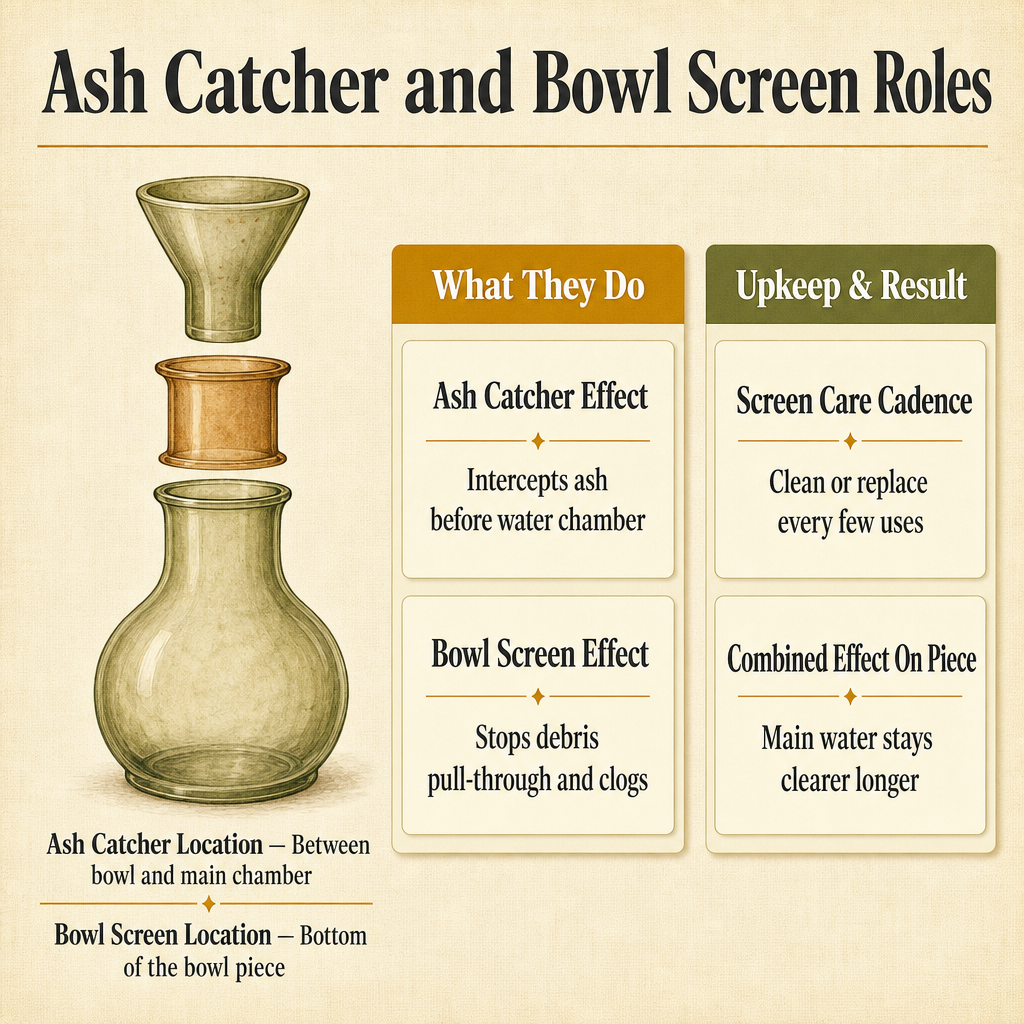
Two small accessories cut how often the main piece needs a deep scrub, and they work because they intercept debris before it reaches the main water chamber. An ash catcher attaches between the bowl and the main chamber, so most ash and tar collect in the catcher instead of the bong water. A bowl screen sits in the bottom of the bowl, so plant material and ash stay in the bowl rather than falling through.
Manufacturer guidance is direct here. An ash catcher shifts most of the buildup into a small attachment that is easier to clean, which in turn keeps the main piece’s water clearer between changes and reduces how often the main bong needs a deep scrub [3] [5]. A bowl screen prevents bowl-hole clogs, keeps pieces cleaner longer by reducing the amount of debris and tar that travels into the pipe or bong, and should be cleaned or replaced every few uses to remain effective [6] [7].
Together, the two accessories make the main piece behave like it is being used less heavily than it actually is. The catcher collects what would otherwise coat the chamber, and the screen keeps the bowl airflow consistent so partial burns and relights happen less often. For readers shopping for one of these upgrades first, an ash catcher typically delivers the largest reduction in main-piece cleanup, and the Ash Catchers range covers the standard joint sizes.
- Add an ash catcher between the bowl and the main chamber to intercept ash and resin before they reach the bong water.
- Drop a bowl screen into the bowl so plant material and ash cannot fall through into the downstem.
- Clean or replace the screen every few uses to keep it blocking debris and to keep airflow consistent.
- Rinse the catcher more often than the main piece, since most of the new buildup now lives in the catcher.
How Do Glass and Metal Bowl Screens Compare for Keeping Pieces Clean?
Bowl screens come in glass and in metal varieties, and the choice between them comes down to a few predictable tradeoffs. Both kinds stop debris from falling through and keep the airflow at the bowl consistent, but they behave differently over time, which matters for the prevention routine this article builds around.
Glass screens are non-porous and easier to clean, and they preserve flavor without altering taste because glass does not hold onto residual compounds. The downside is fragility: a hard drop or a knock against a hard surface can crack them. Brass and stainless-steel screens are more durable and hold up to everyday handling, but they accumulate residue and need more frequent cleaning or replacement because metal traps debris in its surface texture [6] [7]. The matching metal-screen tradeoffs are similar to those discussed in the Glass vs Silicone vs Wood vs Metal Pipes: Which Material Is Best? material comparison, where each option has a clear preferred use case.
Light consistent maintenance favors whichever screen the reader will actually keep clean, rather than the one that theoretically blocks the most debris. A glass screen that gets wiped down after a few uses stays out of the way; a metal screen that goes uncleaned for weeks will start to behave like a debris source rather than a filter. If a reader has dropped screens in the past and broken them, a metal screen is reasonable insurance. If a reader prioritizes flavor clarity and easy cleaning, a glass screen or a thicker-gauge metal screen with regular cleaning both fit the routine.
- Glass screens preserve flavor without altering taste, are non-porous, and are easier to clean than metal screens [6] [7].
- Brass and stainless-steel screens are more durable, but they accumulate residue and need more frequent cleaning or replacement because they trap debris [6] [7].
- Screens trade a small amount of airflow resistance for less debris and slower residue buildup, so the routine matters more than the screen material alone [6] [7].
| Trade | Glass screens | Brass and stainless-steel screens |
|---|---|---|
| Flavor impact | Preserves flavor without altering taste [6] [7] | Does not alter flavor on its own |
| Durability | Fragile; can crack if dropped [6] | Durable and flexible under normal handling [6] |
| Residue behavior | Non-porous and easier to clean [6] [7] | Accumulate residue and need more frequent cleaning or replacement because they trap debris [6] [7] |
| Airflow trade | Small airflow resistance for less debris and slower residue [6] [7] | Small airflow resistance for less debris and slower residue [6] [7] |
Does Smoking Technique Affect How Much Resin Accumulates?
Technique is the cheapest prevention lever in this article because it costs nothing and produces less tar before the tar ever reaches the glass. Four fundamentals do most of the work, and they are the same fundamentals a beginner picks up without thinking about it: how tight the pack is, how consistent the grind is, how clean the airflow is, and whether a bowl is finished with complete combustion or relit after a partial cherry.
Loose packs, consistent medium grinds, clean airflow, and complete combustion produce less tar than tight packs, very fine grinds, restricted airflow, or partially extinguished bowls [1] [7]. The mechanism is straightforward: a tight pack and a fine grind burn hotter and unevenly, which produces more unburned residue that ends up on the glass. A consistent medium grind burns evenly with cooler ember temperature, and complete combustion finishes each bowl instead of relighting it later and producing extra tar.
Readers who already own their piece can adjust technique today without buying anything, and that is sometimes the largest single drop in residue accumulation. The Glass Bongs range covers borosilicate and silicone pieces that respond well to a steady draw, and the technique habits above pair naturally with the ash-catcher and screen habits from the previous sections. Add technique to the routine and most readers will see the next deep scrub come out visibly cleaner than the last one.
- Keep the pack loose rather than tight, so the ember burns evenly instead of running hot and forming tar.
- Use a consistent medium grind instead of dust or boulders, so airflow stays open and combustion stays even.
- Draw with clean airflow rather than restricting the bowl, since restricted draws run hotter and produce more tar.
- Finish the bowl with complete combustion instead of partially extinguishing it for later, since relights produce extra residue.
How Does Proper Storage Between Sessions Reduce Resin Buildup?
Most of the buildup work happens at the boundary between sessions, which is where this section focuses. The piece already had a warm-water rinse right after the last session, and now the question is what happens to it overnight or over the next few days before the next session. Storage steps are short, but they are the steps that decide whether residue starts to harden or stays soft enough for the next rinse to lift.
The first storage step is to empty the chamber and discard old water right after that post-session rinse, so the piece is not sitting with dissolved resin inside it. The next is to let the piece dry completely, because drying keeps fresh residue from setting as a film on the glass. The third is to store it in a cool dry place away from direct sunlight, since heat and UV both age resin faster and degrade the seal on some accessories [1] [3].
The deeper reason to refresh standing water rather than let it sit comes from government infection-control guidance. The CDC establishes that biofilms form in water systems when structures and equipment that hold water are not cleaned for extended periods, so emptying and drying water-containing smoking accessories regularly reduces conditions favorable to biofilm formation [9]. The same habit that prevents hardened resin also reduces the conditions that let organisms colonize standing water, so the storage routine does two jobs at once.
- Empty the chamber and discard old water so the piece is not sitting with dissolved resin inside it.
- Rinse with warm water and let the piece dry completely so fresh residue does not set as a film on the glass.
- Store the piece in a cool dry place away from direct sunlight, since heat and UV age resin faster.
- Refresh standing water rather than letting it sit, to reduce conditions favorable to biofilm formation [9].
Which Glass and Accessory Materials Stay Cleanest Between Sessions?
Some pieces need cleaning less often than others, and the differences come from material and shape rather than from the habits in the previous sections. Borosilicate glass, used in most higher-end bongs and pipes, is non-porous and resists resin adhesion better than cheaper alternatives. Silicone absorbs flavors and odors over time rather than accumulating visible resin, so silicone pieces stay visually clearer between cleans. Multi-chamber bongs with intricate percolators trap resin faster than simple beaker or straight-tube designs.
The shape trade is straightforward: complex pieces accumulate visible residue sooner than simple ones because there are more surfaces and more chambers for residue to settle on [2]. A simple straight tube or beaker bong will go longer between deep scrubs than a multi-perc recycler, all else equal, because there is less area to scrub and the residue sits closer to the top of the water line where it is easier to reach.
The material trade is also clean. Borosilicate glass resists resin adhesion and stays visibly cleaner between cleans, simple beaker or straight-tube bongs stay cleaner longer than multi-chamber pieces, and silicone accessories stay visually clearer but absorb flavors and odors and still need regular washing to avoid off-tastes [2] [6] [8]. Readers who already own a complex multi-chamber piece can compensate with the ash catcher and screen habits from section four, and a piece like the SILICONE BEAKER BONG WITH REMOVABLE GLASS BOWL combines a silicone body with a removable glass bowl for a middle-ground maintenance profile.
- Borosilicate glass resists resin adhesion better than cheaper alternatives and stays visibly cleaner between cleans [2] [6] [8].
- Simple beaker or straight-tube bongs stay cleaner longer than multi-chamber pieces with intricate percolators, which trap resin faster [2].
- Silicone accessories stay visually clearer but absorb flavors and odors over time and still need regular washing to avoid off-tastes [2].
| Material or shape | How it handles resin | Best fit for |
|---|---|---|
| Borosilicate glass | Resists resin adhesion and stays visibly cleaner between cleans [2] [6] [8] | Readers who want the widest piece selection and easy cleaning |
| Simple beaker or straight-tube bong | Stays cleaner longer than multi-chamber pieces [2] | Readers who want the longest stretch between deep scrubs |
| Multi-chamber percolator bong | Traps resin faster than simple shapes [2] | Readers who already own one and lean on ash catchers and screens |
| Silicone accessory | Stays visually clearer but absorbs flavors and odors over time and still needs regular washing [2] | Readers who prioritize low visual buildup and accept flavor carryover |
Frequently Asked Questions
What daily habits keep a bong or pipe from building up heavy resin between deep cleans?
Change bong water after every session, rinse with warm water right after use, and never leave dirty water to evaporate overnight. Add an ash catcher and a bowl screen so debris is intercepted before it reaches the main water chamber, and store the piece empty and dry in a cool dry place between sessions. Light consistent maintenance of this kind caps weekly cleaning time at about 5 to 15 minutes per specialist guides [1] [3].
Does changing bong water after every session actually reduce resin buildup, and why?
Yes, and glass manufacturers point to it as the single biggest day-to-day prevention habit. Stale water holds dissolved resin that re-deposits on glass surfaces as the water evaporates, so fresh water means cleaner interior surfaces [1] [2] [3]. Emptying and rinsing before the piece sits overnight prevents the concentration of residue that leaves harder buildup the next day.
Do ash catchers and bowl screens meaningfully reduce how often the main piece needs to be cleaned?
Yes. An ash catcher attaches between the bowl and the main chamber to intercept ash and resin before they reach the bong water, which keeps the main piece’s water clearer and shifts most of the buildup into a small attachment that is easier to clean [3] [5]. A bowl screen sits in the bottom of the bowl to keep plant material and ash from falling through, prevents bowl-hole clogs, and should be cleaned or replaced every few uses to remain effective [6] [7].
Does water temperature (cold vs. warm vs. ice) change how much resin sticks to glass?
Industry guidance varies. Some manufacturer and retailer sources recommend ice or cold water on the theory that cooler temperatures condense smoke more aggressively and trap residues in the water, while others caution that cold glass surfaces can encourage condensation of sticky compounds on the interior walls [4] [8]. Room-temperature or lukewarm water is most commonly described as a balanced default. Pair the temperature choice with a post-session warm-water rinse so fresh resin does not harden on the glass.
Can smoking technique reduce tar and residue buildup?
Yes. Loose packs, consistent medium grind, clean airflow, and complete combustion produce less tar than tight packs, very fine grinds, restricted airflow, or partially extinguished bowls [1] [7]. Technique fundamentals are the cheapest prevention lever because they cost nothing and reduce the amount of debris and tar that travels into the pipe or bong.
Which glass or accessory materials tend to need cleaning less often?
Borosilicate glass, used in most higher-end bongs and pipes, is non-porous and resists resin adhesion better than cheaper alternatives, so it stays visibly cleaner between cleans [2] [6] [8]. Simple beaker or straight-tube bongs stay cleaner longer than multi-chamber pieces with intricate percolators, which trap resin faster [2]. Silicone accessories do not accumulate visible resin the way glass does but absorb flavors and odors over time, so they stay visually clearer but still need regular washing to avoid off-tastes [2].
What Routine Actually Keeps Bongs and Pipes Clean in Practice?
The single biggest shift comes from treating prevention as the routine rather than the deep scrub. Change bong water after every session, do a quick warm-water rinse before the piece sits, add an ash catcher and a bowl screen, adjust technique toward loose packs and complete combustion, and store the piece empty and dry in a cool place between sessions. Each of those habits is small on its own, and together they cut the deep-scrub schedule down to a weekly alcohol-and-salt clean rather than a long monthly wrestle.
The materials and shapes in the rotation matter too. Borosilicate glass and simple shapes stay cleaner longer than multi-chamber pieces and cheaper glass, and silicone accessories stay visually clearer even though they absorb flavor over time. For readers who already own a complex piece, the ash-catcher and screen habits from section four handle most of the difference. Free shipping on orders $150+ applies across the cleaning-supply collection, so it is reasonable to set up a starter routine in one order.
Readers who want the full deep-clean walkthrough can pair this article with the complete guide linked above, and the cadence article covers how often to repeat each habit for different use patterns. The rest comes down to consistency: a short routine after every session will outperform a long scrub once a month for nearly every reader, and the glass stays clearer for it.
Sources
- MunchMakers: How to Prevent Resin Buildup in Bongs and Pipes
- Thick Ass Glass: How Often Should You Clean Your Bong?
- GRAV: A Clean Bong Is a Happy Bong: A Step-By-Step Guide to Cleaner Glass
- MunchMakers: Isopropyl Alcohol for Cannabis Accessories: Complete Guide
- Thick Ass Glass: How to Use an Ash Catcher With or Without Water
- Badass Glass: Screen Savers: Choosing the Right Glass Bong Screen
- Primate Glass: Pipe Screens 101: Do You Need Them?
- Vitae Glass: Best Ways to Prevent Resin Buildup in Bongs
- U.S. Centers for Disease Control and Prevention (CDC), Healthcare Infection Control Practices Advisory Committee (HICPAC): Guidelines for Environmental Infection Control in Health-Care Facilities (2003) — Appendix C. Water