

Pulsar is a smoking-accessory and vaporizer brand based in Asheville, North Carolina. The company says its first product was a handheld portable dry herb vaporizer called the Pulsar 7 [1], and that it now houses over 1,000 products. Its catalog leans toward glass and prep gear rather than electronics, and it includes related lines and licensed collaborations such as SeshGear, Shire Pipes, and Grateful Dead products.
This guide covers what Pulsar makes and how its device series map to formats. It also explains how Pulsar glass fits standard joints, which vaporizers and batteries are worth buying first, and what parts, warranty, and returns look like after you buy.
What Does Pulsar Actually Make?
Pulsar started on the device side of the industry and grew outward from there. Its own history page says the first product was a handheld portable dry herb vaporizer called the Pulsar 7 [1]. The company is now based in Asheville, North Carolina, where it says it houses more than 1,000 different products. That origin explains the shape of the brand. Pulsar built its reputation on battery-powered devices, then expanded into everything else people need to go with them.
Today the name covers several families of products. Some are Pulsar-branded goods. Others are related lines the company owns or distributes. A few are licensed collaborations that put another brand’s artwork on a Pulsar product. Knowing which family a listing belongs to keeps your expectations in the right place. One company can put out a low-cost battery and a large water pipe under two different names.
One more thing is worth knowing up front. Public feedback on the brand comes mostly from device buyers rather than glass buyers [8]. So most reviews you read online describe a battery or a vaporizer. That matters when you weigh a low-cost glass part against a device. The same company stands behind both, but different customers judge them.
- Pulsar-branded accessories — the core line, covering water pipes, hand pipes, dab rigs, dab tools, grinders, rolling trays, and storage.
- Pulsar-branded devices — battery-powered products sold under series names such as APX and 510 DL, plus wax models and eRigs.
- SeshGear — a related line that appears alongside Pulsar on the brand’s own site, and shows up under its own brand filter inside the bong collection [2].
- Shire Pipes — a pipe line that includes a The Lord of the Rings licensed collection, named by the company as one of its brands [1].
- Grateful Dead licensed products — 55 items on Pulsar’s own site spanning bongs, hand pipes, rolling trays, vaporizers, and stash jars [7], including the Grateful Dead x Pulsar Inside Print Water Pipe – 8.5" / 14mm F / Deadhead Dorm.
How Big Is Pulsar’s Catalog, and Which Categories Lead It?
The clearest picture of what Pulsar sells comes from counting the brand’s own categories. Its shop-by-category module lists far more hardware and prep equipment than electronics [2]. Pulsar is better described as an accessory company that also makes devices than the other way around.
That balance matters because accessories are what you add to a setup you already own. If you want to judge glass quality before you shop, How Can You Tell If a Glass Smoking Piece Is Well Made? explains what separates a well-made piece from a thin one. If you are building a first setup, What Smoking Accessories Do Beginners Need? covers the items that actually get used. Glass and grinders both need upkeep, so How Often Should You Clean Smoking Accessories? covers how often to clean the pieces you reach for most.
Two numbers stand out. Glass and prep equipment together account for well over 1,000 listings. The three device categories total a little over 120. Most of what the brand sells is not electronics — the electronics are the small, specialized part of the catalog.
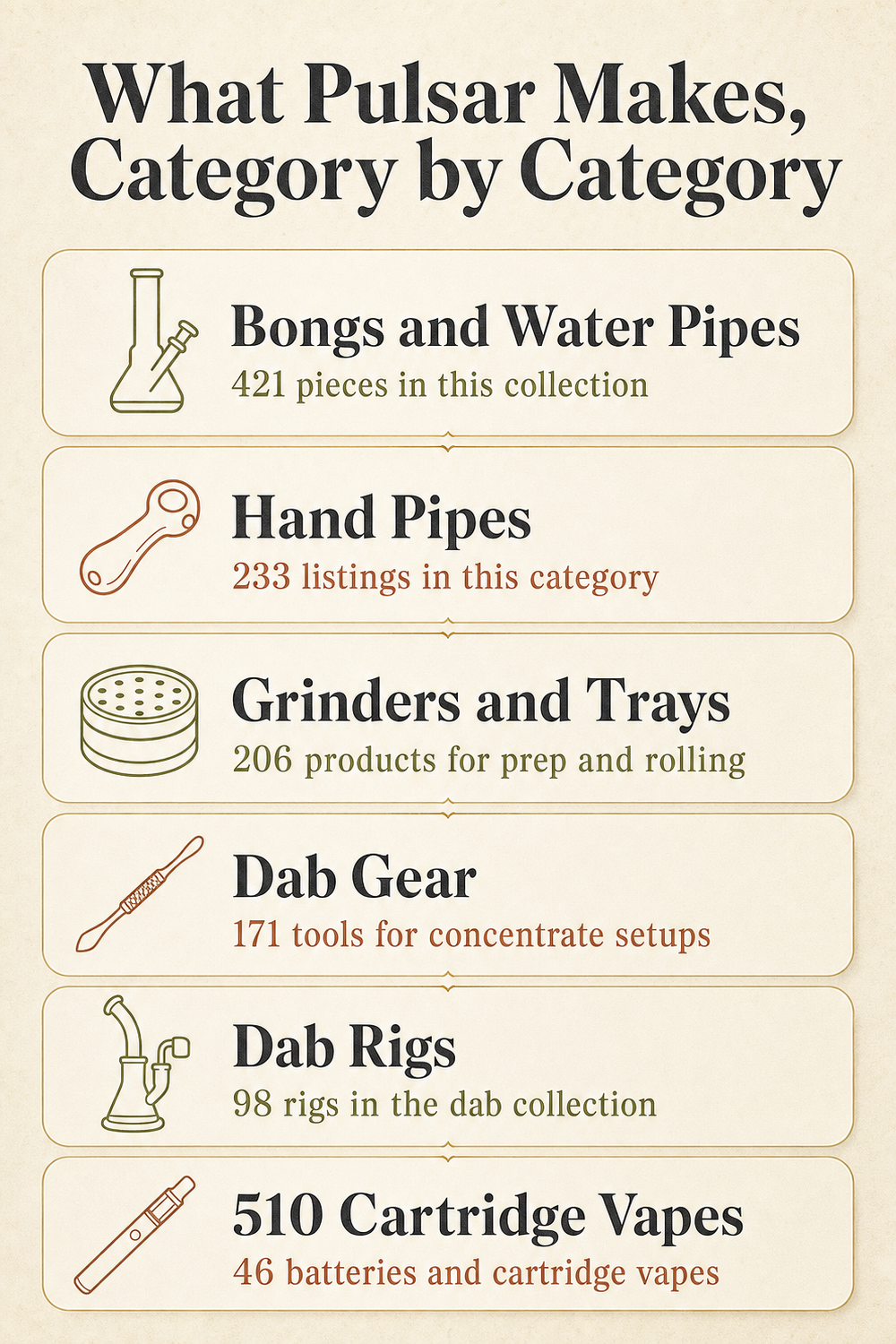
Here is how the major collections stack up, from largest to smallest. The counts come from Pulsar’s own category pages.
- Bongs and water pipes — 421 products, the single largest collection on the site and the category the brand is best known for [2].
- Hand Pipes — 233 listings, covering one-piece glass pieces and spoon-style designs [2].
- Grinders and trays — 206 products, the prep and rolling side of the catalog [2].
- Dab gear — 171 tools for concentrate setups, including the smaller parts that make a rig usable [2].
- Dab Rigs — 98 listings, less than a quarter the size of the bong collection [2].
- 510 cartridge vapes — 46 products, the largest of the three device categories [2].
- Wax vapes and eRigs — 46 products, tied with cartridge vapes [2].
- Dry herb vapes — 30 products, the smallest listed category on the site [2].
What Are the Pulsar Device Series, and Which Generation Is Which?
Pulsar releases its devices as named series over time. That makes a model name unusually informative. The company’s own history lays out the sequence with years attached [1]. A name on a box tells you both the generation and the format.
Sorting the lineup by what it holds is more practical than sorting by year. Three material types cover the range [4]. Oil cartridges run on the 510 DL battery series. Wax and concentrates run on the APX Wax and DL Wax models. Dry herb runs on the APX and DL Flower models. Inside one series, models differ mainly in battery capacity, voltage control, and how large a cartridge they accept.
That is worth knowing before you shop. Two batteries from the same series can be a simple low-cost stick and a 1000mAh device with a screen. If you are still deciding between a portable device and a larger setup, How Do You Choose the Right Portable Vaporizer? covers the questions that narrow the choice.
Here is the release order the company lists, so any model name can be placed in time.
- APX (2015) — the dry herb family that carried the brand’s first generation of handheld vaporizers [1].
- Barb (2017) — a mid-decade release in the same battery-powered lineup [1].
- GiGi (2018) — another named series from that period [1].
- DuploCart (2020) — a cartridge-focused release [1].
- Sipper (2022) — a 2022 addition to the naming line [1].
- 510 DL (2022) — the battery series that now spans the widest range of models, and the one most buyers meet first [4].
- APX eRig (2024) — the newest named release, aimed at concentrate use rather than dry herb [1].
Are Pulsar Bongs and Water Pipes Worth Buying?
Bongs and water pipes are the biggest thing Pulsar makes. The brand’s own collection lists 421 products [2]. Of those, 415 are tagged borosilicate glass. That is the material most water pipes are built from, because it handles temperature changes better than weaker glass does.
Inside that collection the brand also runs a thicker-wall line. Retail listings for the THK series describe it as a thick borosilicate line built for durability [10]. The same listing notes reinforced sidewalls and an integrated tab handle. It also states that its 14mm male joint fits a wide range of female-jointed water pipes, downstems, and ash catchers [10].
Treehouse Lifestyle stocks Pulsar pieces across several categories. Its listings write the fit into the product name, so 14mm F means a 14mm female joint [14]. That means you can confirm a match without opening a product page. Its Pulsar results also carry joint size filters for 10mm, 14mm, and 18mm, plus female and male gender filters [14].
Because the collection is so large, the useful skill is reading a listing correctly. These are the specs that decide whether a piece will work for you.
- Material — borosilicate glass covers the large majority of the collection [2]. Silicone and freezable glycerin pieces also appear, so check the field rather than assume.
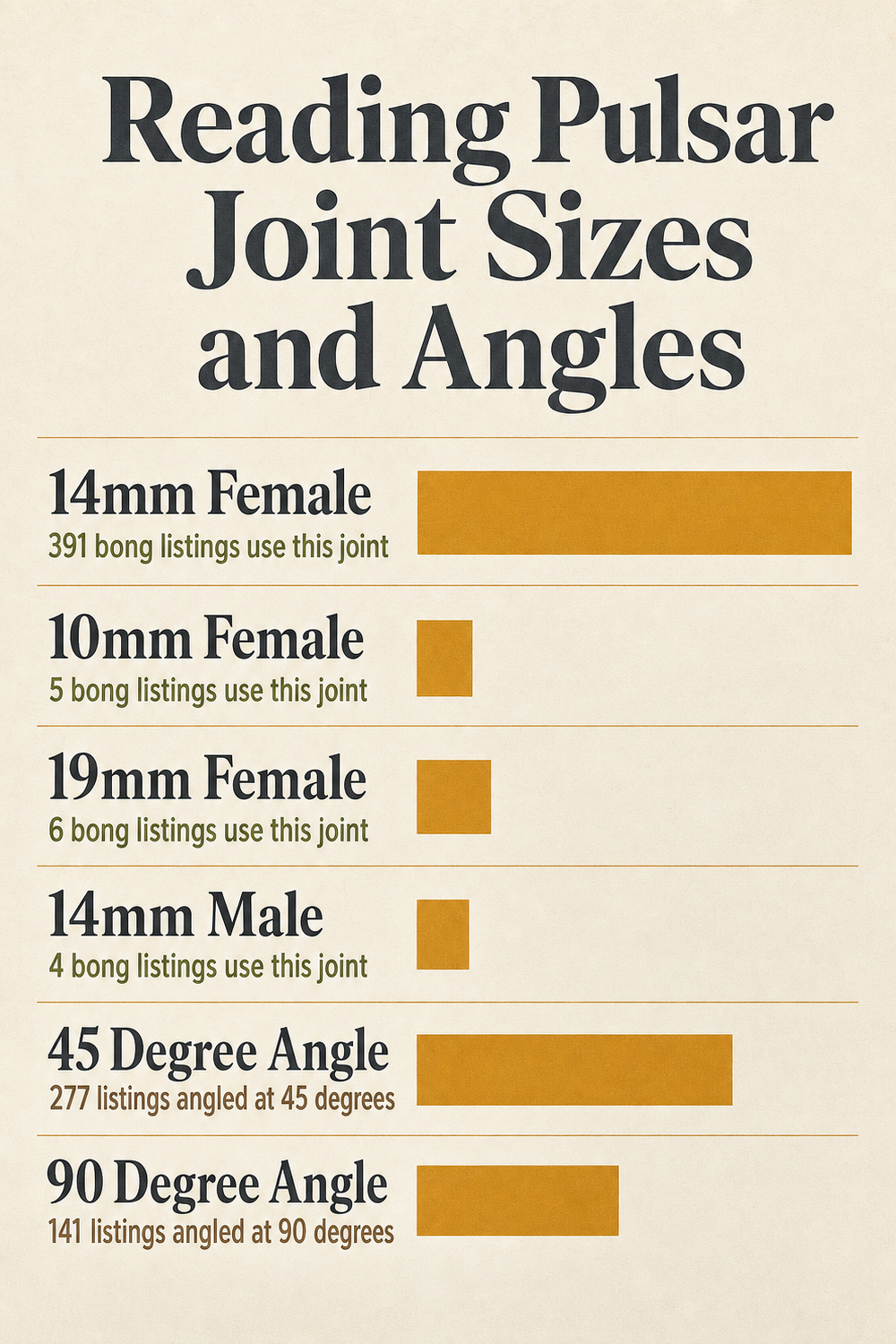
- Joint size — 391 of the listed bongs use a 14mm female joint [2]. That is the fit most bowls and downstems are made for.
- Joint gender — female and male joints do not connect without an adapter. Pulsar’s own filters show both [2].
- Joint angle — 277 listings are angled at 45 degrees and 141 at 90 degrees [2]. The angle decides how a bowl sits on an upright piece.
- Height — a large piece for a table and a smaller piece that travels are different products. Height is listed separately from the joint specs.
- Wall thickness or series — belonging to a thicker-wall line is a durability statement, not a fit statement [10].
Do Pulsar Pieces Use Standard Joint Sizes, and What Fits What?
Ground glass joints are a laboratory standard that glass makers borrowed. That is why fit is predictable across brands. A tapered joint of this style uses a standardized 1:10 taper [11]. It carries a size code such as 14/20 or 14/23. The first number is the outer diameter of the male joint at its widest point. The second is the ground length.
The practical result is that joints of the same specification interchange between makers [11]. A 14mm bowl from one brand generally fits a 14mm female piece from another. Pulsar’s own collection bears that out: 14mm female is the dominant joint across its bongs, with 10mm female, 19mm female, and 14mm male options appearing in much smaller numbers [2]. Its THK parts are described the same way, as a 14mm male joint that fits a wide range of female-jointed pieces [10].
Two exceptions are worth remembering. A silicone or threaded piece may not use a ground glass joint at all. A 10mm or 19mm joint will not take 14mm parts without an adapter. Neither is a defect. It just means the individual listing is the last word on fit.
Here is the order to check, every time you match a bowl, downstem, or ash catcher to a piece.
- Read the joint size on the piece first. This is the number that has to match, because a 14mm female piece takes a 14mm male part.
- Read the gender second. Female and male joints do not connect without an adapter, and Pulsar’s filters show both [2].
- Check the angle if you are buying for a specific pipe. Pulsar’s listings split mainly between 45 degrees and 90 degrees [2].
- Confirm on the individual product page before you buy. Brand filters summarize a collection; your piece’s own listing states its joint.
- Use the same habit on the retail side. Treehouse Lifestyle puts the fit in the product name, so 14mm F covers size and gender at a glance [14].
| Joint on the piece | What fits it | Pulsar bong listings |
|---|---|---|
| 14mm female | 14mm male bowl, downstem, or ash catcher | 391 [2] |
| 10mm female | 10mm male parts only | 5 [2] |
| 19mm female | 19mm male parts only | 6 [2] |
| 14mm male | 14mm female sockets, including downstems and ash catchers [10] | 4 [2] |
Which Pulsar Vaporizers and 510 Batteries Are Worth Buying First?
The device half of the brand is easier to choose than the glass. There are fewer models, and the differences are printed on the label. Start with the material you want to use [4]. Oil cartridges run on the 510 DL battery series. Wax and concentrates run on the APX Wax and DL Wax models. Dry herb runs on the APX and DL Flower models.
For dry herb, the APX V3 is the current entry point. It is listed at $69.99 with a 1600mAh battery, USB-C charging, and five preset temperature steps from 374F to 446F [3]. The page also notes an LED screen, haptic feedback, a 30-second heat time, and a one-year warranty. An independent review calls it a beginner-friendly budget dry herb device with good temperature control [9]. It reports roughly an hour of use per charge, and a mouthpiece that takes force to remove as the other main tradeoff [9]. The brand’s own guidance is to dry-fire a new unit up to three times before loading it [3].
For oil cartridges, the 510 DL series is the lineup. 510 threading is a shared connector standard rather than a Pulsar feature. That is why almost every 510 cartridge fits almost every 510 battery. Sources explain the name differently [12] [13]. One manufacturer page calls it ten threads of 5mm. A retailer guide describes ten threads spaced 0.5mm apart [13]. The practical outcome is the same either way. Compact batteries in the 400-800mAh range typically last about a day of normal use and recharge in one to two hours over USB-C [13].
Here is how the DL models compare on the specs that change day to day.
- 510 DL Original — 320mAh, with two voltage settings at 3.0V and 3.8V [4]. Breath control, and a stated fit of most 1g cartridges.
- 510 DL 2.0 PRO — 1000mAh, five voltage steps, breath and button control, haptic feedback, an LED screen, and a puff counter [4]. Stated fit is most 2g cartridges. It is listed at $24.99 and carries over 1,200 customer reviews [5].
- 510 DL 3.0 Twist — 650mAh, with a dial that adjusts output from 1.8V to 4.2V [4].
- 510 DL Lite — 320mAh with a single fixed voltage setting, the simplest model in the series [4].
- 510 DL 5.0 and 6.0 — 1000mAh, 1.8V to 4.2V, a removable mouthpiece, adjustable airflow, a screen, and a puff counter [4]. The 6.0 states a fit of most 3g cartridges.
- 510 DL Tandem — 650mAh with two cartridge ports [4].
- 510 DL Wax — 650mAh with a nesting dab tool for concentrate use [4].
| What you use | Pulsar series or model | What changes between models |
|---|---|---|
| Oil cartridges | 510 DL battery series [4] | Capacity from 320mAh to 1000mAh, voltage control, and stated cartridge fit |
| Wax and concentrates | APX Wax, DL Wax, and the APX eRig [1] | Format and battery capacity |
| Dry herb | APX and DL Flower models [4] | Battery capacity, temperature steps, and chamber size |
Which Pulsar Product Should You Buy First?
The right first Pulsar purchase depends on what you already own. If you are adding to an existing setup, the useful question is what is missing. If you are starting from nothing, ask how much upkeep you want to take on.
Whatever you choose, confirm the fit before you buy. Treehouse Lifestyle writes the joint size and gender into its Pulsar product names, so 14mm F tells you what a piece accepts at a glance [14]. Free shipping on orders $150+ is worth knowing if you are buying a piece and its accessories together.
Here are the sensible starting points by category, and the practical reason each one works.
- A water pipe, if you want the widest ecosystem of add-ons. The bong collection is the brand’s largest category, at 421 listings [2]. A 14mm female piece accepts the broadest range of standard bowls, downstems, and ash catchers.
- A hand pipe, if simplicity matters most. There is no water and no separate bowl to match, so nothing needs to fit [2]. The brand lists 233 of them.
- A dab rig or dab gear, if you use concentrates. The dab side runs to 98 rigs plus 171 supporting tools, so the rig and its tools are meant to be bought together [2].
- A grinder and a tray, whatever format you use. These support every category on this list. They are also the easiest place to notice the difference between a cheap product and a good one.
- A 510 DL battery, if you use oil cartridges and want the lowest-cost entry into the device line [4].
- An APX V3, if you want a dry herb device rather than a cartridge battery. It is the brand’s current entry-level dry herb model at $69.99 [3].
Are Pulsar Parts, Warranties, and Returns Easy to Handle?
What happens after the sale is where a device brand is usually judged. Pulsar has a fairly clear after-sale structure. The company sells replacement parts for its own devices rather than treating them as disposable [3]. Those parts include APX V3 mouthpieces at $13.99, mouthpiece ceramic screens at $3.99, and replacement stir sticks at $7.99. It also lists a 510 DL 2.0 magnetic bottom connector at $11.99 [4]. If you plan to keep a device running for years instead of replacing it, parts availability is the first thing to check.
The return window is narrower than the warranty. Items bought directly from Pulsar can be returned within 30 days of receiving the order [6]. They must arrive in the same condition and in original packaging, and used items are not accepted at all. Purchases from a second-party retailer are not eligible for refunds through Pulsar. Those fall under the policy of the store where you bought them [6].
The review picture is a signal in both directions. Pulsar’s Trustpilot profile sits at 4.7 out of 5 across about 110 reviews [8]. The most common compliments are about support response times and warranty replacements. A minority of reviewers report devices that failed early, or claims that were hard to resolve. The company says it has replied to 75% of negative reviews, usually within 24 hours [8]. Independent coverage of the APX V3 reports the same tradeoff buyers mention: easy enough for casual use, with limited battery life and a stiff mouthpiece as the costs [9].
Before you commit to a model, run through this short checklist.
- Confirm the warranty term for the specific device. The APX V3 product page notes a one-year warranty, and independent coverage states the same coverage of manufacturing defects [3] [9].
- Check that replacement parts exist for the model you are considering, especially wearable pieces such as mouthpieces and screens [3].
- Keep your order confirmation, because the return window runs from the date you receive the order [6].
- Know which returns policy covers your purchase. Pulsar’s own 30-day policy applies to items bought directly from the brand, and it requires unused items in original packaging [6].
- If you bought from a retailer, expect that retailer’s policy to apply instead [6]. Pulsar does not process refunds for second-party purchases.
Frequently Asked Questions
What does Pulsar make?
Pulsar makes smoking accessories and vaporizers. Its own site lists bongs and water pipes, hand pipes, grinders and trays, dab gear, dab rigs, 510 cartridge vapes, wax vapes and eRigs, and dry herb vapes [2]. The company says it houses over 1,000 different products at its Asheville, North Carolina facilities [1]. It also carries related lines and licensed collaborations such as SeshGear, Shire Pipes, and Grateful Dead products [7].
Is Pulsar a good brand?
The public signal runs in both directions. Pulsar’s Trustpilot profile sits at 4.7 out of 5 across about 110 reviews [8]. Reviewers most often praise customer service, response times on defective merchandise, and warranty replacements. A minority report devices that failed early, or claims that were hard to resolve. The company says it has replied to 75% of negative reviews, typically within 24 hours [8].
Do Pulsar bongs use standard joint sizes?
Most of them do. Pulsar’s own bong filters list 14mm female joints on the large majority of pieces [2]. Options for 10mm female, 19mm female, and 14mm male also appear, and joint angles split mainly between 45 degrees and 90 degrees. Ground glass joints of the same specification interchange between makers, so a standard 14mm bowl, downstem, or ash catcher generally fits [11].
Are Pulsar vaporizers and 510 batteries a good place to start?
The brand’s entry devices are built for casual use. The 510 DL battery series runs from a simple low-cost battery up to 1000mAh models [4]. The larger models add five voltage steps, adjustable airflow, screens, and puff counters. Stated cartridge fit ranges from most 1g cartridges up to most 3g cartridges on the largest model. Independent coverage of the APX V3 dry herb vaporizer calls it beginner-friendly and affordable, with USB-C charging and about an hour of use per charge from its 1600mAh battery [9].
Can you buy replacement parts for Pulsar devices?
Yes. Pulsar sells parts for its own devices [3] [4]. Those include APX V3 mouthpieces, mouthpiece ceramic screens, replacement stir sticks, and the 510 DL 2.0 magnetic bottom connector. That matters if you plan to keep a battery or vaporizer running rather than replacing it. It is worth checking part availability for a specific model before you commit to it.
What is Pulsar’s return policy if you buy from a retailer?
Pulsar’s own 30-day return policy covers items purchased directly from the brand [6]. Only unused items in their original packaging qualify, since used items are not accepted. Purchases made from a second-party retailer are not eligible for refunds through Pulsar. Those fall under the specific policy of the store where you bought them [6].
What Should You Remember About Pulsar?
Pulsar is an Asheville, North Carolina brand that started with a handheld dry herb vaporizer [1]. It now covers more than 1,000 products, most of them glass and prep equipment rather than electronics. Its named series map a model name to both a generation and a format: APX, Barb, GiGi, DuploCart, Sipper, 510 DL, and the APX eRig.
For glass, fit is the main thing to check. A 14mm female joint is the dominant spec across Pulsar water pipes [2]. Smaller numbers of 10mm female, 19mm female, and 14mm male also appear. Ground glass joints of the same specification interchange between makers, so standard bowls and downstems generally work [11].
For devices, start with the material, then compare battery capacity, voltage control, and stated cartridge fit. Replacement parts exist for the models worth keeping. The APX V3 carries a one-year warranty, and returns run through the store you bought from rather than through the brand [6].
Pick the category that matches what you already own. Confirm the joint size in the product name. The rest of the decision comes down to how much upkeep you want to take on.
Sources
- Pulsar Vaporizers (Pulsar Shop): About Us — Pulsar Shop
- Pulsar Vaporizers (Pulsar Shop): Bongs — Pulsar Shop collection page
- Pulsar Vaporizers (Pulsar Shop): Pulsar APX Vape V3 Dry Herb Vaporizer
- Pulsar Vaporizers (Pulsar Shop): Pulsar 510 DL Series — model comparison
- Pulsar Vaporizers (Pulsar Shop): Pulsar 510 DL 2.0 PRO Auto-Draw Vape Bar
- Pulsar Vaporizers (Pulsar Shop): Refund policy — Pulsar Shop
- Pulsar Vaporizers (Pulsar Shop): The Grateful Dead — Pulsar Shop collection
- Trustpilot: Pulsar Vaporizers Reviews — Trustpilot
- Tools420: Pulsar APX V3 Review
- SMOKEA: Pulsar THK 14mm Bong Bowl
- Wikimedia Foundation: Ground glass joint — Wikipedia
- Innokin: What Is the 510 Thread, and How Does It Work?
- Halara Cannabis: What Is a 510 Thread Battery? A Buyer’s Guide
- Treehouse Lifestyle: Bongs — Pulsar brand filter, Treehouse Lifestyle