

A complete beginner’s guide to spoon pipes — parts, materials, use, and care
A spoon pipe is a handheld smoking pipe with a curved bowl, a narrow stem, and a mouthpiece positioned on opposite ends. The curved bowl — which gives the pipe its name — holds dry herb while the stem and mouthpiece let you inhale the smoke. It is one of the most common and straightforward smoking accessories, favored for its portability, simplicity, and ease of use.
Spoon pipes have been a staple of pipe smoking since the practice spread through the Dutch Republic in the 17th century, and they remain popular today in glass, ceramic, metal, and wood variations. [1] Whether you are new to hand pipes or simply want to understand the equipment, this guide covers everything you need to know about what a spoon pipe is, how it works, and how to get the most out of one.
What Are the Parts of a Spoon Pipe Called?
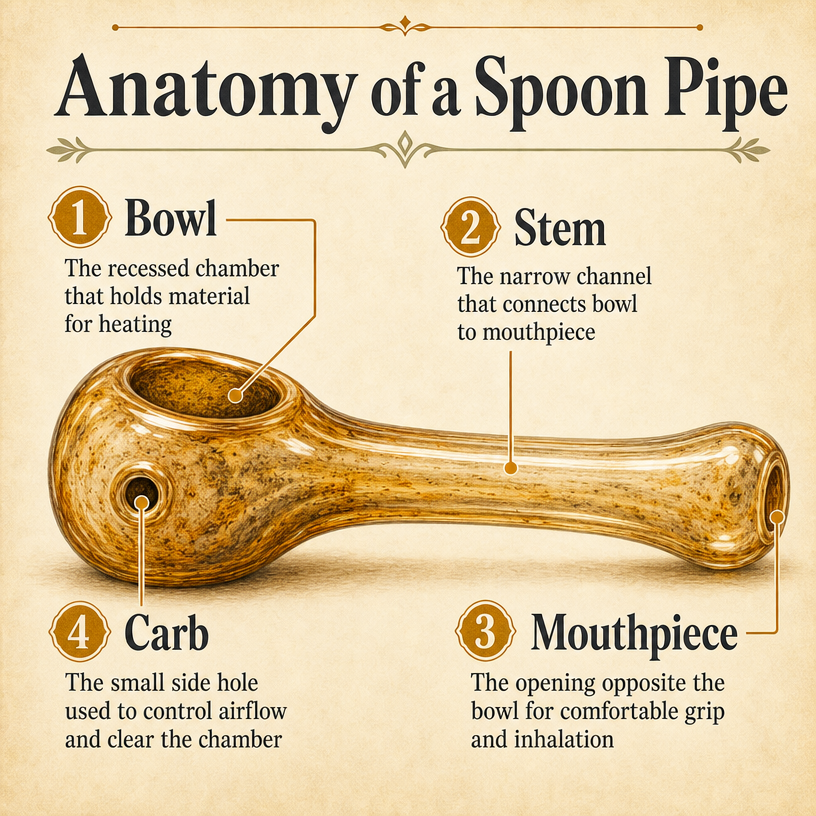
Every spoon pipe has four core parts, though some pipes include additional features. Knowing these terms makes it easier to follow instructions, shop for replacements, and understand how the pipe functions as a whole.
- Bowl — the curved area where herb is placed and lit
- Stem — the narrow channel that carries smoke from bowl to mouthpiece
- Mouthpiece — the end where you place your lips to inhale
- Carb — a small hole you cover and release to clear smoke from the chamber
The bowl is the widest part of the pipe and curves downward, which is where the name "spoon" pipe originates. This is where you place your herb. The shape resembles the bowl of an actual spoon, which is how the design got its common name. The bowl holds the material in place while it burns and connects directly to the stem.
The stem is the long narrow channel that runs from the bowl to the mouthpiece. It carries smoke from where it is generated at the bowl to where you inhale at the mouthpiece. In many pipe designs the stem is diagonal or curved, which slightly cools the smoke before it reaches your lips.
The mouthpiece is the opening at the opposite end of the pipe from the bowl. It is shaped to fit comfortably against your lips. You do not put your lips inside the opening — you place them over the outside of the mouthpiece for a comfortable seal.
The carb is a small hole on the side of the pipe near the bowl. When you cover the carb with your thumb while inhaling, you restrict airflow and help smoke accumulate in the chamber. Releasing the carb allows fresh air to rush through and push the remaining smoke out of the pipe. Some spoon pipes do not have a carb, which is common on one-piece designs.
Read What Are the Parts of a Bong, Rig, or Pipe and How Do They Work? for more detail.
What Materials Are Spoon Pipes Made From?
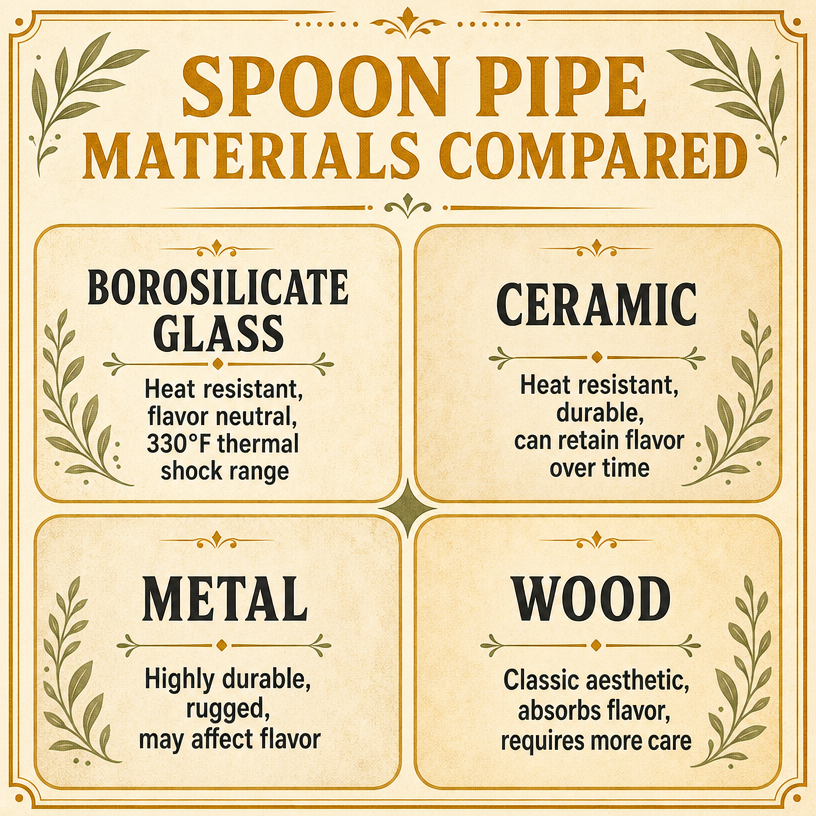
Spoon Pipes come in four main materials, each with distinct characteristics that affect durability, heat resistance, flavor, and maintenance. Choosing the right material depends on how and where you plan to use the pipe.
- Borosilicate glass — heat resistant, flavor neutral, easy to see residue buildup
- Ceramic — durable, decorative, may retain flavor over extended use
- Metal — extremely durable, rugged, may affect taste of herb
- Wood — classic look and feel, absorbs flavor, needs regular care
Borosilicate glass is the most common material for modern spoon pipes. It resists thermal shock, meaning it can handle rapid temperature changes without cracking. [2] Glass does not absorb flavors from previous sessions, so each use tastes clean. The material is also transparent, so you can see when the bowl needs cleaning. Borosilicate glass is the material of choice for most people who prioritize flavor and a clean smoking experience.
Ceramic pipes offer strong heat resistance and are more durable against drops than standard glass. They come in a wide range of colors and decorative styles. Over time, ceramic can absorb some flavor from the material smoked, and the surfaces can chip if the pipe is dropped on a hard surface. Ceramic is a good middle ground between glass and more rugged materials.
Metal spoon pipes are the most durable option available. They will not crack or chip if dropped, making them a practical choice for travel or outdoor use. The main drawback is that metal can affect the taste of your herb, and metal conducts heat more readily, which means the pipe exterior can become hot during use. Metal pipes are often favored for ruggedness over flavor purity.
Wood is a classic material that gives pipes a natural, organic look. Wood handles heat well and feels comfortable to hold. The trade-off is that wood absorbs flavors over time, which can mix with the taste of what you are smoking. Wood also requires more maintenance to prevent cracking and needs periodic conditioning to stay in good shape. [1]
Read What Are Hand Pipes and Bubblers, and How Do They Differ? for more detail.
Read What Are the Different Types of Hand Pipes? for more detail.
| Material | Heat Resistance | Flavor Impact | Durability |
|---|---|---|---|
| Borosilicate Glass | High (330°F thermal shock range) | None | Cracks if dropped |
| Ceramic | High | Low to moderate | Chips if dropped |
| Metal | High | Moderate | Highly durable |
| Wood | Moderate | Moderate (absorbs flavor) | Can crack or warp |
How Do You Use a Spoon Pipe?
Using a spoon pipe is straightforward once you understand the basic steps. The process involves packing the bowl, lighting the herb, inhaling, and clearing the chamber. Follow these steps in order for the best experience.
- Grind the herb to a coarse, even consistency before loading
- Pack the bowl loosely — tight packing restricts airflow
- Cover the carb with your thumb if your pipe has one
- Touch the flame to the edge of the herb, not the center
- Inhale slowly and steadily, then release the carb to clear the chamber
Grind your herb before loading it. Whole buds do not burn evenly in a pipe. A coarse grind — similar to the texture of sea salt — promotes an even burn and consistent airflow through the pipe. Do not pack the bowl too tightly. A loose pack allows enough air to support combustion while the herb burns slowly and evenly. Over-packing restricts airflow and makes it difficult to draw smoke through the stem.
Hold the pipe with the bowl facing upward. Place your lips over the mouthpiece to form a seal. If your pipe has a carb, cover it with your thumb. Begin to inhale slowly as you bring a lighter or match to the edge of the herb in the bowl. You do not need to hold the flame directly over the bowl — touching the flame to the edge of the herb is enough to begin combustion.
Continue inhaling gently. You will see smoke traveling through the stem and feel it reach the mouthpiece. Take slow, steady breaths rather than hard pulls. Rough inhaling can cause the herb to burn too fast or produce an unpleasant taste.
Once you have taken two or three slow breaths, release your thumb from the carb. This allows fresh air to flush the remaining smoke from the pipe chamber. Remove the flame from the bowl and set the pipe down in a safe place. Allow the pipe to cool completely before handling it further or storing it.
How Do You Clean a Spoon Pipe?
Residue buildup inside a spoon pipe affects both flavor and airflow. Regular cleaning keeps the pipe smoking smoothly and extends its usable life. Deep cleaning with isopropyl alcohol and salt is the most effective method for removing built-up residue.
- Run hot water through the pipe after each session while residue is warm
- Use a pipe cleaner tool to clear loose material from the stem
- Soak pieces in 90%+ isopropyl alcohol and Morton salt for several hours
- Shake the sealed bag vigorously for two to three minutes
- Rinse thoroughly under hot water and air dry completely before next use
Between deep cleans, run hot water through the pipe after each session while the residue is still warm. This prevents buildup from hardening and makes the next deep clean easier. A pipe cleaner tool — a thin, flexible brush designed for this purpose — can be run through the stem to dislodge loose material. Allow the pipe to dry completely before your next use to avoid any bacterial growth that can result from a damp environment.
Disassemble the pipe if possible and set aside any removable parts. Place the pieces in a sealable plastic bag or container and cover them with 90% or higher isopropyl alcohol. The alcohol dissolves resin and oil buildup that accumulates inside the pipe over time.
Add two to three tablespoons of coarse Morton salt to the bag. The salt acts as an abrasive that scrubs residue from the glass or ceramic surfaces as you shake the bag. Seal the bag and shake vigorously for two to three minutes. Focus on ensuring the solution reaches all interior surfaces, including the stem and the bottom of the bowl.
Remove the pieces from the bag and rinse each one thoroughly under hot water. All the alcohol and salt must be washed away before you reassemble and use the pipe. Set the pieces on a paper towel and allow them to air dry completely — at least several hours or overnight. Do not rush this step. Residual moisture inside the pipe will dilute the flavor of your next session.
For routine maintenance, clean the pipe at least once a week with regular use. If you notice visible residue in the bowl or stem, a change in taste, or reduced airflow during use, clean the pipe immediately rather than waiting for your next scheduled cleaning. These are clear indicators that buildup has reached a level that affects the smoking experience.
Read How Do I Maintain My Vaporizer for Best Performance? for more detail.
How Is a Spoon Pipe Different From Other Hand Pipes?
Spoon pipes are one of several hand pipe styles, each with a distinct design and set of characteristics. Understanding the differences helps you decide which style fits your needs or decide whether a spoon pipe is the right choice for you.
- Chillums — straight tube, no carb, no cooling path, highly portable but can be harsh
- One-hitters — tiny bowl for single hits, extremely discreet, requires frequent refills
- Bubblers — water-cooled, larger, heavier, requires water to function
- Sherlock pipes — classic curved stem, better cooling, larger and less portable
- Spoon pipes — portable, no accessories needed, carb for chamber clearing, balanced experience
Chillums are a straight, tubular pipe design with no carb, no stem, and no curve. You load the herb at one end and inhale from the other. They are highly portable and discreet, and the straight bore makes for a direct smoking experience. The trade-off is that chillums offer no way to clear the chamber and no natural cooling, which can make the smoke more harsh. [1] Chillums are also harder to hold comfortably near the bowl end since the exterior gets hot during use.
One-hitters are very small, tubular pipes that hold a tiny amount of herb — roughly enough for one or two hits. They are extremely discreet and easy to carry. The small bowl size means frequent refills if you want more than a single use. One-hitters are ideal for situations where portability and discretion are the highest priorities, but they do not offer the capacity or cooling benefits of a spoon pipe.
Bubblers are essentially a hand pipe with a water reservoir built into the base. The water cools smoke before it reaches your lips, and the chamber can catch some ash. [3] The trade-off is that bubblers require water to function, are larger and heavier than spoon pipes, and are less convenient to carry. They also require cleaning of both the pipe and the water chamber.
Sherlock pipes feature a distinctive long, curved stem that gives them a classic, theatrical look. The long stem provides more cooling time for the smoke than a standard spoon pipe, which many users prefer. However, the larger size makes them less portable and the curved shape can be awkward to store or carry in a bag.
For most people, a spoon pipe strikes the best balance between portability, ease of use, and smoking experience. It does not require water or any accessories, fits easily into a pocket or bag, and gives you full control over the size of each pack. [3]
What Should You Look for When Buying a Spoon Pipe?
A few practical considerations help you choose a spoon pipe that matches how you plan to use it. Material, size, bowl depth, and construction quality are the main factors that affect day-to-day use.
- Borosilicate glass for thermal resistance and clean flavor
- Pipe size and portability matching your typical use environment
- Bowl depth that fits your preferred session size
- Consistent, thick glass with no bubbles or thin spots
- Price reflecting real construction quality rather than decoration alone
Material determines durability, flavor, and heat resistance. Borosilicate glass is the most popular choice because it resists thermal cracking and does not affect the taste of your herb. If you need something that can survive being dropped, a metal pipe may be a better fit. Ceramic offers a middle ground with good durability and more visual variety than glass. [2]
Pipe size affects portability and bowl capacity. Smaller pipes — under five inches — are easier to carry and hide but hold less herb. Larger pipes offer more capacity between refills but are less convenient to transport. Think about where you will use the pipe most often before deciding on size.
Bowl depth varies between pipes. Deeper bowls support longer smoking sessions but require more herb per pack. Shallow bowls are easier to load and clean, and they cool down faster between hits. Choose based on how much you typically want to smoke in one session.
Check the quality of the glass or material before buying if possible. Hold the pipe up to light to look for bubbles, thin spots, or uneven thickness in glass pipes. Thin or uneven glass is more likely to crack under heat stress. Thick, consistent glass with no visible imperfections is a sign of better manufacturing quality.
Price ranges vary widely. Basic glass spoon pipes are available at many price points and can smoke just as well as expensive decorative pieces. Higher prices often reflect decorative work, brand name, or specialized materials rather than a meaningfully better smoking experience. Stick within your budget and focus on construction quality rather than price alone.
If you are buying online, review the return policy before purchasing. A pipe can arrive with a manufacturing defect or arrive damaged in shipping, and having the option to return or exchange it protects your purchase.
Browse Glass Hand Pipes to explore related options.
What Are Common Questions About Smoking Accessories?
Is a spoon pipe the same as a tobacco pipe?
A spoon pipe is a type of hand pipe used for dry herb and can contain cannabis or tobacco. While the basic shape overlaps with traditional tobacco pipes, the term ‘spoon pipe’ in modern use specifically refers to the handheld, curved-bowl design popularized in cannabis culture.
Can you use a spoon pipe for tobacco?
Yes. While commonly associated with cannabis, spoon pipes can be used for tobacco or other dry herbs. The same care and cleaning practices apply regardless of the substance smoked.
What is the best material for a spoon pipe?
Borosilicate glass is generally preferred for its thermal shock resistance — it can withstand temperature differentials of roughly 330°F (166°C) without fracturing — and because it does not affect the flavor of the herb. Ceramic offers similar heat resistance with added durability. Metal and wood are more rugged but can impart flavor over time.
How often should you clean a spoon pipe?
A general guideline is to clean a spoon pipe at least once a week with regular use. Visible residue, a change in taste, or reduced airflow are clear signs it needs cleaning sooner.
Are spoon pipes more portable than bubblers?
Yes. Spoon pipes have no water reservoir, making them lighter, smaller, and easier to carry in a pocket or bag compared to bubblers, which require water and a more protected form factor.
Is a Spoon Pipe the Right Choice for You?
A spoon pipe is a compact, low-maintenance hand pipe with a curved bowl that holds dry herb for smoking. The design has persisted for centuries because it works reliably, requires no accessories, and fits easily into a bag or pocket. Understanding how the bowl, stem, mouthpiece, and carb work together is the first step to using one correctly and getting the most out of every session.
Spoon pipes come in four primary materials — borosilicate glass, ceramic, metal, and wood — each with its own trade-off between heat resistance, flavor purity, durability, and maintenance needs. Borosilicate glass is the most popular choice for everyday use. Cleaning requires only isopropyl alcohol, salt, and a little time, and doing it weekly keeps the pipe tasting fresh and drawing well.
Compared to chillums, one-hitters, bubblers, and Sherlock pipes, a spoon pipe offers the most balanced combination of portability, control, and ease of use. Whether you are new to hand pipes or looking for a reliable everyday option, the spoon pipe remains one of the most practical choices available. Treehouse Lifestyle carries a wide selection of spoon pipes in glass, ceramic, and more — with free shipping on orders over $150.
Where Does This Smoking Accessory Information Come From?
- Wikimedia Foundation: Smoking pipe – Wikipedia
- Wikimedia Foundation: Borosilicate glass – Wikipedia
- Wikimedia Foundation: Cannabis smoking – Wikipedia