
How to store rolling papers and pre-rolled cones the right way: keep them in an airtight container, in a dark spot, at roughly 58–62% relative humidity and around 60–70°F (15–21°C), and add a humidity control pack when storing cones. Every reputable manufacturer guide points to the same band for unused papers and filled cones.
What Conditions Actually Damage Rolling Papers and Pre-Rolled Cones?
Rolling papers and pre-rolled cones are made from thin cellulose fibres that react quickly to four environmental threats: low humidity, high humidity, UV light, and heat swings. Once you know what each threat does, you can spot a storage problem before papers or cones are ruined. The same four threats show up across manufacturer guides, which is why storage advice keeps circling back to the same handful of habits.
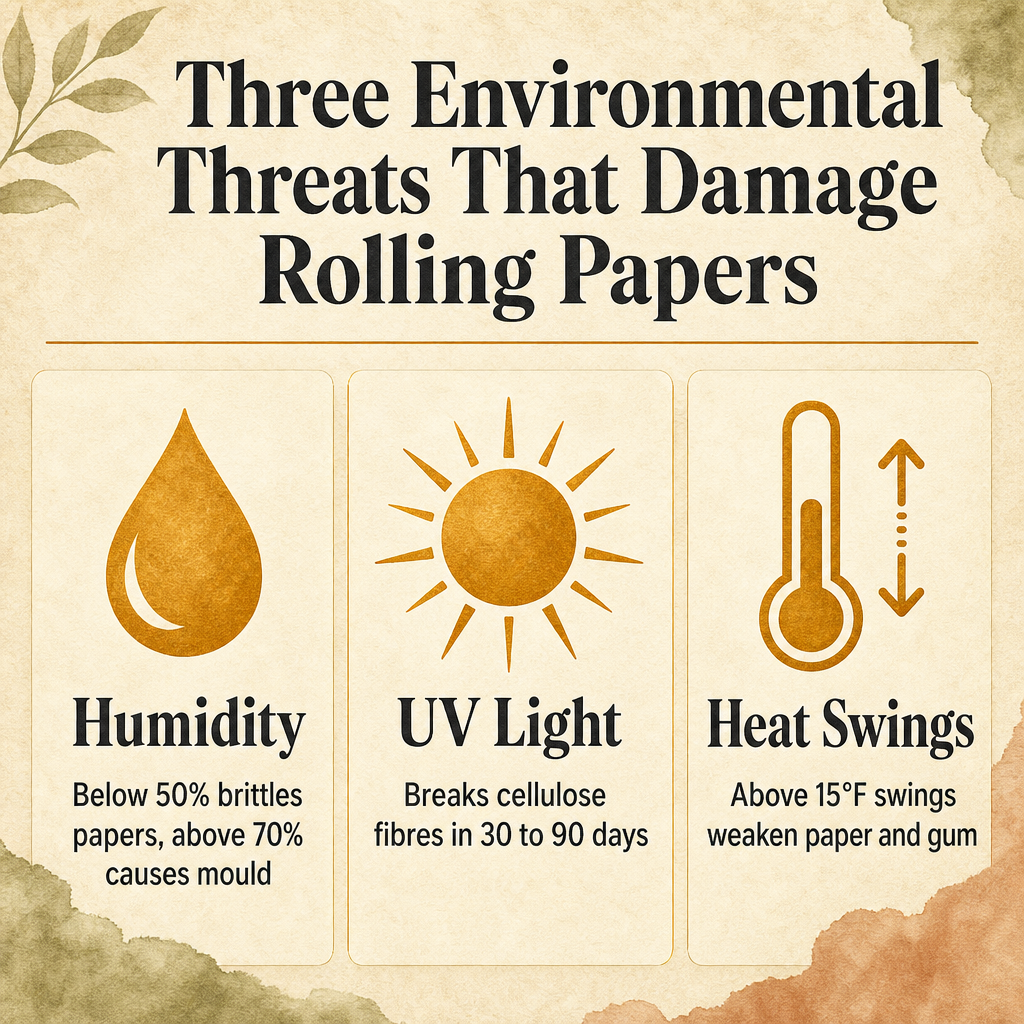
Low humidity is the most common cause of ruined papers. When the air inside a container drops below about 50% relative humidity, papers start losing moisture, become brittle, and crack along the fold or at the gum line [1]. A single dry sheet can tear the moment you try to roll with it, and a whole booklet stored dry for a few weeks can feel like cardboard. High humidity is the opposite problem: above 70% RH, papers absorb moisture, stick together, and lose adhesive strength on the gum line, and once that happens a pack can weld itself into a single unusable block [1].
UV light is the slow, invisible threat. Manufacturer testing shows that sunlight breaks down cellulose fibres over roughly 30–90 days, causing yellowing and a 40–60% reduction in paper strength [1]. Even fluorescent lighting contributes to gradual degradation, which is why the recommended storage spot is always a dark drawer or closed cabinet rather than a windowsill. Heat swings are the fourth threat: temperature swings above roughly 15°F cause fibres to expand and contract, weakening paper structure and degrading the adhesive gum line over time [1] [2] [7].
Once you can name these four threats, the rest of the storage rules fall into place: an airtight container, a dark spot, a stable room temperature, and a humidity control pack for cones. None of it is complicated; it just takes a few minutes of setup. When the storage spot is squared away, the full set of Pre-Rolled Cones and the wider Rolling Papers category are good next stops.
- Low humidity — below 50% RH — dries papers out, makes them brittle, and causes them to crack or tear at the gum line.
- High humidity — above 70% RH — makes papers absorb moisture, stick together, lose adhesive strength, and can support mould growth within 24–48 hours.
- UV light, including sunlight and fluorescent lighting, breaks down cellulose fibres over 30–90 days, causing yellowing and a 40–60% reduction in paper strength.
- Heat swings above roughly 15°F cause paper fibres to expand and contract, weakening the sheet structure and degrading the gum line over time.
What Humidity and Temperature Keep Rolling Papers and Cones in Good Shape?
Manufacturer guides converge on roughly 58–62% relative humidity and around 60–70°F (15–21°C) for both unused rolling papers and pre-rolled cones [1] [2] [8]. A few sources cite 55–62% RH and the same temperature range, so the practical safe zone is the mid-50s to low-60s RH and a steady room temperature that does not swing toward hot or cold.
Those numbers matter because, inside the band, paper fibres stay flexible, the gum line stays tacky enough to seal, and the air inside a sealed container does not feel bone-dry or muggy. Below the band, papers shrink slightly and become brittle. Above the band, papers absorb moisture and lose seal strength. The same band keeps pre-rolled cones from drying out, which is what causes them to crumble or burn unevenly.
A small inexpensive hygrometer takes the guesswork out. Drop one in the drawer or closet where you plan to store papers and cones, leave it for a day, and check the reading. In a dry climate, the fix is usually a humidity control pack inside the container. In a humid climate, the fix is usually an airtight container with a small desiccant. The wider accessory storage guide at How Do I Store My Smoking Accessories the Right Way? covers the same ideas for lighters, pipes, and grinders, and What Rolling Accessories Do I Need and How Do I Choose the Right Ones? rounds out the rolling-accessory list so you can store everything together.
- Target relative humidity: roughly 58–62% RH, with sources citing 55–62% as the broader safe band.
- Target temperature: around 60–70°F (15–21°C), with stable temperatures preferred over occasional cool or warm swings.
- Failure symptoms at the low end: brittle paper, cracked gum line, crumbling cones, papers that tear when handled.
- Failure symptoms at the high end: papers sticking together, gum line losing adhesion, mould risk within 24–48 hours, cones feeling damp or spongy.
- Failure symptoms at the temperature edges: heat above 77°F accelerates moisture loss and weakens paper; cold alone is usually fine, but swings in either direction stress the fibres.
What Containers Work Best for Storing Rolling Papers and Cones?
Every manufacturer guide lands on the same set of container categories. The job of the container is to block air exchange, block light, and protect against physical pressure. If a container does all three, it works for both unused papers and pre-rolled cones. The exact material matters less than the seal and the rigidity.
Glass mason jars with two-piece lids are the workhorse option for cones. Glass is inert, so it does not absorb smells or flavours, and the clear walls let you see what’s inside without opening the lid. Metal tins with tight-fitting lids are a close second and are easier to carry in a bag. Rigid food-grade plastic containers with rubber-sealed lids are the lightest option and travel well. Resealable plastic bags work in a pinch — double-bag them and squeeze out as much air as possible before sealing.
For pre-rolled cones specifically, a humidity-controlled stash box is purpose-built and worth the small extra cost if you actually keep cones around for more than a week. Pre-rolls in the supply chain ship in biaxially-oriented polypropylene (BOPP) overwrap as the moisture-and-oxygen barrier, and individual cones come in polypropylene plastic pop-top tubes, glass tubes, or compostable pop-top tubes [5]. Once that packaging is open, the replacement container should perform the same job. The Rolling Machine vs Hand Rolling: Which Is More Consistent? comparison explains why many people who store cones seriously end up with a small stash box rather than a mason jar.
Whatever container you pick, wash and dry it thoroughly before the first use. Residual moisture or odours from a previous use, like a kitchen jar or a snack tin, can transfer to paper in a sealed space, and once paper picks up a smell it does not give it back.
- Glass mason jars — inert walls, clear visibility, airtight seal; ideal for cones and for paper booklets stored flat.
- Metal tins with tight-fitting lids — sturdy, opaque, pocket-friendly; good for travel and for one or two paper booklets.
- Rigid food-grade plastic containers with rubber-sealed lids — lightweight, durable, easy to pack into a bag; work for both papers and cones.
- Resealable plastic bags — double-bag and squeeze out the air; a budget option for short-term paper storage in a dry climate.
- Humidity-controlled stash boxes — purpose-built for stable RH; the best option for cone storage longer than a week.
| Container | Best for | Notes |
|---|---|---|
| Glass mason jar | Cones, paper booklets | Inert, clear, airtight; needs a humidity control pack for cones. |
| Metal tin with tight lid | Papers, small cone sets | Opaque, sturdy, easy to carry; less visibility for contents. |
| Rigid food-grade plastic | Papers, cones, travel | Lightweight, durable, easy to pack; check the rubber seal stays seated. |
| Resealable plastic bag | Short-term paper storage | Double-bag, remove air; not rigid, so protect from crushing. |
| Humidity-controlled stash box | Cones longer than a week | Built-in or add-on humidity control; premium option. |
How Should You Store Pre-Rolled Cones So They Stay Fresh?
Pre-rolled cones need a tighter setup than empty papers because there is actual material inside that can dry out, lose flavour, or grow mould if the conditions slip. The routine below is the one that actually keeps cones usable for weeks rather than days. It does not take long the first time, and after that it is just a habit.
Step one is choosing the right container. A glass mason jar, a humidity-controlled stash box, or a metal tin with a tight-fitting lid all work, and all three prevent the air exchange that dries cones out [4]. Step two is adding a humidity control pack sized for the container. Two-way humidity control packs, the most common brand is Boveda, use a salt-based solution that adds and removes moisture as needed to maintain a target RH, which prevents both the brittleness that causes breakage and the over-humidification that risks mould [6] [8]. Step three is to count and label the cones so you use the older ones first.
Without humidity control, pre-rolls begin losing moisture after roughly 7–14 days, and within about a month they typically burn unevenly and feel dry. With humidity control in a sealed jar, the same cones can stay in good condition for several weeks to roughly six months depending on strain, packaging, and environment [8]. Step four is to store the container in a dark, stable spot away from windows, radiators, and appliances. Step five is to check the cones weekly for the first month; a quick feel and a quick look inside the lid tells you whether the humidity pack is doing its job. The Pre-Rolled Cones vs Rolling Papers: Which Should You Choose? comparison is a useful read for anyone still deciding between cones and rolling papers, since the storage needs differ slightly between the two formats.
- Choose an airtight container — a glass mason jar, a humidity-controlled stash box, or a metal tin with a tight seal.
- Add a two-way humidity control pack sized for the container, set to the 58–62% RH range.
- Count and label the cones so you use the older ones first and avoid leaving any to dry out in the back.
- Store the container in a dark, stable spot away from windows, radiators, and appliances.
- Check the cones weekly for the first month — feel for dampness or brittleness, and confirm the humidity pack is still flexible.
Do Different Rolling Paper Materials Store Differently?
Yes — the four main rolling paper materials each have a different storage life and a different brittleness profile. The differences are small enough that you do not need to manage each one as its own category, but they show up clearly in manufacturer storage tests and they matter once you have more than one pack open at a time.
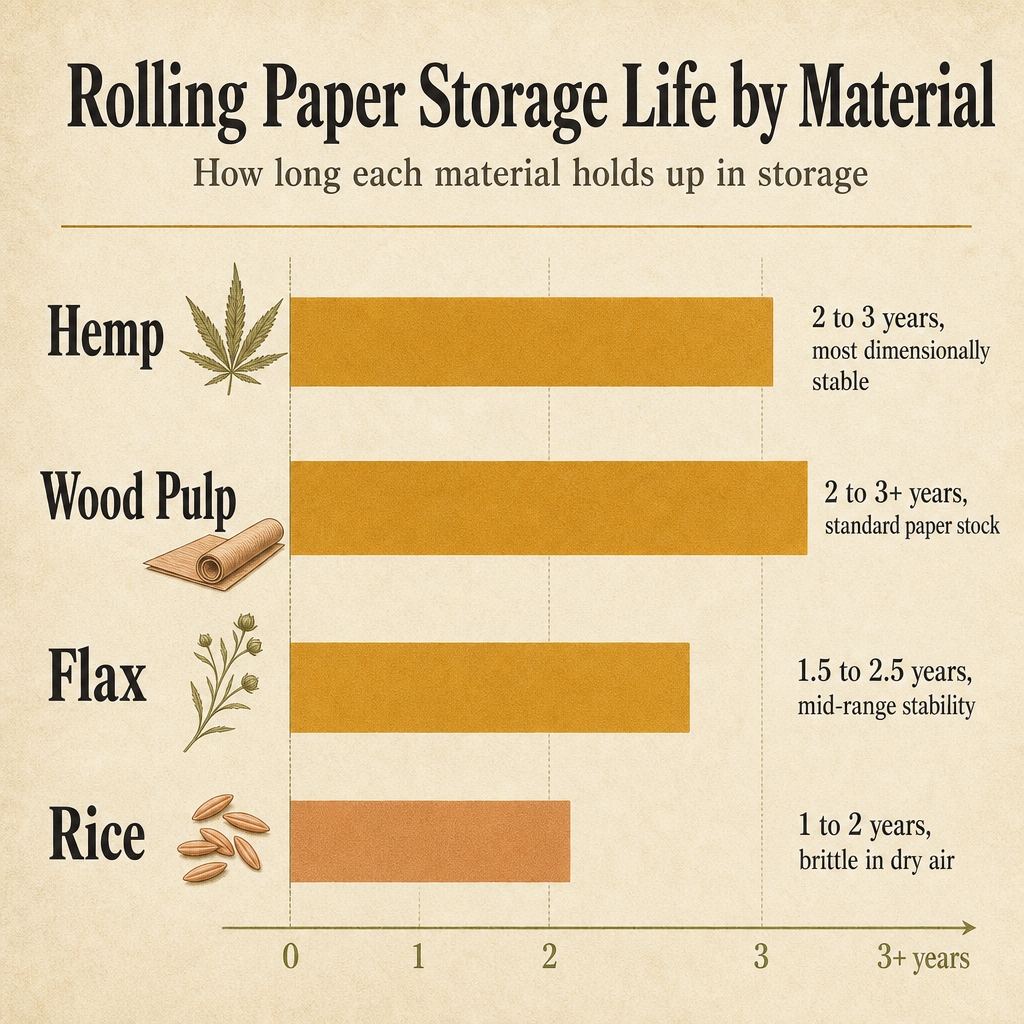
Hemp is the most dimensionally stable of the four. Manufacturer storage tests put hemp at 2–3 years, and both sources flag hemp as the most tolerant of normal room conditions [3] [1]. Wood pulp is the standard paper stock and lasts 2–3+ years, sitting just behind hemp in long-term stability. Flax is mid-range, lasting 1.5–2.5 years, and works well in a sealed container. Rice is the shortest-lived and the most brittle in dry air — manufacturer tests put rice at 1–2 years, with one source flagging rice papers at roughly 6 months of solid storage life and noting they crack more easily in low humidity [3] [1].
In practice the takeaway is simple: rice papers deserve a sealed container and a humidity control pack in a dry climate, and they should be used before hemp or wood pulp packs sitting next to them. The other materials can tolerate a wider range of conditions as long as the basics are covered. The What Are Hemp, Rice, and Wood Pulp Rolling Papers Made Of? material breakdown covers the same four materials with more on how they are made and how they feel in use.
- Hemp — 2–3 years, the most dimensionally stable, tolerates normal room conditions well.
- Wood pulp — 2–3+ years, the standard stock, long-lasting and forgiving in a sealed container.
- Flax — 1.5–2.5 years, mid-range stability, behaves well with a basic airtight container.
- Rice — 1–2 years, the shortest storage life and the most brittle in dry air; benefits most from a humidity control pack.
| Material | Storage life | Brittleness profile |
|---|---|---|
| Hemp | 2–3 years | Most dimensionally stable; tolerates normal room conditions. |
| Wood pulp | 2–3+ years | Standard paper; long-lasting in a sealed container. |
| Flax | 1.5–2.5 years | Mid-range stability; works with a basic airtight container. |
| Rice | 1–2 years | Most brittle in dry air; benefits from a humidity control pack. |
Should You Use Humidity Packs, Desiccants, or Neither?
The right moisture aid depends on what you are storing and where you live. The three options are a two-way humidity control pack (Boveda or equivalent), a desiccant (silica gel), or nothing at all. The decision is usually obvious once you name the two variables.
For pre-rolled cones, the answer is almost always a two-way humidity control pack. Cones have material inside that needs to stay in the 58–62% RH range, and a two-way pack both adds and removes moisture to keep the container inside that band [6] [8]. Without one, cones lose moisture within 7–14 days and dry out; with one, they stay in good condition for weeks to months. The Humidity Control humidity control category has the most common packs and sizes in one place.
For unused rolling papers, the answer is more nuanced. In a dry climate, a small desiccant from shoe, electronics, or food packaging absorbs excess moisture and keeps papers from going soft and sticky. In a humid climate, a desiccant paired with an airtight container does the same job. In a controlled environment that already sits in the 50–60% RH range, neither is needed for short-term paper storage — a sealed container is enough. The one thing to avoid is over-drying: paper that loses too much moisture curls and crumbles at the edges [2].
- Storing pre-rolled cones — add a two-way humidity control pack set to 58–62% RH; this is the standard for cone storage.
- Storing rolling papers in a humid climate — add a small desiccant (silica gel) inside a sealed container to absorb excess moisture.
- Storing rolling papers in a dry climate — use a two-way humidity control pack at a low RH (around 55–58%) to prevent papers from drying out and cracking.
- Storing rolling papers short-term in a controlled environment — a sealed container alone is enough; no moisture aid needed.
- Avoiding over-drying — do not pack tightly with strong desiccants; paper that loses too much moisture curls and crumbles.
Where Should You Avoid Storing Rolling Papers and Cones in the Home?
Most ruined papers and cones do not fail because of bad luck; they fail because they were stored in a bad spot. The bad-location list is short and consistent across manufacturer guides, and most of it is common sense once you know the four environmental threats. A quick scan of your current setup against this list usually catches the problem.
Car interiors and glove boxes are the worst offenders: full-day sun, large temperature swings, and humidity swings from rain or snow. Bathrooms, kitchens, and laundry areas combine humidity swings with heat and steam. Garages, basements, and attics combine temperature swings with humidity drift. Jacket pockets, gym bags, and purses put papers through bending and pressure that creases sheets and crushes tips. Windowsills, radiator shelves, and the tops of fridges combine heat and UV. Anywhere near bottled drinks, perfume, toiletries, or cleaning products risks a leak or condensation that damages thin paper fibres in a way that is usually not reversible [7].
The good spots are almost the opposite: a closed drawer in a climate-controlled room, a closet that does not share a wall with a bathroom, a bedside table that is not directly under a window, and a shelf in a dry basement that is not next to a utility sink. Pick one spot, store everything there, and the rest of the storage rules take care of themselves.
- Car interiors and glove boxes — full-day sun, large temperature swings, rain and snow exposure.
- Bathroom cabinets and shower-adjacent shelves — humidity spikes from showers and baths.
- Kitchens and laundry rooms — steam, cooking heat, appliance heat, and frequent humidity shifts.
- Garages, basements, and attics — temperature swings, humidity drift, and usually poor insulation.
- Jacket pockets, gym bags, and purses — bending, pressure, and being forgotten near liquids.
- Windowsills, radiator shelves, and tops of appliances — heat plus UV plus repeated temperature cycling.
- Anywhere near bottled drinks, perfume, toiletries, or cleaning products — a single leak can ruin a pack of paper.
What Handling Habits Keep Rolling Papers in Usable Condition?
Environment does most of the work, but handling habits finish the job. The booklet is the most fragile thing in your kit, and most of the damage people blame on the brand is actually caused by how the booklet is held, opened, and stored between uses. A handful of small habits keep the booklet in usable condition for the full shelf life of the paper inside.
Keep the booklet closed between uses; every time it is open, the sheets inside are exposed to air, light, and skin oils. Holding sheets by the body rather than the gum line keeps the adhesive edge clean and tacky. Rotating out a daily-use pack rather than handling one large pack repeatedly spreads wear across multiple booklets. Storing the booklet flat in a rigid case takes bending off the table, and Gold Leef’s manufacturer guide specifically calls out bent or compressed booklets as the primary cause of creased papers, crushed tips, and damaged magnetic or card covers [7]. Treating the booklet as a precision item rather than a fidget is the underlying habit, and the rest of the rules follow from it [3] [7].
If you are storing multiple booklets, stack them flat in a rigid container with a small desiccant or a low-RH humidity pack depending on your climate. If you carry a single booklet in a bag, a small rigid case is worth the few extra dollars. Handling is the variable most people control least and notice most, and it is the easiest one to tighten up.
- Keep the booklet closed between uses to limit exposure to air, light, and skin oils.
- Hold sheets by the body rather than the gum line so the adhesive edge stays clean and tacky.
- Rotate between daily-use packs rather than handling one large pack repeatedly.
- Store the booklet flat in a rigid case to avoid bending, creasing, and crushed tips.
- Never use papers as a fidget — oils, bending, and repeated contact with the gum line accelerate deterioration.
Frequently Asked Questions
How long do rolling papers and pre-rolled cones last in storage?
Unused rolling papers last roughly 1–3 years depending on material, with hemp and wood pulp at the long end (2–3+ years) and rice at the short end (1–2 years). Pre-rolled cones kept without humidity control start losing moisture after about 7–14 days; in a sealed jar with a humidity control pack they can stay in good condition for several weeks to roughly six months depending on strain, packaging, and storage environment.
Do hemp, rice, wood pulp, and flax rolling papers really store differently?
Yes. Hemp and wood pulp are the most dimensionally stable and last longest at 2–3+ years; flax sits in the middle at 1.5–2.5 years; rice is the most brittle in dry air and the shortest-lived at 1–2 years. Manufacturer storage tests flag rice papers as more fragile in low humidity and hemp as the most stable across normal room conditions.
Can silica gel desiccant packets be used to store rolling papers?
Yes, but only to absorb excess moisture inside a sealed paper-storage container, and not to over-dry. Paper that loses too much moisture curls and crumbles at the edges. For pre-rolled cones, a two-way humidity control pack (such as Boveda) is preferred over a desiccant because it adds moisture back when the air gets too dry.
Is a humidor required to store pre-rolled cones?
Not strictly required, but a humidity-controlled stash box or any airtight container with a two-way humidity control pack achieves the same goal — keeping cones in the 58–62% RH range. Without humidity control, cones lose moisture within 7–14 days and burn unevenly; with humidity control, they can stay in good condition for several weeks to about six months.
Should rolling paper booklets be stored flat or upright?
Flat. Bent or compressed booklets cause creased papers, crushed tips, and damaged magnetic or card covers. A rigid carrying case or a dedicated section of a bag keeps the booklet flat during transport and protects it from the kind of physical compression that manufacturers identify as a primary cause of unusable sheets.
What Is the Quickest Way to Get Rolling Paper and Cone Storage Right?
Set up one spot, one container, and one habit. The spot is a closed drawer or closet in a climate-controlled room, away from windows, radiators, bathrooms, and kitchen steam. The container is an airtight glass jar, metal tin, or rigid plastic box with a rubber-sealed lid. The habit is to keep the booklet closed between uses, store it flat, and add a humidity control pack whenever you have cones in storage.
Aim for 58–62% RH and around 60–70°F, scan your home for the bad-location list, and rotate so older packs get used first. The whole setup takes about ten minutes, and once it is in place, papers and cones will stay in usable condition for the full shelf life printed on the package.
Sources
- Futurola: How to Store Unused Rolling Papers to Preserve Freshness
- Zig-Zag: Preserving Freshness: Best Practices for Storing Rolling Papers
- Zig-Zag: Do Rolling Papers Expire? Here’s What You Should Know
- Futurola: How to Properly Store Leftover Pre-Rolled Cones for Freshness
- Custom Cones USA: Pre-Roll Packaging: The Ultimate Guide
- Marijuana Packaging: Keeping Pre-Rolls from Breaking with Boveda Packs
- Gold Leef: How to Store Rolling Papers Properly and Keep Them in Good Condition
- Green Dispensary (GreenNV): Do You Need a Humidor for Pre-Rolls? Storage Guide