
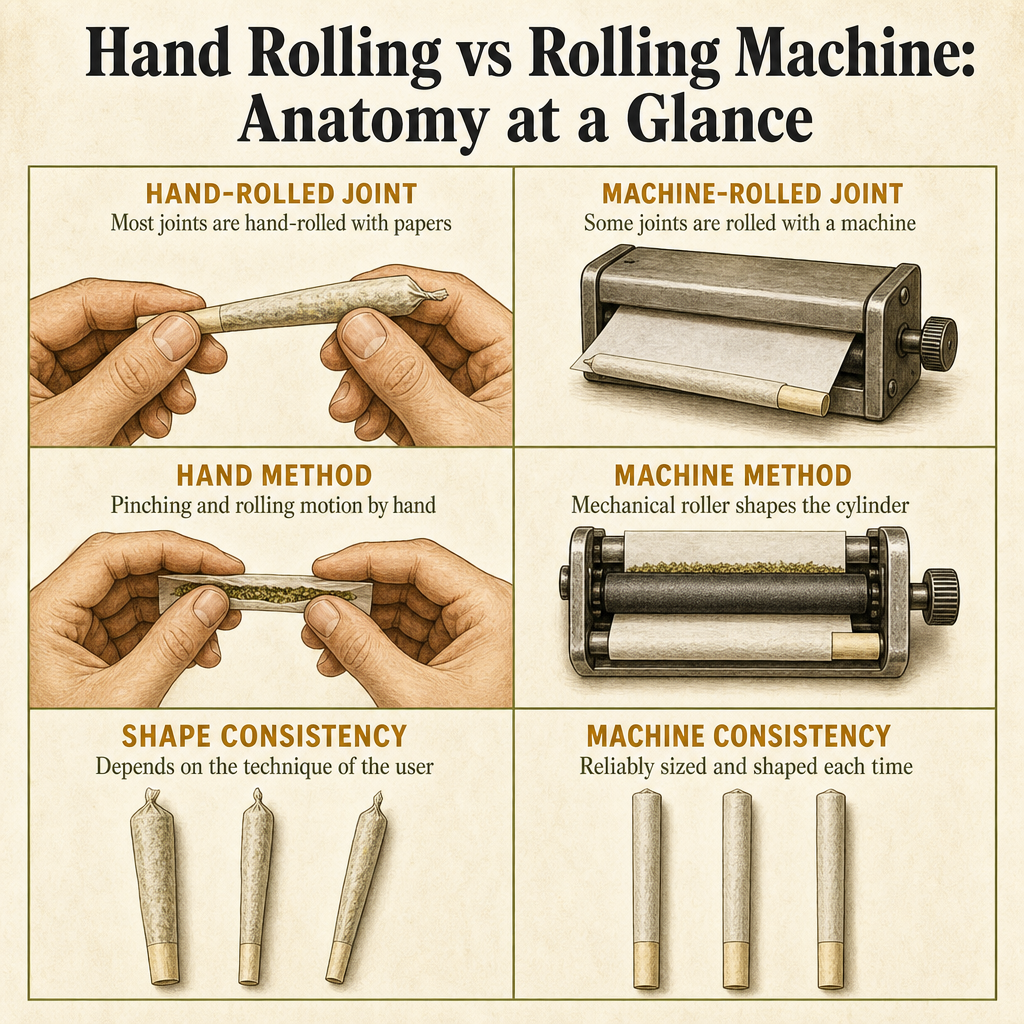
Rolling machine vs hand rolling comes down to one trade-off: machines produce the same size and shape every time, while hand rolling accepts any paper size but varies with your technique. A rolling machine is a small mechanical device with a fixed channel that shapes the cylinder for you. Hand rolling uses a pinching and rolling motion to shape a flat sheet around the fill by hand. [1] [3]
What Is a Rolling Machine and How Does It Differ From Hand Rolling?
A rolling machine is a small mechanical device with a fixed channel that holds the rolling paper in place while you tuck and roll the cylinder. Because the paper sits in the same spot every time and the device applies even pressure along its length, the finished roll comes out the same size and shape each time you use it. That repeatability is the main reason people buy a roller in the first place: it takes the guesswork out of the rolling motion.
Hand rolling is the classic technique where you shape a flat sheet of paper into a cylinder using your fingers. You pinch the paper into a taco shape, sift the fill back and forth to spread it evenly, wet the seam, and press the roll closed. The look and feel of the final roll depend on how steady your hands are, how evenly you distribute the fill, and how much practice you have. A joint is most often hand-rolled with rolling papers, though some joints are machine-rolled, and modern papers are manufactured in a range of sizes from materials including rice, hemp, and flax [1].
Cigarette rolling follows the same two paths. Cigarette rolling may be performed either by hand or with a cigarette roller, and the Wikipedia article on roll-your-own cigarettes documents the existence of consumer cigarette rolling machines and distinguishes a cigarette roller from a cigarette stuffer [3]. That distinction matters when you go shopping: a roller shapes the paper into a tube, while a stuffer only fills an empty tube without rolling.
The simplest way to think about the difference is where the rolling motion comes from. With a machine, the device shapes the cylinder for you. With hand rolling, your fingers shape the cylinder. That single difference drives everything else in this comparison, from consistency to paper choice to which accessories pair best with each method. If you mostly buy standard 1¼-size papers and want the same result every time, a machine is worth a closer look. If you like switching between sizes, shapes, and materials, hand rolling keeps every option open. You can also browse Rolling Papers on the site to see the paper sizes and materials available, which is a quick way to figure out which method lines up with your favorite paper.
- Rolling machine: a mechanical device with a fixed channel that holds the paper and shapes the cylinder for you, producing the same size and shape each time.
- Hand rolling: a pinching and rolling motion that uses your fingers to shape a flat sheet of paper around the fill, with the final shape depending on technique.
- Cigarette rolling can be done either by hand or with a cigarette roller, and consumer rolling machines are widely documented and sold alongside hand-rolling supplies.
- Joints are most often hand-rolled with rolling papers, though some are machine-rolled, so both methods are common in everyday use.
What Types of Rolling Machines Are Available?
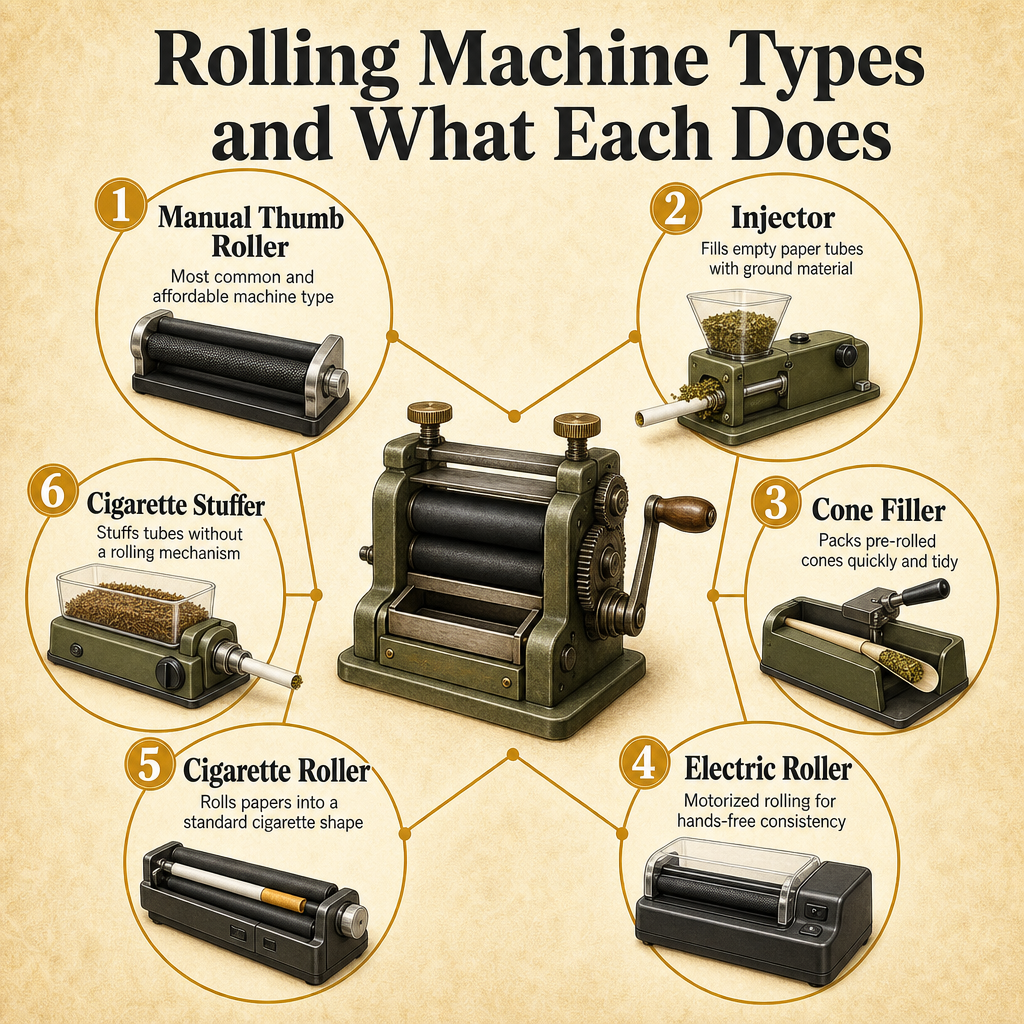
Rolling machines come in a handful of styles, and each one is built for a slightly different job. The manual thumb roller is the most common and affordable type: a small plastic or metal frame with two rollers you turn by hand, sized for standard 1¼ papers. Other varieties include injectors, cone fillers, and electric rollers, and consumer cigarette rolling machines are widely documented as a separate product category [3] [4].
An injector is a different kind of machine. Instead of rolling a flat sheet of paper, an injector fills an empty paper tube that you have already formed. You drop the ground material into the injector, push a plunger, and the fill slides into the tube. Injectors are popular with people who already use empty tubes and want a tidy fill every time.
A cone filler is built for pre-rolled cones, which are ready-shaped paper cones with a built-in filter tip. You stack the cone on top of the filler, drop in your ground material, and the device packs it down evenly. If you mostly roll cones rather than flat papers, a cone filler is the closest match for your workflow. The full Rolling Machines subcategory on the shop page covers manual rollers, cone fillers, and electric rollers in one place, and the Pre-Rolled Cones vs Rolling Papers: Which Should You Choose? article walks through when cones make more sense than flat papers.
Electric rollers take the manual motion off your hands. The Raw Powermatic IV Plus (Electric) is a motorized roller that produces the same shape as a manual thumb roller without any hand turning. Electric rollers are most useful for people who roll often and want the same result with less hand motion, or for anyone with hand or wrist sensitivity who finds the manual motion tiring.
When you compare machine types, three things matter most: build quality, paper size matching, and the kind of fill you use most often. Rolling machines produce consistent cigarette or cone shape and reduce herb waste, torn papers, and rolling mess, but only when the device matches the paper or cone you plan to use [5]. For a fuller walkthrough of which accessories pair with which method, the What Rolling Accessories Do I Need and How Do I Choose the Right Ones? guide covers the full rolling accessory kit.
- Manual thumb roller: the most common and affordable type, a small frame with two rollers turned by hand that fits standard 1¼-size papers.
- Injector: fills empty paper tubes with ground material using a plunger instead of rolling a flat sheet, popular with tube users.
- Cone filler: packs pre-rolled cones quickly and tidily, the closest match for people who already use ready-shaped cones.
- Electric roller: a motorized roller that produces the same shape as a manual thumb roller without any hand turning.
- Cigarette roller vs cigarette stuffer: a roller shapes the paper into a tube, while a stuffer only fills an empty tube without rolling.
How Consistent Are Joints From a Rolling Machine vs Hand Rolling?
Consistency is where the two methods part ways the most. Rolling machines produce reliably sized and shaped rolls that burn more evenly and help mitigate issues like canoeing, with the trade-off that machines can only roll papers that match the size of the device, limiting variability in joint size [4]. Hand rolling produces whatever shape you can manage, and consistency depends entirely on your technique: the joint must not be so loose that it burns unevenly, nor so tight that airflow is restricted [6].
In everyday use, a machine gives you the same cylinder every time you press the rollers. The paper sits in the same channel, the fill sits in the same pocket, and the rollers apply even pressure along the length of the paper. A hand-rolled joint varies from session to session, especially when you are still learning the motion. Over time, practice tightens that variation, but it never quite disappears because each roll is shaped by hand.
The other side of the consistency story is paper compatibility. A machine locks you to the paper size the device was built for, so swapping to a wider or narrower paper means the device will not work. Hand rolling adapts to any paper size or material you happen to have, which is why many people keep both methods in their kit: a machine for the paper size they use most often, and the hand technique for anything outside that size.
Using a rolling machine reduces hand-rolling challenges such as torn papers, loose fills, and uneven burn, and the output is consistent and even, while still requiring pack-tight-but-not-too-tight technique [5]. That last phrase matters: a machine makes the cylinder easier to form, but the pack-down step at the end is still yours. Skip it and the roll comes out hollow; overdo it and the airflow suffers.
- Shape consistency: machines produce the same cylinder each time, while hand rolling varies with your technique and gets tighter only with practice.
- Burn evenness: machine rolls tend to burn more evenly and help mitigate canoeing, while hand-rolled joints can run or canoe if the fill is uneven.
- Size variability: machines are limited to the paper size the device supports, while hand rolling accepts any paper size or material.
- Technique dependency: a machine lowers the technique floor, but the final pack-down step is still yours and affects airflow.
| Factor | Rolling Machine | Hand Rolling |
|---|---|---|
| Shape consistency | Same size and shape each time | Varies with technique |
| Burn evenness | Burns more evenly, less canoeing | Can canoe if fill is uneven |
| Size variability | Limited to paper size of device | Accepts any paper size or material |
| Technique dependency | Lower floor, pack-down still matters | Higher floor, improves with practice |
| Paper compatibility | Must match device size | Works with any size or material |
What Are the Step-by-Step Techniques for Each Method?
Hand rolling is a practice-heavy sequence that gets smoother the more you do it. The steps, in order, are: grind the material, make a crutch, load the paper, pinch into a taco shape, sift back and forth to distribute the fill evenly, wet the seal, pack down, and twist the tip [6]. Each step has a small failure mode, which is why the technique takes a few sessions to feel natural.
Machine rolling is a repeatable mechanical sequence. The steps, in order, are: choose a paper that matches the device size, insert the paper into the channel, load the fill, tuck and roll, and remove the finished roll [5]. The device does the shaping for you, so the moving parts are paper choice, fill amount, and the final pack-down.
Both methods share the same pack-tight-but-not-too-tight principle. Too loose and the roll burns unevenly or canoees. Too tight and airflow gets restricted, which makes the draw feel hard. The hand technique spreads this tension across the whole rolling motion, while the machine technique puts it all into the final pack-down step after the rollers have done their work.
If you are new to either method, the practical question is whether you want to spend time learning the hand motion or skip ahead to the machine sequence. The hand motion rewards practice with full control over paper size, shape, and tightness, and it is the foundation that lets you troubleshoot when something goes wrong. The machine sequence gets you to a consistent result faster, but only for the paper size the device supports. If you are still building out your rolling setup, the What Is the Best Smoking Piece for a Beginner? piece on choosing a first smoking device is a useful companion read for matching your rolling method to the rest of your kit.
- Hand rolling: grind the material, make a crutch, load the paper, pinch into a taco shape, sift back and forth, wet the seal, pack down, and twist the tip.
- Machine rolling: choose a paper that matches the device size, insert the paper into the channel, load the fill, tuck and roll, and remove the finished roll.
- Both methods rely on pack-tight-but-not-too-tight technique, with hand rolling spreading the tension across the whole motion and machine rolling concentrating it in the final pack-down.
What Rolling Paper Materials and Sizes Work Best With Each Method?
Modern papers are manufactured in a range of sizes from materials including rice, hemp, and flax [1]. Each material has its own feel and burn rate, but the rolling method does not really care about the material — it cares about the size and shape of the paper. Hand rolling adapts to any of these sizes and materials, while a machine is limited to the paper sizes the device supports.
Rolling paper composition typically includes fillers such as calcium carbonate, magnesium carbonate, and titanium oxide, and paper permeability is measured in CORESTA units, with higher permeability increasing smoke dilution with air [2]. None of those filler choices are tied to the rolling method, so this is paper science rather than machine-vs-hand science. For a deeper walkthrough of paper materials, the What Are Hemp, Rice, and Wood Pulp Rolling Papers Made Of? article covers hemp, rice, and wood pulp in plain language.
Sizes are where the two methods actually diverge. Standard 1¼-size papers fit a classic thumb roller. Wider king-size papers need a king-size roller. Single-wide papers need a single-wide roller. Hand rolling handles any of those without switching devices, which is one of the quiet advantages of the technique.
On the regulatory side, U.S. federal law defines roll-your-own tobacco and places it under cigarette-tobacco regulatory requirements, and the FDA requires every brand of cigarette rolling paper sold in the US to submit ingredients and seek agency approval [7]. That approval process is about the paper brand, not the rolling method, but it is the reason the same paper brands show up in both hand-rolled and machine-rolled setups.
Filter tips are the companion accessory for both methods. Standard rolling machines can roll papers that match the device size, including papers with built-in filter tips. Cone fillers handle cones with built-in tips as part of their normal workflow. Hand rolling works with crutches you make from a thicker sheet of paper or cardboard, or with papers that already have a tip.
- Materials: rice, hemp, and flax are the three most common modern rolling paper materials, and both methods work with any of them.
- Fillers: calcium carbonate, magnesium carbonate, and titanium oxide are the standard fillers used in rolling paper composition.
- Permeability: paper permeability is measured in CORESTA units, with higher permeability increasing smoke dilution with air.
- Sizes: standard 1¼ fits a classic thumb roller, king-size needs a king-size roller, and single-wide needs a single-wide roller; hand rolling accepts any size.
- Filter tips: both methods work with built-in filter tips, and hand rolling also accepts crutches made from thicker paper or cardboard.
How Do You Pick the Right Rolling Setup for Your Needs?
Picking a setup comes down to four questions: how often you roll, whether you want repeatable size or maximum size variety, whether you want to learn the hand technique or skip it, and whether you roll mostly standard papers or mostly pre-rolled cones. Your answer to those four questions lines up with one of the two methods, and that answer also tells you which supporting accessories belong in your kit.
If you roll often and want the same result each time, a manual thumb roller or electric roller is the cleanest match. Pair it with a grinder for a consistent grind size, a rolling tray to keep the workspace tidy, and a pack of filter tips. Rolling machines produce consistent cigarette or cone shape and reduce torn papers, loose fills, and rolling mess, which is the main practical argument for buying one [4] [5].
If you want size variety and full control over paper choice, hand rolling is the better fit. A grinder, a rolling tray, a few packs of different paper sizes, and a stack of crutches are the core kit. If you also want a piece for sessions where you are not rolling, the SILICONE BEAKER BONG WITH REMOVABLE GLASS BOWL is one option on the site that pairs with a hand-rolled or machine-rolled supply.
If you mostly use pre-rolled cones, a cone filler is the closest match. The cone filler packs cones quickly and tidily, and the cones themselves already have a built-in filter tip, so the rolling motion is replaced by a packing motion. This is a different workflow from a classic thumb roller, and it sits between hand rolling and full machine rolling in terms of effort.
Across all three setups, a grinder and a tray are the two accessories that pay for themselves regardless of method. A consistent grind size makes both hand rolling and machine rolling easier, because the fill distributes more evenly. A tray keeps the workspace tidy and stops you from losing material to the carpet. Those two items are the foundation under either method.
- Roll often and want repeatable size: a manual thumb roller or electric roller, paired with a grinder, a tray, and filter tips.
- Want size variety and full control: hand rolling, paired with a grinder, a tray, multiple paper sizes, and a stack of crutches.
- Mostly use pre-rolled cones: a cone filler, paired with a grinder, a tray, and a cone supply.
- Across all setups: a grinder for consistent grind size and a rolling tray to keep the workspace tidy are the foundation under either method.
What Common Mistakes Should You Avoid With Either Method?
Every roller runs into the same handful of mistakes, and most of them have a quick fix. Listing them out makes it easier to self-diagnose when a roll comes out wrong, whether you are using a machine or rolling by hand.
Hand-rolling mistakes cluster around tightness and fill distribution. Rolling too loose causes canoeing and uneven burn. Rolling too tight restricts airflow. Torn papers usually come from overhandling the paper while you are trying to tuck and roll. Uneven fill distribution shows up as a lumpy roll that burns faster on one side than the other.
Machine-rolling mistakes cluster around paper matching and fill amount. Using a paper size that does not match the device is the most common — the paper either does not sit in the channel or tears when the rollers turn. Overstuffing the channel so the paper tears is the next most common, followed by underfilling so the roll comes out hollow. Skipping the pack-down step leaves a loose roll that burns unevenly, even though the cylinder shape looks tidy.
The fix for most of these mistakes is the same: slow down at the pack-down step. With hand rolling, that means tucking the open end, then gently pressing the fill down with a pen or packing tool before twisting the tip. With a machine, that means running the rollers, then tapping the closed end on the tray a few times to settle the fill before the final pack. Both methods benefit from the same pack-tight-but-not-too-tight principle, and that is where most of the variation in the final roll comes from.
- Hand rolling: too loose causes canoeing and uneven burn, too tight restricts airflow, overhandling tears the paper, and uneven fill distribution makes the roll lumpy.
- Machine rolling: using a paper size that does not match the device is the most common mistake and either tears the paper or keeps it from sitting in the channel.
- Machine rolling: overstuffing the channel tears the paper, underfilling leaves a hollow roll, and skipping the pack-down step leaves the fill loose.
- Both methods: slow down at the pack-down step and aim for pack-tight-but-not-too-tight, since most of the variation in the final roll comes from that step.
Frequently Asked Questions
What is the difference between a rolling machine and hand rolling?
A rolling machine is a mechanical device that holds the paper in a fixed channel and shapes the roll with consistent pressure, producing a uniform cylinder each time. Hand rolling uses a pinching and rolling motion to shape a flat sheet of paper around the fill by hand, with the final shape and tightness depending on the technique of the person rolling.
Do rolling machines produce a more consistent joint than hand rolling?
Yes — rolling machines produce reliably sized and shaped rolls that burn more evenly and help mitigate issues like canoeing. The trade-off is that machines can only roll papers that match the size of the device, so hand rolling still wins for variability in size and shape.
Are rolling machines worth it for beginners?
Rolling machines are often a good first purchase for beginners because they reduce common hand-rolling challenges like torn papers, loose fills, and uneven burn, and produce a consistent result with minimal practice. The main thing to check is that the device matches the paper size you plan to use most often.
What are the different types of rolling machines available?
The manual thumb roller is the most common and affordable type. Additional varieties include injectors, cone fillers, and electric rollers. Consumer cigarette rolling machines are widely available and are distinct from cigarette stuffers.
Can you roll filters and cones with a rolling machine?
Yes. Standard rolling machines can roll papers that match the device size, including papers with built-in filter tips. Cone fillers are a separate machine category designed specifically for packing pre-rolled cones, which are ready-shaped paper tubes with a built-in filter tip.
What rolling paper materials work with either method?
Both methods work with the standard paper materials — rice, hemp, and flax — and with the common fillers used in paper composition, such as calcium carbonate, magnesium carbonate, and titanium oxide. Paper permeability is measured in CORESTA units, with higher permeability increasing smoke dilution with air. Machines are limited to the paper sizes the device supports, while hand rolling accepts any size or material.
So Which Rolling Method Should You Pick?
If you want the same result every time and mostly use one paper size, a rolling machine is the cleaner choice. Machines produce reliably sized and shaped rolls that burn more evenly, and the main thing to check is that the device matches the paper you plan to use most often.
If you want size variety, full control over paper choice, and the satisfaction of a hand-shaped roll, hand rolling is the better fit. The technique takes practice, but it accepts any paper size or material and lets you troubleshoot when something goes wrong.
Most regular rollers end up with both methods in their kit: a machine for the paper size they use most often, and the hand technique for everything else. Pair either method with a grinder, a rolling tray, and the right paper supply, and the rolling session gets noticeably easier. Shop the full Rolling Machines subcategory and the rest of the rolling kit at Treehouse Lifestyle, with free shipping on orders $150+.
Sources
- Wikipedia (encyclopedic reference): Joint (cannabis)
- Wikipedia (encyclopedic reference): Rolling paper
- Wikipedia (encyclopedic reference): Roll-your-own cigarette
- Weedmaps (specialist cannabis publication): How to use a joint roller in 7 steps
- Zamnesia (specialist headshop publication): Rolling Machines: Different Types And How To Use Them
- Weedmaps (specialist cannabis publication): How to roll a joint
- U.S. Food and Drug Administration (government): Section 900 of the Federal Food, Drug, and Cosmetic Act – Definitions