

A King Palm is a pre-formed, hollow cone made from dried Cordia palm leaf that you fill and pack rather than roll. Each pouch holds the roll, a corn husk filter built into the mouthpiece, a packing stick, and a humidity packet. Two steps decide whether it works: slide the paper insert out first, then pack coarse-ground material in layers rather than a fine powder.
What Is a King Palm Wrap Made Of, and Is It a Blunt?
The word wrap causes most of the confusion here. A King Palm roll is not a flat sheet you fold around material. It is a hollow cone already formed from dried palm leaf, so the buyer fills it instead of rolling it. The manufacturer describes its rolls as organic Cordia palm leaves that are hand-cut, rolled into a cone, and then dried, with a corn husk filter built into the mouthpiece end [2]. The brand says it launched in 2016 as an all-natural alternative for blunt smokers and added flavored rolls in 2020 [2].
Those material statements are the manufacturer’s own product claims, not the results of independent testing, and it is worth reading them that way. What can be checked independently is the plant itself. Cordia dichotoma grows as a tree or shrub up to 27 m and is native from India and Pakistan through South China, Southeast Asia, Australia, New Caledonia, and the Pacific Islands, with papery to slightly leathery leaf blades roughly 2 to 16 cm long and 1.2 to 10 cm wide [5]. Singapore’s National Parks Board lists one of its traditional uses as leaves turned into plates and cigar-wrappers, which supports leaf-as-wrapper as a long-standing practice rather than a modern marketing idea [5].
So is it a blunt? The wrap decides the category, not the shape. Rolling papers are thin sheets made from wood pulp, rice, hemp, or cellulose. Blunt wraps are thicker tobacco-leaf sheets that carry nicotine unless the product is a tobacco-free alternative such as palm leaf or hemp [6]. Traditional blunts were cigar wraps split open and re-filled, a practice the manufacturer traces to 1980s New York City smokers reusing Phillies Blunts [7]. A palm roll sits in the blunt-wrap family by shape, capacity, and session length, but not by material.
You also get a choice of formats, which is where a lot of the confusion about the product comes from. Rolls arrive pre-formed and ready to pack, and the brand also sells flavored and unflavored flat palm wraps for buyers who would rather roll their own [8]. If you want to see what the product actually looks like on a shelf before committing, the King Palm Hand-Rolled Leaf Wraps | Mini | 2pc | 10pk Display is a current example in the mini format, and the wider Rolling aisle covers papers, cones, tips, and tools side by side.
- Wrap material: dried Cordia palm leaf, hand-cut and formed into a cone rather than sold as a flat sheet [2].
- Filter: a corn husk filter made in-house and built into the mouthpiece end [2].
- Manufacturer claims: tobacco-free, with no glues, dyes, or added chemicals. Read these as brand statements, not independent test results [2].
- Rolling papers: thin sheets made from wood pulp, rice, hemp, or cellulose [6].
- Blunt wraps: thicker tobacco-leaf sheets that carry nicotine unless they are a tobacco-free alternative [6].
- Formats: pre-formed rolls ready to pack, plus flavored and unflavored flat palm wraps for roll-your-own buyers [8].
What Comes in a King Palm Pouch and What Do You Take Out?
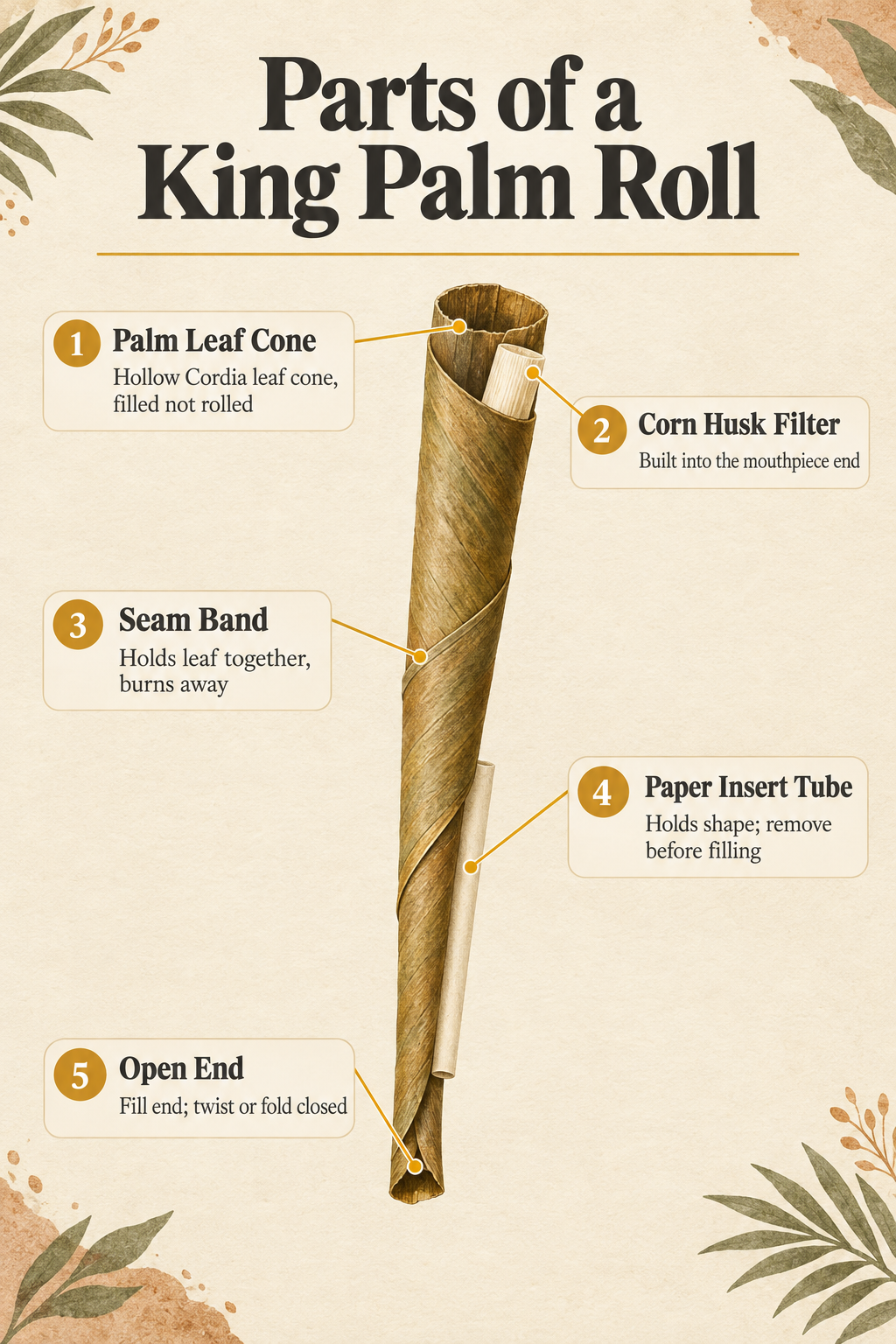
Open the pouch and you get five things: the roll itself, the corn husk filter already built into the mouthpiece, a packing tool, a humidity control packet, and a paper band around the seam [1]. Two of those get misread constantly, and mixing them up is the most reliable way to damage a roll on the first attempt.
The band stays. It is structural rather than decorative: black on natural rolls, gold on flavored rolls, holding the leaf together at the seam, and it burns away as the roll burns down [1]. People pick at it thinking it is a label. It is not, and working it off can split the leaf before you have packed anything.
The paper insert tube is the opposite, and it is the step first-timers skip. It holds the cone’s shape during production and shipping, and it has to come out. Slide it from the filter end and set it aside before any material goes in [1]. Leave it in place and the cone is already occupied, so there is nowhere for the herb to go.
Formats differ slightly on tooling. Flavor tubes intentionally ship without a separate packing stick because the paper insert doubles as the packing tool, while standard pouches normally include a full-size stick [4]. If your pouch has no stick, check whether you bought a flavor tube before assuming something is missing from the box.
Knowing which piece is packaging and which is structural is the difference between a roll that packs cleanly and one that gets torn open. If you are still deciding whether a palm roll belongs in your kit, What Rolling Accessories Do I Need and How Do I Choose the Right Ones? covers the wider accessory set, and How Do You Roll a Blunt Step by Step? covers the flat-wrap technique this product lets you skip entirely. On the paper side of the shelf, What Are Hemp, Rice, and Wood Pulp Rolling Papers Made Of? breaks down each sheet material, What Are Rolling Paper Sizes and Which One Should I Use? covers sheet dimensions, and How Do You Pack a Bowl So It Burns Evenly? covers loading a bowl evenly. That last one matters more than it looks, because even distribution is the same habit that keeps a palm roll burning in a straight line.
- The roll: the hollow palm leaf cone you fill.
- The corn husk filter: built into the mouthpiece and stays in place [1].
- The packing tool: a stick for loading and tamping, absent from flavor tubes where the paper insert does the job [4].
- The humidity control packet: stays in the pouch with any rolls you have not used yet [1].
- The seam band: structural, black on natural and gold on flavored, and it burns away with the roll [1].
- The paper insert tube: packaging only. Slide it out from the filter end before filling [1].
How Do You Pack a King Palm Step by Step?
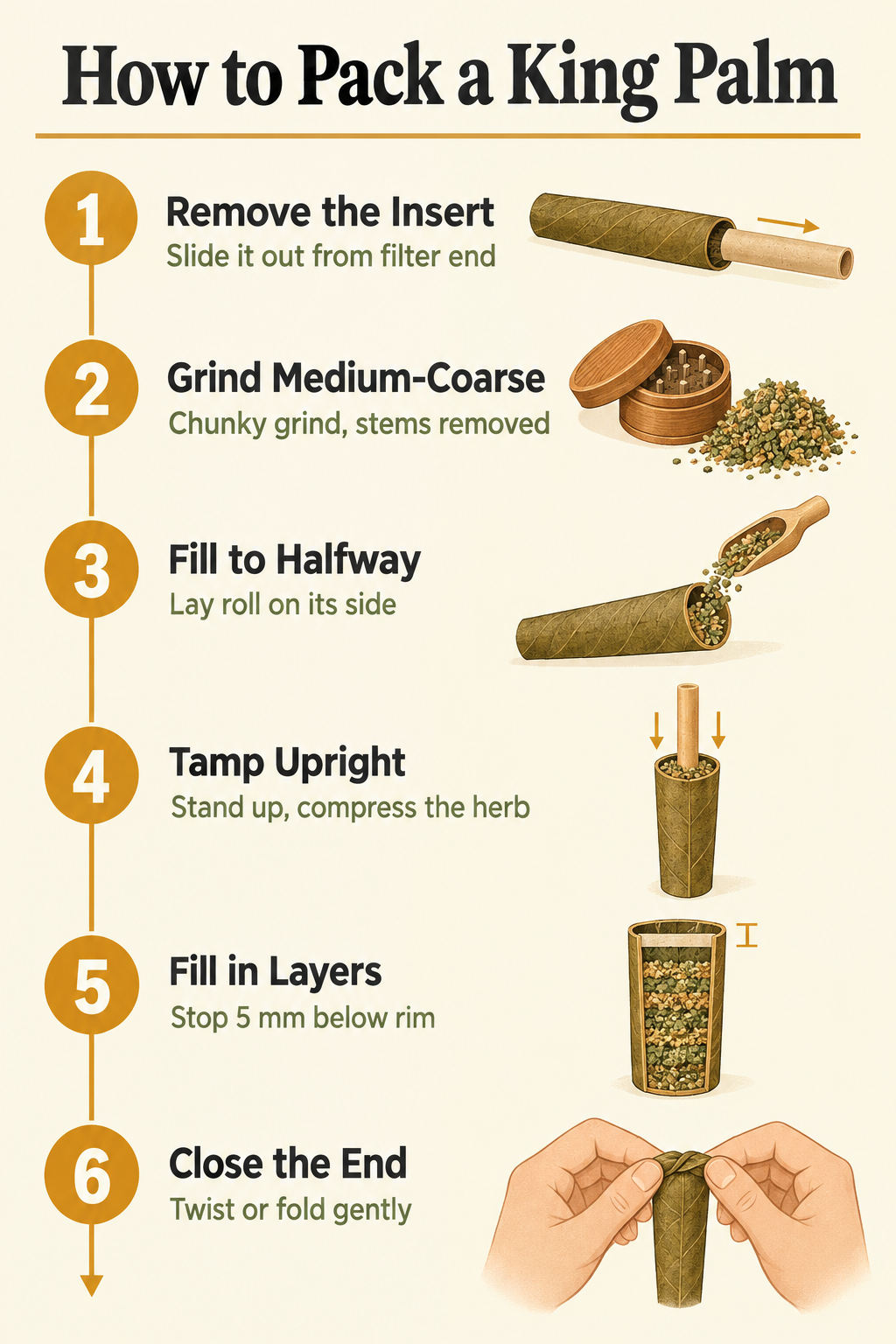
The manufacturer’s sequence is short, but the order matters. Most packing problems trace back to a skipped step or to a grind that was too fine going in [1].
The clock pattern is the part people skip, and it is the part that does the work. Pushing straight down in one spot compresses the middle and leaves the edges loose, so the material is denser in the center than at the wall. Working around the rim at four points evens the density across the whole cross-section, and an even cross-section is what keeps the burn travelling in a straight line instead of running down one side [3].
On firmness, aim for springy and solid rather than rock-hard. Material should not shift when you tip the roll, but you should not be forcing it in either. If the stick will not go in, something near the top is packed too tight. Pull a little material back out and re-tamp that layer before adding more.
Budget two to five minutes once you have done it a couple of times [1]. That is slower than pouring herb into a pre-rolled cone and much faster than learning a flat wrap from scratch. The palm roll skips the rolling step entirely, which is also why a tool like a RAW Rolling Machine has no role here. There is nothing to roll.
- Pull the paper insert out, sliding it from the filter end, and set it aside [1].
- Grind chunky or coarse rather than fine, and pull any stems first [3].
- Lay the roll on its side with the open end angled slightly up so material does not spill as you load [1].
- Fill to roughly halfway using the pointed end of the packing stick [1].
- Stand the roll upright on a flat surface and tamp firmly with the flat end of the stick [1].
- Repeat in layers, tamping at 12, 3, 6, and 9 o’clock each time to push out air pockets, until the roll is full to about 5 mm below the rim [1][3].
- Close the open end by gently twisting or folding it over [1].
Which King Palm Size Should You Start With?
The brand publishes fill weights alongside dimensions, which is far more useful than the size names themselves [2]. Names are marketing; grams are capacity.
There is an honest caveat attached to that chart. Naming and lineup details vary across the manufacturer’s own materials. Its beginner guide presents six sizes and recommends the 1 g Mini as the most popular starting point, while its support spec sheet lists a seventh XXXL size [1][2]. Retailers and brand pages also mix the terms palm leaf wraps, palm rolls, and tobacco-free blunt wraps for the same style of product, so check capacity per product rather than assuming from the size name.
For a first purchase, the Mini Roll is the sensible default. One gram matches roughly what most people pack for a single sitting, it is the size the manufacturer points beginners toward, and it leaves room to decide whether you want a longer session or a shorter one next time [1].
Frame the choice around session length and how much material you normally pack, not around which size sounds most impressive. If you usually roll a standard-size joint, stay in the 1 g to 1.5 g range. If you are packing for two or three people, the XL and XXL formats make more sense than filling three small rolls. If you are stocking several sizes at once, free shipping on orders $150+ is the threshold worth knowing.
- Rollie: 0.5 g, 54 x 8 mm [2].
- Mini Roll: 1 g, 84 x 8 mm, the manufacturer’s beginner pick [1].
- Slim Roll: 1.5 g, 104 x 9 mm [2].
- King Roll: 2 g, 104 x 10 mm [2].
- XL Roll: 3 g, 101.6 x 13.4 mm [2].
- XXL Roll: 5 g, 139.7 x 22 mm [2].
- XXXL Roll: 10 g and up, 160 x 19 mm [2].
- Before you buy: confirm the fill weight on the specific product page, because the lineup varies between the brand’s own documents [1].
How Does the Flavor Tip Work, and Do You Have to Pop It?
Flavored rolls put the flavor element inside the corn husk filter rather than on the leaf, and it stays inactive until you squeeze the tip. That design detail explains most of the confusion: the wrap itself is unflavored, so nothing happens until you decide it should [1].
The manufacturer describes the mechanism two different ways across its own materials, which is worth knowing before you go looking for a bead that is not there. The beginner guide describes a terpene-infused bead activated by squeezing until it pops. The support FAQ describes flavoring built directly into a paper insert inside the filter tip that needs a gentle squeeze with no popping required [1][4]. Both are describing the same general idea on different product lines.
Activation is optional and the timing is entirely yours. You can do it before lighting, partway through, or not at all [1]. There is no wrong answer, and skipping it does not waste the roll.
One quality note saves a support email. Flavor tips are hand-rolled, so roughly 7 to 8 mm of difference between packs is normal rather than a defect [4].
- Check which line you have first: a squeeze-and-pop bead or flavor built into the paper insert [1][4].
- Pinch the filter tip between your fingers [4].
- Squeeze firmly while keeping the roll pointed away from your face and away from anything valuable or breakable [4].
- Squeeze again partway through the roll if you want more, or leave the tip alone for the whole session [1].
King Palm vs Rolling Papers: What Actually Changes About the Session?
The comparison comes down to the wrap, not to preference. Everything else follows from that one material choice: thickness, prep time, cost per session, and how long the thing lasts.
Prep effort is the second axis, and it is where a palm roll separates itself. Because a palm roll is filled rather than rolled, the skills flat wraps demand simply do not apply. The manufacturer’s flat-wrap guidance calls for softening a dry wrap by warming it between the palms so it does not crack, sealing with clean water rather than saliva, and avoiding overfilling, which it says forces an uneven burn [8]. A palm roll trades all three of those steps for filling and tamping.
Cost and burn-time comparisons have to be presented as ranges, because published figures disagree with each other. One comparison puts blunt wraps at roughly 20 to 40 minutes and joints at 5 to 15 minutes, with blunt wraps at about $0.50 to $2.00 per unit against $0.05 to $0.10 for papers [6]. The manufacturer’s own blunt guide cites 20 to 30 minutes for a blunt against 5 to 10 minutes for a typical joint, and separately states that individual palm rolls start around $2 or more depending on size and retailer [7][2]. Read any single number you see quoted as one source’s estimate.
The decision frame is simple. Pick papers for the lowest cost per session and full control of shape and size. Pick a palm roll when you want zero rolling skill and a consistent shape you pack to a known capacity. Pick a flat palm or hemp wrap when you want the slower, thicker-wrap session but still want to roll it yourself.
- Wrap material: thin sheets of wood pulp, rice, hemp, or cellulose for papers; thicker leaf for blunt-style wraps, which carry nicotine unless tobacco-free [6].
- Prep: papers and flat wraps need rolling technique and sealing; a palm roll needs filling and tamping only [8].
- Cost per session: roughly $0.05 to $0.10 for papers against about $0.50 to $2.00 per blunt wrap, with palm rolls starting around $2 each [6][2].
- Burn time: published ranges run about 5 to 15 minutes for joints and 20 to 40 minutes for blunt wraps, with the manufacturer citing 5 to 10 and 20 to 30 [6][7].
- Skill floor: flat wraps need softening between the palms, water sealing, and restraint on overfilling [8].
- Consistency: a pre-formed roll gives the same capacity every time, while hand-rolled shape varies with technique [1].
| Option | Wrap material | Prep work | Typical cost | Published burn time |
|---|---|---|---|---|
| Rolling papers | Thin sheet of wood pulp, rice, hemp, or cellulose [6] | Roll and seal by hand | $0.05 to $0.10 per paper [6] | 5 to 15 minutes [6] |
| Palm leaf roll | Dried Cordia palm leaf, pre-formed cone [2] | Fill and tamp, no rolling | From about $2 per roll [2] | Not published separately; blunt-wrap figures run 20 to 40 minutes [6] |
| Flat palm or hemp wrap | Thicker leaf sheet you roll yourself [8] | Soften, roll, seal with clean water [8] | $0.50 to $2.00 per wrap [6] | 20 to 30 minutes [7] |
Why Is Your King Palm Burning Unevenly, and How Do You Store the Rest?
Both of the common complaints come down to how the leaf and the material inside it are handled. Neither one usually means the product is faulty.
For an uneven burn, whether it is canoeing, running down one side, or going out, the manufacturer’s troubleshooting guidance is the same as its packing guidance: use a chunky or coarse grind and distribute the material evenly around the roll instead of concentrating it in one spot [3]. In practice that means going back to the layered, four-point tamp rather than chasing the burn with a lighter.
Two things that look like defects are not. Resin pooling near the filter is described as normal, and more likely with oil-rich material [4]. And because these are real dried palm leaves rather than paper, some natural variation is expected: tiny holes or thin spots do not typically affect how a roll packs or how it performs [4].
For a roll that feels drier than it should, the manufacturer lists three rehydration options, and none of them are instant. For storage, an airtight container in a cool, dark place away from direct sunlight and extreme humidity keeps rolls at their best, with a stated shelf life of up to a year when stored properly [2]. Keep the humidity control packet in the resealed pouch with whatever rolls are left [1].
- Even burn: coarse grind, distributed evenly around the roll rather than clumped in one spot [3].
- Resin near the filter: described as normal, and more likely with oil-rich material [4].
- Tiny holes or thin spots: natural variation in a real leaf, not usually a defect [4].
- Rehydration option one: wrap the roll loosely in a slightly damp paper towel inside a sealed bag for a few hours [4].
- Rehydration option two: leave a fresh humidity pack in a sealed container overnight [4].
- Rehydration option three: hold the roll near, not in, steam briefly [4].
- Storage: airtight, cool, dark, away from direct sun and extreme humidity, up to a year [2].
- Leftovers: keep the humidity packet in the resealed pouch [1].
Frequently Asked Questions
Does a King Palm contain tobacco or nicotine?
The manufacturer states its rolls are tobacco-free and made from organic Cordia palm leaves with no glues, dyes, or added chemicals. That matters because the wrap is what decides the category: blunt wraps are thicker tobacco-leaf sheets that carry nicotine unless the product is a tobacco-free alternative such as palm leaf or hemp. Read the material description as a manufacturer claim rather than an independent test result.
Do I have to roll a King Palm, or does it come pre-rolled?
Rolls come pre-formed and ready to pack, so no rolling skill is needed. You fill the hollow cone and tamp it in layers. If you would rather roll, the brand also sells flavored and unflavored flat palm wraps for roll-your-own use, and those do require the standard flat-wrap technique.
What grind should I use for a King Palm?
A chunky or coarse grind rather than a fine powder, with stems removed. The manufacturer gives the same advice for fixing an uneven burn: coarse grind, and distribute the herb evenly around the roll instead of concentrating it in one spot.
Which King Palm size should a beginner start with?
The manufacturer’s beginner guide recommends the 1 g Mini Roll as the most popular starting point. Note that its own materials disagree slightly on the lineup: the beginner guide presents six sizes while the support spec sheet lists a seventh XXXL size. Check the fill weight on the specific product rather than assuming from the size name.
What is the paper tube inside the roll, and do I remove it?
It is a paper insert that holds the cone’s shape during production and shipping. Pull it out, sliding it from the filter end, before any herb goes in. Packing with the insert still in place leaves nowhere for the herb to go. Leave the paper seam band alone, though: that one is structural and burns away with the roll.
Can you rehydrate a King Palm that feels dry, and how should you store the rest?
The manufacturer lists three options: wrap the roll loosely in a slightly damp paper towel inside a sealed bag for a few hours, leave a fresh humidity pack in a sealed container overnight, or briefly hold the roll near, not in, steam. For storage, use an airtight container in a cool, dark place away from direct sunlight and extreme humidity. The stated shelf life is up to a year when stored properly, and the humidity control packet should stay in the resealed pouch with the remaining rolls.
So Which One Should You Buy First?
Start with a Mini Roll in the format you expect to use most. One gram is the size the manufacturer points beginners toward, it packs the same way every time, and it answers the two questions that matter before you commit to a bigger box: whether you like filling a cone instead of rolling one, and whether the palm leaf itself is what you want in a wrap [1].
The mechanical part is genuinely simple once you have done it twice. Remove the insert, grind coarse, fill in layers, tamp at four points, close the end. Nearly every complaint about uneven burns traces back to one of those steps being skipped, and nearly every complaint about the insert is because it was never pulled out.
If you already roll comfortably and cost per session drives your decision, papers still win and palm rolls are an occasional upgrade rather than a replacement. If the rolling step is what you want to skip entirely, a palm roll is the shortest path to a consistent result.
Sources
- King Palm: King Palm for Beginners: Everything You Need to Know
- King Palm Support: Product Specs & Education
- King Palm Support: How do you use King Palm products?
- King Palm Support: Product Quality & Common Questions
- National Parks Board Singapore (NParks): Cordia dichotoma — Flora & Fauna Web
- The Smokery Hub: Rolling Papers vs Blunt Wraps — What’s the Difference?
- King Palm: Blunts: A Complete Guide to Rolling, Flavors, and Alternatives
- King Palm: How to Roll Hemp Wraps That Burn Slow and Hit Smooth