

RAW rolling papers are one brand covering four product families: paper lines like Classic, Black, Organic Hemp, and Ethereal; an eight-step cone ladder from 1¼ to Challenge; more than ten tip styles; and rollers or cone loaders sized to match. That is why two shoppers can both buy RAW rolling papers and come home with different products.
What Does the RAW Rolling Papers Lineup Actually Cover?
RAW splits into four product families, and knowing which shelf you are on solves most of the confusion. Papers are loose sheets in a booklet. Cones are pre-shaped paper tubes that are already rolled. Tips are the mouthpieces that sit at one end. Hardware is the metal or plastic tooling that helps you roll or fill.
The paper side carries the most names: Classic, Black, Black Organic Hemp, Organic Hemp, and Ethereal. Each line is sold in its own spread of formats and leaf counts, so the same brand name can mean 32 leaves or 100 leaves per pack depending on which box you picked up. RAW builds the cone side differently. Cones are organized by format first, which is why you see sizes like 1¼, Lean, and Kingsize before a paper line is named at all.[1]
Tips are their own category rather than an add-on to papers. RAW lists more than ten tip styles, from plain originals to perforated, wide, and pre-rolled versions, and the pre-rolled ones are sold in their own pack counts.[3]
Before you buy, ask which of the four families the product belongs to. Most first-time RAW buyers mean one of them and come home with another. The Rolling category shows what is currently stocked.
The cone side gets specific in its naming. The listing for RAW Black Classic Cones names one cone format in one paper line, so the full product name usually tells you what you are holding.
- Papers: loose sheets in booklets, flat packs, or rolls, sold by line and by format.
- Cones: pre-shaped paper tubes that skip rolling, sold by length and tip size.
- Tips: mouthpieces in loose, perforated, wide, and pre-rolled styles.
- Hardware: rollers matched to paper width, plus loaders and fillers for cones.
- Display packs: case-size listings for shops and heavy users, priced per pack rather than per booklet.
Which RAW Paper Line Should You Pick: Classic, Black, Organic Hemp, or Ethereal?
The paper lines differ mostly in how the sheet is described and how many formats each one reaches. For Classic, RAW points to a criss-cross steam imprint that the brand says helps prevent runs and keep an even burn, plus a natural tree-sap gumline with no added dyes or chalk.[2]
Black is pressed extra-fine. RAW calls it the thinnest, unbleached rolling paper the brand has ever made, and calls Black Organic Hemp the thinnest, slowest burning unbleached hemp paper it has made. Those are lines from product pages, not measurements. Ethereal is described as phenomenally thin, close to "as if there was almost no paper at all," and it is sold in only two formats.[4][5]
Here is the honest limit of that comparison: none of those pages publish a paper weight in grams per square meter. Without a number, "thinner than Classic" is a brand description, not a spec you can check. Read the ladder above Classic as marketing language, and let your own handling of a sheet decide for you.
Format availability ends up mattering more than the adjectives. Classic is the widest line and reaches the most shapes. Ethereal stops at 1¼ and Kingsize Slim. Black sits in between. If you roll different sizes from week to week, Classic is the line that will not run out of options.
If material matters more to you than thickness, What Are Hemp, Rice, and Wood Pulp Rolling Papers Made Of? breaks down hemp, rice, and wood pulp side by side. Cones versus loose papers is its own decision, covered in Pre-Rolled Cones vs Rolling Papers: Which Should You Choose?, and palm-leaf wraps are a third path again in What Are King Palm Wraps and How Do You Pack Them?. When you are ready to build a full kit, What Rolling Accessories Do I Need and How Do I Choose the Right Ones? walks through the accessories that go with it.
Black also comes in an inside-out cut, where the gumline faces inward and the paper is rolled with the textured side out. RAW Black Classic Inside Out Rolling Papers | King Size Slim | 50pk Display is one example of that format sold as a display pack rather than a single booklet.
- Classic: unbleached paper with a criss-cross steam imprint and tree-sap gumline; the widest format range of the five.
- Black: pressed extra-fine, marketed as the brand’s thinnest unbleached paper, with no published paper weight.
- Black Organic Hemp: the hemp version of Black, marketed as the thinnest and slowest burning of the brand’s hemp papers.
- Organic Hemp: unbleached certified organic hemp paper; RAW says it is made in Benimarfull, Spain.
- Ethereal: described as phenomenally thin; sold only in 1¼ at 50 leaves and Kingsize Slim at 32 leaves.
What Do RAW Paper Sizes and Pack Counts Actually Mean?
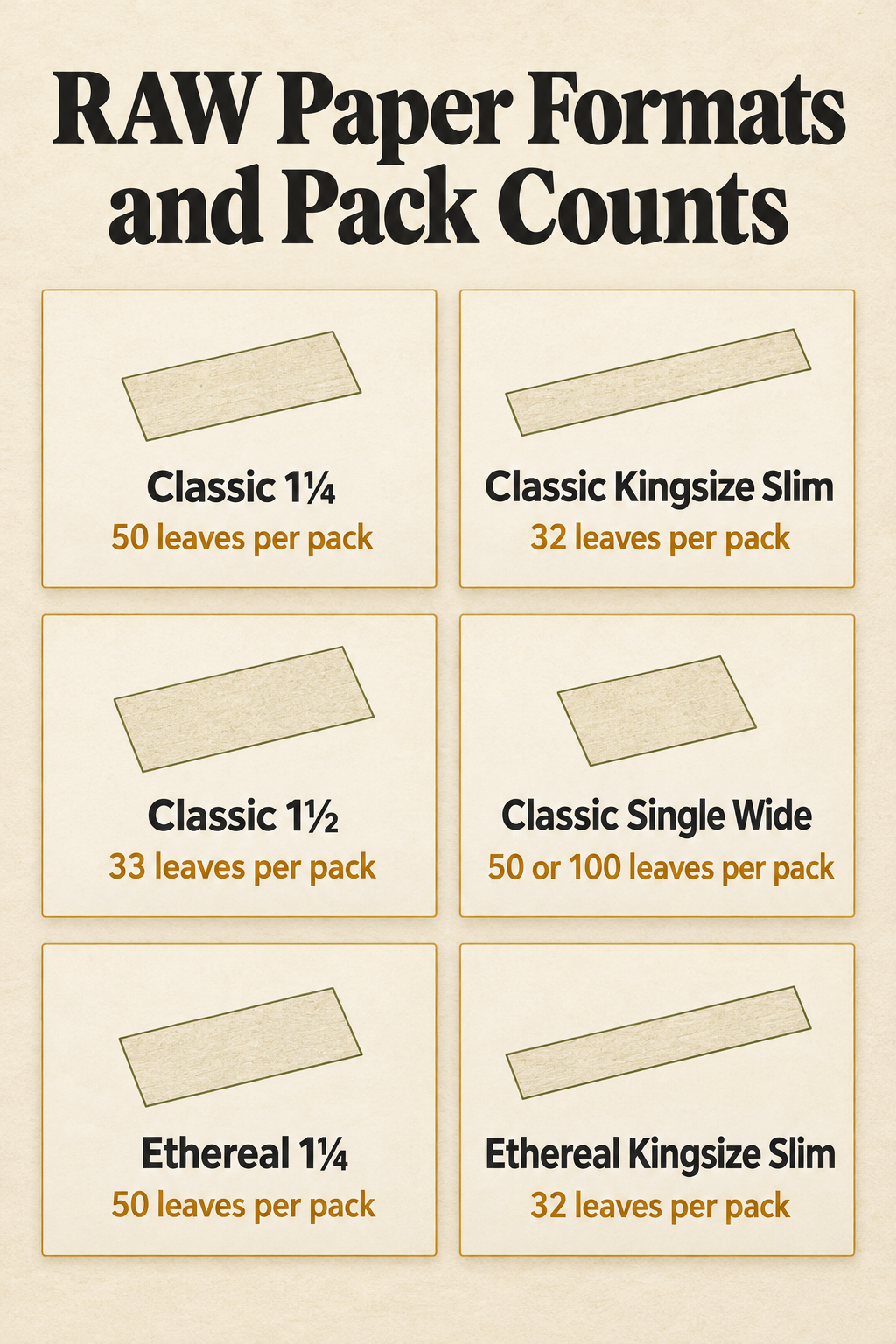
Paper format names describe sheet size, not quality. 1¼ is the historic Spanish Size that RAW calls its original, and it was the standard paper size for hundreds of years before other shapes spread. Kingsize Slim is longer and narrower. Single Wide is narrow. 1½ sits between 1¼ and Kingsize in width.[10][2]
The trap is pack count. Classic 1¼ holds 50 leaves. Classic Kingsize Slim holds 32. Classic 1½ holds 33. Classic Single Wide holds 50 or 100 depending on whether it is the Single Feed, Double Feed, or Cut Corners style.[2] A 32-leaf pack is not worse value than a 50-leaf pack, because the individual sheets are bigger.
Ethereal repeats the same pattern at a smaller scale: 50 leaves for 1¼ and 32 leaves for Kingsize Slim.[5] That consistency is useful, because it means leaf counts are comparable within a format even when they are not comparable across formats.
Beyond booklets, RAW sells Creaseless flat packs, RAWlet packs of 20 sheets, and rolls of roughly 9 feet or 16 feet that you cut to length yourself.[2] Each one suits a different habit: a roll for someone who always rolls the same length, a RAWlet for a pocket, a flat pack for a bag that gets crushed.
Case-size listings are a separate thing again. 50CT DISPLAY – RAW Classic Double Wide Rolling Papers – 34pc is sold as a display of packs, so the price covers many booklets rather than one. Compare cost per leaf, not cost per listing.
- Name the format in the product title first, whether that is 1¼, Kingsize Slim, 1½, or Single Wide.
- Count the leaves in the pack and write the number down before you look at the price.
- Check the cut style, since Single Feed, Double Feed, and Cut Corners change both the leaf count and how the sheet feeds.
- Decide whether a booklet is even right, or whether a flat pack, RAWlet, or roll fits how you actually roll.
- Divide the price by the leaf count so two packs are compared on the same basis.
Which RAW Cone Size Should You Buy?
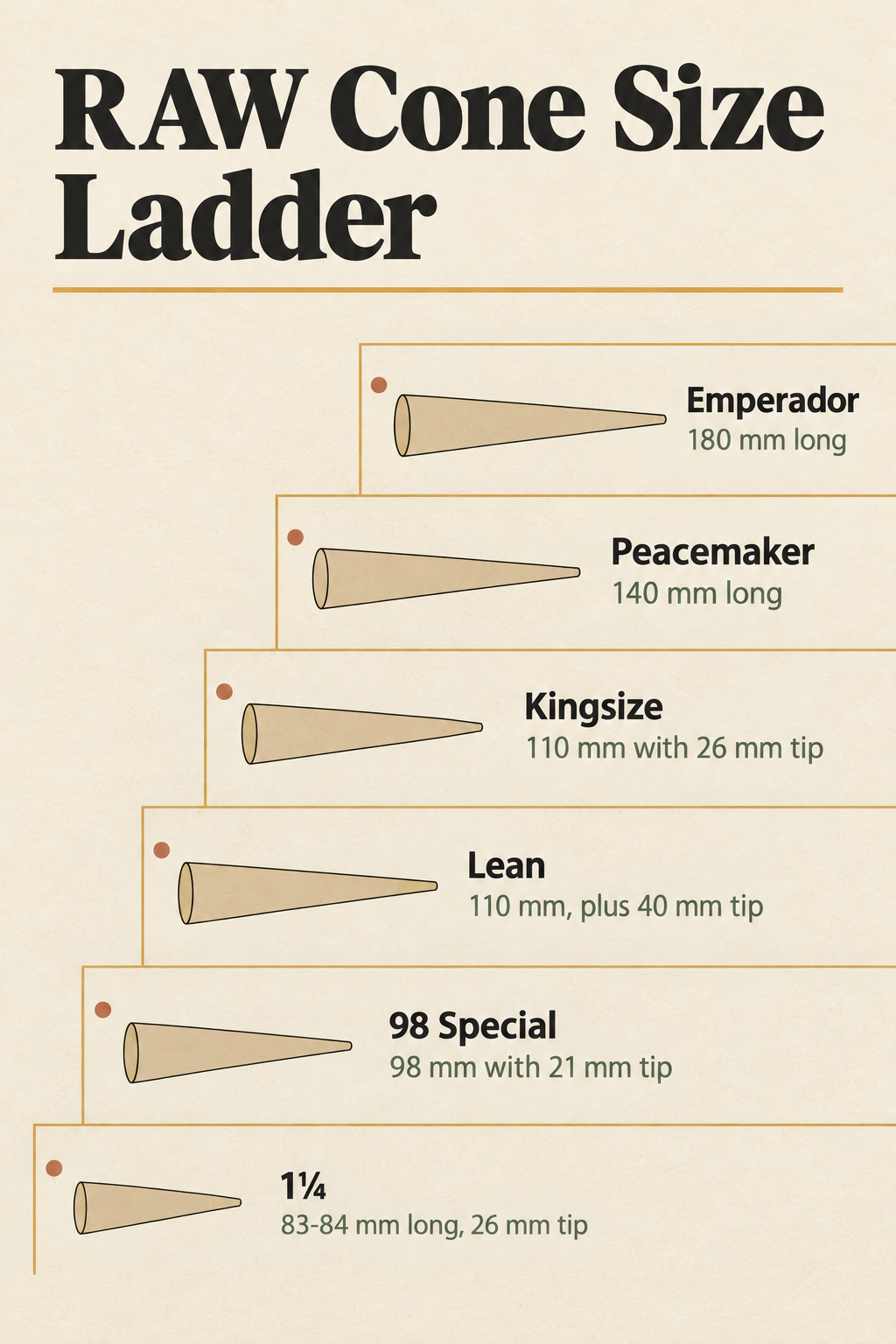
Cone sizes run in order of length. The sizes below come from RAW’s own cone page, which adds that all weights are approximate.[1]
Two quirks are worth knowing before you pick. Lean is 110 mm, the same length as Kingsize, but it carries a longer 40 mm tip, so the paper section is shorter than the number suggests. RAW’s own Kingsize entry is also internally inconsistent: the product description says 110 mm while the size chart on the same page lists 109 mm. Published cone dimensions should be read as nominal, not precision specs.[1]
Capacity numbers are estimates, and rough ones. Two retailer charts disagree on the same formats. One lists Kingsize near 1.15 g and Peacemaker near 1.5 g, while another lists 1.25 g and 2.25 g for the same two sizes. Both note that grind, moisture, and how tightly you pack move the number. The table below puts the two published sets of estimates side by side.[11][12] Use capacity for rough planning only.
Short formats are easier to fill evenly, and long formats hold more material and take more effort to pack. That is the practical trade-off between a 1¼ and a Peacemaker. One thing paper choice does not change is what smoking does to your body: a thinner sheet changes how a roll feels and burns, not the risk that comes with smoking it.[9]
- 1¼ — 83 to 84 mm with a 26 mm tip. The smallest standard cone and the easiest to fill evenly.
- 98 Special — 98 mm with a 21 mm tip. Slightly longer than 1¼ with a shorter mouthpiece.
- Lean — 110 mm with a 40 mm tip. Same paper length as Kingsize but a longer mouthpiece.
- Kingsize — listed as 110 mm in the copy and 109 mm in the size chart. The most common long format.
- Peacemaker — 140 mm. One clear step up in length and material.
- Emperador — 180 mm. A long format for a slow session or for sharing.
- Supernatural — 280 mm, which RAW describes as a full one-footer.
- Challenge — 600 mm, which RAW calls a two-footer. A novelty format more than a daily one.
| Cone size | Chart A estimate | Chart B estimate |
|---|---|---|
| 1¼ | 0.75 g | 0.75 g |
| 98 Special | 0.95 g | 1 g |
| Lean | 0.75 g | 1 g |
| Kingsize | 1.15 g | 1.25 g |
| Peacemaker | 1.5 g | 2.25 g |
| Emperador | 3 g | not listed |
Do You Need RAW Tips, Roller, or a Cone Loader?
RAW’s tip range is broad enough that "RAW paper tips" does not name a product. The line includes Original Tips milled on a Fourdrinier machine, Perforated Gummed Tips, Black Tips, Perforated Wide Tips, Seeded Tips, Perfecto Cone Tips, Maestro Cone Tips, Slim Herbal Tips at about 30% skinnier than the standard tip, Wide Tips, the 480-tip RAWlbook, and pre-rolled tips.[3]
Pre-rolled tips are the one item RAW claims as an invention. The brand says they are a US-patented invention and sells them 21 per pack or 200 per bag. Perfecto Pre-Rolled Cone Tips are hand-rolled in Bali and come 21 per pack or 100 per box.[3]
Rollers are matched to paper width rather than sold as one universal size. Hemp-plastic rollers come in 70 mm, 79 mm, and 110 mm. The 2-Way roller has a side switch for standard or wide rolls, the Supernatural Roller is built for 280 mm papers, and the Phatty Roller is 125 mm.[6]
Cone-filling tools overlap with rollers, which is where buyers waste money. RAW sells two Loader sizes, one for 1¼ and Lean cones and one for Kingsize and 98 Special cones, plus a Six Shooter that fills 1, 2, 3, or 6 cones at once and a slide-style Cone Filler in 1¼ and Kingsize.[6] If you buy cones, a loader is the tool that matches your product and a roller is not.
- Pick a tip style first, loose or pre-rolled, because that choice follows you through every roll you make.
- Match a roller to your paper width, at 70, 79, or 110 mm, instead of buying the largest one available.
- If you use cones instead of loose papers, skip the roller and match a Loader to your cone format.
- Only then consider multi-cone tools like the Six Shooter, which help when you are filling several cones at once.
- Add a tray and storage last, since neither changes anything about how the paper or cone is built.
How Can You Tell Genuine RAW Papers From Counterfeits?
Fake RAW is a documented problem, and the warnings come from the brand itself. RAW’s product pages steer buyers away from marketplaces such as Wish, DHgate, and eBay, say that counterfeits have occasionally turned up on Amazon, and point shoppers to authorized dealers and a verification video.[10]
Cones carry a check that booklets do not. RAW states that genuine RAW cones ship with a natural paper straw, and that RAW cones do not use plastic straws. If the tube inside the pack is plastic, that is a strong sign something is off.[1]
Price is a weak signal on its own, but a bargain far under the usual shelf price deserves a second look. So does packaging with odd lettering, a misaligned fold, or a print that looks soft next to a pack you already own. The brand’s own pages are the reference point, so compare against those rather than against a marketplace photo.
Buying from a seller you can name, with a return policy, removes most of the risk. That is a boring answer, and it is the one that works.
- Start with the seller rather than the price, and buy from an authorized dealer you can name.
- Skip Wish, DHgate, and eBay listings for RAW, all three of which the brand names directly.
- Check Amazon listings with care, since RAW says fakes have occasionally appeared there.
- On cones, check for a natural paper straw and no plastic tube inside the pack.
- Run the brand’s verification video against the pack you received before you open it.
- Keep the order confirmation so a return is still possible if the check fails.
Where Are RAW Papers Made, and Does ‘Unrefined’ Still Apply?
RAW rolling papers date to 1995, when Josh Kesselman created the brand, with Arizona-based HBI International as the parent company. The first full RAW rolling paper line launched in 2005, after a reported $1 million investment in unbleached base paper.[7]
Manufacturing claims around RAW have been litigated. In the case between HBI International and Republic Technologies, a judge found the claim that RAW papers are handmade by artisans in Alcoy, Spain misleading. Forbes reported that the base paper is made in Saint-Girons, France, and then packaged by Iberpapel in Benimarfull, Spain.[8]
As part of the permanent injunction in that case, HBI agreed to stop advertising its papers as "unrefined." The same record undercut claims that RAW’s organic hemp papers were the first or only organic hemp papers, and claims that Kesselman invented the cone. RAW’s own product pages still use the word "unrefined" in current copy.[8][2]
RAW clarified in 2023 that its Organic Hemp papers are made in Benimarfull, in Spain’s Alicante province, using unbleached certified organic hemp milled in southern France.[7]
For a shopper, this mostly means provenance claims deserve a careful read. The lineup itself is well documented, and the format, leaf count, and print quality on the pack you are holding tell you more than a slogan does.
- Brand history: created by Josh Kesselman in 1995, with HBI International in Arizona as the parent company.
- First full paper line: launched in 2005, after a reported $1 million investment in unbleached base paper.
- Court record: a judge found the claim that the papers are handmade by artisans in Alcoy, Spain misleading.
- Paper origin per Forbes: base paper made in Saint-Girons, France, then packaged in Benimarfull, Spain.
- Injunction: HBI agreed to stop advertising the papers as "unrefined," though current product pages still use the word.
- 2023 clarification: Organic Hemp papers are made in Benimarfull, Alicante, from organic hemp milled in southern France.
Frequently Asked Questions
Are RAW cones easier than loose RAW papers for a beginner?
Cones remove the rolling step entirely, so most beginners start there. RAW Classic cones use the same unbleached paper as Classic papers and arrive pre-shaped with a hand-folded W tip, so the only job left is filling and twisting. Loose papers give you more control over length and shape once you have practiced.
Do RAW tips come pre-rolled?
Both options exist. RAW calls its Pre-Rolled Tips a US-patented invention and sells them 21 per pack or 200 per bag, with Perfecto Pre-Rolled Cone Tips hand-rolled in Bali at 21 per pack or 100 per box. Loose formats such as Original, Perforated Gummed, and Wide tips are also sold, and you roll or fold those yourself.
Is a RAW rolling machine worth buying if I only roll sometimes?
It depends on which format you bought. If you use loose papers, a roller matched to your paper width saves time and keeps rolls consistent. If you already buy cones, a cone loader or the slide-style Cone Filler does the same job, and the two tools overlap, so there is little reason to own both.
How many RAW leaves come in a pack?
It varies by format and line, which is why pack size is a poor way to compare value. Classic 1¼ holds 50 leaves, Classic Kingsize Slim holds 32, Classic 1½ holds 33, and Classic Single Wide holds 50 or 100 depending on the style. Ethereal matches the 50-leaf 1¼ and 32-leaf Kingsize Slim counts.
Does RAW still say its papers are unrefined?
Yes. A 2023 permanent injunction required HBI to stop advertising the papers as "unrefined," but RAW’s current product pages still use the word in their copy. RAW clarified in 2023 that its Organic Hemp papers are made in Benimarfull, Spain, using organic hemp milled in southern France.
Which RAW Papers or Cones Should You Actually Buy?
Pick by format and count before you pick by paper line. If you roll loose, choose a format you can comfortably hold, note the leaf count, and only then decide whether Classic, Black, or Ethereal is worth the step up. If you would rather skip rolling, choose a cone length from the ladder and match a loader to that size.
Keep the two traps in mind. Pack counts are not comparable across formats, because a 32-leaf Kingsize Slim pack holds bigger sheets than a 50-leaf 1¼ pack. And cone dimensions are nominal, with RAW’s own Kingsize listing disagreeing with itself between the copy and the size chart.
Buy from a seller you can name. RAW’s own pages point to authorized dealers, and the paper-straw check on cones takes seconds. If you are stocking up for a group or a trip, Treehouse offers free shipping on orders $150+.
Sources
- RAWthentic (HBI International): RAW Cones — official product line page
- RAWthentic (HBI International): RAW Classic Paper — official product line page
- RAWthentic (HBI International): RAW Classic Tips — official product line page
- RAWthentic (HBI International): RAW Black Papers — official product line page
- RAWthentic (HBI International): RAW Ethereal — official product page
- RAWthentic (HBI International): RAWling — rolling accessories page
- Wikipedia: RAW (rolling papers)
- Forbes: The Pinocchio Of Pot
- Centers for Disease Control and Prevention: Cannabis and Lung Health
- RAWthentic (HBI International): RAW Classic 1¼ — official product page
- Head Candy Smoke Shop: RAW Cone Size Comparison Chart
- Green Blazer: RAW Cones Size Chart