
A practical comparison of convenience, control, cost, and burn quality to help you pick the right rolling accessory for your setup.
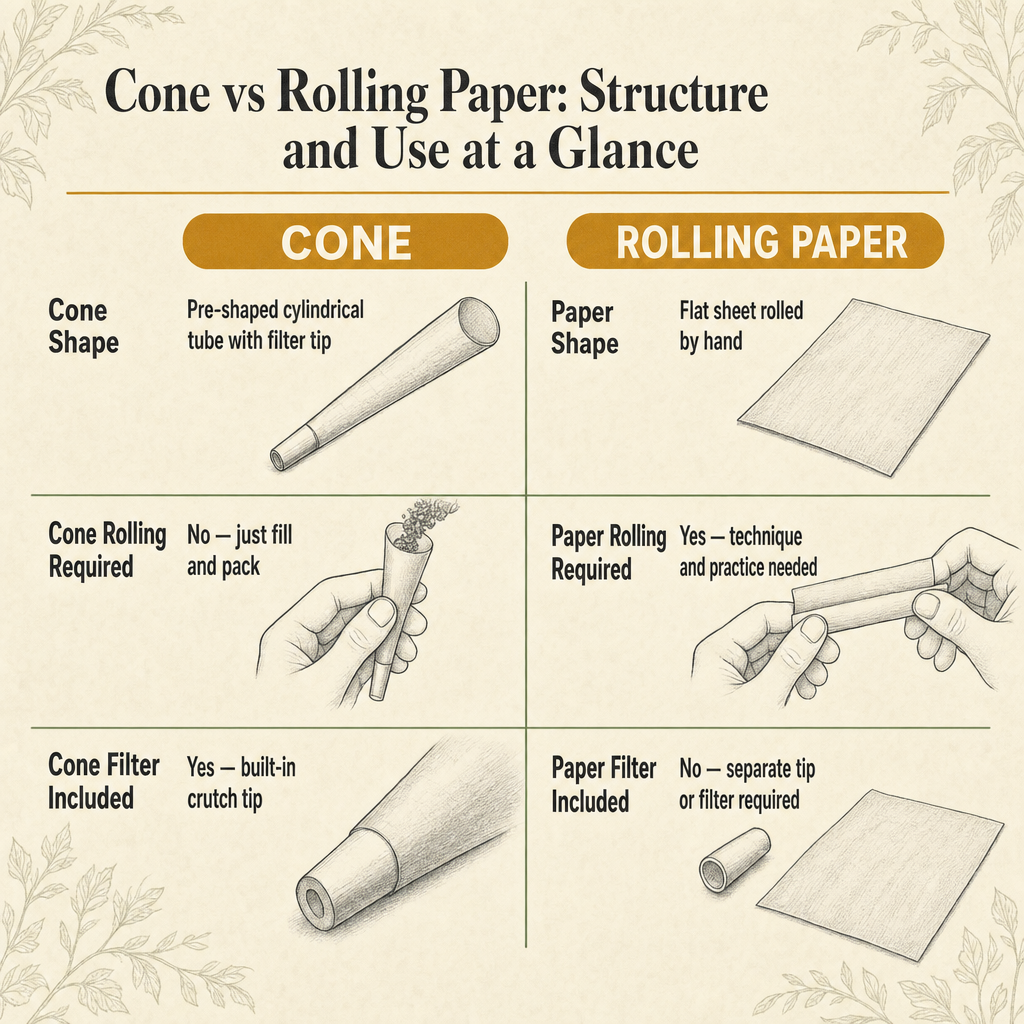
Pre-Rolled Cones and rolling papers both produce a smokeable rolled product, but they take opposite approaches. Cones come pre-shaped with a built-in filter tip — you simply fill and pack from the wide end. Rolling papers are flat sheets you roll into a cylinder yourself around a separate filter or tip. With cones vs rolling papers, the trade-off is speed and consistency versus full control over shape, size, and fill density.
What Are Pre-Rolled Cones and How Do They Work?
A pre-rolled cone is a cylindrical paper tube that is already shaped and glued in place, with a built-in filter tip at the narrow end. Unlike a flat rolling paper, a cone widens from the filter tip toward the open end, giving it a funnel-like appearance. You purchase cones empty, then fill them through the wide opening rather than rolling from scratch. This means the most difficult part of the rolling process — forming a uniform cylinder — has already been done for you.
- Pre-shaped paper tube with a built-in filter tip already attached and sealed
- Filled through the wide open end rather than rolled from a flat sheet
- Available in rice paper, hemp, and other materials common to rolling papers
- Consistent shape from one cone to the next, reducing user-induced variation
- Built-in filter eliminates the need to purchase or insert a separate tip
- Sold empty, ready for you to fill and pack at home
The filling process is straightforward: ground material goes into the wide end, then gets tamped down gently to pack it evenly toward the filter. No rolling technique is required. You do not need to lick a gum strip, tuck a flap, or worry about tearing the paper as you curl it around your material. Cones are sold in the same range of materials as rolling papers, including rice paper and hemp, so your material preference is not limited by choosing the cone format.
Because the shape is fixed before you begin, every cone you fill ends up with the same cylindrical form. This removes one of the trickiest parts of hand-rolling — getting a uniform cylinder — and makes the process noticeably faster once you have the hang of it. The built-in filter tip also means you do not need to buy or handle separate filter tips, which simplifies the overall workflow. Cones are also easier to fill in moving environments, such as a car or at a crowded event, where hand-rolling a paper neatly can be impractical. For users with limited dexterity, cones remove the fine motor skill requirements that hand-rolling demands, making them a more accessible option across a wider range of users.
What Are Rolling Papers and How Do They Differ?
Rolling Papers are thin, flat sheets sold in rectangular packs. Each sheet has a narrow gum strip along one edge that you moisten to seal the finished cylinder. To roll a joint, you place a separate filter or tip at one end of the paper, distribute your ground material evenly along the sheet, then curl the paper around the material and press the gum strip down to close it. The result is a hand-formed cylinder that is as unique as the person who rolled it, with each joint reflecting the individual roller is technique and preferences.
- Flat gummed sheet that you form into a cylinder by hand around a separate filter or tip
- Requires practice to distribute material evenly and seal the edge without tearing
- Available in standard and king size, in materials including rice paper, hemp, wheat straw, and flax [1]
- Gum strip is either natural plant gum or synthetic adhesive depending on the brand
- Size, shape, and fill density are entirely controlled by the roller, offering full customization
- Separate filters or tips must be purchased and inserted before rolling
This hand-rolling process requires practice. Getting the material distributed evenly, maintaining consistent tension as you roll, and pressing the gum strip firmly without tearing the paper all take a few tries to master. A poorly rolled paper can end up lopsided, loose in spots, or prone to tearing during smoking. The learning curve is real, and even experienced rollers occasionally produce a sub-par result on a given attempt. [1]
Rolling papers come in several sizes — standard and king size being the most common — and are made from a variety of materials including rice paper, hemp, wheat straw, and flax. [1] Some papers use natural plant gum rather than synthetic glue, which matters to users who want a fully natural smoking experience. The wide range of brands, materials, and formats means there is a rolling paper for almost every preference, but it also means the buying decision requires more research than simply picking up a pack of cones.
Read What Rolling Accessories Do I Need and How Do I Choose the Right Ones? for more detail.
What Materials Are Rolling Papers and Cones Made From?
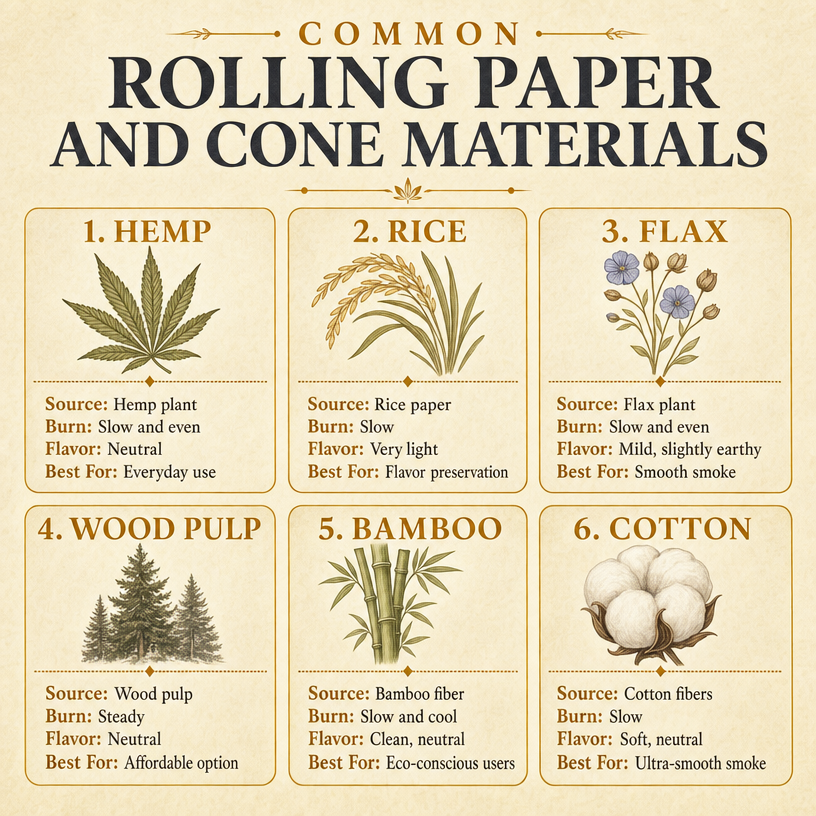
The most common Rolling paper and cone materials are rice paper, hemp, wheat straw, and flax. Each material behaves differently when burned, affecting how quickly the paper consumes and what kind of ash it leaves behind. Rice paper tends to be very thin and burns relatively fast, which some users prefer for a quick session. Hemp and flax papers are generally more durable and tend to burn more slowly and evenly, which many smokers prefer for a longer, more controlled experience. [3]
- Rice paper — very thin, burns quickly, produces low ash [3]
- Hemp — slow-burning, durable, popular for natural-fiber preference
- Wheat straw — thin sheets common in standard-sized papers [2]
- Flax — smooth burn with strong paper integrity [3]
- Mineral fillers such as calcium carbonate, magnesium carbonate, and titanium oxide are used to regulate burn rate and ash quality [1]
- Flavoured options available in fruit, dessert, and natural plant varieties [1]
Beyond the base fiber, rolling paper composition often includes mineral fillers such as calcium carbonate, magnesium carbonate, and titanium oxide. These fillers affect the paper’s burn rate, ash quality, and structural strength during rolling. A study of commercially available rolling papers found concentrations of copper, chromium, and vanadium in some products that may be relevant for frequent users to consider. [1] Alternative rolling materials including banana leaves, newspaper, and copybook paper have been documented in various global regions, and their use is associated with different health outcomes than manufactured rolling papers. [5]
Paper cigarettes rose to popularity in the second half of the 19th century, displacing more expensive cigars and leading to the emergence of companies such as Pay-Pay, Smoking, and Rizla. [1] Both rolling papers and cones come in flavoured varieties, ranging from fruit and dessert flavours to natural plant options. Flavored papers and cones add a subtle taste that some users enjoy, though others prefer the unflavored experience that lets the material’s natural profile stand on its own.
How Easy Is Each Option to Fill and Use?
If ease of use is your priority, pre-rolled cones are the more accessible option. The shape is already formed and stuck together — you simply fill and pack. There is no gum strip to lick, no tucking technique to learn, and no risk of the paper tearing as you curl it around the material. The main steps are loading ground material into the wide end and using a tamper or pen to compress it evenly toward the filter. Most people can fill a cone correctly on their first attempt, and the learning curve is essentially flat after that.
- Load ground material into the wide end of the cone using a small funnel, scoop, or packing tool
- Tamp the material down gently toward the filter tip using a tamper, pen, or stick — work in small layers rather than dumping it all in at once
- Press down firmly to compress the fill and create an even, solid pack that will burn consistently
- Twist or pinch the exposed end to close it securely above the fill line, then your cone is ready to smoke
Rolling papers require more steps and more coordination. You must hold the paper flat, distribute material evenly across its length, form the cylinder with consistent tension, and press the gum strip firmly — all in sequence. Uneven distribution is the most common cause of a lopsided or loosely packed joint, and loose packs can cause the material to shift or the joint to burn unevenly. [2]
Both options benefit from using a grinder first. A grinder breaks down material into a consistent particle size, which makes packing cones more uniform and makes rolling papers easier to distribute evenly. Without a grinder, hand-shredded material tends to be uneven in thickness, which affects how both cones and papers burn. The time saved by not hand-rolling is real, but the overall session still requires the same grinding and preparation steps before you touch the cone or paper.
See test yeeet as one current product example.
How Do Cones and Rolling Papers Compare on Burn Quality and Performance?
Burn quality depends heavily on paper thickness, material, and how evenly the product was packed. Thinner papers — including most rice paper options — tend to burn faster and can require more frequent relighting during a session. Thicker papers made from hemp or flax typically burn more slowly and steadily, which many smokers prefer for a longer, more controlled experience. The CORESTA unit measurement is used to rate the permeability of rolling papers, which affects how much air dilutes the smoke — commercial filter cigarette papers range from 14 to 51 CORESTA units, though this specification is rarely printed on recreational rolling paper packaging. [1]
- Paper thickness and material directly affect burn speed — rice paper burns faster than hemp or flax [3]
- Consistent packing in cones reduces the risk of asymmetric burning compared to loosely rolled papers
- Rolling papers can canoe if material distribution or rolling tension was uneven during the rolling process [3]
- Both products are sensitive to humidity and temperature, which affect how they light and how evenly they burn
- Paper composition and certain fillers can produce different elemental concentrations in smoke between paper types [1]
- The permeability of rolling paper, measured in CORESTA units, affects smoke dilution with air — commercial filter cigarette papers range from 14 to 51 CORESTA units [1]
Pre-rolled cones maintain a consistent cylindrical shape throughout the entire smoking session. Because the paper is already formed and the fill is compressed uniformly, cones are less prone to the asymmetric burning known as canoeing, where one side of the joint burns faster than the other. Rolling papers can canoe if the material was distributed unevenly during rolling or if the tension was inconsistent. [3]
Environmental factors such as humidity also affect both products. Very dry conditions can make paper brittle and cause it to burn faster than intended, while high humidity can make the paper damp and difficult to light consistently. Storing both cones and papers in a sealed container away from extreme temperatures helps keep them in optimal condition. Rolling papers and cones made with mineral fillers can produce different elemental concentrations in smoke depending on the filler composition, which is worth considering for frequent users. [1]
Are Pre-Rolled Cones or Rolling Papers Better for Your Budget?
Rolling papers are one of the least expensive rolling accessories available. A single pack of standard rolling papers typically costs only a few dollars and contains enough sheets for multiple sessions. For occasional users, this low upfront cost makes rolling papers an economical choice. The per-session cost when using papers is very low, especially if you are buying in bulk multi-packs, which most brands offer at a meaningful discount.
- Rolling papers have a very low per-pack cost, making them economical for occasional users
- Pre-rolled cones cost more per unit but reduce waste from poorly rolled or torn papers
- Frequent rollers who have mastered hand-rolling technique will generally spend less on papers over time
- Cone holders are a small additional purchase that make the filling process easier and more repeatable
- For regular users, the cost break-even point depends on how many joints are ruined during the learning phase
- Bulk multi-packs of rolling papers offer meaningful savings over single packs, further reducing per-session cost
Pre-rolled cones carry a higher per-unit cost because you are paying for the convenience of pre-formed, pre-glued paper tubes. The trade-off is that cones can reduce waste from badly rolled joints — if you are new to hand-rolling, a significant portion of your papers may end up in the trash due to tears, lopsided fills, or failed seals. For a beginner, the cost of ruined papers can add up quickly, making the higher price of cones comparatively reasonable. Over time, the cost difference between cones and papers depends on how many joints you roll and how often you mishandle a paper.
If you roll frequently and have already developed the technique, papers are likely the more economical long-term choice. If you are still learning, or if you value consistency and convenience over per-unit cost, cones can be worth the premium. Some users also buy cone holders — small devices that keep the cone steady while you fill it — which are a modest additional investment. The holder also keeps the cone upright between fills, which is helpful when rolling several at once for a group session.
For beginners, the cost comparison often tips in favour of cones. Ruined papers add up fast when you are still developing technique, and the cost of a torn pack of papers can easily exceed the per-unit price difference with cones. Once the rolling skill is established, the economics shift toward papers.
Browse Rolling Machines to explore related options.
What Sizes and Styles Are Available for Cones and Papers?
Both cones and rolling papers are available in a range of sizes. The most common sizes are 1¼ (standard) and king size. Cones also come in a 98 size, which falls between standard and king in capacity. King size options are longer and wider, accommodating more material for longer sessions or groups, and are particularly popular in social contexts where a single large joint is shared among several people.
- Standard 1¼ size is the most common for both cones and papers — suitable for solo or small-group sessions
- King size offers more capacity for longer sessions or sharing, available in both product types
- 98 size cones fall between standard and king, providing a middle-ground capacity option
- Cones are available in conical and straight-walled shapes, while rolling papers differ mainly by brand, material, and gum type
- Built-in filter tips on cones are made of cardboard, perforated cardboard, or glass, affecting draw feel and end-session heat
- Rolling papers use separate filters or tips, which are inserted by hand before rolling
- Flavoured options are available for both cones and papers, spanning fruit, dessert, and natural plant varieties [1]
Beyond size, there are style differences worth noting. Cones are available in straight-walled and conical shapes. The conical shape gives them the funnel-like appearance — wider at the filling end, narrower at the filter. Both shapes hold the same amount of material overall, but the conical design can affect how the fill is distributed during packing and how the joint burns near the end. Rolling papers differ by brand, material, gum type (natural plant gum versus synthetic glue), and whether they are flavoured. [1]
Filter tips for cones are built in, but the crutch material varies: standard cardboard, perforated cardboard, or glass. Perforated and glass tips allow more airflow and can keep the draw cooler toward the end of the session when the material nearest the filter can heat up. For rolling papers, filters and tips are purchased separately and inserted by hand before rolling begins. Both products come in flavoured versions for users who want a hint of taste with their session. [1]
Read Beaker Bong vs Straight Tube: What Is the Difference? for more detail.
What Are Common Questions About Smoking Accessories?
What is the main difference between a pre-rolled cone and a rolling paper?
A pre-rolled cone is a cylindrical paper tube with a built-in filter tip that you fill from the wide end — no rolling technique required. A rolling paper is a flat sheet you roll into a cylinder yourself, requiring a separate filter or tip and hand-rolling skill.
Are pre-rolled cones harder to fill than rolling papers?
No — cones are generally easier to fill. You pack ground material into the wide opening and tamp it down. Rolling papers require learning to distribute material evenly, tuck the paper, and seal the edge without tears or gaps.
Do cones or rolling papers burn more evenly?
Both can burn evenly when used correctly. Cones maintain a consistent shape throughout smoking, which promotes even burning. Rolling papers can canoe or burn unevenly if rolled loosely or with inconsistent tension.
What are rolling papers made of?
Common rolling paper materials include rice paper, hemp, wheat straw, and flax. Paper composition may also include fillers such as calcium carbonate, magnesium carbonate, and titanium oxide to affect burn rate and ash quality.
Are flavoured cones and rolling papers available?
Yes, both flavoured cones and flavoured rolling papers are available. Flavored options range from fruit and dessert flavors to hemp and natural plant varieties.
Which option is better for beginners?
Pre-rolled cones are generally better for beginners because they require no rolling technique and produce a consistent result every time. Rolling papers take practice to master but offer more control over size, shape, and fill density once learned.
Which Should You Choose — Cones or Rolling Papers?
Choosing between pre-rolled cones and rolling papers comes down to your priorities at the moment you roll. If you want speed, consistency, and a minimal learning curve, cones are the practical answer. They are ready to fill, produce the same shape every time, and let you pack a joint in seconds without any rolling technique. Pre-rolled cones are particularly useful when you are rolling multiple at once, rolling in a moving environment, or simply do not want to practice tucking and sealing a flat sheet.
If you value control, economy, and the ritual of hand-rolling, papers are the better choice. Once you have developed the technique, papers give you full command over the size, shape, and density of every joint you roll. Papers cost less per session over time and offer a wider variety of brands, materials, and flavours to explore. For many people, the hand-rolling process itself is part of the experience — the muscle memory of rolling a good joint is a skill worth having.
Many smokers use both, depending on the situation. Keeping a pack of cones handy for quick, on-the-go sessions and a supply of papers at home for more deliberate rolling is a perfectly reasonable approach. Some users prefer cones for solo sessions and reserve papers for social contexts where they can show off a clean roll. Others start with cones while learning and transition to papers once they have the technique dialed in.
Whether you go with cones, papers, or both, Treehouse Lifestyle offers free shipping on orders $150+ so you can stock up on your preferred rolling accessories without added costs. Having the right accessories on hand — whether that is a box of cones, a pack of your favourite hemp papers, or both — means you are always ready for a session, no matter what the occasion calls for.
Where Does This Smoking Accessory Information Come From?
- Wikipedia: Rolling paper
- wikiHow: How to Roll a Cigarette
- wikiHow: How to Roll a Cigarette
- Wikipedia: Cannabis smoking
- Google Scholar: Scholarly research on rolling paper composition and smoker perceptions