

The best rolling papers are the ones whose size, fiber, and flavor match how you roll. All three details are printed on the pack, and size trips up the most shoppers because format names are not standardized between brands [2]. Read the millimeter dimensions first, then the fiber and its grams per square meter.
What Should You Compare Before Buying Rolling Papers?
Three things decide whether a pack works for you: sheet size, fiber with its basis weight, and whether flavor has been added. Everything else is secondary, but secondary is not the same as unimportant. Leaf count, the gum line, and the brand all change how a pack behaves in daily use.
Size comes first because it changes the roll the most. A longer sheet holds more material and takes longer to work through, while a shorter sheet keeps one roll small and quick to finish. Zig-Zag puts the trade-off plainly: bigger formats hold more material but take more practice to roll evenly [3].
Material comes second, and it is best read as a number rather than a marketing word. Basis weight in grams per square meter tells you how much paper mass sits in a given area, and rolling papers typically run 10–25 gsm [7].
Flavor comes third, and it is not only a taste decision. Flavored products sit under rules that vary by state and by what the paper is sold with, so a pack that is easy to find in one place may not be sold in another [9].
When you are ready to shop, the Rolling section of the store groups sheets, tips, cones, and trays together, and the Rolling Papers subcategory goes straight to the papers themselves. If a particular brand is already on your list, read Which OCB rolling papers should you choose: Organic Hemp, Virgin or Bamboo?.
One habit makes all of this easier. Turn the pack over before you decide. The front of a booklet sells a format name; the back and side panel usually carry the dimensions, the fiber, and the leaf count, which is where the real comparison lives.
- Sheet size in millimeters, because a format name means different dimensions at different brands [2]
- Fiber family and basis weight, which together set thickness and how the sheet handles [7]
- Flavor status, which carries separate rules depending on your state and what the paper ships with [9]
- Leaf count per booklet, which follows brand and format rather than one industry standard [1]
- Gum line material, most often gum arabic, which decides how the sheet seals when dampened [8]
What Do Rolling Paper Size Names Actually Mean?
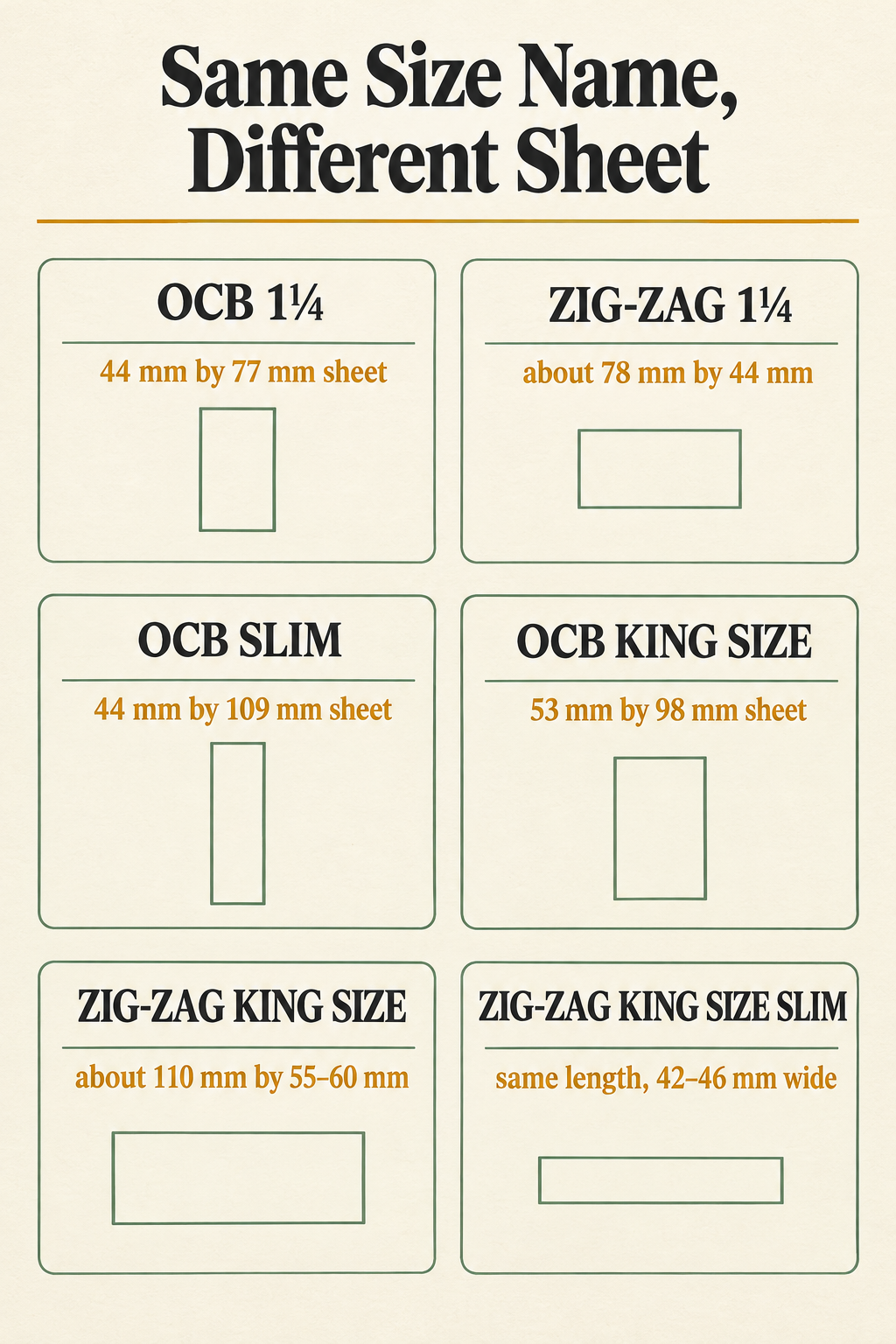
Size names are the least reliable thing on a pack. OCB’s own chart shows why. Its Slim sheet measures 44 × 109 mm and is the longest sheet in the line, while its King Size measures 53 × 98 mm, which is shorter and wider [2]. Anyone who assumes king size always means longest will pick the wrong booklet.
Zig-Zag publishes a different set of numbers under the same vocabulary: about 78 × 44 mm for 1¼, about 78 × 60 mm for 1½, about 110 × 55–60 mm for king size, and the same length as king size but only 42–46 mm wide for king size slim [3]. Two manufacturers, one shared set of names, two different sets of sheets.
The name with the longest history is 1¼. RAW calls 1¼ its original size and notes that it was the standard rolling paper size before other shapes and formats were introduced [1]. That history is why so many everyday packs still land near that footprint.
Read the list below as a translation table rather than a ranking. Each name describes a footprint, and the footprint is what you are buying. A single wide and a king size slim can hold similar amounts of material while feeling completely different in the hand.
For the format question on its own, read What Are Rolling Paper Sizes and Which One Should I Use?. Sizes are only part of the picture, though: for the full kit that surrounds a pack, read What Rolling Accessories Do I Need and How Do I Choose the Right Ones?. Fiber is covered in more depth in What Are Hemp, Rice, and Wood Pulp Rolling Papers Made Of?, cones are weighed against sheets in Pre-Rolled Cones vs Rolling Papers: Which Should You Choose?, and tray sizing is handled in What Size and Material Rolling Tray Should You Buy?.
- Regular or single wide: about 70 × 36–38 mm at Zig-Zag, and 36 × 69 mm at OCB [3]
- 1¼: 44 × 77 mm at OCB and about 78 × 44 mm at Zig-Zag, the common everyday format [2]
- 1½: about 78 × 60 mm at Zig-Zag, a wider sheet than 1¼ at roughly the same length [3]
- Slim: 44 × 109 mm at OCB, the longest sheet in that line despite the modest name [2]
- King Size: 53 × 98 mm at OCB and about 110 × 55–60 mm at Zig-Zag [3]
- King Size Slim: same length as king size but narrower, about 42–46 mm wide [3]
- Rolls: 44 mm wide with roughly 4 m on the roll at OCB, a different product category from a booklet [2]
How Do You Choose a Rolling Paper Size for How You Roll?
Once the names make sense, choosing a size becomes a short set of trade-offs rather than a hunt for the best pack. Work through the considerations below in order, because each one narrows the field for the next.
A concrete comparison helps more than a rule. OCB lists its 1¼ at 44 × 77 mm, while Zig-Zag describes its 1¼ at roughly 78 × 44 mm [2][3]. The two pairs cover almost the same area, which suggests the brands list the measurements in a different order. Compare the full pair rather than the first figure, or measure a sheet from a pack you already like.
If you are new to rolling, 1¼ is the usual starting point. Zig-Zag describes bigger formats as holding more material while taking more practice to roll evenly, and 1¼ is often named as the easiest place to begin [3]. A sheet that forgives an uneven tuck is worth more than a sheet that holds a little extra.
If you already roll comfortably, size becomes a question of how much you want to work through in one sitting rather than a question of skill. That is a preference, and it is the one part of this decision nobody else can make for you.
- Decide how much material the sheet needs to hold, since a longer and wider format holds more than a short one [3]
- Decide how long one roll should last, because longer papers generally mean a longer burn [3]
- Match the format to your practice level, with 1¼ commonly described as the easiest starting point [3]
- Match the pack to how it will be used, since a solo roll and a shared session call for different capacities [3]
- Check the millimeter dimensions against a pack you already like instead of trusting the name on the front [2]
| Format | OCB | Zig-Zag |
|---|---|---|
| Single wide or regular | 36 × 69 mm | about 70 × 36–38 mm |
| 1¼ | 44 × 77 mm | about 78 × 44 mm |
| King Size | 53 × 98 mm | about 110 × 55–60 mm |
What Does GSM Tell You About a Rolling Paper?
GSM stands for grams per square meter, and it is the most useful specification on a pack. It measures mass per unit area rather than the thickness of a single point, but for paper the two track closely enough that gsm is the number buyers use.
Rolling papers typically run 10–25 gsm, and the four common fiber families occupy different parts of that band. Rice straw sits at about 10–14 gsm, hemp at about 14–18 gsm, flax and linen at about 12–16 gsm, and wood pulp at about 18–25 gsm [7].
The number answers a practical question: how much paper is in the sheet that has to burn. A lower gsm sheet is thinner and generally burns more slowly, because there is less paper mass per unit area to combust, while a thicker sheet is easier to grip and handle [7].
There is one trap worth naming. Porosity is a separate property from thickness, so two sheets with the same gsm can still behave differently because air moves through them at different rates [7]. If a pack advertises airflow or a porous paper, that is a different measurement from the weight.
Read a gsm number in this order and it stops being abstract.
- Find the basis weight on the pack, usually printed as a gsm figure near the fiber name
- Place it inside the 10–25 gsm band that most rolling papers occupy [7]
- Match it to the fiber family: rice straw about 10–14, hemp about 14–18, flax about 12–16, wood pulp about 18–25 gsm [7]
- Read the figure as thickness, since lower gsm means less paper mass per unit area to combust [7]
- Weigh the handling trade-off, because a thicker sheet is easier to grip [7]
- Keep porosity separate in your head, since it is measured differently from thickness [7]
Which Rolling Paper Material Is Right for You?
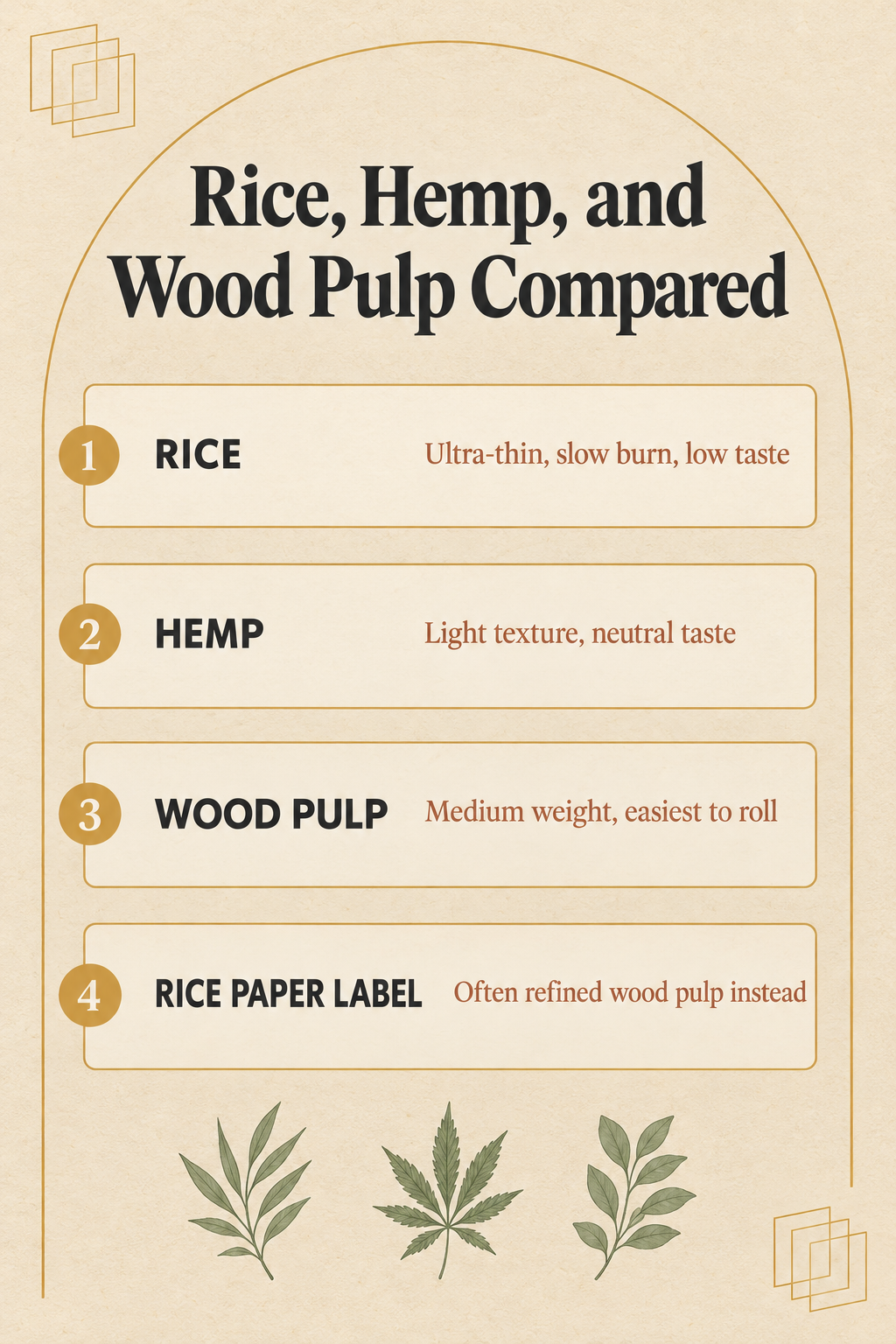
Manufacturers compare their own papers on five terms: thickness, burn, rolling ease, taste impact, and sourcing. Zig-Zag sums up the three mainstream materials as rice being ultra-thin with a slow burn and very little paper taste of its own, wood pulp being medium weight and the easiest of the three to roll with a more noticeable paper taste, and hemp being finely textured with a neutral taste [4].
That framing is more useful than a ranking, because the right answer depends on which of those five terms you care about. If you want the thinnest sheet available, rice and flax sit at the low end of the weight range. If you want a sheet that cooperates while you are learning, wood pulp is the more forgiving option [7].
One correction matters here. Many papers sold as rice paper are actually made from refined wood pulp, and the phrase has historically described a thin white sheet rather than a sheet made of rice [5]. The material line on the pack, not the product name, is what tells you what you are holding.
It is also worth being clear about what these labels do not mean. Brand material guides frame the choice around thickness, burn, grip, taste, and sourcing, and no standardized health classification appears on the packs reviewed [7]. Phrases like healthiest rolling papers work better as search terms than as product grades, so compare on the measurable terms instead.
- Rice: described as ultra-thin with a slow burn and very little paper taste of its own [4]
- Hemp: finely textured with a neutral taste in the same manufacturer comparison [4]
- Wood pulp: medium weight, the easiest of the three to roll, with a more noticeable paper taste [4]
- Flax and linen: a separate fiber family sitting around 12–16 gsm, near the lighter end of the range [7]
- Rice paper as a label: frequently refined wood pulp rather than rice fiber [5]
- Sourcing: part of how brands position a paper, and printed on the pack rather than implied by the format name [4]
| Paper | Described as | Taste impact |
|---|---|---|
| Rice | Ultra-thin with a slow burn | Very little paper taste |
| Hemp | Light-textured | Neutral |
| Wood pulp | Medium weight, easiest to roll | Noticeable paper taste |
Are Unbleached Rolling Papers Different From White Ones?
Bleaching, in papermaking, means whitening. It does not automatically mean chlorine, and that distinction is where most of the confusion about brown versus white papers comes from [5].
The routes are distinct. Elemental chlorine-free processing, usually written ECF, whitens pulp with chlorine dioxide. Totally chlorine-free processing, or TCF, uses oxygen, ozone, or hydrogen peroxide instead. Unbleached paper skips the whitening step and keeps its residual lignin and natural tone [5][6].
The persistent myth is that a darker sheet burns more slowly because of its color. It does not. Burn speed is set by basis weight, fibre length, sheet formation, and the watermark, which means two sheets of the same color can burn at different rates and two sheets of different colors can burn at the same rate [6].
What unbleached paper actually gives you is a shorter process and a visible one. It keeps the natural tone of the pulp instead of being whitened, and the label tells you which route the mill used [6]. If the whitening route is what you care about, read that line on the pack rather than judging by shade.
- Elemental chlorine: listed as its own pulp route, separate from the chlorine-free and unbleached routes [6]
- Elemental chlorine-free (ECF): pulp whitened with chlorine dioxide [5]
- Totally chlorine-free (TCF): pulp whitened with oxygen, ozone, or hydrogen peroxide [5]
- Unbleached: no whitening step, so residual lignin and the natural pulp tone remain [6]
- Colour is not a burn setting, since burn speed follows basis weight, fibre length, formation, and the watermark [6]
Do Flavored Rolling Papers Change the Taste, and Where Are They Allowed?
Flavor on a paper can be applied in four main ways, and the method explains why some packs smell strongly out of the booklet while others are subtle [12].
The flavor is experienced where the paper meets your lips and tongue, and one of the four methods concentrates it on the gum strip rather than across the sheet [12]. One well-known line, Juicy Jay’s, uses a proprietary triple-dipped system and lists flavors including raspberry, peach, butterscotch, watermelon, strawberry, coconut, banana, chocolate, menthol, orange, cherry, and blueberry [13].
The rules are the part shoppers underestimate. Federal guidance states that a cigarette, and any of its component parts including the paper, may not contain a characterizing artificial or natural flavor other than tobacco or menthol, and the definition of cigarette includes tobacco that is likely to be purchased as roll-your-own [9].
Papers sold on their own are a separate question, and it has not been fully settled. In 2009 a maker of flavored rolling papers challenged the FDA, and the court recorded that its papers were sold in separate packages apart from any tobacco and contained no tobacco. The court dismissed the case on jurisdictional grounds rather than deciding the merits [11].
State law adds another layer. California, for example, bars tobacco retailers including online and delivery sellers from selling most flavored tobacco products, and requires covered products to appear on the Attorney General’s Unflavored Tobacco List to be sold in the state [10]. Other states and cities have their own rules, so whether a flavored pack is available to you depends on where you are ordering from.
- Food-grade ink printing, where flavor sits in the printed design on the sheet [12]
- Triple-dip flavoring, where the sheet is dipped repeatedly to build a stronger coating [12]
- Gum strip concentration, where most of the flavor sits on the strip that meets your lips [12]
- Botanical terpene infusion, where plant-derived aroma compounds are added to the paper [12]
How Do You Compare Two Packs Side by Side?
Any two packs can be compared in about two minutes with the same routine, whether you are standing in a store or reading two product pages. Run the steps in order and you will rarely be surprised by what arrives.
The first two steps do most of the work. Dimensions tell you what you are actually getting, and fiber plus gsm tells you how that sheet will handle. Leaf count is the tiebreaker when two packs are priced similarly but sized differently, since counts follow brand and format rather than any standard [1].
The last two steps are the ones people skip. Flavor status is a legal question before it is a preference question, and the gum line decides whether the sheet seals cleanly when you dampen it. Gum arabic, also called acacia gum, is the material on most papers and is a food-grade ingredient carrying the E number E414 [8].
- Read the millimeter dimensions on both packs before anything else, since names are not standardized [2]
- Compare fiber family and gsm side by side, because thickness and handling follow from them [7]
- Compare leaf counts per booklet, which vary by brand and format rather than following a standard [1]
- Check flavor status against your state’s rules before you buy, since availability varies by location [9]
- Compare the gum line, usually gum arabic, which decides how the sheet seals [8]
Frequently Asked Questions
How many papers come in a pack of rolling papers?
Pack counts follow brand and format rather than one standard. RAW lists 50 leaves in a 1¼ pack and 32 leaves in a king size slim pack, with different counts again for single wide formats [1]. Because the count is usually printed on the booklet, compare leaf count alongside sheet dimensions when you price two packs against each other.
What is the sticky strip on a rolling paper made of?
The gum strip on most rolling papers is moisture-activated gum arabic, also called acacia gum, harvested from Acacia senegal and Acacia seyal trees. It is a food-grade material and carries the E number E414 [8]. The strip activates when it picks up moisture, which is why a paper seals when you dampen the edge rather than pressing it dry.
Does a lower GSM rolling paper burn more slowly?
Basis weight is one input. A lower gsm sheet is thinner and generally burns more slowly because there is less paper mass per unit area to combust [7]. Thickness also changes handling, since a thicker sheet is easier to grip. Porosity is a separate property from thickness, so two sheets of the same gsm can still differ in how they draw [7].
Are rice rolling papers actually made of rice?
Not always. Many papers sold as rice paper are made from refined wood pulp, and the phrase has historically described a thin, white sheet rather than a sheet made of rice [5]. If the fiber matters to you, read the material line on the pack instead of relying on the product name.
Are flavored rolling papers legal where I live?
It depends on your location and on what the paper is sold with. Federal guidance prohibits a cigarette, including its component parts such as the paper, from containing a characterizing flavor other than tobacco or menthol, and that definition covers tobacco purchased as roll-your-own [9]. Flavored papers sold in separate packages containing no tobacco were the subject of a 2009 challenge that was dismissed on jurisdictional grounds, so the merits were never settled [11]. State rules add another layer: California, for instance, bars retailers including online and delivery sellers from selling most flavored tobacco products and requires covered products to appear on the Attorney General’s Unflavored Tobacco List [10]. Check your own state’s rules before ordering.
Which Rolling Papers Should You Buy First?
Start with a 1¼ pack in a fiber you can identify by name. It is the format RAW identifies as the historical standard, it is the one most often described as the easiest place to begin, and the dimensions are printed on the pack so you can compare it honestly against anything else you pick up [1][3].
From there, change one variable at a time. Move up to king size when you want more capacity, down to single wide when you want a shorter roll, and sideways into a different fiber when the handling of your current sheet is the thing that bothers you. Changing size and material at once makes it hard to tell which change you actually liked.
Buy the small booklet first. A pack you have not rolled with is a guess, and the price gap between one booklet and a box is the cheapest test available. Orders of $150 or more ship free, which makes a mixed order of two or three formats an easy way to compare them in one go.
The short version: read the millimeters, check the gsm against the fiber, confirm the flavor rules for your state, and then roll with it.
Sources
- RAWthentic (RAW Rolling Papers): RAW Classic Paper
- OCB: Rolling paper sizes: Choose the right one
- Zig-Zag: Best Rolling Paper Sizes for Beginners & Everyday Use
- Zig-Zag: Best Rolling Papers: Rice, Hemp, or Wood Pulp?
- GreenState: What’s really in your rolling papers? Myths, facts, and hidden risks
- Skins Rolling Papers: Unbleached vs bleached rolling papers: what chlorine-free actually means
- Rollpedia: How Rolling Paper Thickness (GSM) Works
- The Rolling Paper Company: Natural Gum Arabic for Rolling Papers
- U.S. Food and Drug Administration: General Questions and Answers on the Ban of Cigarettes that Contain Certain Characterizing Flavors (Edition 2)
- California Department of Public Health: California Prohibits Retailers from Selling Flavored Tobacco Products
- U.S. District Court, District of Arizona (via CourtListener): BBK Tobacco & Foods, LLP v. U.S. Food & Drug Administration
- Futurola: Do Flavored Rolling Papers Affect Taste – Complete Guide
- Rolling Supreme: Juicy Jays