

Here is how to roll a blunt by hand: split a cigar or cigarillo lengthwise, empty the loose tobacco, and refill the leaf wrapper with ground cannabis. Spread the fill evenly, tuck the near edge, roll with firm pressure, wet the exposed edge, and press the seam closed. Then bake the seam with lighter heat so it sets. [1]
A cigarillo-sized blunt usually takes about 1 to 2 grams of ground cannabis, and a full-size cigar or a large wrap takes noticeably more. The amount follows wrap size and how tightly you pack it rather than a fixed rule. [1] [4]
Hemp wraps that come pre-split skip the gutting step entirely, which makes them the easier starting point for a first attempt. [4] Whichever wrap you pick, plan on the first two or three coming out loose or slightly crooked. That is normal, and it is fixable.
What Is a Blunt, and How Is It Different From a Joint?
A blunt is a cigar or cigarillo that has had most or all of its loose tobacco filler removed and replaced with cannabis. The leaf wrapper stays in place, so the finished roll is a tobacco-and-cannabis product rather than a paper roll. [1] [8]
That wrapper is the real difference from a joint. A joint is cannabis rolled in paper with no tobacco in the wrap, while a blunt uses a tobacco leaf or tobacco sheet instead of paper. [2] The shape is not what separates the two. The material is.
The name has a history. It comes from Phillies Blunt cigars, which were the common cigar used for this in the 1980s and 1990s on the U.S. East Coast. People still name a blunt after the cigar brand they used, so you will hear "a Swisher", "a Dutchie", or "some Backwoods". [2]
The thicker wrap changes the practical side of things. A blunt holds more material than a joint of similar length, it burns slower and longer, and it is usually rolled to share. [4] It also costs more per roll. A pack of Blunt Wraps holds roughly two to four wraps, while a booklet of Rolling Papers holds up to 50 leaves. [2]
One point gets lost in the how-to talk. Even a fully emptied cigar wrapper is a tobacco product. Product testing of five cigars commonly used for blunts found 1.2 to 6.0 mg of nicotine in the wrapper alone, and the wrapper made up 8 to 18 percent of the cigar’s total weight. [9] A 2025 commentary in the Journal of General Internal Medicine makes the same point: people who use blunts often believe they are getting only cannabis. [8]
If you are picturing something else entirely, What Is a Blunt Pipe and How Is It Different? clears up a common mix-up. And if you would rather skip hand-rolling altogether, Pre-Rolled Cones are filled and tamped instead of tucked.
- Wrap material: a blunt uses a whole tobacco leaf or a bonded tobacco sheet, while a joint uses paper made from wood pulp, flax, or hemp. [2]
- Fill amount: a blunt holds more ground cannabis than a joint of the same length, so it wants a fuller spread along the wrap.
- Burn time: blunts are described as slower-burning and longer-lasting than joints, which is why they are usually rolled for sharing. [4]
- Pack count and cost: two to four wraps per pack against up to 50 papers per booklet, so the cost per roll is higher. [2]
- Tobacco content: the wrapper stays a tobacco product even with the filler gone, so a blunt is a tobacco-and-cannabis roll. [9]
| Feature | Blunt | Joint |
|---|---|---|
| Wrap material | Whole tobacco leaf or bonded tobacco sheet | Wood pulp, flax, or hemp paper |
| Fill amount | Holds more ground cannabis | Holds less for the same length |
| Burn time | Slower-burning and longer-lasting | Faster, shorter session |
| Cost per roll | Two to four wraps per pack | Up to 50 papers per booklet |
| Tobacco in the roll | The wrapper itself is a tobacco product | None in the wrap |
Which Type of Blunt Wrap Should You Buy?
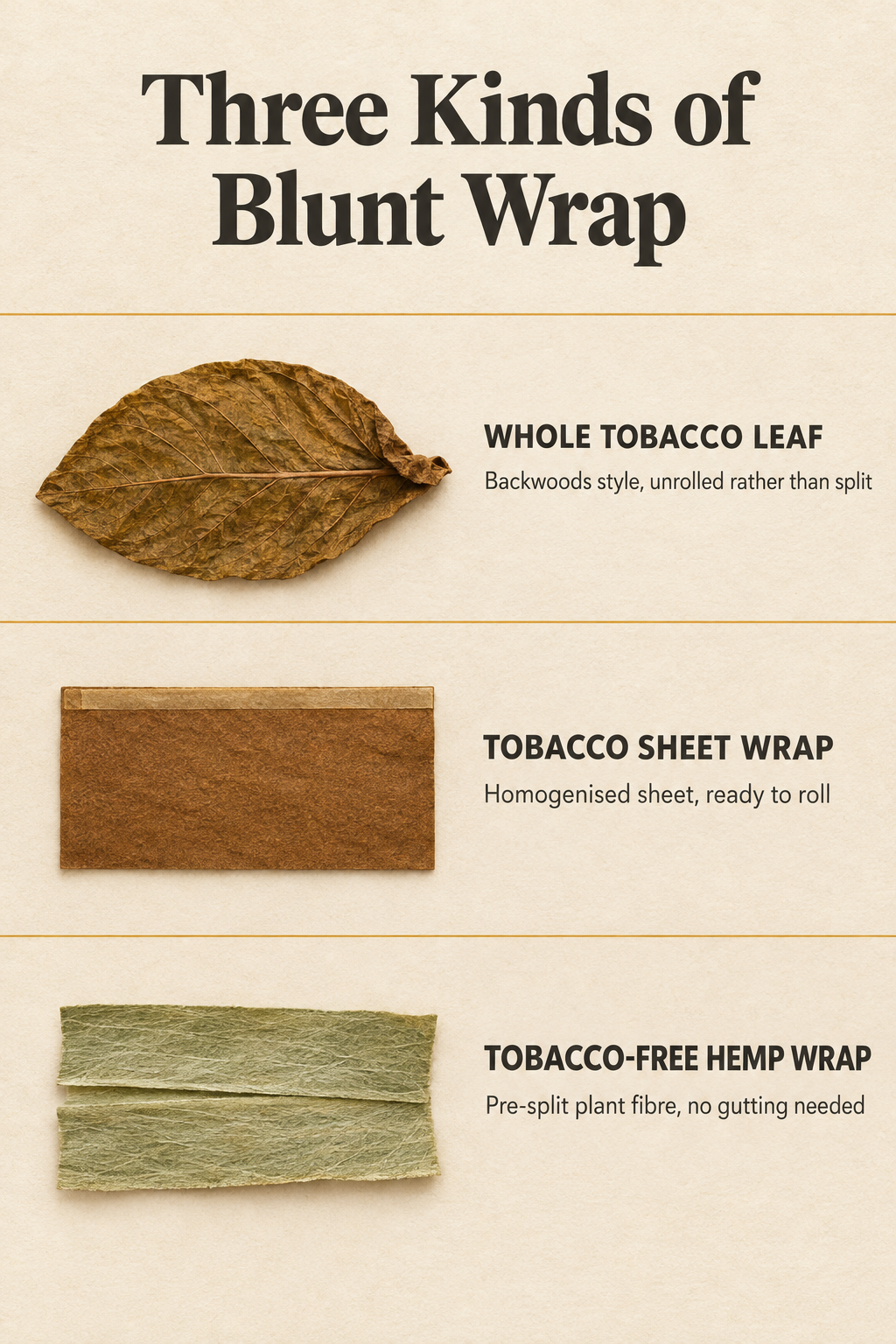
Wraps come in three broad forms, and each one asks something different of the person rolling. Knowing which form you bought tells you what the next ten minutes will involve.
A whole tobacco leaf, the Backwoods-style cigar, is unrolled rather than split. Retailer guides call it the more advanced option, and they are right. The leaf is irregular, it wants to curl back on itself, and you are shaping it rather than folding it. [4]
A homogenized or pulped tobacco sheet sold as a ready-to-roll blunt wrap or cigar wrap is the middle path. It is even in thickness and it splits predictably, so the tuck behaves the same way every time you use one. [2]
A tobacco-free wrap made from hemp or another plant fiber arrives pre-split. There is no cigar to open, no filler to dump, and the sheet is already the right shape. That makes it the more forgiving option for a first roll. [4] [6]
Sizes are not standardized, and one brand can sell both a large blunt and a cigarillo-sized one. Zig-Zag lists its natural leaf tobacco wraps at 110 x 65 mm, which is larger than a king-size rolling paper, and its ‘Rillo-size wraps at 108 x 34 mm. [2] Read the measurements on the pack instead of trusting the name.
Hemp wrap packs often settle the tip question for you. One brand puts two wraps plus two filter tips in each resealable pouch, 25 pouches to a box, and explains that the wraps feel dry out of the pouch because the manufacturer adds no glycerin or humectants. [6]
Watch for perforated cigarillo wrappers too. Some are scored at the factory to make splitting easier, a design feature the 2025 commentary links to marketing aimed at cannabis users. [8] Buying any tobacco wrap is an age-restricted purchase, since federal law sets the minimum age for tobacco product sales at 21. [7] The FDA also states plainly that cigars are not a lower-risk alternative to cigarettes, and that cigar smoke is at least as toxic as cigarette smoke. [7]
If the tuck itself is what worries you, How Do You Roll a Joint, Step by Step? covers the same motion on paper first, and Pre-Rolled Cones vs Rolling Papers: Which Should You Choose? weighs cones against papers for the same job. Even burning starts with an even fill, and How Do You Pack a Bowl So It Burns Evenly? covers that same principle for bowls. If you are stocking wraps, papers, and tips at once, Treehouse offers free shipping on orders $150+.
- Whole tobacco leaf: unrolled rather than split, irregular in thickness, and shaped by hand. Best left until your tuck and seal already feel natural. [4]
- Tobacco sheet wrap: even thickness, splits predictably, and rolls the same way every time. A reasonable second wrap once you have one blunt behind you. [2]
- Tobacco-free hemp wrap: pre-split, no gutting needed, and often sold with filter tips in the pouch. The simpler starting point for a beginner. [6]
- Size matters more than brand: a 108 x 34 mm ‘Rillo-size wrap makes a small blunt, while a 110 x 65 mm natural leaf wrap holds far more. [2]
- Age and content check: tobacco wraps are a 21-and-over tobacco purchase, and the wrapper carries nicotine even when emptied. [7] [9]
| Wrap type | What it asks of you | Best for |
|---|---|---|
| Whole tobacco leaf | Unroll the leaf instead of splitting a seam | Rollers who already have the tuck down |
| Tobacco sheet wrap | Split the seam, empty the filler, roll evenly | A second or third blunt |
| Tobacco-free hemp wrap | Warm the sheet and fill it, with no gutting | A first attempt |
How Do You Open and Empty a Cigar or Cigarillo?
This is the step where most first attempts go wrong, so handle it as its own short sequence rather than something to rush through on the way to the fill.
Guides describe three ways to open a cigar. You can cut or score it lengthwise with a razor or a sharp knife. You can crack it by pressing a thumbnail along the existing seam. Or you can moisten the seam first and split it after about 30 seconds, which guides say opens more cleanly than a dry split. [1] [4] Whichever you choose, work along the seam rather than across the body of the cigar, because the seam is the weakest line and the one that will close again most easily.
Once it is open, empty the loose tobacco filler out and set it aside. The wrapper is the only part you are reusing. The tobacco inside the cigar is not what makes a blunt, and leaving half of it in place turns your roll into something else entirely. [1] [4]
There is one exception that trips people up. Backwoods-style cigars are unrolled rather than split, which is a different motion: you are peeling the leaf off the cigar instead of opening a seam. That is one reason guides call whole-leaf wraps a more advanced option. [4]
Before you fill, check the wrap. It should sit open and flat, with one intact edge you can tuck against and one edge you can moisten and press. If the split ran off the seam and left a small tear, do not throw the wrap away: a gummed strip from a rolling paper will patch a split while you roll. [1]
A rolling machine will not help at this stage, because the machines handle paper rather than a leaf wrapper. How Do You Use a Rolling Machine Step by Step? is the right guide if paper is what you are working with.
- Pick your opening method: a razor or sharp knife along the length, a thumbnail pressed into the seam, or a moistened seam split after about 30 seconds. [1]
- Work the split along the existing seam from one end to the other, keeping the blade or thumbnail shallow so it does not cut through the far side of the leaf.
- Open the cigar like a book and tip the loose filler out into a tray or straight into the bin. The filler is not reused. [4]
- Check that the leaf is still one piece, with an intact tuck edge on one side and a clean edge to moisten on the other. [1]
- Patch, do not discard: a gummed strip from a rolling paper will hold a small split closed while you roll. [1]
- If you bought a pre-split hemp wrap instead, skip this whole sequence. There is nothing to open and nothing to empty. [6]
How Do You Roll a Blunt by Hand, Step by Step?
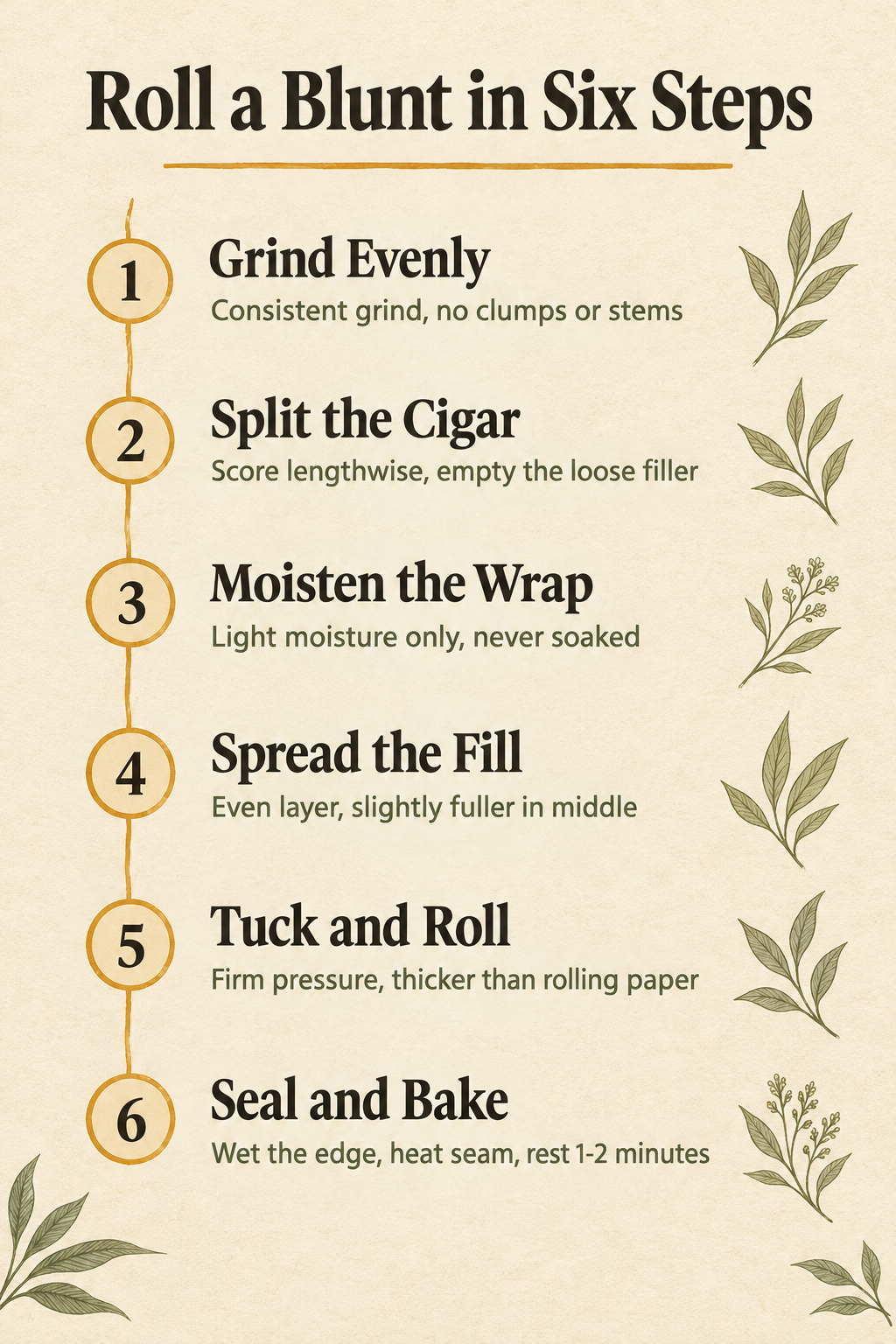
This is the core sequence, and it is worth reading once through before your hands are sticky. Set up on a clean flat surface with everything within reach: a grinder, the ground material, a tray, an optional tip, and a lighter.
Prep decides more of the outcome than the roll does. Grind the cannabis to an even consistency, because an uneven grind leaves gaps that burn unevenly and clumps that make the wrap bulge. [1] [3] Pull out stems as you go, since a stem will punch through a leaf wrap when you press down on it.
The wrap needs attention before it meets the cannabis. A dry leaf cracks and tears while you roll it, so guides call for light moisture first: a damp fingertip, a little saliva, or a quick pass with water rather than a soaked sheet. [1] [4] Hemp wraps are different. They often feel stiff out of the pouch, and both makers recommend warming the sheet rather than wetting it — held flat between the palms for about 10 to 15 seconds, or rubbed between the fingers. [6] [3]
Pressure is where a blunt stops being a joint. A blunt wrap is thicker and stiffer than rolling paper, so guides consistently call for firmer pressure than a joint needs. [4] Roll too gently and the blunt comes out loose and will not hold its shape. Roll too hard on an over-filled wrap and the leaf tears or the seam refuses to close.
Sealing has two parts, and skipping the second one is why seams open back up. After you moisten the exposed edge and press the seam closed end to end, bake it: run a lighter’s heat along the length of the seam and around the outside without letting the flame touch the wrap, then let the blunt sit for a minute or two so the seal sets. [1] [4] The goal is heat rather than flame.
- Grind the cannabis to an even consistency and pull out stems. Uneven material is the usual reason a finished blunt burns down one side. [1]
- Warm or lightly moisten the wrap. Use a damp fingertip or a little saliva on a tobacco leaf, or warm a stiff hemp sheet between your palms for 10 to 15 seconds. [4] [6]
- Lay the wrap flat with the gummed or adhesive edge facing away from you. You roll toward that edge, so it is the last thing you moisten and press. [3]
- Spread the ground material evenly along the length, slightly fuller down the middle, and leave a little room at each end. [4]
- Tuck the near edge over the material with your thumb and index finger, holding the shape of the cylinder with the other hand. [3]
- Roll with steady, firm pressure from the middle outward. Firmer than a joint, but stop the moment the leaf starts to strain. [4]
- Moisten the exposed edge and press the seam closed end to end, working from one end to the other rather than dabbing at the middle. [1]
- Bake the seam with lighter heat — no flame on the wrap — then let the blunt rest 1 to 2 minutes so the seal sets before you light it. [1] [4]
How Much Cannabis Should You Put in a Blunt?
A cigarillo-sized blunt is commonly filled with roughly 1 to 2 grams of ground cannabis. A full-size cigar or a large wrap needs more. The right amount is a function of wrap size and how tightly you pack it, not a fixed rule. [1] [4]
The shape of the fill matters as much as the weight. Aim for an even layer with slightly more material down the middle, so the finished blunt tapers at both ends instead of bulging in one spot. [4] A bulge is where the wrap strains, and a strain is where it splits.
Quantity goes wrong in both directions. Overstuffing tears the wrap and stops the seam from closing cleanly, while under-filling leaves a loose blunt that will not hold its shape and burns poorly. [3] The way to judge it is by feel rather than by the scale: the finished roll should feel firm and even, with a little give when you press it, not rock hard and not spongy.
Grind consistency is the other half of the question. An uneven grind leaves gaps, and gaps burn unevenly no matter how well you sealed the seam. [1] If you are working with a large wrap, spread the material thinner and wider rather than piling it higher in the middle.
- Cigarillo-sized blunt, roughly 1 to 2 grams: the common starting amount, and enough to fill a standard wrap without straining it. [1]
- Large wrap or full-size cigar: noticeably more than 2 grams, spread thinner and wider so the leaf is not stretched at any one point. [2]
- Small ‘Rillo-size wrap, about 108 x 34 mm: less than a standard cigarillo fill, because the wrap is narrow and has little room to give. [2]
- Signs of over-packing: the wrap will not meet at the seam, the leaf feels tight as a drum, and the tuck keeps slipping open. [3]
- Signs of under-packing: the roll feels spongy, it sags in the middle, and the wrap wrinkles instead of sitting smooth. [3]
- Grind check: an even, coarse texture spreads and burns evenly, while clumps and dust create gaps. [1]
Why Does Your Blunt Crack, Tear, or Burn Unevenly?
Almost every blunt fault traces back to moisture, pressure, or an uneven fill, and each symptom points at one of the three. The good news is that most of them are fixable on the spot rather than by starting over.
Cracking and tearing come from a wrap that was too dry at the start, from rolling too aggressively, or from overstuffing. [4] A dry leaf has no stretch left in it, so the first real pressure splits it. Moisture in the right amount, applied before the roll rather than after, prevents most of this.
A seam that will not stay closed is usually the opposite problem. Too much moisture softens the leaf so the edge slides instead of sticking, and under-sealing leaves the ends of the seam loose. [1] [3] The fix is less water and a firmer press from one end of the seam to the other.
A loose blunt that will not hold shape is a pressure problem. Blunt wraps are thicker than paper, and gentle rolling that works on a joint is not enough here. [4] Canoeing, where one side burns down faster than the other, is attributed to unevenly distributed cannabis or inconsistent moisture across the wrap. [4]
One repair is worth knowing before you need it: a small split does not ruin the roll. A gummed strip from a rolling paper holds it closed while you keep rolling. [1]
- The wrap cracks while you roll it: it was too dry. Light moisture first, or warm a hemp sheet between your palms for 10 to 15 seconds. [4] [5]
- The leaf tears at the tuck: the roll is over-filled or you are pressing too hard. Take some material out and roll with steady rather than sudden pressure. [3]
- The seam will not stick: too much moisture on the edge, or the edge was not pressed along its full length. Use less water and press end to end. [1]
- The blunt stays loose and sags: rolling was too gentle for a wrap this thick. Use firmer pressure and pack the fill a little more evenly. [4]
- One side burns faster than the other: uneven material or uneven moisture. Spread the fill evenly, keep moisture consistent, and rotate the blunt while you light it. [4]
- A split appears mid-roll: patch it with a gummed strip from a rolling paper instead of starting over. [1]
Do You Need a Crutch, Filter, or Rolling Machine for a Blunt?
None of the three is required, and two of them are genuinely optional. A blunt wrap is stiff enough that most rollers skip a crutch entirely. [1]
A tip still earns its place if you want one. Guides note that a crutch keeps the end open, adds structure so the roll stays straight, blocks loose material from reaching your mouth, and keeps your fingers away from the burning end. [1] [3] Hemp wrap pouches frequently include tips, so the pack often makes the choice for you. [6]
On machines, the answer is simple: a blunt is rolled by hand. The guides reviewed describe no rolling machine for blunts, and the wrap is too thick and too irregular for a roller to grip properly. [1] [4]
The shortcuts that do exist are worth knowing. Pre-split hemp wraps remove the gutting step, and pre-rolled wrap cones are filled and tamped with a packing stick, a pen, or a chopstick. [3] A pair of scissors is also useful for trimming both ends to an even finish. [5]
A sensible path through all of it: first attempt on a pre-split hemp wrap, second attempt on a tobacco sheet wrap, and whole-leaf cigars once the tuck and seal feel natural. [4]
- Crutch or tip: optional, but it keeps the end open, adds structure, and keeps loose material out of your mouth. Often included in a hemp wrap pouch. [1] [6]
- No crutch: the wrap is already stiff enough to hold the mouth end open, which is why most blunt rollers skip one. [1]
- Rolling machine: not part of blunt rolling. The guides reviewed describe hand-rolling only, and a leaf wrap does not feed through a roller. [4]
- Pre-split hemp wrap: the simplest shortcut, because it removes the open-and-empty step completely. [3]
- Pre-rolled wrap cone: fill and tamp in stages with a packing stick, pen, or chopstick, then seal. [3]
- Scissors: useful for trimming both ends square so the finished blunt sits evenly and lights cleanly. [5]
Frequently Asked Questions
Do you have to hollow out a cigar to roll a blunt?
Only if you are starting from a whole cigar or cigarillo. You split it lengthwise, empty the loose tobacco filler, and keep the leaf wrapper. [1] If you buy a ready-to-roll blunt wrap or a pre-split tobacco-free hemp wrap, there is nothing to hollow out. The sheet is already empty, so you go straight to filling and rolling. [4]
Can you roll a blunt without a rolling machine?
Yes, and in practice that is the only way. The guides reviewed describe no rolling machine for blunts, because the wrap is hand-rolled. [1] The shortcuts that do exist are pre-split wraps that skip the gutting step and pre-rolled wrap cones that you fill and tamp with a packing stick, pen, or chopstick. [3]
Are hemp wraps easier to roll than tobacco blunt wraps?
Usually, for a beginner. Hemp wraps arrive pre-split, so there is no cigar to open and empty, and retailer guides describe them as the more forgiving option. [4] They often feel stiff or dry out of the pouch, so warm the sheet first, held flat between the palms for roughly 10 to 15 seconds or rubbed between the fingers, rather than wetting it heavily. [6]
How long should a finished blunt sit before you use it?
About 1 to 2 minutes. After you moisten the exposed edge, press the seam closed end to end, and run lighter heat along the seam without touching flame to the wrap, letting it rest gives the seal time to set. [4] Lighting it immediately is a common reason a seam opens back up again.
Is a blunt wrap still a tobacco product?
A tobacco-leaf or tobacco-sheet wrap is, yes. Even when every bit of loose filler has been removed, the wrapper itself carries nicotine: product testing of five cigars commonly used for blunts found wrapper nicotine of 1.2 to 6.0 mg per cigar, with the wrapper making up 8 to 18 percent of the cigar’s total weight. [9] Tobacco-free hemp wraps are sold as containing no tobacco and no nicotine. [6] Federal law sets the minimum age for tobacco product sales at 21. [7]
What Should You Practice First to Roll a Better Blunt?
Practice the tuck. Roll an empty wrap around a tip a few times until the motion feels familiar, then add material. Almost every fault in this guide gets easier once the tuck and the seam are reliable.
Start with a pre-split hemp wrap, about 1 to 2 grams of evenly ground cannabis, and light moisture rather than a wet sheet. Spread the fill evenly, roll with more pressure than a joint needs, press the seam end to end, and bake it with heat instead of flame. [4] [6]
Change one thing at a time. Fill amount first, then wrap size, then wrap type. That way when a blunt comes out better, you know exactly which change did it. Expect the first few to be imperfect, and keep a rolling paper on hand to patch the ones that split. [1]
Sources
- Leafly: How to roll a perfect blunt: A step-by-step guide
- Zig-Zag (blunt wrap manufacturer): Rolling Papers vs. Blunt Wraps
- Zig-Zag: How To Roll Hemp Wraps (Without Looking Like a Noob)
- MunchMakers: How to Roll a Blunt: Step-by-Step Guide with Cigar Wraps and Hemp Wraps
- High Hemp Co. (hemp wrap manufacturer): The Science Of Rolling Blunts
- High Hemp Co. (hemp wrap manufacturer): High Hemp Organic Wraps | Tobacco-Free Hemp Blunt Wraps | 16 Flavors
- U.S. Food and Drug Administration (Center for Tobacco Products): Cigars, Cigarillos, Little Filtered Cigars
- Journal of General Internal Medicine (Sanchez, Fong & Hampilos), via PubMed: Blunt Talk on "Blunts": The Increasingly Popular Tobacco Product That Is Potentially Exacerbating Tobacco-Related Health Disparities
- Drug and Alcohol Dependence (Peters, Schauer, Rosenberry et al.), via PubMed: Does marijuana "blunt" smoking contribute to nicotine exposure?: Preliminary product testing of nicotine content in wrappers of cigars commonly used for blunt smoking