

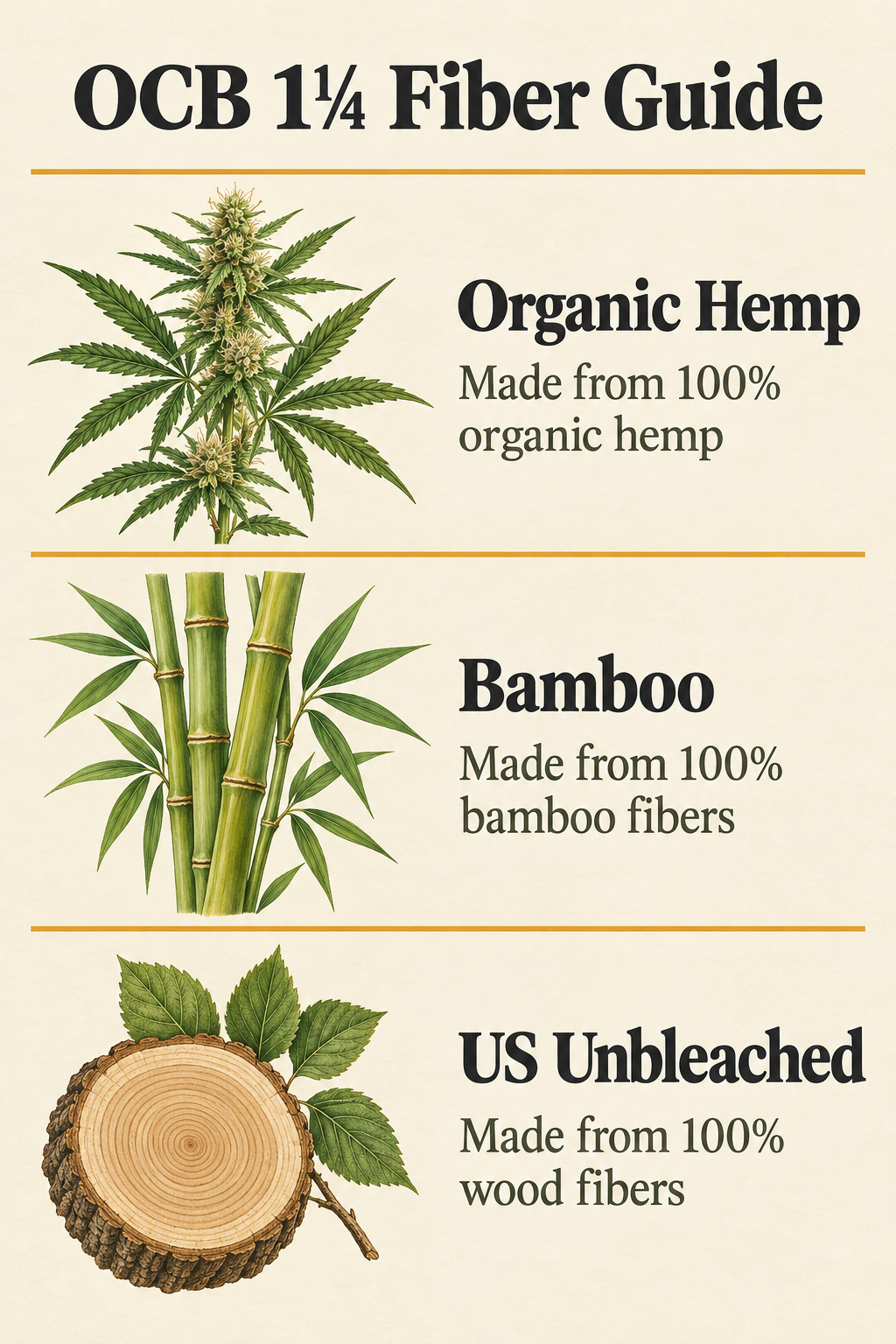
Choose OCB rolling papers by fiber, size and pack contents. Organic Hemp uses organic hemp, Bamboo uses bamboo, and the reviewed US Unbleached papers use wood fibers. All three reviewed 1¼ booklets list the same sheet size and leaf count. If a pack says Virgin, check its regional specifications before matching it to a US Unbleached product. [1] [2] [3]
OCB’s international site uses Virgin for a brown, ultra-thin, unbleached range. The US pages reviewed here use Unbleached. This guide compares the documented US 1¼ products, then explains Slim sizes and packs with tips. It does not assume that every regional Virgin listing has the same specifications. [4]
What do Organic Hemp, Virgin and Bamboo mean on OCB papers?
Organic Hemp and Bamboo name two different fiber choices. OCB USA describes Organic Hemp as 100% organic hemp grown in Champagne, France. Its Bamboo page specifies 100% bamboo. Both reviewed 1¼ products are described as ultra-thin and unbleached, so those shared labels do not separate the materials. [1] [2]
Virgin is where regional names can make shopping less clear. OCB’s international Green Spirit overview describes Virgin as brown, ultra-thin and unbleached. The verified US Unbleached 1¼ page gives a more specific material statement: 100% wood fibers from responsibly managed forests. That supports a comparison with that US product, not a promise that every item labeled Virgin has the same details. [4] [3]
Think of the range name as a starting point. You still need the material statement, size and format to know what you are buying. A brown sheet is not enough information to decide between hemp, bamboo and wood fiber, and a familiar brand name does not settle the booklet count.
Product names can also describe a different format from the loose sheets compared here. For example, Houseplant by OCB Cones – Bamboo / 8pc / Mini 32ct is a cone listing, not one of the three US 1¼ paper booklets in this guide. Do not carry the booklet dimensions or leaf counts over to it just because OCB and Bamboo appear in its name.
Read the package in the order below. If a listing leaves out the fiber or format, check that detail before ordering. A similar-looking pack may belong to a different range or contain a different product.
- Find the full range name, such as Organic Hemp, Bamboo, Virgin or US Unbleached.
- Read the stated fiber. Look for hemp, bamboo or wood rather than guessing from the paper color.
- Read unbleached as a separate description, not as the name of a fiber.
- Check the market, size and exact format so a regional name does not hide a product difference.
How do OCB Organic Hemp, Bamboo and US Unbleached papers compare?
Comparing the same size makes the differences easier to see. The reviewed US Organic Hemp, Bamboo and Unbleached 1¼ pages all list 44 mm × 77 mm sheets, 50 leaves per booklet and natural acacia gum. The table below is limited to those exact products. [1] [2] [3] Related reading: Houseplant by OCB Papers + Tips – Brown Rice /50pc/ 1 1/4" 24ct.
The main material difference is straightforward. Organic Hemp lists organic hemp, Bamboo lists bamboo, and US Unbleached lists wood fibers. If you want a certain fiber, that part of the label gives you a direct answer. Shared dimensions mean you do not have to switch sheet size just to choose a different material among these three booklets.
The listed paper weight also changes. Organic Hemp and Bamboo each state 14 g/m², while US Unbleached states 12 g/m². This measure, often called basis weight, tells you the mass of paper per unit of area. It is not the weight of the whole booklet or the weight of one finished sheet. [1] [2] [3]
Basis weight is not a measured thickness or a burn-time score. The reviewed pages do not provide a head-to-head rolling test either. Use the number as a paper specification, not as proof that a lower-weight sheet will suit you better.
OCB’s international Organic Hemp page describes that range as slow burning, and the US Bamboo page describes Bamboo as slow and straight burning. Those are manufacturer descriptions, not a controlled comparison of the three options. They do not establish which one burns longest. [7] [2]
For wider material context, read What Are Hemp, Rice, and Wood Pulp Rolling Papers Made Of?. If size terms are the confusing part, What Are Rolling Paper Sizes and Which One Should I Use? covers that separate buying decision. Keeping those questions apart helps you compare an exact pack instead of letting a broad label stand in for all of its specifications.
- Fiber differs: organic hemp, bamboo and wood are the documented choices in this comparison.
- Sheet dimensions match: all three reviewed US 1¼ products list 44 mm × 77 mm.
- Booklet counts match: each reviewed 1¼ booklet lists 50 leaves.
- Basis weight differs: Organic Hemp and Bamboo list 14 g/m²; US Unbleached lists 12 g/m².
- Gum matches: all three list natural acacia gum, so it is not a deciding difference here.
| Verified US 1¼ product | Stated fiber | Sheet size | Leaves per booklet | Basis weight | Gum |
|---|---|---|---|---|---|
| Organic Hemp | 100% organic hemp | 44 mm × 77 mm | 50 | 14 g/m² | Natural acacia gum |
| Bamboo | 100% bamboo | 44 mm × 77 mm | 50 | 14 g/m² | Natural acacia gum |
| Unbleached | 100% wood fibers | 44 mm × 77 mm | 50 | 12 g/m² | Natural acacia gum |
Should you choose OCB 1¼ or Slim rolling papers?
Choose between these documented sizes by the sheet dimensions you want. The three reviewed US 1¼ products list 44 mm × 77 mm. The US Unbleached Slim page lists 44 mm × 109 mm, so that Slim sheet is longer while its listed width is the same. [1] [2] [3] [5] Related reading: 50CT DISPLAY – RAW Classic Double Wide Rolling Papers – 34pc.
The booklet count changes with those formats, too. US Unbleached 1¼ lists 50 leaves, while US Unbleached Slim lists 32. OCB’s international Organic Hemp page also documents 44 mm × 109 mm Slim sheets with 32 leaves and 44 mm × 77 mm 1¼ sheets with 50 leaves. These are product-specific details, not size rules for every brand. [3] [5] [7]
If you already have a format you like, compare its printed dimensions with the new listing. Check both length and width. Measurements are more precise than a size name such as Slim, especially when you move between brands or regional listings.
You do not need to choose a fiber and a size at the same time. First decide whether you want hemp, bamboo or the documented wood-fiber option. Then check which dimensions the exact product offers. The research here does not establish Bamboo Slim dimensions, so do not copy the Organic Hemp or Unbleached Slim figures onto a Bamboo listing.
Treehouse Lifestyle’s Rolling category is a place to check current listing details. Read the product page rather than assuming every manufacturer format appears there. A guide can explain the documented size choices without promising that a specific pack is available when you shop.
- Reviewed US 1¼ booklets: 44 mm × 77 mm sheets and 50 leaves for Organic Hemp, Bamboo and Unbleached.
- Reviewed US Unbleached Slim: 44 mm × 109 mm sheets, 32 leaves and a listed basis weight of 12 g/m².
- International Organic Hemp Slim: the range page documents 44 mm × 109 mm sheets and 32 leaves.
- Any different listing: check its own dimensions and count, especially when the market or format changes.
Do OCB paper booklets include tips, and what other formats are available?
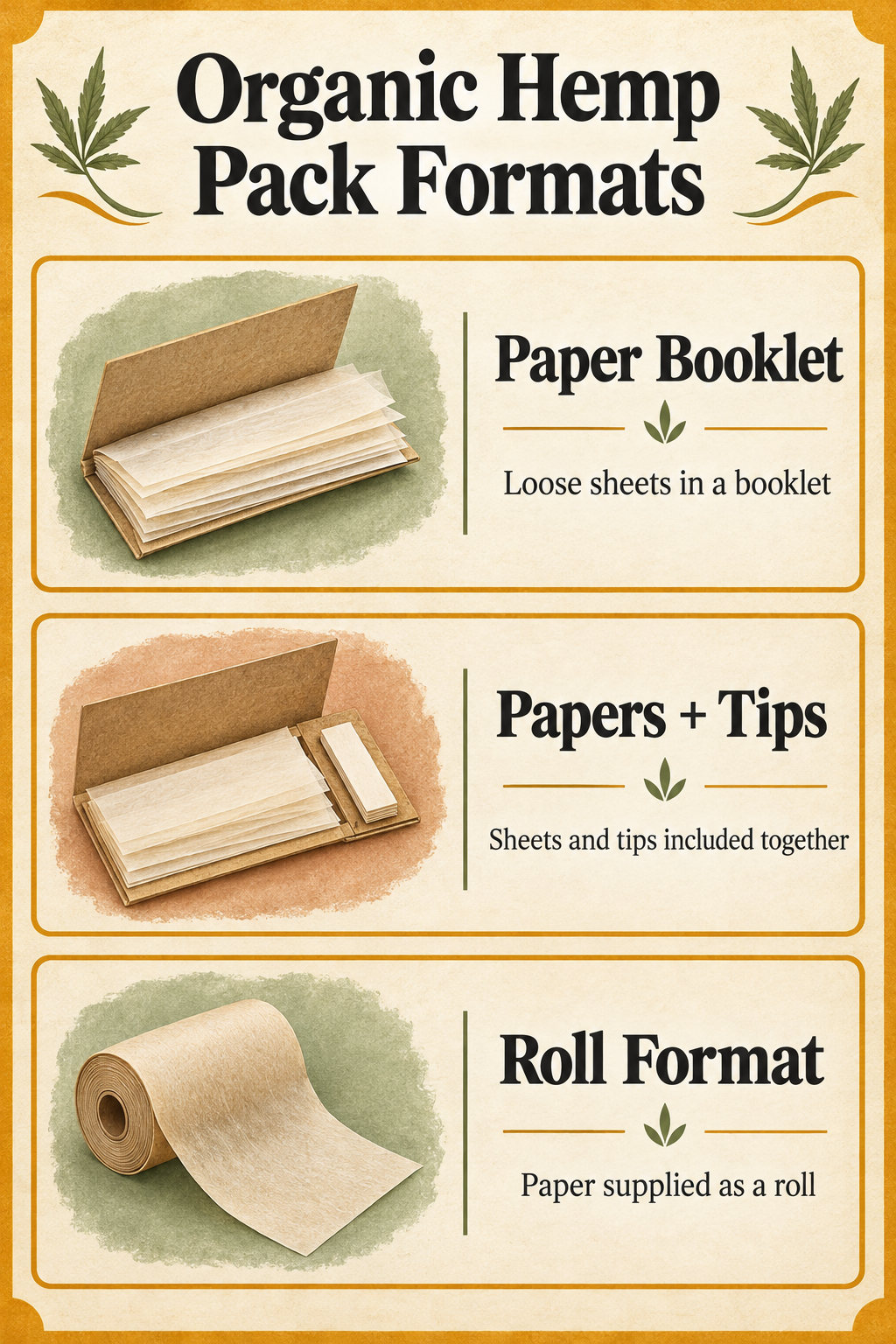
Do not assume a paper booklet includes tips. OCB USA lists Organic Hemp 1¼ Papers + Tips as a separate product with 50 leaves and 50 tips per booklet. The ordinary Organic Hemp 1¼ page lists 50 leaves but does not list included tips. An explicit + Tips label is a better buying cue than the range name alone. [6] [1]
This is a pack-content choice, not a change from hemp to another fiber. Someone who wants papers and tips in the same booklet should check for both counts. Someone who only wants paper sheets should still read the exact contents rather than assuming all Organic Hemp packaging is identical.
OCB’s international Organic Hemp range page documents loose-sheet booklets, booklets with tips and a roll format. The roll is described as approximately 4 m long and 44 mm wide. It is a separate paper format, not a booklet with a stated leaf count. [7]
That distinction matters when comparing packs. A booklet supplies a listed number of sheets at a stated size, while the documented roll is described by length and width. Do not turn the roll length into a sheet count without knowing what cut length would be used. The manufacturer page does not give one universal booklet-equivalent count.
The international range also shows what the manufacturer offers, not what every retailer sells. It does not prove that Treehouse Lifestyle carries all those formats, or that Bamboo and US Unbleached come in every format shown for Organic Hemp. Keep the material, format and retailer listing separate as you narrow the choice.
Before ordering, look for a written contents statement. If the title, photo and description do not make tip inclusion clear, confirm the exact pack. Do not rely on a feature shown on a different version of the same range.
- Ordinary paper booklet: the reviewed Organic Hemp 1¼ listing states 50 leaves without listing included tips.
- Papers + Tips booklet: the reviewed Organic Hemp 1¼ version explicitly lists 50 leaves and 50 tips.
- Organic Hemp roll: the international range page describes approximately 4 m of paper at 44 mm wide, not a fixed count of leaves.
What do OCB’s gum and packaging descriptions tell you?
Fiber, gum and packaging describe different parts of a product. Fiber tells you what the paper is made from. Gum describes the adhesive strip. Packaging describes the booklet or other outer materials, not the composition of the paper sheet itself.
The verified US Organic Hemp, Bamboo and Unbleached 1¼ pages all specify natural acacia gum. OCB’s international materials overview explains that acacia gum is also called arabic gum. Seeing those two names does not, by itself, establish that the products use different adhesive types. [1] [2] [3] [4]
Because the three reviewed products share this gum description, it does not identify a winner between them. The supplied pages do not give a head-to-head adhesive test. Choose on the differences that are documented rather than adding a performance claim to a shared ingredient.
OCB says its Organic Hemp packaging uses recycled materials and vegetable-based inks. Keep that statement tied to the documented Organic Hemp range. It does not establish that Bamboo or US Unbleached packaging has the same features, and it is not a full comparison of the environmental impact of the three lines. [7]
If you want more context on fiber labels, see Hemp Rolling Papers vs Regular: What’s Actually Different?. For this purchase, the useful habit is to ask which part of the pack each statement describes. A packaging claim does not change the sheet dimensions, and an organic-hemp description does not tell you whether tips are included.
A documented packaging feature can matter to your choice without proving an overall environmental ranking. Compare the specific statements available for each product. Where a page gives no packaging details, leave that point unknown rather than borrowing a claim from another OCB range.
- Paper fiber: compare the stated organic hemp, bamboo or wood fibers for the exact product.
- Gum: the three reviewed US 1¼ products share the natural acacia gum description.
- Packaging: recycled materials and vegetable-based inks are documented for the international Organic Hemp range, not established here for all three lines.
How can you choose an OCB paper that matches your preferences?
Start with a preference you can name. If you want paper made from organic hemp, the documented Organic Hemp line fits that material choice. If you want bamboo, choose a listing that states bamboo. If you want the reviewed wood-fiber option, check the US Unbleached listing rather than relying on the word brown. [1] [2] [3] Related reading: What Are the Best Flavored Rolling Papers for a Smooth Smoke?.
Next, decide what needs to stay the same as a pack you already use. You might want the same sheet dimensions but a different fiber. Among the three reviewed US 1¼ products, the listed dimensions and leaf counts match, so those specifications do not force a choice between the materials.
Or you might want a longer sheet and tips included in the pack. Those are two separate requirements. Check dimensions first, then check the contents of that exact format. Do not assume a Slim label implies tips or that a + Tips label implies a particular sheet length.
The listed basis weight can be part of your comparison, but it should stay in its proper role. The reviewed 1¼ Organic Hemp and Bamboo papers list 14 g/m²; US Unbleached lists 12 g/m². That is a specification difference, not proof that one is easier to roll or performs better. [1] [2] [3]
These sources do not establish one best OCB paper for everyone. Use your material, size and pack-content preferences to narrow the choice. The sequence below turns those preferences into features you can check on a product page.
For example, a clear brief might be organic hemp, 1¼ dimensions, and tips included. The reviewed Organic Hemp 1¼ Papers + Tips listing documents those features. That is a match to the brief, not a claim that it beats Bamboo or Unbleached for every reader. [6]
- Choose the stated fiber you want: organic hemp, bamboo or the documented US wood-fiber option.
- Choose dimensions, using the exact product measurements rather than a size name alone.
- Check the leaves per booklet so the pack count matches your expectations.
- Decide whether tips must be included and look for an explicit contents statement.
- Confirm the full regional product name before matching it to the specifications in this guide.
What should you check before buying OCB rolling papers online?
Your final check should focus on the exact offer, not just the product family. A manufacturer page may describe one booklet and also give a display quantity. Those are different counts. OCB USA’s Organic Hemp 1¼ listing states 50 leaves per booklet and 24 booklets per display, but that does not tell you which sales unit a retailer’s offer includes. [1]
Keep sheet count, booklet count and tips count in separate columns when comparing offers. A title with more than one number can be hard to read at a glance. The useful question is what each number counts, not which listing has the largest number in its name.
The same care applies to price comparisons. Before comparing two displayed prices, confirm whether each offer is for a single booklet, several booklets or another sales unit. This guide does not supply current prices or stock levels, so it cannot tell you which live offer costs less.
If a label is unclear, use the material and size guides linked above to check the term. Then return to the offer and confirm its contents. A paper range tells you only part of what is in the pack; dimensions, sheet count and included tips complete the picture.
Finally, check availability on the listing you intend to buy. A format on OCB’s international website establishes that manufacturer’s documented range, not current Treehouse inventory. If a retailer uses Virgin while a source uses Unbleached, ask for the exact material and format details rather than treating the names as a complete match. [4] [7]
- Match the full range name to the stated fiber, including any regional naming difference.
- Confirm the sheet dimensions for that exact format.
- Check leaves per booklet instead of applying the 1¼ count to every OCB pack.
- Confirm whether tips are explicitly included and how many are listed.
- Identify the sales unit: one booklet, multiple booklets, a display or another stated format.
- Review the listing’s current availability and price before placing the order.
Frequently Asked Questions
Are OCB Organic Hemp and Bamboo both unbleached?
Is OCB Virgin the same name as OCB Unbleached?
How many sheets are in an OCB booklet?
Do all OCB Organic Hemp booklets include tips?
Does a lower listed paper weight mean OCB papers burn longer?
Which OCB pack fits the material and format you want?
Choose Organic Hemp for a documented organic-hemp fiber preference, Bamboo for bamboo, or the reviewed US Unbleached product for wood fibers. If a listing uses Virgin, check its exact specifications instead of assuming the regional name settles every detail. [1] [2] [3] [4]
Then finish the decision with sheet dimensions, leaves per booklet and included tips. The material comparison and size guide linked above can help you sort out unfamiliar terms. A clearly described pack that fits your preferences is a more useful goal than a winner based on color, a paper-weight number or an untested performance claim.
Sources
- OCB USA / Republic Brands: Organic Hemp 1¼ Rolling Papers
- OCB USA / Republic Brands: Bamboo 1¼ Rolling Papers
- OCB USA / Republic Brands: Unbleached 1¼ Rolling Papers
- OCB: Green Spirit | Sustainability inspired by nature
- OCB USA / Republic Brands: Unbleached Slim Rolling Papers
- OCB USA / Republic Brands: Organic Hemp 1¼ Rolling Papers + Tips
- OCB: Organic Hemp | Sustainable, Natural & Vegan Paper