
Hemp rolling papers are made from fibers of the industrial hemp plant (Cannabis sativa). ‘Regular’ rolling papers in most brand listings mean traditional wood pulp sheets — usually unbleached or lightly bleached. Hemp sits in the middle on weight, texture, and burn rate: heavier and easier to grip than ultra-thin rice paper, thinner and slower-burning than classic wood pulp.[1][2]
Unbleached hemp skips the chlorine step used on many white wood pulp sheets. Most major brands seal every sheet with a gum arabic strip you lick to stick. Hemp papers are sold in the same booklet sizes as wood pulp and rice papers, so the main choice is the material itself, not the dimensions.
What Are Hemp Rolling Papers Made Of?
Hemp rolling papers start as fibers pulled from the stem of the industrial hemp plant. The plant is a variety of Cannabis sativa grown for its fiber rather than its flower. After harvest, the woody core is broken down and the long outer fibers — called bast fibers — are separated, cleaned, and pressed into thin sheets of paper.[2]
Those bast fibers hold a lot of cellulose, which is the building block of paper. Dried hemp stem fiber is about 57% cellulose. Wood, by comparison, runs about 40–50% cellulose. Hemp also has much less lignin — about 5–24%, versus 20–35% in wood. Lignin is the stiff, glue-like compound in wood that makes paper yellow and brittle over time, so lower lignin helps sheets stay flexible.[2]
Hemp fibers are also much longer than wood fibers — about four to five times longer on average. Longer fibers lock together more tightly when formed into a sheet, which is why hemp paper can be made thin without falling apart. That strength lets hemp rolling papers hit the middle of the weight range and still tear less easily than very thin rice sheets.
If you want to see what unbleached hemp sheets look like in person, the Treehouse Lifestyle Hemp Rolling Papers subcategory carries a few different brands so you can compare texture and color side by side.Hemp Rolling Papers
- Hemp paper is made from bast fibers of industrial hemp (Cannabis sativa), pressed into thin sheets.
- Hemp stems are about 57% cellulose, compared with 40–50% in wood — more cellulose means stronger paper at lower weights.
- Hemp has only 5–24% lignin, versus 20–35% in wood, which is part of why hemp sheets stay more flexible.
- Hemp fibers are roughly four to five times longer than wood fibers, so the sheets hold together even when thin.
What Does ‘Regular’ Rolling Paper Actually Mean?
In the rolling paper trade, the words ‘regular’ and ‘classic’ usually point to the oldest and most common material: wood pulp. These are the papers most people picture when they think of a standard rolling paper booklet — usually a thin off-white sheet with a slight texture and a straight gum strip along one edge.[1]
Wood pulp papers are sometimes bleached white, sometimes left unbleached for a natural tan look, and sometimes dyed in colors. Bleached wood pulp papers often go through a chlorine or peroxide treatment to lighten the natural brown color of wood fiber. Major wood pulp brands include the long-running Zig-Zag line, which is made from a blend of wood pulps and has been on the market for over a century.[6]
When a brand listing says ‘regular’ next to ‘hemp,’ ‘rice,’ or ‘flax,’ it is the trade shorthand for ‘the wood pulp version.’ Shoppers who want the original, thicker, easier-to-grip sheet usually pick the regular option. Shoppers who want something thinner, slower-burning, or plant-based usually pick hemp or rice.
For a real example of what a ‘classic’ wood pulp product looks like on the shelf, the RAW Black Classic Inside Out Rolling Papers | King Size Slim | 50pk Display is a wood pulp sheet pressed very thin with the gum on the inside — a popular regular-paper pick.RAW Black Classic Inside Out Rolling Papers | King Size Slim | 50pk Display
- ‘Regular’ or ‘classic’ rolling paper usually means unbleached or lightly bleached wood pulp.
- Wood pulp papers are the original, most traditional rolling paper material.
- Bleached white wood pulp papers often go through chlorine or peroxide treatment to lighten the natural wood color.
- Unbleached wood pulp papers skip the bleaching step and keep a natural tan color.
How Do Hemp and Wood Pulp Papers Compare in Weight, Texture, and Burn?
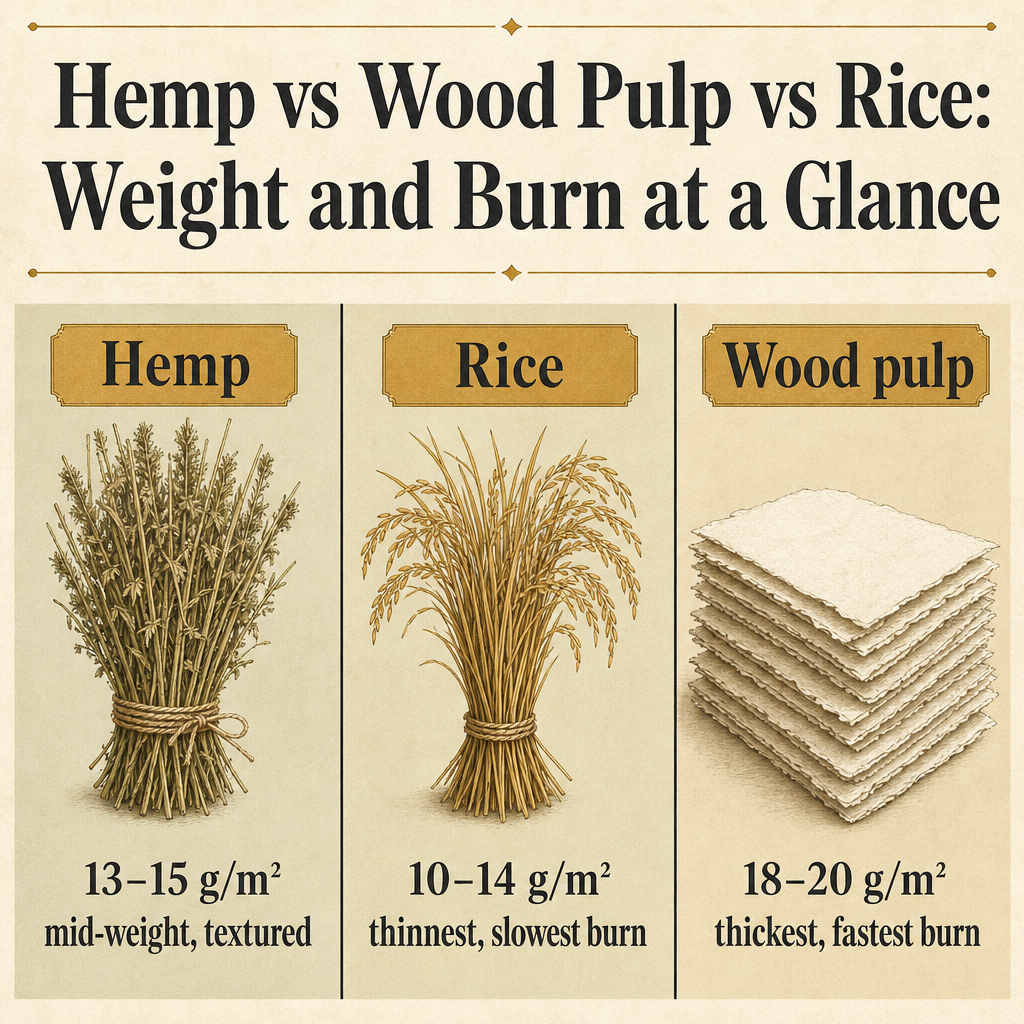
On weight, hemp papers usually run around 13–15 grams per square meter (g/m²). Wood pulp papers are heavier at about 18–20 g/m², and rice papers are the lightest at about 10–14 g/m². A lower number means a thinner sheet. So in the hand, rice feels almost transparent, hemp feels like a normal thin sheet of paper, and wood pulp feels stiffer and more like a small card.[6]
On texture, hemp papers have a soft, slightly toothy surface. The natural fiber pattern grips well while you shape the roll, which is why most retailers describe hemp as the easiest material for beginners. Wood pulp papers also have grip, but they feel thicker and a bit stiffer in the fingers. Rice papers are smooth and almost slippery — they need a steady hand to roll cleanly.
On burn, hemp sits in the middle. Wood pulp papers burn fastest because the sheet is thicker and the fiber releases material more quickly. Rice papers burn slowest because the sheet is so thin there is less paper to burn. Hemp papers burn slower than wood pulp and a little faster than rice, which gives a steady, even burn line for most users.[1][6]
On flavor, hemp papers have a mild, slightly earthy taste that most people barely notice. Wood pulp papers have a more neutral, papery taste. Rice papers have almost no taste at all because the sheet is so thin. None of these materials is meant to add flavor — that comes from what you put inside the roll.
If you want a deeper breakdown of these three materials side by side, the Treehouse Lifestyle guide What Are Hemp, Rice, and Wood Pulp Rolling Papers Made Of? walks through each one in plain language.What Are Hemp, Rice, and Wood Pulp Rolling Papers Made Of?
- Hemp papers: about 13–15 g/m², mid-weight, soft texture, even burn, mild earthy flavor.
- Rice papers: about 10–14 g/m², lightest, smooth texture, slowest burn, almost no flavor.
- Wood pulp papers: about 18–20 g/m², thickest, easy grip, fastest burn, neutral flavor.
- Hemp is the easiest for beginners because the textured surface holds material in place while you roll.
| Material | Weight (g/m²) | Texture | Burn rate | Flavor |
|---|---|---|---|---|
| Hemp | 13–15 | Soft, lightly textured, easy grip | Middle — steadier than wood pulp | Mild, slightly earthy |
| Wood pulp ("regular") | 18–20 | Thicker, stiffer, grippy | Fastest of the three | Neutral, papery |
| Rice | 10–14 | Smooth, almost slippery | Slowest of the three | Almost none |
Are Hemp Papers Unbleached, and What Is the Gum Strip?
Most hemp papers sold today are unbleached. That means the manufacturer skips the chlorine step used on many white wood pulp papers and keeps the natural light brown color of the hemp fiber. Unbleached papers can still be cleaned and pressed with hydrogen peroxide, which lightens the sheet without chlorine bleach, but they are usually sold in the natural color range.[1][3]
Why skip the bleach? Standard paper bleaching with chlorine compounds can leave behind small amounts of organochlorine by-products, including dioxins and furans, in the finished product. These are well-known industrial residues that manufacturers avoid when they can. Hemp’s natural light color means the paper does not need much bleaching to begin with, so most hemp rolling paper makers go with an unbleached sheet.[1]
Now for the gum strip. Almost every rolling paper booklet has a thin adhesive band along one edge that you lick to seal the roll. The most common adhesive used by major rolling paper brands is gum arabic. Gum arabic is a natural, water-soluble gum harvested from Acacia senegal and Vachellia seyal trees, which grow across the Sahel region of Africa. The hardened sap is collected, sorted, and milled into a powder that paper makers dissolve in water and apply as a thin band along the paper edge.[4]
Gum arabic holds FDA GRAS (Generally Recognized As Safe) status under 21 CFR 184.1330, which is the U.S. Food and Drug Administration’s food-safety designation for ingredients that have a long safe history of common use. That is why gum arabic also shows up in candy, soft drinks, and many other everyday products. A few manufacturers use polyvinyl alcohol (PVA) as the adhesive instead, especially on transparent cellulose papers — but gum arabic is by far the most common on hemp, wood pulp, and rice sheets.[4]
If you store your papers somewhere dry, the gum strip stays ready to use for years. If the booklet sits in a damp spot, the gum can pre-activate and the strip turns gummy — a good reason to keep rolling papers in a sealed bag or case, similar to the advice in How Do I Choose the Right Cannabis Storage Container?.How Do I Choose the Right Cannabis Storage Container?
- Hemp fibers are naturally light-colored, so most hemp papers skip the chlorine-bleaching step used on some wood pulp sheets.
- Standard chlorine bleaching of paper pulp can produce organochlorine by-products such as dioxins and furans as industrial residues.
- Hydrogen peroxide is the common alternative bleach for unbleached or ‘virgin’ papers.
- The gum strip on most papers is gum arabic, harvested from Acacia senegal and Vachellia seyal trees in the Sahel.
- Gum arabic holds FDA GRAS status under 21 CFR 184.1330.
- A few manufacturers use polyvinyl alcohol (PVA) instead of gum arabic, especially on transparent papers.
Which Rolling Paper Sizes Do Hemp Papers Come In?
Hemp papers ship in the same four standard sizes you see on every other rolling paper brand. The booklet sizes are based on the leaf dimensions, and each size holds a different amount of material. Most U.S. brands use the metric sizes below because they match what most pre-rolled cones ship in.[7]
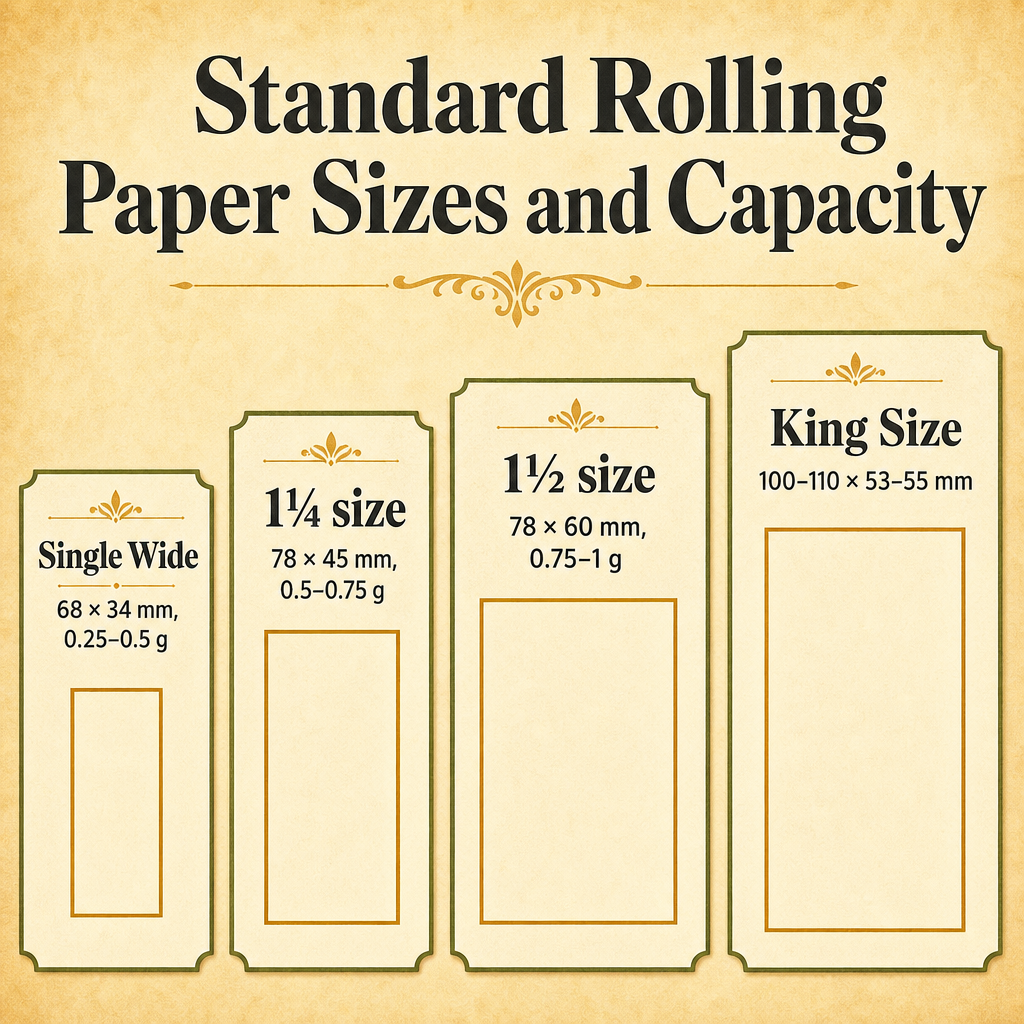
Single Wide is the smallest standard size at about 68 × 34 millimeters. It holds roughly 0.25 to 0.5 grams and is the right pick when you only want a short roll or you are still learning. Some hemp brands make Single Wide packs for samplers and starter bundles.
1¼ size is the global default. It measures about 78 × 45 millimeters and holds 0.5 to 0.75 grams. Most pre-rolled cones you find on the shelf use this footprint, and most hemp brand king-slim packs ship in this size.
1½ size is the in-between pick at about 78 × 60 millimeters. It holds 0.75 to 1 gram and gives you a wider roll without jumping all the way up to king size.
King Size is the largest standard booklet at about 100 to 110 millimeters long and 53 to 55 millimeters wide. It holds the most material and is the right pick when you want a long roll. Hemp papers are sold in all four of these sizes by major brands.
If you want a full walkthrough of which size fits which use case, see What Are Rolling Paper Sizes and Which One Should I Use? for a side-by-side comparison of dimensions and capacity.What Are Rolling Paper Sizes and Which One Should I Use?
- Single Wide: about 68 × 34 mm, holds 0.25–0.5 g — smallest standard size.
- 1¼ size: about 78 × 45 mm, holds 0.5–0.75 g — the global default used by most pre-rolled cones.
- 1½ size: about 78 × 60 mm, holds 0.75–1 g — wider roll without going to king size.
- King Size: about 100–110 × 53–55 mm — largest standard size for longer rolls.
- Hemp papers are sold across all four standard sizes by major brands.
Which Well-Known Brands Focus on Hemp vs Wood Pulp vs Rice?
A few brands have built their whole identity around hemp paper. RAW is the most well-known hemp-focused brand. RAW was founded in 1995 by Josh Kesselman, and in 2005 he launched the first commercially available ‘vegan,’ unbleached rolling papers. As of 2023, RAW’s Organic Hemp line is made in Benimarfull, in the Alicante province of Spain, from unbleached certified organic hemp that is milled in Southern France. Forbes reported in 2025 that RAW is the #1 total-dollar brand in the U.S. rolling papers and accessories category.[5]
Other hemp-focused brands include Hornet, which sells a wide range of unbleached hemp booklets and cones, and Juicy Jay’s, which makes flavored hemp papers in many flavor options. Both lean on the same basic unbleached hemp sheet as RAW and tweak the gum, the flavoring, or the booklet design.
Wood pulp-focused brands are the longest-running in the trade. Zig-Zag has been making rolling papers since 1894 and is famous for its classic wood pulp booklet with the orange pack. Most of the historic European rolling paper houses — including Rizla and JOB — started with wood pulp sheets and have kept wood pulp as a major part of their line, even as they’ve added rice and hemp products over time.[6]
Rice paper brands tend to be newer. Elements is the most visible rice paper brand and is known for its thin, slow-burning rice sheets and minimalist packaging. Rizla also makes a ‘Ultra Thin’ line using rice straw. Most rice brands combine rice straw with other plant fibers to keep the sheet strong at very thin weights.
To browse a mix of brands across all three materials, the Rolling Papers subcategory at Treehouse Lifestyle carries wood pulp, hemp, and rice options from major manufacturers so you can try a few and see which material fits your style.Rolling Papers
- Hemp-focused brands: RAW (Organic Hemp line made in Spain from French-milled organic hemp), Hornet, Juicy Jay’s.
- Wood pulp-focused brands: Zig-Zag (since 1894), Rizla, JOB — the longest-running rolling paper makers.
- Rice-focused brands: Elements (thin rice sheets, minimalist packaging), Rizla Ultra Thin line.
- Most major brands now sell at least one option in each material, so brand choice no longer locks you into one material.
Frequently Asked Questions
Are hemp rolling papers harder or easier to roll than wood pulp papers?
Most retailers describe hemp sheets as the easiest material for beginners because the textured surface grips well while you shape the roll. Wood pulp sheets are also grippy but thicker, so they feel stiffer in the fingers.
Are hemp rolling papers healthier or safer than regular papers?
Elemental composition of rolling papers is largely unregulated in most jurisdictions, and a 2024 peer-reviewed ACS Omega study of 53 commercial products found copper, chromium, and vanadium at potentially problematic levels for frequent users in some papers. Unbleached hemp papers skip the chlorine-bleaching step used on many white wood pulp sheets, which avoids chlorine-bleach residues, but no paper type has been shown to be ‘safe’ to inhale.
What’s the difference between hemp rolling papers and hemp wraps?
‘Hemp’ in a rolling-paper context usually means a thin sheet pressed from long hemp bast fiber. Products marketed as ‘hemp wraps’ or ‘blunt wraps’ are often made from ground whole-plant hemp rather than pressed fiber sheet, so not every product labeled ‘hemp’ is a typical rolling paper.
Do all rolling papers use the same adhesive strip?
Most major manufacturers use gum arabic — a water-soluble natural gum harvested from Acacia senegal and Vachellia seyal trees — which holds FDA GRAS status. Some manufacturers use polyvinyl alcohol instead, so it is worth checking the pack if the adhesive matters to you.
Are rice papers thinner than hemp papers?
Yes. Rice papers run around 10–14 g/m², hemp papers run around 13–15 g/m², and wood pulp papers run around 18–20 g/m², which is why rice sheets are the most translucent and wood pulp sheets are the thickest.
So Which Rolling Paper Should You Pick?
The choice between hemp and regular really comes down to three things: weight, texture, and how the paper burns. Hemp papers are the middle ground — about 13–15 g/m², with a soft grippy surface and an even burn rate. Wood pulp papers are thicker and burn faster. Rice papers are the thinnest and burn the slowest. None of these materials is ‘better’ across the board — each one fits a different rolling style.
If you are just starting out, hemp is usually the easiest sheet to roll because the textured surface holds material in place while you shape the roll. If you want the original classic feel, wood pulp is the traditional pick. If you want the thinnest sheet and the slowest draw, rice is the right material. Hemp papers are sold in all four standard booklet sizes — Single Wide, 1¼, 1½, and King Size — so you can stick with whatever size you already use and just switch the material.
For shoppers looking to try a few materials, the Treehouse Lifestyle Rolling Papers subcategory carries hemp, wood pulp, and rice options from major brands, with free shipping on orders $150+ across the site.
Sources
- Wikipedia (Rolling paper): Rolling paper
- Wikipedia (Hemp paper): Hemp paper
- ACS Omega (peer-reviewed journal article, open access via PubMed Central): Elemental Composition of Commercially Available Cannabis Rolling Papers (Wright et al., 2024)
- Wikipedia (Gum arabic): Gum arabic
- Wikipedia (RAW rolling papers): RAW (rolling papers)
- Zig-Zag (rolling paper manufacturer): Which Rolling Paper Material Is Right for You? Rice, Wood, and Hemp Compared
- MunchMakers: Rolling Paper Sizes: Single Wide vs 1 1/4 vs King Size