

In a 2 piece vs 4 piece grinder comparison, choose a 2-piece grinder for simple grinding, easy carrying, and quick cleaning. Choose a 4-piece grinder if you want a screen and lower chamber that collect fine particles separately. Grind quality depends more on the teeth, machining, materials, and fit than on the number of pieces.
What Is a 2-Piece Grinder and How Does It Work?
A 2-piece grinder is the simplest grinder design on the market. It uses two parts: a magnetic lid on top and a single grinding chamber on the bottom. [1] The lid has teeth on its underside, and the base has matching teeth that line up when you close the grinder. As you twist the lid, the teeth pass each other and break down the material placed between them. The ground material simply falls back into the same chamber where you loaded it, ready to scoop out when you finish. [3]
Because there is no screen and no separate chamber, the grinder is physically smaller and lighter than a 4-piece version of the same diameter. There are fewer parts to keep track of, fewer seams to clean, and nothing to disassemble beyond unscrewing the lid. For shoppers who want a grinder that travels well, fits in a small drawer, or slips into a rolling kit without bulk, the 2-piece design is the easier carry. [4]
The trade-off is that you do not get a separate collection chamber. Fine particles stay mixed in with the rest of the grind, and there is no screen layer to separate anything out. [1] If you mainly care about a quick, consistent grind and do not need a dedicated chamber for fine material, a 2-piece grinder covers that routine without the extra weight or steps. It is also usually the lowest-priced design, which makes it a sensible starting point if you are buying your first grinder. [2]
- Magnetic lid: twists onto the base and carries teeth on its underside that do the cutting [1]
- Grinding chamber: the bottom half, with matching teeth that line up with the lid teeth as you twist
- Material handling: ground material stays in the same chamber where you loaded it, with no screen or separate compartment [3]
- Carry and storage: smaller, lighter, and easier to slip into a pocket or small kit than a 4-piece grinder [4]
- Cleaning: only two parts to wipe, with no screen to brush or extra chamber to empty [2]
- Price: typically the most affordable grinder design, often chosen as a first grinder
What Is a 4-Piece Grinder and Why Do People Choose One?
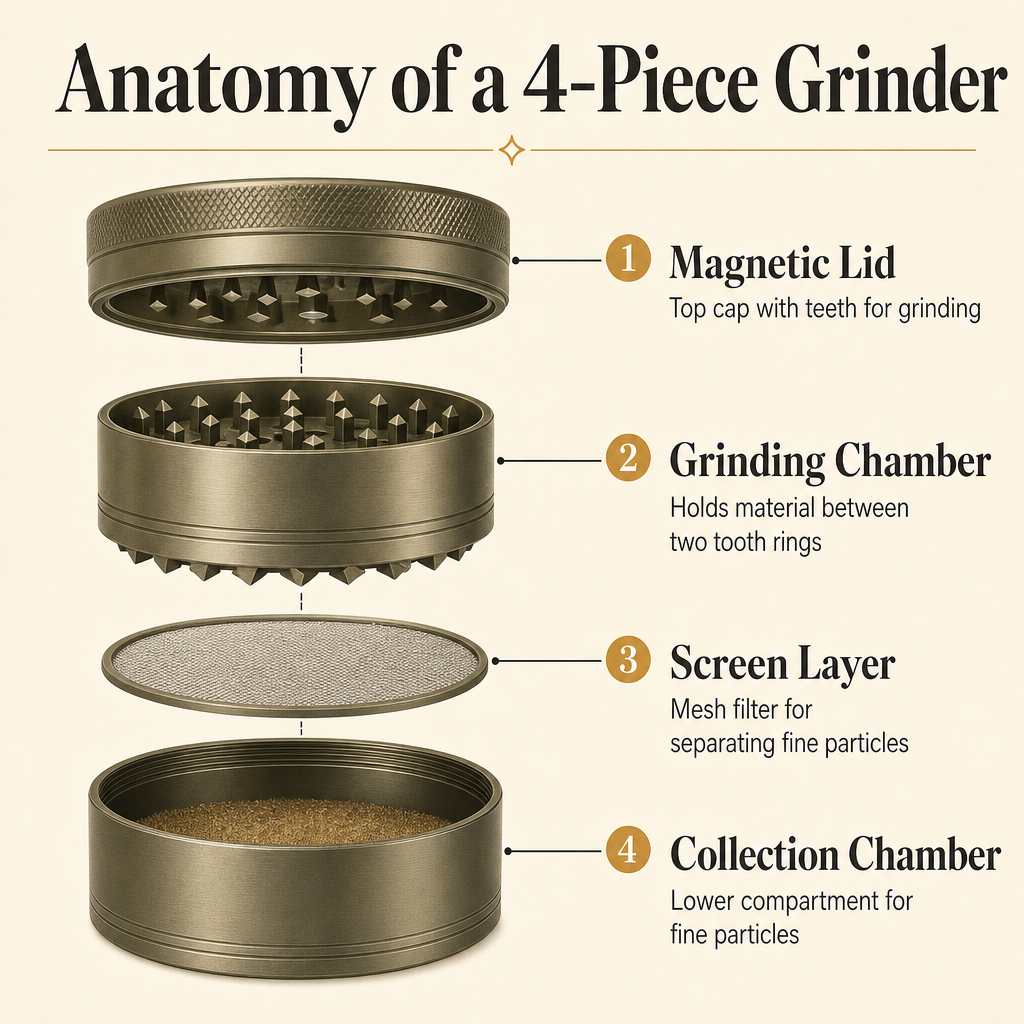
A 4-piece grinder takes the basic 2-piece layout and adds two more layers: a screen section and a collection chamber. The four parts are the magnetic lid, the grinding chamber, a screen layer with a fine mesh, and a lower collection chamber that sits below the screen. [1] As you twist the lid, the teeth break down material in the grinding chamber. When the particles get small enough, they fall through the mesh and collect in the lower chamber, leaving the coarser grind behind above the screen. [3]
The main reason people pick a 4-piece grinder is that screen-based collection. The lower chamber holds the fine particles on their own, so you can scoop out or empty that chamber separately from the main grind. [2] Some users prefer to keep the fine material for later use, while others simply like that the heaviest grind stays in the top and the lightest material drops to the bottom. Either way, the design gives you a built-in separation step without extra tools.
The extra layers also mean more parts, more weight, and more cleaning. A 4-piece grinder is taller than a 2-piece grinder of the same diameter, and clearing the screen takes some care so you do not damage the mesh. [1] Shoppers who want a screened grinder should also look at the screen specification, since some manufacturers offer replacement screens in different sizes and mesh options so you can swap a worn screen without replacing the whole grinder. [5] If you would like a broader look at the full grinder category, our Rolling category and our guide on what to look for when buying a weed grinder cover the rest of the buying decision.
- Magnetic lid: top cap with teeth underneath, just like a 2-piece design [1]
- Grinding chamber: holds material between two tooth rings as you twist the lid
- Screen layer: fine mesh that lets small particles drop through while holding back the coarser grind [3]
- Collection chamber: bottom compartment that gathers fine particles on their own, separate from the main grind [2]
- Emptying: you can open the lower chamber and remove the fine material without disturbing the grind above [1]
- Replacement screens: available from some manufacturers in different sizes and mesh options for screened designs [5]
How Do 2-Piece and 4-Piece Grinders Compare in Daily Use?
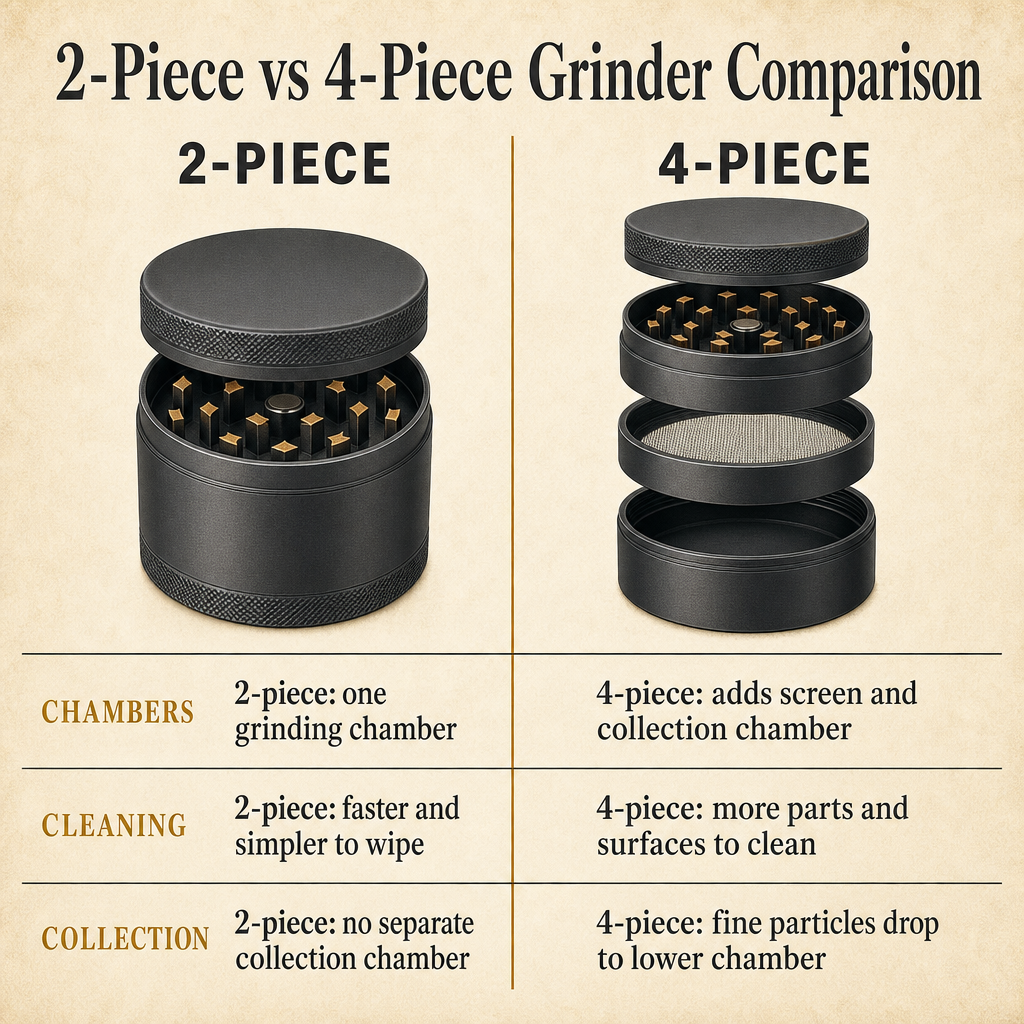
Both grinder designs break down material using the same basic action: teeth on a lid twisting against teeth on a chamber. The practical differences come down to chamber layout, weight, cleaning, and whether you get a separate collection compartment. [2] The comparison below walks through the criteria that tend to matter most when picking between them, so you can match the design to your routine instead of choosing on piece count alone. You can browse the full range of grinder styles on our Grinders page.
Portability is one of the clearest differences. A 2-piece grinder is shorter and lighter because it has fewer layers, so it slips into a pocket or a small rolling kit more easily. [4] A 4-piece grinder of the same diameter is taller and a bit heavier, since the screen and collection chamber add material. For travel kits or small setups, the 2-piece has the edge. For a grinder that mostly stays on a desk, the 4-piece size is usually fine.
Grind consistency is not determined by piece count. Tooth design, machining, how well the parts fit together, and the materials used all matter more than the number of parts. [2] A well-made 2-piece grinder can produce a more even grind than a poorly made 4-piece grinder, and vice versa. Buyers should look at tooth shape, magnet strength, and overall fit rather than rely on piece count as a quality signal. [4]
Collection is where the 4-piece design clearly wins. Only a 4-piece grinder has a screen and a separate lower chamber, so only a 4-piece gives you that built-in fine-particle collection. [1] A 2-piece grinder has no such chamber, so everything stays in the grinding chamber together. [3] If you want to separate fine material from the main grind, the 4-piece is the only layout of the two that does the job.
Cleaning is where the 2-piece design has the edge. With only two parts, you wipe the lid and the chamber and you are done. A 4-piece grinder has more components and more surfaces to maintain, so cleaning takes longer and you need to be careful around the screen. [1] Price tracks similarly: 2-piece grinders are usually the least expensive option, while 4-piece grinders with the same diameter and material cost more because they have more parts. [2]
- Portability: 2-piece is shorter and lighter for travel kits; 4-piece is a bit taller and heavier but stays in one place just fine [4]
- Grind consistency: depends on tooth design, machining, fit, and materials rather than the number of pieces [2]
- Collection: only a 4-piece has a screen and a lower collection chamber for fine particles; a 2-piece has no separate collection step [1]
- Cleaning: 2-piece is faster to wipe down since there are only two parts; 4-piece involves more components and more screen care [3]
- Price: 2-piece is typically the lower-cost option; 4-piece costs more because of the extra screen and chamber [2]
- Learning curve: 2-piece is essentially twist and go; 4-piece asks a little more attention around the screen when emptying and cleaning
| Feature | 2-Piece Grinder | 4-Piece Grinder |
|---|---|---|
| Layout | Lid and one grinding chamber | Lid, grinding chamber, screen, and lower chamber |
| Collection | Fine particles stay with the main grind | Fine particles pass through the screen into a lower chamber |
| Portability | Shorter and lighter | Taller and heavier |
| Cleaning | Fewer parts and faster cleaning | More parts and careful screen cleaning |
| Best fit | Simple routines and travel kits | Separate collection and stationary setups |
How Do You Clean and Maintain Each Grinder Type?
A clean grinder grinds more evenly and lasts longer, but the cleaning routine looks different depending on the design. [1] A 2-piece grinder is the simpler of the two: you only have the lid and the grinding chamber to deal with, so a quick wipe and brush is usually enough. A 4-piece grinder adds the screen and the lower collection chamber, which means more surfaces and a little more time in the routine. [2]
The right tools make both jobs easier. A small stiff brush, a plastic or wooden pick, and a soft cloth handle most routine cleaning. Avoid metal tools on the screen, since they can stretch or tear the mesh. For a deeper clean, isopropyl alcohol works on metal grinders, but you should follow the manufacturer’s instructions and let every part dry fully before reassembly. [1] You can find more accessory cleaning tips in our complete guide to cleaning smoking accessories.
Cleaning frequency should match how often you use the grinder and how quickly material builds up. Brush loose material from the teeth after use, and clean more deeply when the parts become hard to turn or the mesh stops passing fine particles. A 4-piece screen needs extra attention because buildup can block its openings. [1] [2] If the screen gets clogged or damaged, some grinder systems offer replacement screens in different sizes and mesh options. Match the replacement to the grinder model and size before buying. [5]
- Disassemble the grinder fully: unscrew the lid from a 2-piece, or unscrew the lid, grinding chamber, and lower collection chamber from a 4-piece [1]
- Tap out loose material over a tray or sheet of paper so you can collect any leftover grind and keep your workspace clean
- Brush the teeth and the inside of the grinding chamber with a small stiff brush to remove stuck particles [2]
- For a 4-piece, gently brush the screen in a back-and-forth motion — avoid metal tools that can damage the mesh [5]
- Wipe every part with a soft cloth, or soak briefly in isopropyl alcohol for a deeper clean, then air dry fully before reassembly
- Reassemble the grinder, do a dry twist to confirm the parts move smoothly, and store it in a dry place
How Do You Choose the Right Grinder for Your Routine?
The right grinder is the one that matches how you actually use it. Start with how often you grind, whether you want a separate collection chamber for fine particles, and how much cleaning you want to do. Piece count is a useful starting point, but it is not the whole answer. Tooth design, machining, fit, materials, and screen construction all matter just as much. [2]
If you grind occasionally and want the simplest setup, a 2-piece grinder is usually the better match. It weighs less, is easier to empty, faster to clean, and has fewer parts to keep track of. [4] You will not get a separate collection chamber, but you will get a quick, consistent grind with the least maintenance. This is also a sensible pick if you are buying a first grinder and do not want to overthink the choice.
If you grind regularly and want fine particles collected separately, a 4-piece grinder is the more useful design. The screen and lower collection chamber handle the separation step, so your fine material stays on its own and you can empty it without disturbing the main grind. [1] Accept that cleaning takes a few extra minutes and that the grinder is a bit taller and heavier than a 2-piece of the same diameter. [3]
A few practical buying points apply to both designs. Look at tooth shape and quality, magnet strength, how well the parts fit together, and the material of the body. Check whether the manufacturer offers replacement screens in different sizes and mesh options if you are buying a 4-piece, since screen compatibility and mesh specification vary by maker. [5] If you want to round out your setup, our guide on specialty pipes is a useful companion read for picking the rest of your rolling kit. Treehouse Lifestyle offers free shipping on orders $150+, so you can stock up on grinders and accessories in one go.
- Grind frequency: occasional grinders usually do well with a 2-piece; regular grinders often prefer the collection step of a 4-piece [4]
- Collection needs: only a 4-piece has a screen and lower collection chamber for fine particles [1]
- Cleaning tolerance: 2-piece is faster to wipe down; 4-piece takes more time around the screen [2]
- Portability: 2-piece is shorter and lighter for travel kits; 4-piece is better suited to a stationary setup [3]
- Build quality: tooth design, machining, fit, magnet strength, and material matter more than piece count for grind quality [2]
- Replacement parts: check whether the manufacturer offers replacement screens in different sizes and mesh options for a 4-piece [5]
Frequently Asked Questions
Does a 4-piece grinder actually collect material separately from the main grind?
Yes. A 4-piece grinder has a screen layer between the grinding chamber and a lower collection chamber, so fine particles drop through the screen and collect in their own compartment while the coarser grind stays above. You empty the lower chamber on its own without disturbing the main grind. [1]
Is a 2-piece grinder easier to carry and clean than a 4-piece?
A 2-piece grinder is lighter, has fewer parts, and is quicker to empty and wipe down because there is no screen or extra chamber to deal with. A 4-piece grinder has more components and surfaces, so cleaning takes a little longer and you have to be careful around the screen. [2]
Does the number of pieces determine how well a grinder grinds?
No. Piece count describes the chamber layout, not the grind quality. Tooth design, machining, materials, how well the parts fit together, and screen construction all matter just as much, and sometimes more, than whether the grinder is a 2-piece or 4-piece design. [4]
Why do some brands call similar grinders different piece counts?
Grinder terminology is not fully universal. Some manufacturers describe the lid and grinding chamber as two pieces, while others describe the same layout with a screen or collection chamber counted differently. Shoppers should compare the actual chambers and screen rather than rely only on the piece count. [3]
Can you replace the screen on a 4-piece grinder if it gets clogged or damaged?
On many screened designs, replacement screens are available in different sizes and mesh options so you can swap a worn screen without replacing the whole grinder. Match the replacement screen to your grinder model and size, since screen compatibility and mesh specification vary by manufacturer. [5]
Which grinder is better for someone who grinds occasionally and wants the simplest setup?
A 2-piece grinder is usually the better match for an occasional grinder who wants a simple routine. It weighs less, is easier to empty, faster to clean, and has fewer parts to worry about. A 4-piece grinder makes more sense once you want a separate collection chamber for fine particles and do not mind the extra cleaning step. [4]
Which Grinder Should You Pick?
A 2-piece grinder is the right pick if you want the simplest setup, the lightest carry, and the quickest cleaning. It gives you a single grinding chamber with no screen and no separate collection, which is more than enough for many smokers’ routines. [1] It is also typically the most affordable option, which makes it a sensible first grinder for shoppers who do not want to overthink the choice.
A 4-piece grinder is the right pick if you want a screen and a separate collection chamber for fine particles. The extra layers add some weight and a few extra cleaning steps, but they also give you a built-in separation step that a 2-piece simply cannot do. [2] Look for solid tooth design, good fit, and a screen that you can replace if it wears out. [5]
Either way, match the design to your routine rather than choose on piece count alone. A well-made 2-piece grinder beats a poorly made 4-piece grinder, and a sturdy 4-piece grinder is worth the extra cleaning for shoppers who want the collection step. Browse the Grinders collection to compare options, and remember that Treehouse Lifestyle offers free shipping on orders $150+ so you can pick up a grinder and the rest of your rolling kit in one order.
Sources
- DaVinci Vaporizer: Are 4-Piece Grinders Harder to Clean Than 2-Piece Ones?
- Norddampf: 2-piece vs. 4-piece grinder: Is the difference worth it?
- Iaso Goods: 3 Piece vs 4 Piece Herb Grinders – Which is Better for You?
- INHALCO: 4-Piece vs. 2-Piece – Which Grinds Better?
- RYOT / Kannastör: Grinder Screens