
Good vaporizer battery care starts with the manual for your specific device. Use the charger and cable the manufacturer recommends, charge at room temperature on a dry open surface, unplug when the battery is full, and stop using any battery that swells, overheats, leaks, or smells unusual.
What Kind of Battery Does a Vaporizer Use, and Why Does That Matter?
Most modern vaporizers run on rechargeable lithium-ion batteries. Some have a sealed battery pack built into the body. Others use one or more removable cells that can be taken out and placed in a separate charger. These designs can look similar from the outside, but the care steps are not the same. [3]
A sealed pack is charged through a port on the device. Do not open the housing or try to replace the pack unless the maker says the battery is user-serviceable. Opening a sealed device can damage the pack, the wiring, the charging board, or the shell.
A removable cell needs extra attention because its metal ends can touch keys, coins, tools, or other batteries. It also has an outer wrap that should stay intact. If you do not know the cell type, do not guess from size or shape. Check the model manual or the label supplied by the maker.
Battery size alone does not tell you the correct voltage, current, charger, or direction of insertion. The device manual is the best place to find those details because charging systems vary by model. Manufacturer support pages also organize instructions by exact device. [5]
If you are still choosing among Vaporizers, decide whether you want the simple routine of an internal pack or the flexibility of removable cells. How Do You Choose the Right Portable Vaporizer? can also help you compare portable designs before buying. The right choice is the one whose care routine you will follow consistently.
Learn these basic design differences before you charge:
- Sealed internal pack: charge through the device port and follow the maker’s replacement rules.
- Removable cell: inspect the wrap and ends, insert it in the marked direction, and carry it in a case.
- Model-specific system: use only the cable, power input, and charger listed for that device.
- Unknown or unlabeled cell: stop and identify it before charging or installing it.
Which Charger and Cable Should You Use With a Vaporizer?
Lithium-ion charging depends on tightly controlled voltage and current. The correct charger is not simply the one with the largest watt number. Start with the cable, adapter, or removable-cell charger named in the manual. [2]
If the original cable is missing, read the label on the device and its instructions. Match the connector and the supported input. A cable that fits the port is not automatically the right choice. When the manual is unclear, ask the manufacturer rather than testing random adapters.
Check the cable before every charge. Do not use it if the plug is bent, the outer jacket is split, or wires are visible. Look into the charging port under good light. Remove loose surface dust only as directed by the maker, and never force a tool into the port.
Owners who want a broader device overview can read What Is a Vaporizer and How Does It Work?. If you have a pen-style device, What Is a Pen Vaporizer and How Do You Choose the Right One? explains how those compact models differ. Keep charging instructions separate from general cleaning advice; for the rest of the device, see The Complete Guide to Cleaning Smoking Accessories.
For removable cells, use a charger that supports the exact battery type. Insert each cell in the marked direction. Never force a cell into a bay, mix different cell types, or use a cell with a torn wrap. Follow this check before plugging anything in:
- Read the device manual and find the stated charging input.
- Match the connector, cable type, adapter rating, and removable-cell type.
- Inspect the plug, cable jacket, port, charger bay, and battery wrap.
- Place the charger on a dry, open surface where you can check it.
- Connect the cable without bending or forcing the plug.
- Confirm that the normal charging light or screen symbol appears.
How Should You Charge a Vaporizer Battery Day to Day?
You do not need to drain a lithium-ion battery to zero before every charge. These batteries can be topped up before they are empty. A regular top-up that fits your routine is easier than waiting for the device to shut down each time.
Charge while you are awake and able to check the device. Do not make overnight charging your normal habit. When the indicator shows that charging is complete, unplug the cable unless the manual gives different instructions. Keeping a battery at its peak charge voltage longer than needed adds voltage stress. [2]
Switch the vaporizer off while it charges unless the manual clearly allows use while plugged in. Running a portable device during charging can add a second load and interfere with the normal charge cycle. If you need a device that stays in one place, compare Portable vs Desktop Vaporizer: Which Fits Your Routine? before relying on pass-through use.
Pay attention to normal behavior. Learn how long a routine charge usually takes and what the indicator looks like. A charge that suddenly takes much longer, stops and starts, or causes unusual heat is a reason to unplug and check the manual.
Do not cover the vaporizer with clothing, bedding, or a bag while it charges. Keep liquid containers away from it. After charging, pull the plug by its body rather than yanking the cable, then let the device return to its usual temperature before putting it away.
Use this simple daily order:
- Inspect the device, port, cable, and battery before charging.
- Turn the vaporizer off and place it on a dry, open surface.
- Connect the charging gear listed for the model.
- Check the device from time to time while it charges.
- Unplug when the normal full-charge indicator appears.
- Store the cable without tight bends or pressure on either plug.
Where Should You Store and Charge a Vaporizer?
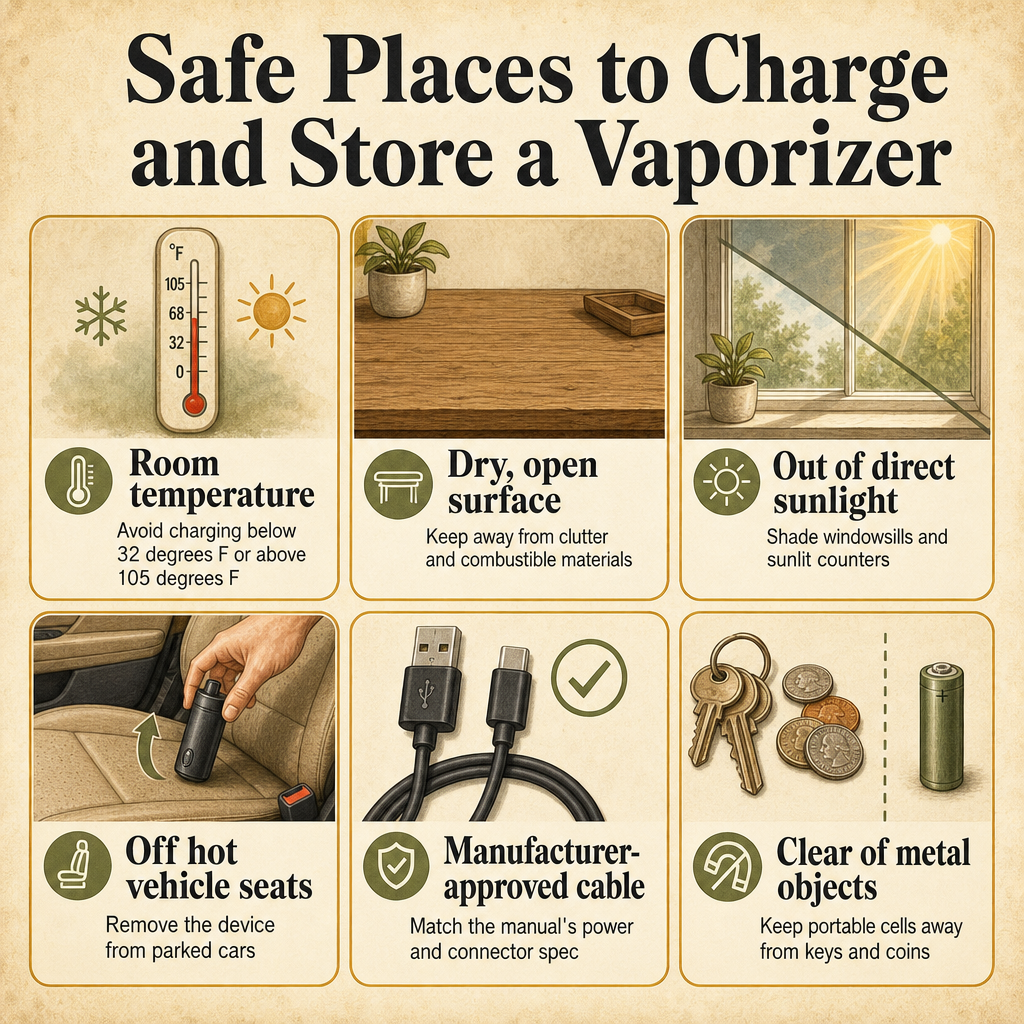
Choose a dry, open spot at room temperature. The U.S. Fire Administration advises not to charge lithium-ion batteries below 32 degrees F or above 105 degrees F, and to keep them out of direct sunlight and hot vehicles. [1]
A desk, counter, or shelf can work if it is stable, clear, and away from water. Do not charge on a bed, sofa, carpet pile, or under papers and clothing. Those places can hide the device and hold heat around it.
A parked car is a poor storage place. The cabin can become very hot even when outdoor air feels mild. Bring the vaporizer inside instead of leaving it on a seat, dashboard, or center console. During cold weather, let a chilled device reach room temperature before charging it.
Keep charging gear away from sinks, showers, drinks, and damp storage areas. If the device gets wet, disconnect it only if you can do so safely, then follow the maker’s instructions. Do not plug it in merely to test whether it still works.
A travel case, such as the Puffco New Peak Vaporizer & Travel Bag Bundle | Onyx, can keep a device and cable organized when they are not charging. Take the device out of a closed case for charging unless its manual says otherwise. Cases are for orderly storage and travel, not for covering a powered device.
Use these location rules:
- Choose a dry, stable, open surface at room temperature.
- Keep the device away from direct sun, hot windows, heaters, and parked cars.
- Keep papers, fabric, bedding, and other clutter away during charging.
- Keep water, drinks, sinks, and damp rooms away from the charging area.
- Do not charge a very cold device until it has reached room temperature.
- Keep the device where an adult can notice a change in heat, smell, shape, or sound.
What Warning Signs Mean a Vaporizer Battery Should Stop Being Used?
A battery or device can show clear signs that something is wrong. Stop using and charging it if you notice swelling, a new shape, leaking, an odd smell, unusual color, excessive heat, or strange noises. Do not keep plugging it in to see whether the problem goes away. [1]
Some warmth during use or charging may be normal for a model, but a sudden change from its usual behavior matters. If it becomes too hot to approach, starts expanding, smokes, or burns, move away and contact emergency services. Do not pick it up, open it, or carry it through the building. [4]
If there is no immediate emergency, keep the device switched off and follow the maker’s damaged-battery instructions. A sealed pack may need service or full-device recycling. A removable cell may need a battery recycling program that accepts damaged cells. Call ahead because drop-off rules differ.
Inspect removable cells for torn wraps, dents, rust, or damaged ends. Do not patch a cell with ordinary household tape and return it to service. Terminal tape mentioned for recycling is used to keep the ends from touching metal during transport; it does not repair a damaged cell.
If replacement is allowed by the manufacturer, use the exact cell type it names. The 510 Batteries section can help you browse compatible product formats, but the device manual remains the final check for fit and specifications.
Stop and respond to these warning signs:
- Swelling or a changed shape: stop using and charging the device.
- Leaking or an unusual smell: move away and follow the maker’s damaged-battery directions.
- Excessive or rapidly rising heat: do not touch the device; move away if conditions worsen.
- Smoke, flame, popping, or hissing: leave the area and call emergency services.
- A torn wrap, dent, rust, or damaged terminal: retire the removable cell.
- Repeated charging errors: unplug the device and contact the manufacturer.
How Do You Carry a Vaporizer Battery When You Travel?
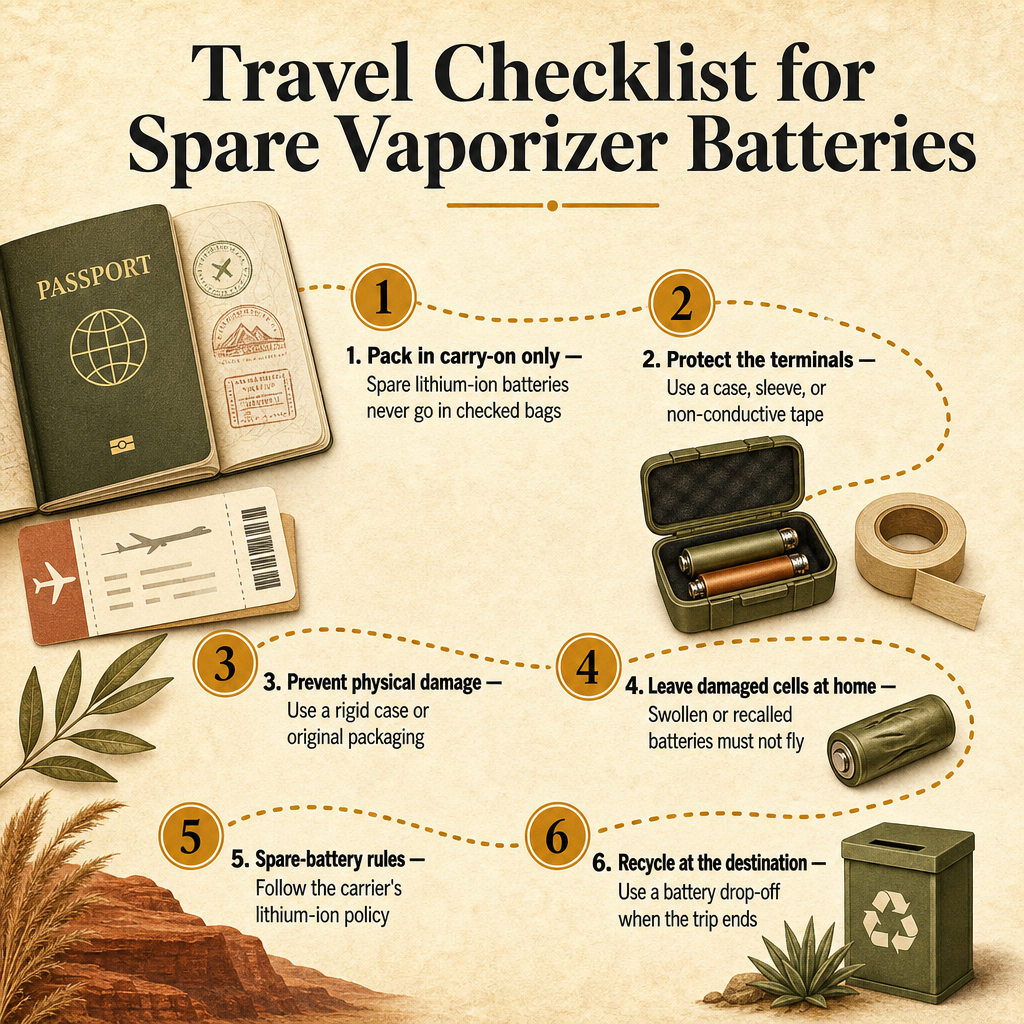
Removable batteries should never roll loose in a pocket, purse, backpack, or tool bag. Their terminals can touch coins, keys, jewelry, or other metal items. Put each spare cell in its retail package, a dedicated battery case, or another separate container that keeps the terminals covered. [3]
Before air travel, check the current rules from the airline and the Federal Aviation Administration. Spare lithium-ion batteries belong in carry-on baggage, not checked baggage. Their terminals must be kept from touching metal or other batteries. [4]
Do not bring a swollen, leaking, damaged, or recalled battery onto an aircraft. If a device is checked at the gate, remove spare batteries first and keep them in the cabin as instructed. Turn the vaporizer fully off and prevent buttons from being pressed by items inside your bag.
Pack the manual or save a digital copy if you are traveling for several days. It can help you identify the supported charger and battery. Do not buy an unknown replacement cell at the last minute simply because it fits the compartment.
Rules can change, and airlines may add their own limits. Check again shortly before the trip instead of relying on an old screenshot or a past flight. For road travel, keep the device out of direct sun and do not leave it in a parked vehicle.
Use this travel checklist in order:
- Inspect the device and every spare cell before packing.
- Place each removable cell in its own battery case or retail package.
- Keep spare lithium-ion batteries in carry-on baggage for air travel.
- Keep terminals away from coins, keys, jewelry, and other batteries.
- Check the FAA, airline, and destination rules before leaving.
- Leave damaged, swollen, leaking, or recalled batteries out of your luggage.
How Should You Store a Vaporizer That Will Sit Unused for a While?
Long-term storage starts with the model manual. If it gives a storage charge range, use that range. Lithium-ion batteries do not need to be stored completely full, and they should not be left fully empty for a long time.
Turn the device off, let it reach room temperature, and clean only the exterior areas named in the instructions. Remove loose material from the case so it does not enter the charging port. Do not take apart a sealed battery housing for storage.
Choose a dry indoor place with a steady room temperature. Keep the device away from windows, heaters, bathrooms, garages with large temperature swings, and places children or pets can reach. The U.S. Fire Administration recommends room-temperature storage when possible. [1]
Use the original box or a clean case that prevents buttons from being pressed. For removable cells, use individual battery cases. Do not store loose cells together, and do not let their terminals touch metal tools or spare parts.
Check the stored device from time to time. Look for a changed shape, leakage, corrosion, odor, or unusual heat. Recharge only as directed by the manual. If the battery has dropped very low and the device will not charge normally, contact the maker rather than repeating charge attempts.
Follow this storage routine:
- Read the model’s storage and charging instructions.
- Set the battery to the storage level named by the manufacturer.
- Turn the device off and let it reach room temperature.
- Place it in a clean case or original package in a dry indoor spot.
- Keep removable cells in separate battery cases.
- Inspect the device at regular intervals and recharge only as directed.
How Do You Recycle a Vaporizer Battery When It Is Finished?
Lithium-ion batteries and devices that contain them do not belong in household garbage or curbside recycling bins. Trash trucks and sorting equipment can crush batteries. Use a program made for batteries or electronics instead. [3]
Start by checking whether the battery is removable. Do not pry open a sealed vaporizer. The manufacturer, a certified electronics recycler, or a local household hazardous-waste program can tell you whether to bring the full device or only the removable cell.
For an undamaged removable battery, place non-conductive tape over exposed terminals or put each cell in a separate plastic bag before transport. Keep it in a battery case until drop-off. Ask the receiving site how it wants cells prepared because local rules can vary.
Damaged batteries need special instructions. Do not mail, carry, or place a swollen, leaking, or hot cell in a public collection box without approval from the program. Call the manufacturer, recycler, or local waste office and describe the condition first.
Remove personal accessories that the recycler does not accept, but do not dismantle the battery pack. Keep your receipt or record if the maker offers a take-back or warranty program.
Look for one of these recycling channels:
- A battery recycler that accepts rechargeable lithium-ion cells.
- A certified electronics recycler that accepts complete vaporizer devices.
- A retailer or manufacturer take-back program.
- A local household hazardous-waste collection site.
- A municipal drop-off event that specifically lists lithium-ion batteries.
- A special damaged-battery service arranged by the maker or local waste office.
Frequently Asked Questions
Is it okay to leave a vaporizer charging overnight?
Do not make overnight charging your routine. Charge while you are awake and can check the device, then unplug when the normal full-charge indicator appears unless the manufacturer clearly allows another method.
Can I use my vaporizer while it is charging?
Keep it switched off while charging unless the exact model manual clearly allows use while plugged in. Using a portable device during charging can interfere with its normal charge cycle. [2]
What charger should I use if the original one is lost?
Use the voltage, current, connector, cable, and charger type listed for your model. If the manual does not give enough detail, contact the manufacturer instead of trying random high-wattage adapters.
How should I carry a removable vaporizer battery?
Place each cell in its retail package or a dedicated battery case. Keep its terminals away from coins, keys, jewelry, tools, and other loose batteries.
Can I throw a used vaporizer battery in the trash?
No. Use a battery recycler, certified electronics recycler, retailer take-back service, manufacturer program, or local household hazardous-waste site. Do not put it in curbside recycling.
What should I do with a battery that is swollen or smells strange?
Stop using and charging it. If it is rapidly heating, expanding, smoking, or burning, move away and call emergency services. Otherwise, follow the manufacturer’s damaged-battery instructions and contact an appropriate recycling program before transporting it.
What Is the Best Vaporizer Battery Care Routine to Remember?
Start with the manual for your exact vaporizer. Inspect the device, use the recommended charging gear, charge it in a dry and open place at room temperature, and unplug it when charging is complete. Keep removable cells in individual cases whenever they are outside the device.
Pay attention to changes. A new smell, leak, changed shape, unusual heat, odd sound, or damaged wrap means it is time to stop. When the battery reaches the end of its useful life, take it to a battery or electronics recycling program instead of putting it in household trash.
Sources
- U.S. Fire Administration: Battery Fire Safety
- Battery University: BU-409: Charging Lithium-ion
- U.S. Environmental Protection Agency: Used Lithium-Ion Batteries
- Federal Aviation Administration: PackSafe – Lithium Batteries
- STORZ & BICKEL: My Devices Support