
A vaporizer temperature guide starts with one number: the combustion point. Cannabis flower ignites between 230 and 315 °C (445–600 °F), so most dry herb vaporizers are designed to operate below that ceiling — inside a 180–220 °C window where cannabinoids and terpenes release without the plant burning. [1] [2]
How hot does a dry herb vaporizer actually get?
Most dry herb vaporizers are designed to operate in a roughly 180–220 °C (about 356–428 °F) window, which sits comfortably below the 230–315 °C range where cannabis flower ignites. [1] That gap between the operating window and the combustion point is the whole reason a vaporizer exists: heat the material enough to release its compounds, but not enough to set it on fire. [5]
An academic review on vaporization describes the same range, noting that cannabinoids and terpenes release without combustion between roughly 180 °C and 220 °C. [3] Below about 180 °C, very little releases from the material. Above about 230 °C, the cellulose inside the plant begins to break down into compounds more similar in nature to what you would get from burning. [2]
The numbers you actually see on a device screen or app sit inside that same physical range, even when the labels look different. Some brands display the temperature in Celsius, others in Fahrenheit, and a few use low / medium / high bands rather than numbers at all. The underlying physics does not change with the label. [1]
If you are still learning the basics of how these devices work, our guide on What Is a Dry Herb Vaporizer and How Does It Work? walks through the core mechanics before you start turning dials. What Is a Dry Herb Vaporizer and How Does It Work?
- The typical dry herb vaporizer operating window sits between roughly 180 °C and 220 °C (about 356–428 °F)
- Cannabis flower begins to combust in the 230–315 °C range, which is the ceiling most vaporizers are designed to stay below
- Celsius and Fahrenheit displays describe the same physical range; brand apps often expose low / medium / high bands rather than raw numbers
- Below roughly 180 °C very little releases from the material; above roughly 230 °C the cellulose in the plant begins to break down
What is the difference between combustion and vaporization temperatures?
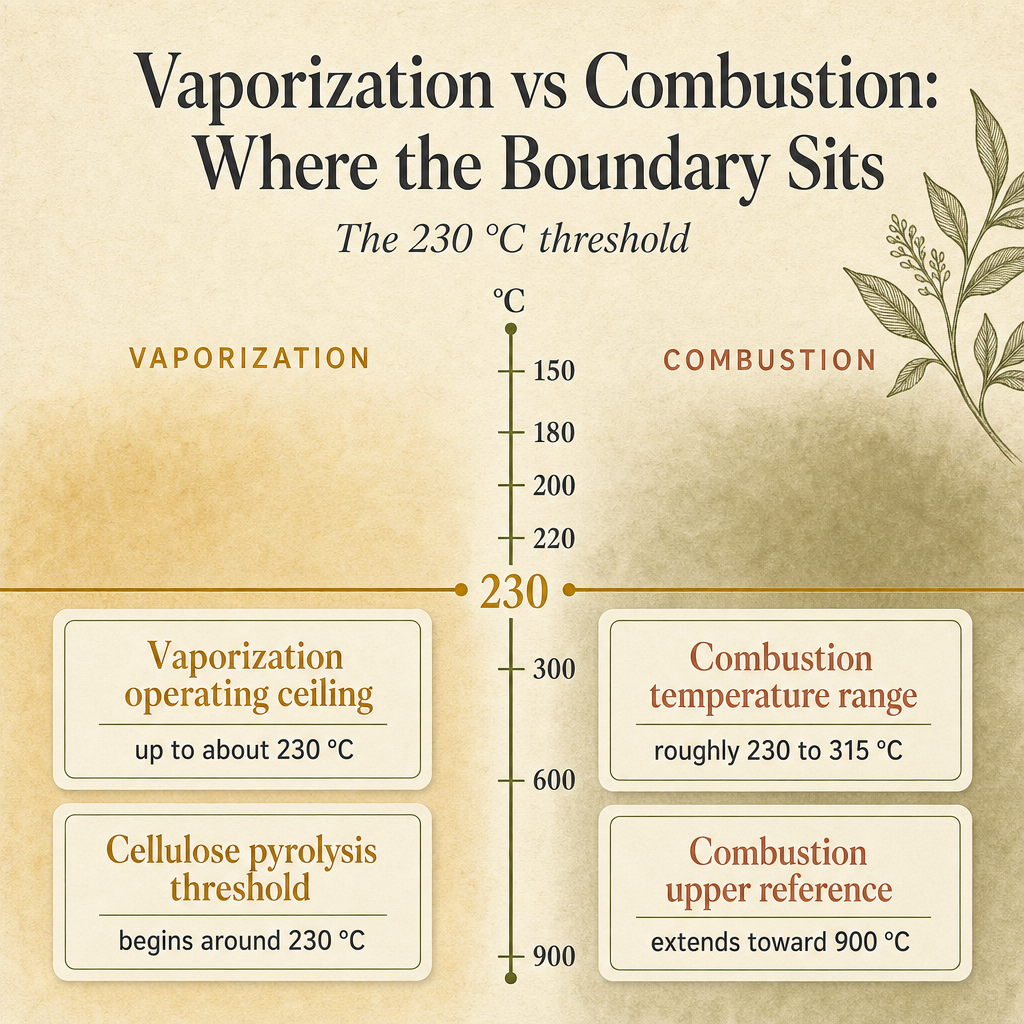
Combustion is the burning range. Cannabis flower ignites somewhere between 230 °C and 315 °C and, depending on conditions, the burning zone can extend toward 900 °C. [1] Above the ignition point, the plant material burns and the heat produces smoke rather than releasing compounds as vapor. [2]
Vaporization is the gentler process below that ceiling. A vaporizer heats the material up to roughly 230 °C, which is enough to release cannabinoids and terpenes from the flower without lighting it on fire. [2] The material warms, the compounds leave the surface, and the plant stays unburned. [5]
The boundary that matters most is around 230 °C, because that is where cellulose — the structural fiber in plant material — begins to pyrolyze, or break down with heat. Fundación CANNA notes that some vaporizers can creep above 230 °C in conduction mode, and when they do, the conditions inside the chamber start to resemble combustion rather than vaporization. [2]
This is why most dry herb vaporizers are built with hard upper limits in their firmware, and why paying attention to where your dial is actually set matters more than chasing the highest number on the screen. [3]
If you are shopping for a device and want to compare the broader Vaporizers category, the rest of this guide assumes you are working in that same physical range. Vaporizers You can also read What Is a Vaporizer and How Does It Work? for a fuller breakdown, What Is a Vaporizer and How Does It Work? and What Is the Difference Between Conduction and Convection Vaporizers? for the heating-method comparison that builds on the temperature concepts here. What Is the Difference Between Conduction and Convection Vaporizers? [1]
- Combustion runs from roughly 230 °C to 315 °C for cannabis flower and can extend toward 900 °C depending on conditions
- Vaporization sits below that ceiling, up to about 230 °C, where cannabinoids and terpenes release without the material igniting
- Cellulose pyrolysis begins around 230 °C, which is why most vaporizers are designed to stay below that threshold
- Excess heat from a conduction chamber can creep above the pyrolysis line, shifting the residue profile closer to combustion in nature
- Most device firmware enforces an upper temperature limit to keep the chamber inside the vaporization window
How does conduction heating change the temperature inside a vaporizer chamber?
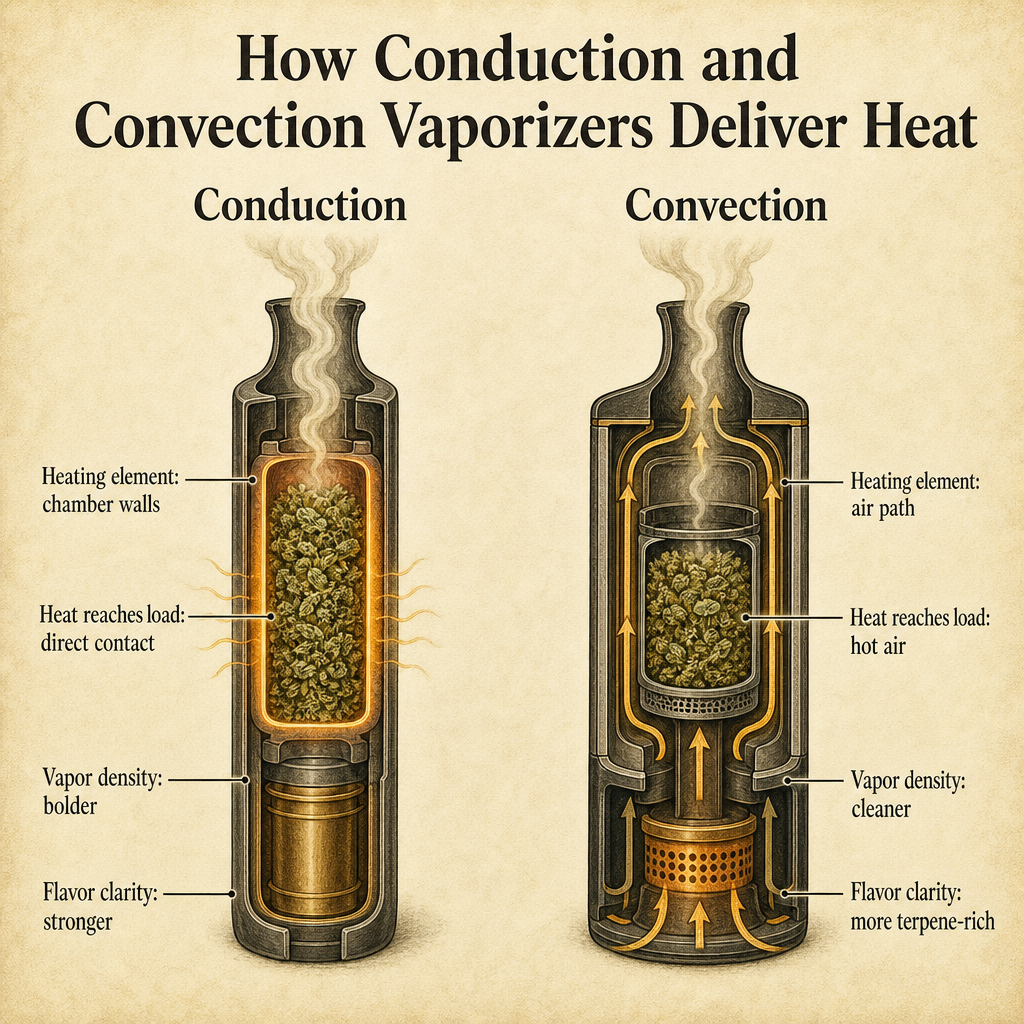
Conduction heating works by warming the walls of the chamber — or a metal plate inside it — and then transferring that heat into the material by direct contact. The herb that touches the hot surface warms first, and the warmth spreads inward from there. [4]
Because the heat starts at the chamber wall, conduction devices typically reach their working temperature in just a few seconds. The metal gets hot, the herb touching it warms up, and vapor production can begin almost immediately. That speed is one of the most noticeable features of a conduction device in everyday use. [4]
The trade-off is that heat does not arrive at every part of the load at the same time. Material that sits pressed against the hottest wall can run noticeably warmer than material in the middle of the chamber. Over a long session, that gap can produce uneven extraction, where some portions of the load have released most of their compounds while other portions have barely started. [4]
Two habits make conduction heating more consistent. First, a light, even pack lets air reach as much of the surface area as possible and reduces hot spots. Second, a brief stir or shake between draws redistributes the load so the side that was facing away from the wall gets its turn closer to the heat. [4]
If you are weighing conduction against concentrate setups, our comparison How Do Dry Herb Vaporizers Differ from Concentrate Vaporizers? walks through the temperature ranges each format needs.
- The chamber walls or a metal plate warm first, then heat transfers into the herb by direct physical contact
- Heat-up time is short, often just a few seconds, because the metal element is right next to the load
- Material pressed against the hottest surface can run several degrees warmer than material in the center of the chamber
- A light, even pack reduces hot spots by giving air room to move between the pieces of herb
- A short stir or shake between draws redistributes the load so every portion of the chamber takes a turn close to the wall
How does convection heating deliver temperature to dry herb?
Convection heating works the other way around. Instead of warming the chamber walls, a convection device warms the air that is about to pass through the chamber. That hot air moves through the herb on its way to the mouthpiece, and the heat transfers from the air into the plant material along the way. [4]
The path of that hot air matters. Intake air enters the device, passes over the heating element, then travels through the chamber and out toward the mouthpiece. Each step in that path warms the air a little more, and by the time it reaches the herb, it is already at the temperature the device is targeting. [4]
Because the air surrounds every piece of herb in the chamber, the temperature inside the load tends to be much more even than in a conduction device. There are no chamber walls cooking one side of the load faster than the other. That uniformity is the main reason convection devices tend to extract the load more completely and preserve more of the volatile aromatic compounds that carry flavor. [4]
The cost of that even heat is time and battery. The device has to warm the element, then warm the air, then push the air through the chamber before vapor production really begins. Most convection vaporizers need 30 seconds to over a minute to reach a stable operating temperature, and they draw more power from the battery to do it. [4]
- Intake air passes over the heating element and warms up before it ever reaches the chamber
- Hot air flows through the chamber and exchanges heat with the herb on the way to the mouthpiece
- Each particle of herb gets exposed to roughly the same air temperature, which keeps the load warming evenly
- Even heat delivery is the main reason convection devices tend to produce cleaner, more terpene-rich vapor
- The extra steps of warming air and pushing it through the chamber typically mean a longer heat-up time and higher battery draw than conduction
Conduction vs convection vaporizers: which one fits your temperature habits?
Side by side, the two heating methods change what you actually experience at a given temperature setting. Conduction warms the herb by contact, so it heats up fast but tends to cook the material closest to the wall more aggressively than the material in the center. Convection warms the herb with hot air, so it takes longer to start but tends to deliver temperature evenly across the entire load. [4]
If you tend to take a single short draw and put the device down, conduction’s quick heat-up tends to fit that pattern well. If you tend to take longer draws or run the chamber through several passes, convection’s even heat distribution tends to make those sessions feel more consistent from start to finish. [4]
Heat-up time is the most obvious practical difference between the two. Conduction devices are usually ready in under ten seconds, and many are ready in under five. Convection devices typically need 30 seconds to over a minute to bring the air path up to operating temperature. [4]
Size follows the same pattern. Conduction designs can be small and pocket-friendly because they do not need fans or large air chambers. Convection designs tend to be larger, and many of the most popular convection units are Desktop Vaporizers designed for home use rather than travel. [4]
Flavor profile and vapor density differ as well. Convection vapor tends to be cleaner and more terpene-rich because the herb never touches a hot surface. Conduction vapor tends to be bolder, because the contact heating extracts quickly once the chamber is up to temperature. Neither description is a judgment about quality — they are simply different characteristics that suit different session styles. [4]
- Conduction warms the chamber walls first and heats the load by contact; convection warms the air first and heats the load by airflow
- Conduction heat-up time is typically under ten seconds; convection usually needs 30 seconds to over a minute
- Conduction devices can be built small and pocket-friendly; convection devices tend to be larger and are often desktop designs
- Convection tends to produce cleaner, more terpene-rich vapor; conduction tends to produce bolder, more immediate vapor
- Conduction suits short, single-draw sessions; convection suits longer sessions where even heat distribution matters
| Dimension | Conduction | Convection |
|---|---|---|
| How heat reaches the load | Direct contact with hot chamber wall or plate | Hot air flowing through the chamber |
| Typical heat-up time | Under 10 seconds, often under 5 | 30 seconds to over a minute |
| Typical device size | Compact, often pocket-friendly | Larger, often desktop-oriented |
| Vapor density profile | Bolder, more immediate | Cleaner, more terpene-rich |
| Flavor clarity profile | Stronger character, can shift across a session | More consistent from first draw to last |
| Best fit for | Short, single-draw sessions | Longer sessions with even extraction |
What are the standard temperature bands on a dry herb vaporizer?
Most dry herb vaporizers expose three bands that map to the same underlying 180–220 °C window. The names change from brand to brand, but the bands themselves are roughly the same: a low band that emphasizes flavor, a mid band that balances flavor and vapor density, and a high band that pushes denser vapor. [1]
The low band usually sits in the lower part of the operating window. Vapor density is lighter at this end, and the aromatic compounds that carry flavor are at their most expressive because they are exposed to the least excess heat. [5] This is the band most shoppers gravitate to when they want to taste what a particular strain is offering. [4]
The mid band covers the middle of the window. Vapor density is fuller than at the low end, and most of the volatile compounds still release without being driven off by excess heat. For many shoppers, the mid band is the everyday default because it produces a balance between flavor clarity and visible vapor. [1]
The high band sits at the top of the window, just below the cellulose pyrolysis line. Vapor density is at its fullest here, and what you get is the most robust extraction the device can produce while staying inside the vaporization range. The trade-off is that some of the most volatile flavor compounds may begin to break down at the upper end, so flavor clarity can soften compared to the mid band. [2]
When you shop for Dry Herb Vaporizers, the same three bands appear across most brands, sometimes under different names. The labels and units change, but the physical process at each band is comparable across devices.
- Low band: sits in the lower part of the operating window, lighter vapor density, the most expressive flavor profile
- Mid band: covers the middle of the window, fuller vapor density than the low band, balanced flavor
- High band: sits near the top of the operating window, fullest vapor density, some flavor softening compared to the mid band
- Most brands expose these three bands under different names, and the labels change between Celsius and Fahrenheit displays
- The underlying physical process at each band is comparable across devices, even when the wording on the screen looks different
What changes when you turn the temperature up or down between sessions?
Even at the same numerical setting, two vaporizers can produce noticeably different results. The temperature on the screen is a target, but several variables influence what actually reaches the load at any given moment. [1]
Chamber fill consistency is one of the largest variables. A loose, evenly ground pack lets air move through the load and lets heat distribute more uniformly. A tightly packed chamber traps heat near the walls and slows air movement, which can leave the center of the load cooler than the edges. [1]
Draw technique matters as well. A long, slow draw gives hot air more time to exchange heat with the herb in a convection device, which can pull more from the load. A short, quick draw heats less of the load before the air leaves the chamber. On conduction devices, draw speed has less impact on temperature delivery because the heat is coming from the wall rather than from passing air. [4]
Temperature consistency of the device itself is the third variable. Some devices hold their target temperature within a degree or two throughout a session. Others drift several degrees as the chamber warms up or as the battery drains. Devices with tighter temperature control tend to feel more predictable from one session to the next. [1]
The heating method shapes the result as well. A conduction chamber reaches temperature at the wall first, then works inward, so the load sees a temperature gradient. A convection chamber delivers hot air to all parts of the load at once, so the load sees a more uniform temperature. The same numerical setting can therefore feel different across devices, and the heating method is part of why.
If you are shopping and want a device that holds temperature tightly across a session, the Pax Four Vaporizer is one example of a unit designed with consistent heat delivery in mind. [4]
- Chamber fill consistency: a loose, even pack heats more uniformly than a tightly packed chamber
- Draw technique: long, slow draws give convection chambers more time to exchange heat; short draws pull less from the load
- Device temperature consistency: some devices hold their target within a degree or two; others drift several degrees during a session
- Heating method: conduction delivers heat from the walls inward; convection delivers heat from the air outward
- Grind size: consistent particle size helps every part of the load warm at the same rate
How do you pick the right vaporizer temperature setting for a new device?
When you unbox a new vaporizer, the goal for the first few sessions is to learn the device, not to settle on a final setting. A short routine gets you familiar with the dial faster than jumping around the operating window. [1]
Start in the middle of the device’s window. The mid band gives you a baseline read on what the device does at a temperature most manufacturers tune for everyday use. Take a few draws at that setting and pay attention to the vapor density, the flavor character, and how long it takes the chamber to feel spent. [5]
From the mid band, adjust by one band at a time. Move to the low band and compare it to the mid band: notice what changes in the vapor and what changes in the flavor. Then move to the high band and do the same comparison. Changing more than one band at a time makes it hard to know what actually changed. [1]
Clean the chamber before the next comparison. Residue from a previous session changes the flavor and can insulate part of the load, which makes temperature comparisons unreliable. A quick chamber wipe between sessions keeps the comparison honest. [2]
After a few sessions of this routine, you will know how your specific device behaves at each band, and you can pick a starting setting based on what you actually want from a session. [4]
- Start in the middle of the device’s window to establish a baseline
- Adjust by one band at a time so you can isolate what each setting changes
- Clean the chamber between comparisons to keep residue from skewing the results
- Note the vapor density, the flavor character, and how quickly the chamber feels spent at each band
- Use what you learn to pick a starting setting based on the kind of session you want
Frequently Asked Questions
What temperature does a dry herb vaporizer actually reach?
Most dry herb vaporizers are designed to operate in a roughly 180–220 °C window, well below the 230–315 °C range at which cannabis flower combusts. The exact dial on a given device maps to that same physical range, even when brands display it in Fahrenheit or label it as low, medium, or high.
What is the difference between combustion and vaporization temperatures?
Combustion is the burning range, roughly 230–900 °C depending on the source, where plant material ignites and produces smoke. Vaporization sits below the combustion threshold, up to about 230 °C, where heat releases cannabinoids and terpenes from the flower without lighting it on fire.
Do lower heat settings preserve more flavor than higher heat settings?
Yes. Lower settings within the vaporization window are typically associated with cleaner flavor because the terpenes — the volatile aromatic compounds — are less likely to be destroyed by excess heat. Higher settings tend to push denser vapor at the cost of some flavor clarity.
How does conduction heating differ from convection heating in terms of temperature delivery?
Conduction heats the chamber walls and the material in direct contact with them, which can produce bolder vapor but risks uneven extraction. Convection passes hot air through the chamber, which tends to deliver temperature more evenly across the load and produces cleaner, more terpene-rich vapor.
Are there standard temperature bands used across the industry for dry herb vaporizers?
Yes. Most brands expose a similar low, medium, and high band that maps to the same underlying 180–220 °C operating window. The labels and units change from brand to brand, but the physical process at each band is comparable across devices.
What components of cannabis change at different temperatures?
Within the vaporization window, cannabinoids and terpenes release at different points as heat rises. As temperature climbs past roughly 230 °C, cellulose in the plant material begins to break down into compounds more similar in nature to combustion residue, which is why most devices are designed to stay below that threshold.
Which vaporizer temperature setting should you actually use?
Pick the band that fits the session you want. The low band leans toward flavor, the mid band balances flavor and vapor density, and the high band pushes fuller vapor at the upper edge of the vaporization window. The right setting depends on what you are trying to get out of a given session, and the same setting can feel different across devices because of the heating method, the chamber design, and how tightly the device holds its target temperature.
Once you understand the three bands, the conduction vs convection distinction, and the boundary between vaporization and combustion, the dial on a new device stops feeling like a guess. You have a reference range, you know what each band emphasizes, and you have a simple routine for learning a new device before you start comparing models.
Sources
- Wikipedia: Vaporizer (inhalation device)
- Fundación CANNA: Vaporizer Usage: Safety and Toxicology
- Canadian Journal of Public Health / NCBI PMC: Are vaporizers a lower-risk alternative to smoking cannabis?
- DynaVap: Conduction vs Convection Vaporizers: What’s the Real Difference?
- Leafly: Vaporizer