
Borosilicate glass usually leads ceramic bongs vs glass bongs vs silicone comparisons because it stays flavor-neutral and supports advanced percolators [2][5]. Silicone wins on drops, weight, and price, but the porous surface absorbs residue over time [5][6]. Ceramic is the oldest category with thick walls, hand-glazed finishes, and strong heat tolerance, though it has fewer percolation options than glass [7][11].
What Are the Main Differences Between Ceramic, Glass, and Silicone Bongs?
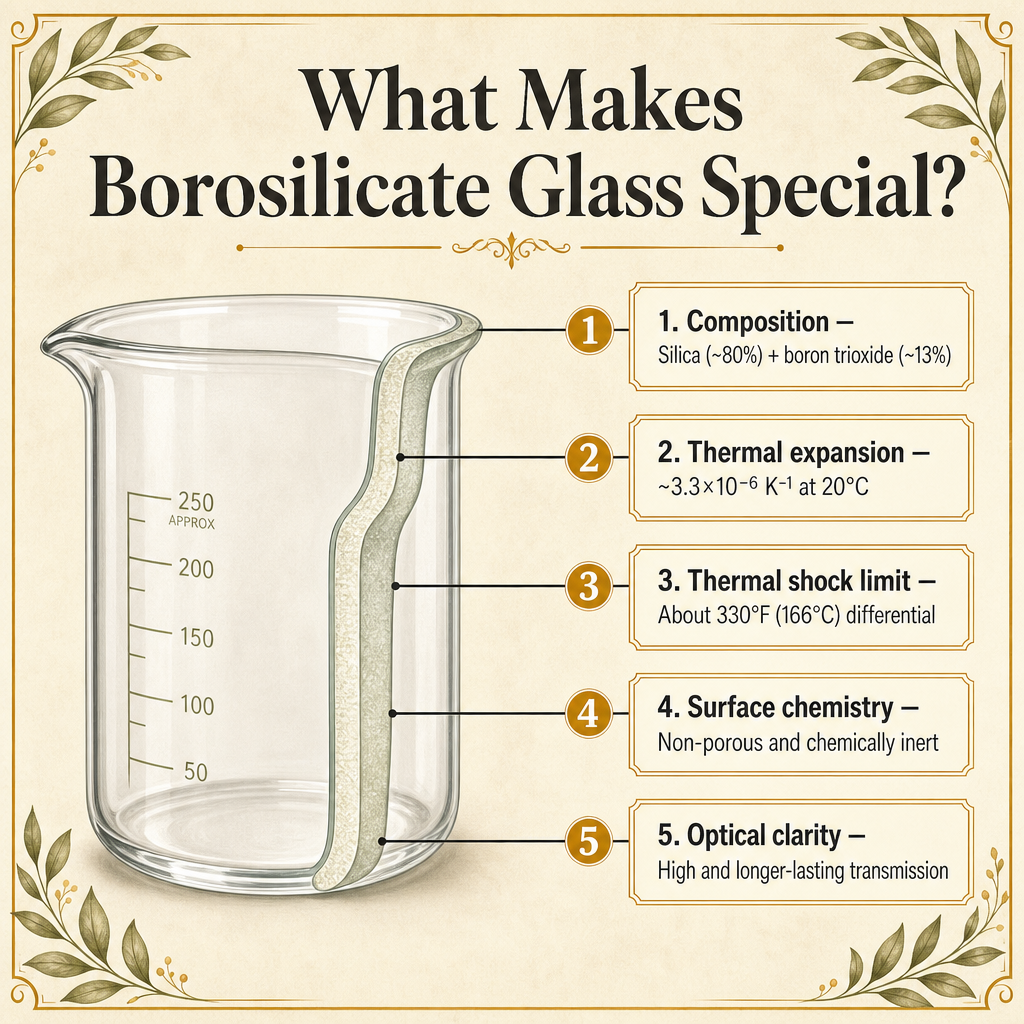
The three bong materials you see most often — ceramic, glass, and silicone — come from completely different manufacturing worlds, and those origins explain almost every difference you will notice in everyday use. Borosilicate glass is the same family of glass used in laboratory beakers and high-end cookware, made primarily from silica (~80%) and boron trioxide (~13%) [1][2]. The boron trioxide is what gives borosilicate its famously low coefficient of thermal expansion (about 3.3×10⁻⁶ K⁻¹ at 20°C) and its ability to handle temperature swings of roughly 330°F (166°C) without cracking [1][3]. That same dense, cross-linked glass network also makes the surface non-porous and chemically inert, so it does not absorb odors or leach flavors into smoke [2][4].
Silicone bongs are made from food-grade silicone rubber — most commonly platinum-cured silicone for higher-end pieces — and are produced in injection-molded or compression-molded forms [8]. The base material is heat-resistant and flexible, which is why silicone pieces can be bent, packed, and dropped without breaking [5][6]. The trade-off is that silicone is porous at the surface, so resin, smoke residue, and odors soak in over time [5][8]. That is also why silicone is regulated as a rubber article under FDA 21 CFR 177.2600 when it is sold for repeated food contact, with operating temperatures ranging from about −80°F to +450°F and intermittent resistance up to roughly 500°F [9][10].
Ceramic bongs are one of the oldest bong-making categories, traditionally hand-built from clay and finished with a glaze that seals the outer surface [7][11]. The walls are thick and heavy, the glaze gives each piece a one-of-a-kind finish, and ceramic tolerates temperature changes well because the material is naturally heat-resistant [7][11]. The flip side is weight and rigidity: ceramic bongs are heavy to hold, fragile if dropped onto tile or stone, and usually built with simple internal geometry rather than complex percolators. To see how the same trade-offs play out in a focused two-material breakdown, see our Glass vs Silicone Bong: Which Material Should You Actually Buy?.
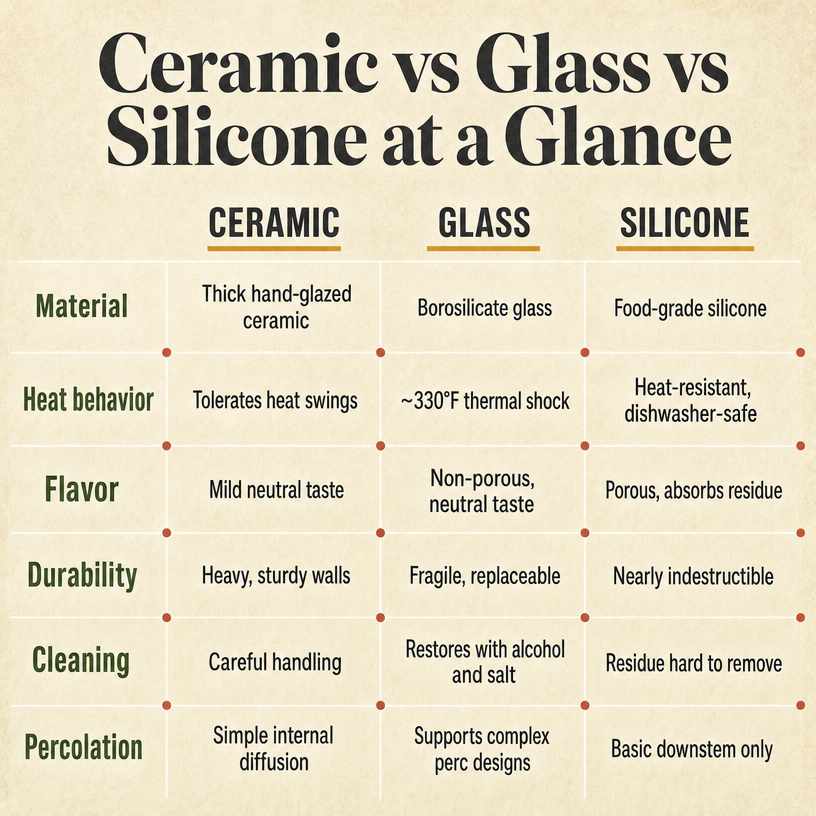
Putting those material basics side by side is the fastest way to see why the three categories behave so differently in practice. Glass wins on flavor neutrality, thermal shock resistance, and percolation complexity. Silicone wins on raw durability, weight, and price. Ceramic wins on heat tolerance, weight in the hand, and the kind of hand-glazed vintage styling you cannot get from a mold.
- Borosilicate glass is silica + boron trioxide, with thermal-shock resistance of about 330°F and a non-porous surface that keeps flavor clean.
- Silicone is a flexible food-grade rubber, regulated under FDA 21 CFR 177.2600, that absorbs residue over time but tolerates drops, packing, and bending.
- Ceramic is a thick-walled clay body sealed with glaze, valued for heat tolerance and unique finishes but heavier and more rigid than the other two.
Which Bong Material Gives the Cleanest Flavor?
Borosilicate glass sets the bar for flavor neutrality. Its surface is non-porous and chemically inert, so it does not absorb odors, hold onto smoke residue in its walls, or leach flavors into what you are pulling through [2][4]. Specialty glass retailers describe borosilicate as giving a ‘clean, untainted hit’ compared with porous materials, and laboratory suppliers highlight the same high chemical durability for beakers and cookware [2][5]. That is also why glass is favored by shoppers who put flavor at the top of their priority list — it adds nothing to the experience and, when cleaned regularly with isopropyl alcohol and coarse salt, can be brought back to a like-new condition over and over.
Ceramic sits in the middle on flavor. A properly glazed ceramic bong has a sealed, glass-like inner surface that does not react with smoke, so it stays relatively flavor-neutral [7][11]. Unglazed or chipped ceramic is a different story — exposed clay is porous and can hold onto residue and odors the same way silicone does. As long as the glaze is intact and the piece is cleaned on a routine schedule, ceramic is closer to glass than to silicone on flavor performance.
Silicone is the weakest performer on flavor over time. The same flexibility that lets you bend a silicone piece also creates a porous surface where resin, smoke residue, and odors soak in [5][6][8]. Cannabis-accessory retailers describe a ‘rubbery aftertaste’ that builds up with use and is hard to fully reverse even with dishwasher cleaning [5][6]. Platinum-cured silicone is the higher-purity tier and reports lower extractables than peroxide-cured silicone, but it still does not match the flavor neutrality of borosilicate glass [8]. For a deeper look at how flavor interacts with glow-in-the-dark coatings and other surface treatments, see our Glow in the Dark Bongs: Do They Work and Are They Safe?.
If your priority is flavor and you want a piece that returns to a near-factory state after cleaning, borosilicate glass is the clear winner. If you mainly care about flavor on day one and do not mind some aging of taste, a glazed ceramic piece comes close. If you are buying silicone, plan for flavor drift over months of use and factor in replacement as part of the cost.
- Borosilicate glass is non-porous and chemically inert, so it does not absorb odors or leach flavors, and can be restored with alcohol and salt.
- Ceramic with an intact glaze behaves similarly to glass on flavor, but unglazed or chipped clay can hold residue like silicone does.
- Silicone is inherently porous at the surface and absorbs resin and odors over time, leaving a stale, rubbery aftertaste that is hard to fully remove.
- Platinum-cured silicone is the higher-purity tier, with extractables roughly 10 times lower than peroxide-cured silicone, but it still ages on flavor.
Which Material Is Most Durable and Travel-Friendly?
Silicone is the clear winner on raw durability. It can be dropped onto hardwood, packed into a backpack, stepped on, and bent into a U-shape without cracking [5][6]. Cannabis-accessory retailers routinely call silicone bongs ‘nearly indestructible,’ which is the main reason the format became popular for travel, festivals, and beach use [5][6]. The food-grade silicone used for bongs is also heat-resistant across a wide range, with operating temperatures from about −80°F to +450°F and intermittent resistance up to around 500°F under FDA 21 CFR 177.2600 [9][10].
Borosilicate glass is tougher than it looks but still breaks on impact. The same dense glass network that gives borosilicate its thermal-shock resistance also makes it harder than soda-lime glass and more resistant to cracks from drops [1][3]. It can withstand temperature differentials of about 330°F (166°C), which matters when a lighter flame heats the bowl while room-temperature smoke moves through the chamber [1][3]. Still, borosilicate is glass — drop a piece onto concrete from countertop height and you are likely picking up shards. For a wider comparison that includes hand pipes and other accessories, see our Glass vs Silicone Smoking Accessories: Which Should You Choose?.
Ceramic is somewhere in the middle on durability. The thick clay body and rigid walls handle heat changes well and shrug off small bumps, but ceramic chips or shatters when it hits a hard surface at speed [7][11]. The weight that makes ceramic feel substantial in the hand also makes it harder to catch if it slips, and it adds real heft to anything you pack for a trip. Most ceramic bongs are designed as stay-at-home pieces for that reason.
For pure travel and rough handling, silicone wins. For thermal-shock performance and resistance to everyday knocks at home, borosilicate glass is the safer pick. Ceramic is best when the piece lives on a shelf or a coffee table and rarely moves.
- Silicone is nearly indestructible under drops, packing, and bending, and handles operating temperatures from about −80°F to +450°F.
- Borosilicate glass is harder and more thermal-shock resistant than soda-lime glass, but still breaks on hard impact like any glass.
- Ceramic tolerates temperature changes well but chips or shatters when dropped onto hard surfaces, and the weight is awkward to travel with.
- Silicone is the go-to for travel, festivals, and beater-duty; glass and ceramic are better suited to a stable spot at home.
Which Bong Material Is Easiest to Clean and Maintain?
Borosilicate glass is the easiest material to bring back to a like-new state. The non-porous surface means residue sits on top of the glass rather than soaking in, so a routine cleaning with isopropyl alcohol and coarse salt dissolves the buildup and rinses it away [5][6]. Specialty glass retailers describe glass as fully restorable this way, even after heavy use, because the alcohol-and-salt scrub reaches every part of the chamber and downstem [5][6]. The only catch is that glass is fragile, so the cleaning process itself needs a soft surface and a steady hand.
Ceramic can also be cleaned with similar methods, but the weight and rigidity of the piece make the job more cautious. You are scrubbing a heavy, breakable object with smooth glazed walls, so any slip can chip the glaze or drop the bong onto the counter [7]. As long as the glaze is intact, the surface behaves a lot like glass and responds well to alcohol-based cleaning. Once the glaze is compromised, exposed clay behaves like a porous material and starts to hold residue.
Silicone is the easiest material on the mechanical side — many silicone bongs are marketed as dishwasher-safe — but the easiest on cleaning does not mean the easiest to fully restore [6]. The same porosity that drives the flavor issue also holds residue that dishwasher cycles and alcohol soaks do not always reach [5][6]. Over time, the buildup contributes to that rubbery aftertaste, and the only reliable fix is replacement. If you want a silicone piece that you can keep rotating in and out, shop our Silicone Bongs collection for current styles.
The right pick depends on how much maintenance you are willing to do. Glass rewards a 15-minute alcohol-and-salt soak every week or two with like-new flavor. Ceramic follows a similar routine but needs a careful hand. Silicone tolerates rough cleaning methods but slowly loses flavor purity, so factor in a shorter service life.
- Borosilicate glass cleans fully with isopropyl alcohol and coarse salt, because residue sits on the non-porous surface and rinses away.
- Ceramic with an intact glaze cleans similarly to glass, but the heavy rigid body demands a careful hand to avoid chips or drops.
- Silicone tolerates dishwasher cleaning and rough handling, but absorbed residue is hard to fully remove and flavor drifts over time.
- Plan glass for a long service life with routine cleaning, ceramic for a stable home setup, and silicone as a replaceable travel piece.
Frequently Asked Questions
Is borosilicate glass better than regular glass for bongs?
Yes — borosilicate glass is the standard for higher-quality bongs because it has a much lower coefficient of thermal expansion than soda-lime glass (around 3.3×10⁻⁶ K⁻¹ at 20°C) and can handle temperature differentials of roughly 330°F (166°C) without cracking. That thermal-shock resistance matters when a flame heats the bowl while room-temperature smoke moves through the chamber. Borosilicate is also harder, more resistant to breakage from drops, and chemically inert, which keeps flavors clean.
Do silicone bongs absorb smell and taste over time?
They can. Silicone is inherently heat-resistant, but it is also porous at the surface level, so resin, smoke residue, and odors can soak in over time and mute flavor with a rubbery aftertaste. Even dishwasher cleaning does not always restore a silicone piece fully. If you want long-term flavor neutrality, borosilicate glass is the safer pick.
Can silicone bongs handle heat safely?
Yes — food-contact silicone is rated for operating temperatures from roughly −80°F to +450°F (−62°C to +232°C), with intermittent resistance up to about 500°F (260°C) under FDA 21 CFR 177.2600. A lighter flame applied to the bowl is well within that range. The heat question for silicone is less about damage and more about residue absorption, which is a flavor concern rather than a safety one.
What does food-grade silicone mean for a bong?
Food-grade silicone refers to silicone that meets FDA 21 CFR 177.2600, the U.S. regulation that governs rubber articles intended for repeated food contact. Platinum-cured silicone is the higher-purity tier of food-grade silicone, with reported extractables up to 10 times lower than peroxide-cured silicone, and is the standard for food, beverage, and pharmaceutical-grade tubing.
Why do glass bongs cost more than silicone bongs?
Glass bongs — especially borosilicate pieces with percolators, multi-chamber designs, or hand-blown detailing — cost more because of the material itself, the skilled labor to shape it, and the tighter tolerances required for working percolators and downstems. Silicone bongs use cheaper raw material, are made in injection-molded or compression-molded forms, and have simpler internal geometry, which keeps the price down. The premium for glass is essentially paying for flavor neutrality, thermal performance, and percolation complexity.
Which Bong Material Should You Pick for How You Actually Use It?
The short version is that ceramic, glass, and silicone each have a clear best-case use. Choose borosilicate glass if flavor neutrality, thermal-shock performance, and complex percolation matter most and the piece will live on a stable spot at home. Choose silicone if you need a travel companion, a festival beater, or a low-cost option that can take a beating, and plan for replacement as part of the cost because residue will build up over time. Choose ceramic if you want a hand-glazed statement piece with vintage character that handles heat well and rarely leaves the shelf. Matching the material to the use case is the easiest way to be happy with the bong you buy.
Sources
- Wikipedia: Borosilicate glass
- SCHOTT AG: Borosilicate Glass — A Special Material
- Elfglass (glass-pipe manufacturer, Shenzhen): Borosilicate vs Soda-Lime Glass (Pyrex): Which Is Safe?
- Elfglass (glass-pipe manufacturer, Shenzhen): Borosilicate vs Soda-Lime Glass (Pyrex): Which Is Safe?
- Thick Ass Glass (specialist glass retailer): Silicone Bong Vs Glass | Which Is Better?
- Chill Steel Pipes (cannabis-accessory retailer): Glass vs Silicone Bong: Which Should You Choose?
- Fat Buddha Glass (glass retailer, blog): Ceramic vs. Plastic vs. Glass: Which Is the Best for Bongs/Pipes?
- Elastostar (silicone manufacturer): What is the Difference Between Silicone and Platinum-Cured Silicone?
- U.S. Government Publishing Office / eCFR (U.S. Food and Drug Administration regulation): 21 CFR 177.2600 — Rubber articles intended for repeated use
- ElastaPro (silicone manufacturer): FDA 21 CFR 177.2600 Silicone Sheet & Compound
- The Boombox Club (cannabis accessories retailer): Ceramic Bong vs Glass Bong: Which One’s Right for You?