

A practical guide to comparing two classic dry herb pipes for size, design, session style, and portability.
A chillum and a one-hitter are both slender, straight pipes for dry herb, but they differ in capacity, design, and intended use. A chillum holds more material and supports multiple hits before reloading, while a one-hitter holds a single measured dose of roughly 0.1–0.3 grams intended for one inhalation. [2] Chillums originated in 18th-century South Asia for communal use; one-hitters evolved for solo, discreet microdosing. [1] If you want portability and exact dosing, a one-hitter wins. If you want a slightly larger pipe for group or extended sessions, a chillum is the better fit.
What Is a Chillum and Where Does It Come From?
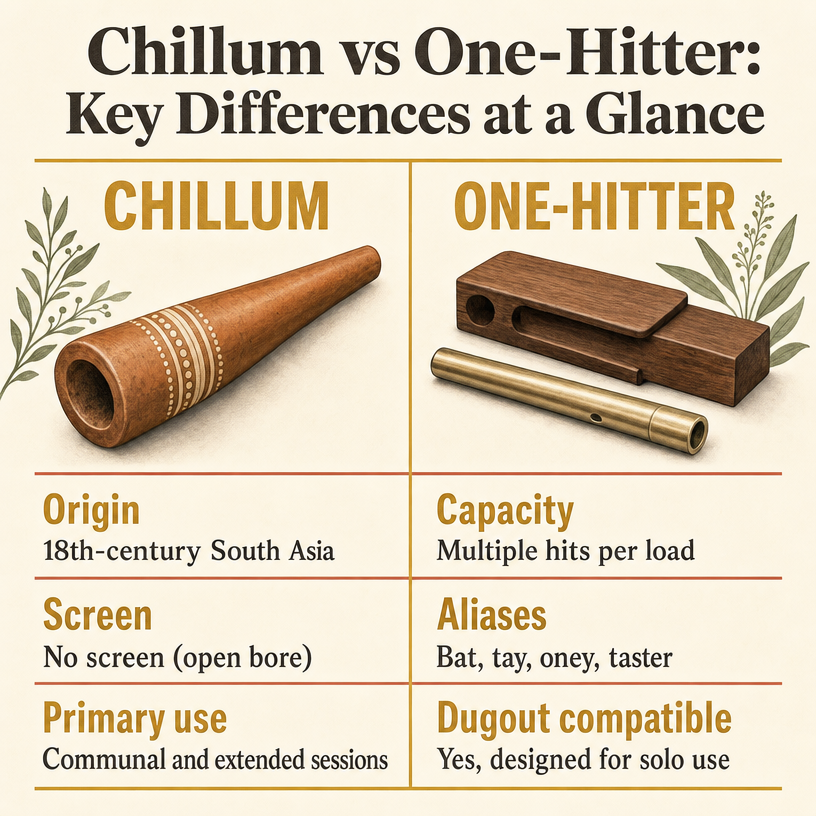
A chillum is a straight, conical pipe with a bore that runs end to end. It holds more material than a one-hitter and can deliver multiple hits from a single load. [1] You load one end, draw from the other, and ash moves through the open bore as you smoke.
- Originates from Nepal and India, with use documented since at least the 18th century
- Used historically by Hindu monks, Sadhus, Yogis, and later in Rastafarian ceremonies
- Traditional materials include clay, steatite (soapstone), and catlinite (pipestone)
- Spread from South Asia to Africa and reached the West in the 1960s
The chillum has deep roots in South Asian spiritual practice. Hindu monks, Sadhus, and Yogis in Nepal and India used chillums for ritual and meditation as early as the 18th century. [1] The pipe was often passed in group settings, making it a communal tool from the start.
Traditional chillums were made from natural materials found in the region. Common options include clay, steatite (also called soapstone), and catlinite (a type of pipestone). [1] These materials were chosen for their availability and ability to withstand repeated use over an open flame.
From South Asia, the chillum spread to Africa, particularly through Rastafarian communities where it became central to reasoning sessions — group gatherings centered on discussion and herbal use. [1] The chillum reached the Western world in the 1960s as international travel and cultural exchange expanded.
What Is a One-Hitter and What Are Its Alternative Names?
A one-hitter is a slender pipe with a screened or pinched narrow bowl designed for a single inhalation of approximately 0.1–0.3 grams of dry herb. [2] The restricted bowl design keeps ash from reaching the mouthpiece, making each load a self-contained, measured dose.
- Also called a bat, tay, oney, or taster in various English-speaking communities
- Similar pipes exist in other cultures, including the Japanese kiseru, Middle Eastern midwakh, and North African sebsi
- Typically paired with a dugout — a small two-compartment case for the pipe and ground herb
- Designed for a single measured inhalation of roughly 0.1–0.3 grams per load
The one-hitter goes by many names. Common aliases include bat, tay, oney, and taster. [2] In Japan, a similar thin-stemmed pipe called a kiseru serves the same function. In the Middle East, the midwakh fulfills a comparable role, and in North Africa, the sebsi shares the concept as well. [2]
The one-hitter is traditionally paired with a dugout — a small rectangular case, often wooden, with two compartments. One holds the pipe; the other holds ground herb. [2] This combination makes the setup extremely portable and discreet.
The one-hitter is built for solo use and precise dosing. You load, inhale, and done. [3] For those who want a quiet, controlled experience, the one-hitter and dugout are hard to beat. What Are Hand Pipes and Bubblers, and How Do They Differ? What Are the Different Types of Hand Pipes?
Read What Are Hand Pipes and Bubblers, and How Do They Differ? for more detail.
Read What Are the Different Types of Hand Pipes? for more detail.
Browse One Hitters to explore related options.
How Do Chillums and One-Hitters Differ in Design and Construction?
The most fundamental difference lies in the internal bore and the presence or absence of a screen. A traditional chillum has a straight open bore with no screen or restriction inside. The channel runs from the bowl to the mouthpiece uninterrupted. [1] Ash moves freely through the open bore — you do not have to worry about a screen clogging or needing replacement.
- Chillums have a fully open bore with no screen; one-hitters have a pinched or screened restriction near the bowl
- Chillums are slightly wider to accommodate multiple hits; one-hitters are narrow enough to fit in a dugout
- Both are made in glass, stone, and clay, with metal and silicone options more common in one-hitters
- Screen maintenance is a consideration for one-hitters; chillums have no screen to worry about
A one-hitter typically has a pinched or screened restriction near the bowl. This restriction prevents ash from traveling past it and into the mouthpiece. [2] The design keeps your mouth clean during use, but it also means there is a component that can wear out over time.
Both pipes are slender and straight, but Chillums are generally slightly wider to accommodate more material. One-hitters are narrow enough to fit into a dugout compartment. One Hitters The bowl on a one-hitter is calibrated for a single dose; the bowl on a chillum can be loaded more generously.
Both types can be made from a wide range of materials. Glass is popular for both because it is easy to clean and does not affect herb flavor. Stone and clay remain common for chillums, honoring traditional materials. Metal and silicone are more common in one-hitters, particularly in dugout sets. [1] [2]
| Feature | Chillum | One-Hitter |
|---|---|---|
| Origin | 18th-century South Asia | Modern international |
| Capacity | Multiple hits per load | 0.1–0.3 grams (single dose) |
| Screen | No screen (open bore) | Screened or pinched restriction |
| Primary use | Communal and extended sessions | Solo, measured microdosing |
| Aliases | None common | Bat, tay, oney, taster |
| Dugout compatible | No | Yes |
| Materials | Glass, stone, clay | Glass, metal, silicone |
Which Is More Portable: a Chillum or a One-Hitter?
Portability is one of the strongest advantages of the one-hitter, especially when paired with a dugout. The entire setup — pipe and herb — fits inside a small rectangular case that slides into a pocket. [2] The case is roughly the size of a cigarette lighter, making it one of the most discreet options available.
- One-hitter and dugout combo is the most portable — the entire kit fits in a pocket
- Chillums are pocket-sized but require a separate container for herb
- One-hitters are narrower and more discreet when carried
- Chillums are still highly portable but lack the all-in-one convenience of a dugout system
A chillum is also pocket-sized, but it lacks the all-in-one storage solution that a dugout provides. The pipe takes up more space, and you need somewhere to carry your ground herb separately. [3] This does not make the chillum impractical for travel, but it does require a bit more organization.
When it comes to keeping your smoking discreet, the one-hitter wins on size and subtlety. The narrow profile and contained storage make it easy to use without drawing attention. [5] A chillum is less conspicuous than a bong or larger pipe, but it is still more visible than a one-hitter tucked into a dugout. Portable vs Desktop Vaporizer: Which Fits Your Routine?
Read Portable vs Desktop Vaporizer: Which Fits Your Routine? for more detail.
How Do Session Size and Capacity Compare Between a Chillum and a One-Hitter?
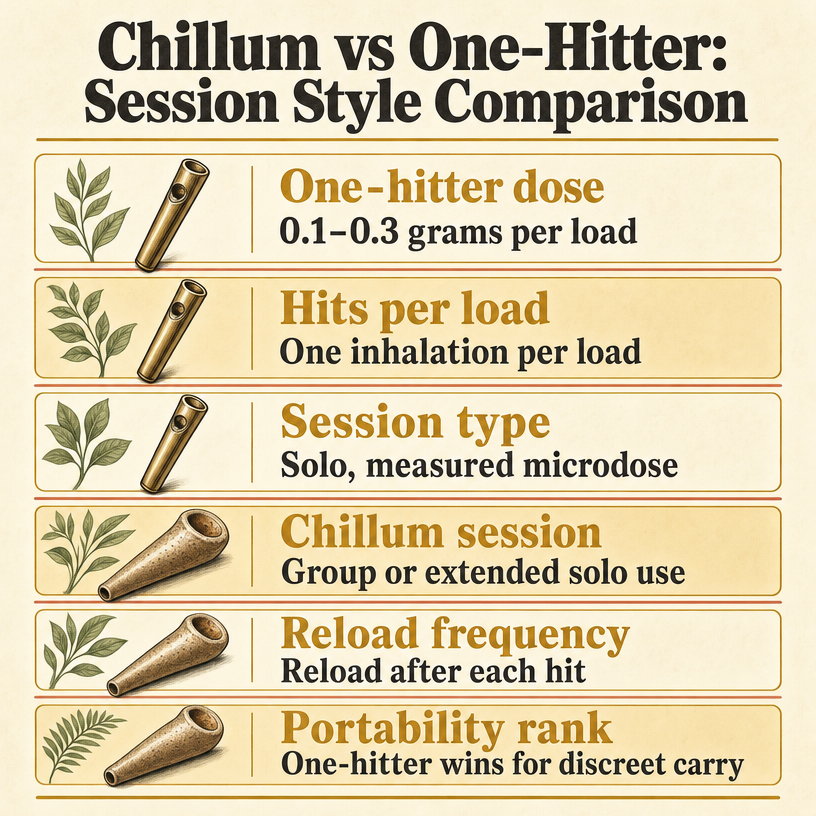
Capacity is where the chillum and one-hitter diverge most clearly. A one-hitter is designed to hold a single dose of roughly 0.1–0.3 grams. [2] You load, you draw, you are done. There is no reloading mid-session because the bowl does not hold more than that amount.
- One-hitter holds 0.1–0.3 grams per load — a single measured dose per use
- Chillum holds significantly more, supporting multiple hits from one load
- Reload frequency is every hit on a one-hitter; less often on a chillum
- One-hitter suits microdosing and controlled sessions; chillum suits group or extended solo use
A chillum holds considerably more material per load. The exact amount depends on the specific pipe and how generously you pack it, but chillums are built for multi-hit sessions. [4] You can load once and share with a group or take multiple hits over several minutes without touching the herb again.
If you want a controlled, measured experience with no excess, a one-hitter delivers exactly that. If you want to relax into a longer session without constant reloading, the chillum is the better choice. [5]
With a one-hitter, you reload after every hit, which keeps each inhalation fresh and potent. [3] With a chillum, the herb sits in the bowl between hits, which can affect burn rate. For group sessions, a chillum reduces the interruption of stopping to reload. What Is the Difference Between a Bubbler and a Bong?
Read What Is the Difference Between a Bubbler and a Bong? for more detail.
What Materials and Styles Are Available for Each Pipe Type?
Both chillums and one-hitters come in a range of materials. Glass is the most common for both types. It is easy to clean, does not interfere with herb flavor, and allows for a wide range of visual styles. [1] Glass pipes are also relatively affordable and widely available.
- Glass: most common for both types; easy to clean, no flavor interference, wide style range
- Stone (steatite, soapstone): traditional for chillums; durable, retains heat, natural look
- Clay: traditional material for chillums; affordable but more fragile than glass or stone
- Metal and silicone: common for one-hitters; extremely durable and good for travel
Stone pipes — particularly those made from steatite or soapstone — are traditional for chillums and remain popular. Stone retains heat well and produces a different smoking experience. [1] The material is durable and can last a long time with proper care.
Clay is another traditional material, especially for chillums. Clay pipes have been used for centuries in South Asia. [1] They are generally more affordable but can be fragile if dropped.
For one-hitters, metal and silicone are also common, particularly in dugout sets. Metal one-hitters are extremely durable and easy to clean. Silicone one-hitters are flexible, heat-resistant, and nearly unbreakable. [2] Some users prefer metal or silicone for travel because they can withstand more rough handling than glass. Stoned Potter Classic Spoon Ceramic Pipe
See Stoned Potter Classic Spoon Ceramic Pipe as one current product example.
How Do You Clean and Maintain a Chillum vs a One-Hitter?
Cleaning both pipe types follows the same basic principle: residue buildup affects performance over time. The longer you go between cleanings, the harder the residue becomes to remove. Regular maintenance keeps both pipes smoking smoothly.
- Clean one-hitter screens and bores regularly with a pipe cleaner or brush dipped in isopropyl alcohol
- Soak glass components in isopropyl alcohol and coarse salt for deep cleaning; rinse thoroughly
- Use long-handled brushes for chillum bores; avoid soaking stone or clay chillums for long periods
- Replace worn screens on one-hitters; consider a loose screen insert for chillums to reduce residue buildup
For a one-hitter, the screen or pinch near the bowl is the key area to maintain. If the screen becomes clogged, it restricts airflow and makes the pipe harder to draw from. [2] To clean a one-hitter, use a pipe cleaner or thin brush dipped in rubbing alcohol. Run it through the channel until residue comes off. For a deeper clean, soak the metal or glass components in alcohol for a few hours.
Glass one-hitters respond well to the same methods as other glass pipes. Isopropyl alcohol and coarse salt make an effective cleaning mixture. Shake the components in a sealed bag with the solution, then rinse thoroughly with water. [2] Make sure the pipe is completely dry before using it again.
Chillums with an open bore may require longer brush tools to reach the full length of the channel. A long pipe cleaner or a brush designed for chillums works well. For heavy residue, soak the chillum in isopropyl alcohol and then scrub the bore. Stone and clay chillums should not be soaked for extended periods, as the materials can absorb liquid and crack when heated.
Both pipes benefit from regular use of a screen or filter to reduce ash and residue entering the bore. Replacing worn screens on one-hitters keeps the pipe performing well. Storage matters as well — keeping your pipe in a protective case or pouch prevents damage and keeps the bore free of debris.
Both chillums and one-hitters have been trusted smoking tools for generations, and for good reason. They are durable, easy to use, and produce a clean, satisfying smoke. Choosing between them ultimately comes down to your lifestyle. If you want something discreet that fits in a pocket or cigarette case, a one-hitter is hard to beat. If you prefer a more comfortable grip and a slightly cooler smoke over a longer draw, a chillum may be the better everyday choice. Either way, both are affordable, low-maintenance tools that deliver a quality experience without requiring any special equipment or technique.
Browse Silicone Bongs to explore related options.
What Are Common Questions About Smoking Accessories?
Can a chillum be used for a single hit like a one-hitter?
Yes, a chillum can be loaded with a small amount and used for a single inhalation, but it is not designed for that purpose. Chillums hold more material and are better suited to multiple hits before reloading.
Are chillums stronger than one-hitters?
Strength and durability depend on the material (glass, stone, clay) rather than the pipe type. Both chillums and one-hitters are available in a range of materials suited to different durability preferences.
What is a dugout and does it work with a chillum?
A dugout is a small wooden case with two compartments—one for a one-hitter and one for ground herb. Dugouts are designed for one-hitters due to their slender shape and are not typically used with wider chillums.
Which pipe is better for sharing?
A chillum is better suited for sharing. Its larger capacity allows multiple hits before reloading, making it more practical for group sessions. One-hitters are designed for solo, measured dosing.
Do chillums and one-hitters require a screen?
Traditional chillums are straight-bore with no screen. One-hitters typically have a pinched or screened restriction near the bowl to prevent ash from entering the mouthpiece.
Which Pipe Should You Choose: a Chillum or a One-Hitter?
Choosing between a chillum and a one-hitter comes down to how you smoke and what you need from a pipe. If portability, discreetness, and precise dosing are your priorities, the one-hitter is the clear winner. The narrow profile, contained storage in a dugout, and single-dose design make it one of the most convenient options for solo use on the move. [3]
If you prefer longer sessions, group use, or a pipe with more cultural and historical character, the chillum is worth considering. The open bore, larger capacity, and spiritual heritage give it a different feel that many smokers prefer. [1]
Both pipes have been refined over centuries and decades of use. Many smokers keep both on hand for different occasions.
Where Does This Smoking Accessory Information Come From?
- Wikipedia: Chillum
- Wikipedia: One-hitter (smoking)
- GiggleGlass: The Differences Between a Chillum and a One Hitter
- Thick Ass Glass: Chillum vs One Hitter: A Direct Comparison of Styles
- Zen Leaf: Chillum vs. One Hitter: Which One is Right for You?