

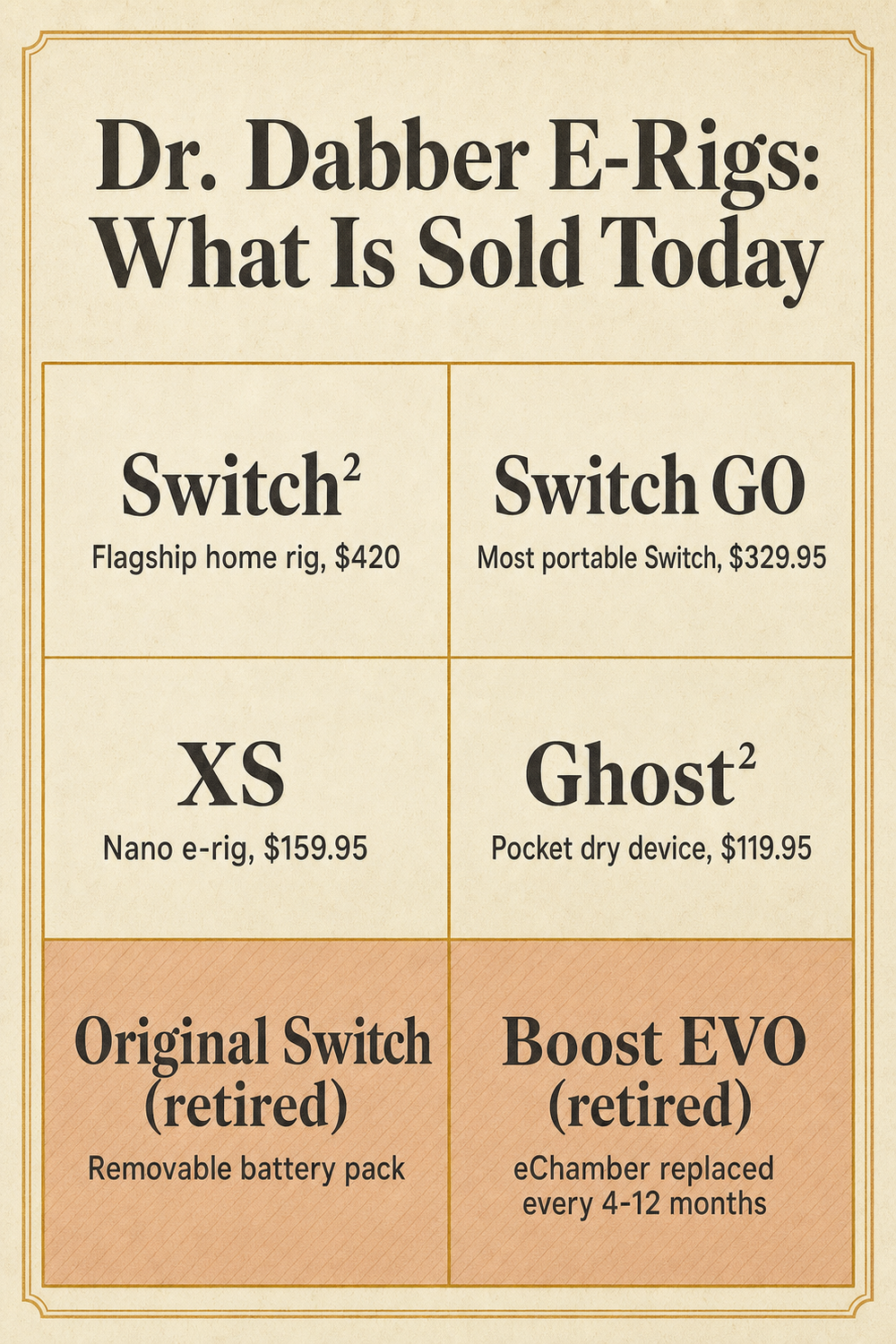
Dr. Dabber is the company that says it built the first e-rig, and the line-up it actually sells today is smaller than the brand’s back catalog suggests. The manufacturer’s own vaporizer collection lists four devices – Switch², Switch GO, Ghost², and XS – plus an XS On-The-Go Bundle and the Light pen kit, and its support hub publishes documentation for exactly five products [1] [15].
Neither the original SWITCH nor the Boost EVO is among them. Both have been retired from the manufacturer’s own store, the Boost EVO collection page now carries accessories only, and its former product URL redirects to a general vaporizer collection [16].
Two things decide almost everything after that. The first is heating design: Switch² and Switch GO use induction heating with reusable inserts and no replaceable heating chambers, while XS and Ghost² use quartz eChambers with built-in temperature sensors. The second is format: Switch² is the home flagship, Switch GO is the smaller portable, Ghost² is a pocket-sized dry device the company describes as a complement rather than a replacement, and XS is the smallest and least expensive [6].
This guide compares them on published specs, explains the heating difference, and covers loading, cleaning, warranty, and what ownership costs beyond the device itself.
What is Dr. Dabber, and which e-rigs does the brand still sell?
Start with what the brand sells now, because the most common buying mistake is shopping for a device the maker no longer carries. The manufacturer’s vaporizer collection lists four current devices with their own support documentation – Switch², Switch GO, Ghost², and XS – alongside an XS On-The-Go Bundle and the Light pen kit, and the support hub indexes knowledge bases and user manuals for exactly five products [1] [15].
The original SWITCH and the Boost EVO are not among them. The Boost EVO collection page now contains accessories only, with no device listed for sale, and the former product URL redirects to a general vaporizer collection [16]. Buyers searching either name are looking at hardware the maker has taken out of its own store, even though third-party retailers still list it.
The history explains why the names are confusing. The company says it created the first e-rig in 2015 with the Dr. Dabber Boost, and that the Ghost pen dates to 2013 and helped shape the wax pen segment [6] [20]. The original Switch released in 2018, the Boost EVO launched in fall 2020, and Switch² and Switch GO are the current generation of that same induction platform [8] [19].
Two things stay constant across the line, and the later sections build on them: every current device charges over USB-C with pass-through charging, and each one uses either a reusable quartz insert or a quartz eChamber with a built-in temperature sensor. The manufacturer frames reusable inserts as a deliberate position against what it calls a competitor business model of continuous chamber replacement [6].
The Dr Dabber XS e-Rig Portable Vaporizer is one of the four devices in the current line-up, and it is a useful reference point for the smallest end of the range. Replacement parts and consumables, meanwhile, sit in our Accessories collection, and the wider Dab Rigs collection covers the rest of the category if you want to compare formats side by side.
- Current devices: Switch², Switch GO, Ghost², and XS, plus an XS On-The-Go Bundle and the Light pen kit.
- Retired from the manufacturer’s own store: the original SWITCH and the Boost EVO.
- Support documentation exists for exactly five products, which corroborates which devices are still backed [15].
- Brand history: the first e-rig dates to 2015, the original Switch to 2018, and the Boost EVO to fall 2020.
- Shared across the current line: USB-C charging with pass-through, and either a reusable quartz insert or a quartz eChamber.
What is the difference between the Switch², Switch GO, Ghost², and XS?
Use the published spec blocks as the spine, because this is a case where the manufacturer’s own numbers separate the devices cleanly. Switch² is the flagship at $420 with a published 250-650°F range, a 5-20 second heat-up depending on setting, up to 30 heating cycles per charge, a 60-90 minute charge over USB-C with pass-through, 9 inches by 4 inches at 25.6 oz, and a 2-year warranty on the battery, charger, and electrical components. Kit contents are the vaporizer, the Drop heated loading tool, a glass attachment, a carb cap, a USB-C charging cable, and a charging adapter [2] [11].
Switch GO is the same platform scaled down at $329.95. The manufacturer describes it as 54% smaller than Switch² and publishes the same 250-650°F range and 5-20 second heat-up, up to 20 heating cycles per charge, a 45-60 minute charge, 6 inches by 3.3 inches at 12.8 oz, a 14mm single-crystal quartz insert in a titanium heating chamber, and a 1-year warranty [3].
XS is the smallest and least expensive e-rig at $159.95, described as the first nano e-rig, with four settings at 475, 525, 575, and 625°F, a 9-12 second heat-up, up to 35 heating cycles per charge, a 30-60 minute charge, 6.47 inches by 1.82 inches at 9.4 oz, a 20-second hold time, a 5-minute auto shutoff, and a 1-year warranty. Its listing also carries a ‘*For use with CBD only’ footnote, and the Light pen kit carries the same footnote [5] [13].
Ghost² is the outlier rather than a smaller e-rig: $119.95 for a pocket device with no water attachment, a 420-540°F range across five settings, a 5-10 second heat-up, up to 20 heating cycles per charge, a 45-60 minute charge, a 15-minute auto shutoff, 3.5 inches by 1.7 inches at 7 oz, and a 1-year warranty. The company describes it as a complement to a standard e-rig, not a replacement for one [4] [14].
One pattern is worth noticing: cycles per charge, charge time, and warranty length all move with size and price, while heat-up time is the published figure that barely changes across the line. If you have read our What Is Puffco and How Do the Peak, Peak Pro, and Proxy Compare? already, the shape of that line-up will look familiar – a flagship, a smaller portable, and a pocket device. For the pen-style end of things, Vape Pen vs Box Mod: Which Is Right for You? covers that format on its own.
- Switch² – $420 flagship; 250-650°F; 5-20 second heat-up; up to 30 heating cycles per charge; 60-90 minute charge; 9 in by 4 in at 25.6 oz; 2-year warranty on the battery, charger, and electrical components.
- Switch GO – $329.95; 54% smaller than Switch²; 250-650°F; 5-20 second heat-up; up to 20 cycles per charge; 45-60 minute charge; 6 in by 3.3 in at 12.8 oz; 1-year warranty.
- XS – $159.95; four settings at 475, 525, 575, and 625°F; 9-12 second heat-up; up to 35 cycles per charge; 30-60 minute charge; 6.47 in by 1.82 in at 9.4 oz; 20-second hold time; 5-minute auto shutoff; 1-year warranty.
- Ghost² – $119.95; 420-540°F across five settings; 5-10 second heat-up; up to 20 cycles per charge; 45-60 minute charge; 3.5 in by 1.7 in at 7 oz; 15-minute auto shutoff; 1-year warranty.
- Inserts – Switch² ships with a 20mm quartz insert and sells a Sapphire Plus insert separately; Switch GO uses a 14mm single-crystal quartz insert; XS and Ghost² use quartz eChambers with built-in temperature sensors.
- Kit details – Switch² includes the Drop heated loading tool, a glass attachment, a carb cap, a USB-C cable, and a charging adapter, while the XS and Light pen listings carry a ‘*For use with CBD only’ footnote.
| Feature | Switch² | Switch GO | XS | Ghost² |
|---|---|---|---|---|
| Price | $420 | $329.95 | $159.95 | $119.95 |
| Temperature range | 250-650°F | 250-650°F | 475, 525, 575 and 625°F | 420-540°F across five settings |
| Heat-up time | 5-20 seconds | 5-20 seconds | 9-12 seconds | 5-10 seconds |
| Cycles per charge | Up to 30 | Up to 20 | Up to 35 | Up to 20 |
| Charge time (USB-C) | 60-90 minutes | 45-60 minutes | 30-60 minutes | 45-60 minutes |
| Size and weight | 9 x 4 in, 25.6 oz | 6 x 3.3 in, 12.8 oz | 6.47 x 1.82 in, 9.4 oz | 3.5 x 1.7 in, 7 oz |
| Insert | 20mm quartz; Sapphire Plus sold separately | 14mm single-crystal quartz in a titanium chamber | Quartz eChamber with a built-in sensor | Quartz eChamber with a built-in sensor |
| Warranty | 2 years on battery, charger and electrical components | 1 year | 1 year | 1 year |
Which Dr. Dabber e-rig fits how you dab?
Work five checks in order, because each one rules models out before you reach the next.
One quiet difference shapes long-term ownership more than the specs do. XS uses a disposable eChamber that is not covered by warranty and typically needs replacing every 4-12 months, while Switch² and Switch GO are marketed on reusable inserts with no replaceable heating chambers [7] [13]. If a silicone-and-glass water piece suits your setup better than a portable e-rig, the SILICONE BEAKER BONG WITH REMOVABLE GLASS BOWL is one example of the alternative format.
- Decide home or pocket first. Switch² is a 9-by-4-inch, 25.6-oz home unit, Switch GO is 54% smaller at 6 by 3.3 inches and 12.8 oz, XS is 6.47 inches tall and 1.82 inches around at 9.4 oz, and Ghost² is 3.5 by 1.7 inches at 7 oz [2] [3] [4] [5].
- Check whether you want water in the path. Switch², Switch GO, and XS use glass attachments, while Ghost² has no water attachment at all – the manufacturer describes it as a complement to a standard e-rig rather than a replacement for one [4].
- Match cycles per charge to how long your sessions run. Published maximums are up to 30 for Switch², up to 20 for Switch GO and Ghost², and up to 35 for XS, and the manufacturer notes that how many cycles a charge delivers depends on the heat setting used [2] [3] [5] [9].
- Budget for the whole setup rather than the device alone. List prices run $420 for Switch², $329.95 for Switch GO, $159.95 for XS, and $119.95 for Ghost², and the accessory breakdown later in this guide shows what recurring spend looks like [2] [4].
- Read the manufacturer’s own recommendation, then read it critically. Asked which product is for whom, Dr. Dabber says Switch² is the flagship home device for buyers who want the best, Switch GO is the smaller, more portable, most versatile option and likely best for most people, and Ghost² is a discreet pocket device that complements a full rig. That answer does not mention XS or the Light pen even though both are still sold, so a buyer relying on the FAQ alone will not see the full line-up [6] [7].
How does induction heating work, and how is it different from an eChamber?
Induction is what the Switch platform uses. The manufacturer says induction heating generates heat directly in the heating element via a magnetic field, which lets the heating system sit physically separated from the electronics, and describes the heating as omnidirectional – surrounding the insert and warming the sidewalls and the base at the same rate rather than the bottom only [6].
Switch² adds an integrated infrared sensor to that arrangement, which the company describes as a first for the line [2] [11]. The payoff the manufacturer claims for induction is not a number but a design consequence: there is no replaceable heating chamber to buy, which the manufacturer frames as a deliberate design position [6]. Our Dr. Dabber Switch² ™ eRig page shows the device this platform is built into.
The eChamber devices work differently. XS and Ghost² use quartz eChambers with built-in temperature sensors, and the retired Boost EVO used a magnetic quartz eChamber with a built-in sensor that conducted heat to the load – the manufacturer’s own comparison content describes the Boost EVO as a conduction device while calling the original SWITCH induction [8] [9] [13] [14].
The heating modes are the other half of the story, and they change the shape of the heating curve rather than just the set point: Descent Mode is the Switch² default and drops about 1°F per second during the session, Ascent Mode starts low and climbs, and Steady Mode holds a stable temperature while adjusting to load size and draw. Ghost² carries the same three dynamic modes [2] [14].
- Induction (Switch², Switch GO, original SWITCH) – heat is generated in the element by a magnetic field, so the heating system sits apart from the electronics [6].
- Omnidirectional heating – surrounds the insert and warms the sidewalls and the base at the same rate rather than the bottom alone.
- eChamber (XS, Ghost², and the retired Boost EVO) – a quartz chamber with a built-in temperature sensor; on the Boost EVO the manufacturer describes the design as conduction [9] [13].
- Dynamic modes – Descent drops about 1°F per second and is the Switch² default, Ascent climbs from a low start, and Steady holds temperature while adjusting to load size and draw.
- Practical consequence – induction means no replaceable heating chamber on the device, while the eChamber devices have a chamber that counts as a wear part.
| Feature | Induction heating | eChamber heating |
|---|---|---|
| How heat is generated | A magnetic field generates heat directly in the heating element | A quartz chamber with a built-in sensor conducts heat to the load |
| Where the heating system sits | Physically separated from the electronics | Built into the chamber that holds the load |
| Replaceable heating chamber | None – reusable inserts only | Yes on the Boost EVO and XS, where it is a wear part replaced every 4-12 months |
| Devices in the line | Switch², Switch GO and the retired original Switch | XS, Ghost² and the retired Boost EVO |
| Heat control | Descent, Ascent and Steady dynamic modes, plus app customization on Switch² and Switch GO | Selectable temperature settings fixed per device |
How do you load and run a Dr. Dabber e-rig?
Work the routine in the order a new owner actually does it, because the loading details differ more between models than the product pages make obvious.
Two practical notes complete the routine. The manufacturer notes that how many cycles a charge delivers depends on the heat setting used, and that the Boost EVO and XS will not charge from a high-wattage adapter such as a laptop charger [5] [9]. If you are weighing an e-rig against a torch and a banger, the everyday difference comes down to a battery, a published temperature range, and stated cycle counts instead of open flame and timing.
- Load small. The manufacturer’s general recommendation is a rice-sized amount placed directly on the bottom heating plate or into the insert, with the load not exceeding half the chamber’s capacity [9] [11].
- Respect each device’s stated ceiling. The Switch² documentation says it can handle up to full-gram loads, the Switch GO documentation says up to half-gram loads, and Ghost² guidance is roughly half a pea-sized amount, with a warning that overloading restricts airflow [11] [12] [14].
- Match the insert to the material. Switch GO documentation names the titanium insert as the appropriate choice for flower, dry materials, or concentrates with high plant matter such as hash, and the Switch² documentation makes the same recommendation for flower or high-plant-matter material [11] [12].
- Pick a heat setting, knowing that published numbers diverge. The manufacturer publishes 250-650°F for both Switch² and Switch GO, 420-540°F across five settings for Ghost², and four settings for XS at 475, 525, 575, and 625°F, while a specialist review of the same Switch² describes it as five preset temperatures running from 400°F to 540°F with LED color cues [2] [3] [5] [23]. Read any single quoted range as one source’s version rather than the whole spec.
- On the models that offer one, pick a heating mode. Descent Mode is the Switch² default and drops about 1°F per second during the session, Ascent Mode climbs from a low start, and Steady Mode holds temperature while adjusting to load size and draw [2] [11].
- Handle the Drop tool and the body the way the documentation says. Do not scrape the Drop heated loading tool on the edge of the insert, because the electronics inside the battery-powered unit can be damaged if it contacts the induction field, and give Switch GO about 20 minutes to cool after three or more consecutive cycles since its top and back get warm [11] [12].
How do you clean a Dr. Dabber e-rig, and which parts wear out?
Here is the cleaning routine as the manufacturer publishes it, followed by the part that catches new owners out.
The blink codes are the difference between cleaning a part and replacing it: on the Boost EVO and XS, three white blinks indicate an open circuit or a missing eChamber and three pink or orange blinks indicate other faults, and the first response is to clean the contacts. The manufacturer attributes failed recalibrations to a temperature difference between the eChamber and the main unit, unclean electrode connections, or a chamber that is not seated properly, and notes that several attempts may be needed [9] [13]. Switch² documentation also includes a cleaning assist cycle, and XS adds a 5-minute auto shutoff [11] [13].
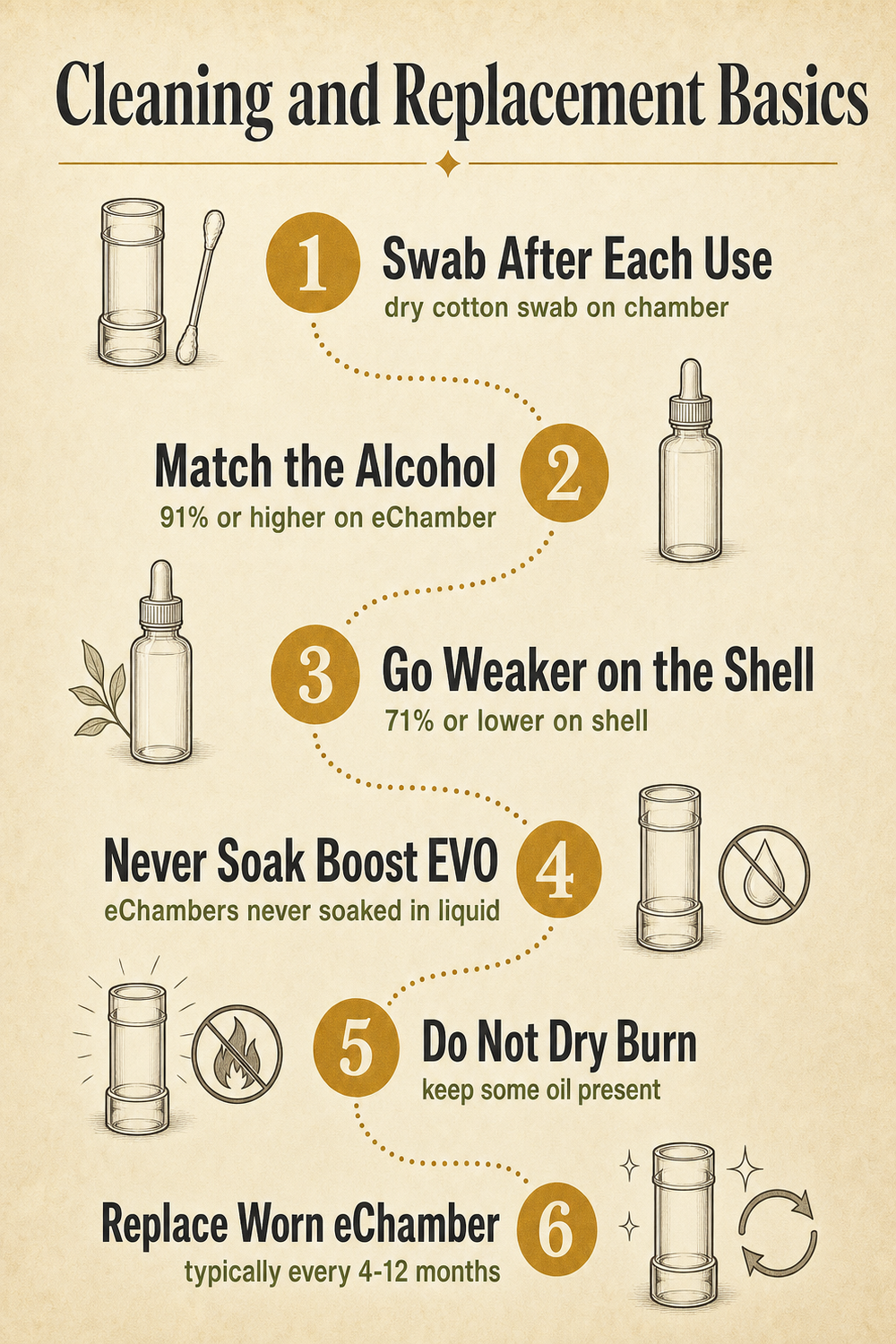
- Swab after every use. The general guidance across the line is to swab the chamber with a dry cotton swab, and to use an isopropyl-dipped swab on a still-warm chamber for stubborn residue [9] [13].
- Match the alcohol strength to the part. XS documentation specifies 91% or higher isopropyl alcohol for the eChamber and glass attachment, and 71% or lower on the unit shell, because a higher alcohol concentration risks removing the paint finish [13].
- Never soak a Boost EVO eChamber. Its eChambers must not be soaked in isopropyl alcohol or any other liquid, and they should not be dry burned, because a small amount of oil should always be present while in use [9].
- Clean Boost EVO glass separately. Unlike the chamber, the glass can be filled with isopropyl, shaken, then rinsed and air dried [9].
- Track the wear part. On the Boost EVO and XS the eChamber is a disposable component that is explicitly not covered by the warranty and that the manufacturer says typically needs replacing every 4-12 months depending on usage and cleaning habits, while Switch² and Switch GO use reusable inserts with no replaceable heating chambers [7] [9] [13].
- Recalibrate after a Boost EVO chamber swap. With the unit off and unplugged for 15 minutes so the main unit and the eChamber reach the same temperature, click the button four times while holding on the fourth press; three white blinks indicate success and three red blinks indicate failure [9].
What does the Dr. Dabber warranty cover, and what voids it?
Warranty terms live on product pages rather than in a single policy document – both /pages/warranty and /pages/warranty-policy return 404, so there is no standalone warranty page to read. What the product pages state is a 1-year warranty across Dr. Dabber vaporizers with the SWITCH family singled out at 2 years, and the Switch² spec block separately specifies 2-year coverage on the battery, charger, and electrical components [2] [3].
The exclusions and conditions are easy to miss at purchase, so it is worth listing them rather than paraphrasing.
- Coverage by device – Switch² specifies 2-year coverage on the battery, charger, and electrical components, while Switch GO, Ghost², and XS listings each state a 1-year warranty [2] [3] [4] [5].
- Excluded parts – eChambers are excluded from coverage as disposable components [9] [13].
- Software condition – the Switch² and Switch GO knowledge bases state that only the official Dr. Dabber and LabLink apps are recommended for connecting to the devices, and that third-party app usage may void the warranty [11] [12].
- Handling condition – the same documentation warns against scraping the Drop heated loading tool on the edge of the insert, because the electronics in the battery-powered unit can be damaged if it contacts the induction field.
- Returns – the manufacturer’s window is 30 days and is limited to items that are unopened and in original packaging.
- Manufacturer shipping – the product pages state free domestic shipping on orders over $150, which means most single-device orders qualify [2].
- Shopping with us – Treehouse Lifestyle offers free shipping on orders $150+, and the Vaporizers collection is where our portable devices and e-rigs live.
What does Dr. Dabber ownership cost beyond the device?
Start with the accessory list, because it shows where recurring spend sits. Replacement Switch² parts list at $129.95 for the Sapphire Plus insert, $134.95 for the Incycler glass attachment, $79.95 for replacement glass, $39.95 for a quartz insert, $24.95 each for a titanium insert and a replacement carb cap, and $39.95 for the Drop heated loading tool [2].
Then look at what happens to parts when a device is retired. Boost EVO accessories have moved to the manufacturer’s Legacy Accessories collection at clearance pricing, with glass attachments cut from $99.95 to $40, the Hive Ball from $119.95 to $45, and the Boost EVO Quartz eChamber listed at $49.95, and at least one Boost EVO item is marked out of stock [16] [17].
Independent hands-on reviews flag trade-offs rather than uniform praise, and they are worth reading before you commit to a model.
- Switch² accessories – Sapphire Plus insert $129.95, Incycler glass attachment $134.95, replacement glass $79.95, quartz insert $39.95, titanium insert $24.95, replacement carb cap $24.95, and the Drop loading tool $39.95 [2].
- Retired-device parts – Boost EVO glass attachments fell from $99.95 to $40 and the Hive Ball from $119.95 to $45 in the Legacy Accessories collection, and stock on those items is finite [17].
- Carb cap – reviewers rate the Switch² highly for its induction heating and easy cleaning, but note that the included directional carb cap limits airflow relative to an aftermarket spinner cap [18].
- Insert upgrade – the quartz-to-sapphire upgrade was the least noticeable of the upgrades one reviewer tested [18].
- Packaging – a retailer review calls the Switch² packaging unusually minimal for the price and recommends budgeting for an aftermarket case, since the original Switch shipped with a padded case that Switch² does not replicate [19].
- Ghost² design – a review singles out its hinged magnetic top and zirconia mouthpiece as that device’s standout features [20].
Frequently Asked Questions
Is the Dr. Dabber Boost EVO discontinued?
Yes – it has been retired from the manufacturer’s own store. The Boost EVO collection page now carries accessories only with no device listed for sale, the product URL redirects to a general vaporizer collection, and the support hub publishes documentation for five products (Switch², Switch GO, Ghost², XS, and the Light kit) with nothing for the Boost EVO or the original Switch. Third-party listings for the hardware still appear, and its parts now sit in the manufacturer’s Legacy Accessories collection at clearance prices [15] [16] [17].
What is the difference between the original SWITCH and the Switch²?
The original Switch released in 2018 with 25 heat settings spanning 300°F to 780°F in 20-degree steps and a removable battery pack, and it has since been discontinued. Switch² is the current flagship at $420 with a published 250-650°F range, three dynamic heating modes, an integrated infrared sensor alongside omnidirectional induction heating, and an internal battery a retailer hands-on review describes as not user-removable. One trade-off comes up in reviews: the original Switch shipped with a padded case that Switch² does not replicate [10] [19] [22].
Do Dr. Dabber e-rigs need replacement chambers?
It depends on the model. On the Boost EVO and XS, the eChamber is a disposable component that is explicitly not covered by warranty and that the manufacturer says typically needs replacing every 4-12 months depending on usage and cleaning habits. Switch² and Switch GO are marketed on the opposite premise – reusable inserts with no replaceable heating chambers, using a quartz insert included in the kit with sapphire or titanium sold separately [7] [9] [13].
How many hits does a Dr. Dabber battery deliver per charge?
The published maximums are up to 30 heating cycles for Switch², up to 20 for Switch GO and Ghost², up to 35 for XS, and 60+ hits for the retired Boost EVO, and the manufacturer notes the count depends on the heat setting used. Hands-on figures differ from published ones: a review that ran the Switch² as shipped measured between 17 and 25 dabs per charge depending on hit style, dropping to about ten sessions when sessions were extended from 30 to 90 seconds. Read per-charge numbers as best-case figures [2] [5] [9] [18].
How do you clean a Dr. Dabber e-rig?
Swab the chamber with a dry cotton swab after every use, and use an isopropyl-dipped swab on a still-warm chamber for stubborn residue. XS documentation calls for 91% or higher isopropyl alcohol on the eChamber and glass attachment and 71% or lower on the unit shell, because a higher alcohol concentration risks removing the paint finish. Two rules matter most on the Boost EVO: its eChambers must not be soaked in isopropyl alcohol or any other liquid, and they should not be dry burned, because a small amount of oil should always be present while in use [9] [13].
What does the Dr. Dabber warranty cover, and what voids it?
The product pages state a 1-year warranty across Dr. Dabber vaporizers, with the SWITCH family singled out at 2 years and the Switch² spec block specifying 2-year coverage on the battery, charger, and electrical components. eChambers are excluded as disposable components. Two manufacturer-stated conditions can take a device outside coverage: third-party app usage may void the warranty on Switch² and Switch GO, since only the official Dr. Dabber and LabLink apps are recommended, and scraping the Drop loading tool on the insert edge can damage its electronics. There is no standalone warranty page, so check the individual product page [2] [11] [12].
So which Dr. Dabber e-rig should you buy?
Confirm the model is in the current line-up before anything else, because that single check separates a device the manufacturer still supports from one whose parts are already moving to clearance. As of the manufacturer’s own collection and support pages, that means Switch², Switch GO, Ghost², and XS [1] [15].
After that, the decision comes down to format and heating design. If you want a home unit with the largest published battery figures and the longest warranty, Switch² is the flagship at $420. If you want the same induction platform in a smaller body, Switch GO at $329.95 is the model the manufacturer itself recommends for most people. If portability is the priority and you accept a device the company describes as a complement rather than a replacement, Ghost² at $119.95 is the smallest and cheapest option. XS at $159.95 sits between them on price while offering the highest published cycle count and the smallest e-rig footprint – with the caveat that its eChamber is a wear part [2] [3] [4] [5].
Whichever you choose, budget beyond the sticker price, read the warranty line on that specific product page, and follow the manufacturer’s cleaning rules for the exact part you are handling. It is also worth remembering what these devices are built around: public-health guidance notes that concentrates may contain additives or be contaminated with other substances, and that scientists do not have enough evidence to say that any one method of use carries less risk than another [24] [25].
Sources
- Dr. Dabber: Vaporizers Collection
- Dr. Dabber: Dr. Dabber Switch²
- Dr. Dabber: Dr. Dabber Switch GO
- Dr. Dabber: Dr. Dabber Ghost²
- Dr. Dabber: Dr. Dabber XS
- Dr. Dabber: Dr. Dabber FAQ
- Dr. Dabber: Which eRig is Right for Me?
- Dr. Dabber: Boost EVO vs SWITCH: Which Smart Rig is Best for You?
- Dr. Dabber Knowledge Base: Boost Evo Knowledge Base
- Dr. Dabber Knowledge Base: Switch Knowledge Base
- Dr. Dabber Knowledge Base: Switch² Knowledge Base
- Dr. Dabber Knowledge Base: Switch GO Knowledge Base
- Dr. Dabber Knowledge Base: XS Knowledge Base
- Dr. Dabber Knowledge Base: Ghost² Knowledge Base
- Dr. Dabber: Support Hub
- Dr. Dabber: Boost Evo Collection
- Dr. Dabber: Legacy Accessories Collection
- Troy and Jerry ThinkDank: Dr Dabber Switch 2 Review
- To The Cloud Vapor Store: Dr. Dabber Switch 2 Vaporizer – Reimagining the Switch
- 420 Vape Zone: Dr Dabber Ghost 2 Review
- Fat Nugs Magazine: Dr. Dabber Boost EVO Review
- Vaporizer Wizard: Dr. Dabber Boost EVO vs. Switch Dab Rig
- TVape: Dr. Dabber Switch 2 Review: Is Induction Better than Convection?
- Centers for Disease Control and Prevention: Cannabis Frequently Asked Questions
- National Library of Medicine / PubMed Central: Cannabis dabbing: An emerging trend