
Keep your dab rig in top working condition with these proven cleaning methods
A dab rig is cleaned by filling it with 91% isopropyl alcohol and coarse salt, shaking it for about 5 minutes, then rinsing thoroughly and letting it air dry completely. This dissolves reclaim buildup and sanitizes the rig. Alternative methods include hot water soaks for those who want to collect reclaim for later use.
Regular cleaning keeps your dabs tasting pure and your rig working the way it should. Over time, residue collects inside the water chamber, the nail or banger, and the joint. That residue can change the flavor of your dabs and make the rig harder to clean the longer it sits. The good news is that a basic cleaning takes less than 10 minutes once you have the right supplies.
What Supplies Do You Need to Clean a Dab Rig?
Gathering everything before you start makes the cleaning process much smoother. Rushing through without the right materials usually means the job takes longer or produces poor results. Using the correct concentration of isopropyl alcohol and the right type of salt are the two most important factors in getting a truly clean rig. Without both of these elements in place, the cleaning will not work as well and you may have to repeat the process multiple times.
- 91% isopropyl alcohol (or higher concentration)
- Coarse salt such as rock salt, sea salt, Himalayan salt, or Epsom salt
- A sealable bag or container deep enough to hold the rig pieces
- Warm water for thorough rinsing
- Cotton swabs or soft brushes for detailed parts like the nail or banger
The concentration of isopropyl alcohol matters a great deal when you are cleaning a dab rig. Anything below 91% is diluted with too much water to effectively dissolve reclaim residue [1]. You need the higher concentration to break down the sticky oil that builds up inside the water chamber, the neck, and the joint. Most drugstores and grocery stores carry 91% isopropyl alcohol in the first aid section. You can also find it at auto supply stores, where it is sold as a fuel additive.
Coarse salts work significantly better than fine table salt because the larger crystals provide a physical scrubbing action that finer salt cannot match [1]. Rock salt, sea salt, Himalayan salt, and Epsom salt all work well for this purpose. The grit helps shake loose debris that the alcohol alone cannot dissolve, especially in the joint and downstem where solution flow is limited. When you shake the sealed rig, the salt crystals bounce against the glass walls and physically dislodge residue while the alcohol dissolves it chemically.
Beyond the two main cleaning agents, you also need a few supporting supplies. A sealable bag or a deep plastic container gives you a vessel to shake the rig without making a mess. A folded towel provides a non-slip surface to work on and absorbs any spills. Rubber gloves protect your hands from prolonged alcohol contact, especially if you have sensitive skin. Cotton swabs and soft brushes help you reach tight spots like the inside of the nail or banger after the main cleaning is done.
Browse Cleaning Supplies to explore related options.
Browse Dab Rigs to explore related options.
Read How Do You Clean a Bong the Right Way? for more detail.
What Are the Steps to Clean a Dab Rig with Isopropyl Alcohol and Salt?
The isopropyl alcohol and salt method is the most widely used approach for deep-cleaning a dab rig because it works quickly and thoroughly. The alcohol dissolves reclaim buildup on contact while the coarse salt acts as an abrasive to scrub away residue from the glass walls [1]. When you shake the sealed rig, the solution reaches every interior surface including areas you cannot see or reach with a brush. For heavily soiled rigs that have not been cleaned in weeks, you may need to repeat the process or let the rig soak in the solution for 10 to 15 minutes before shaking.
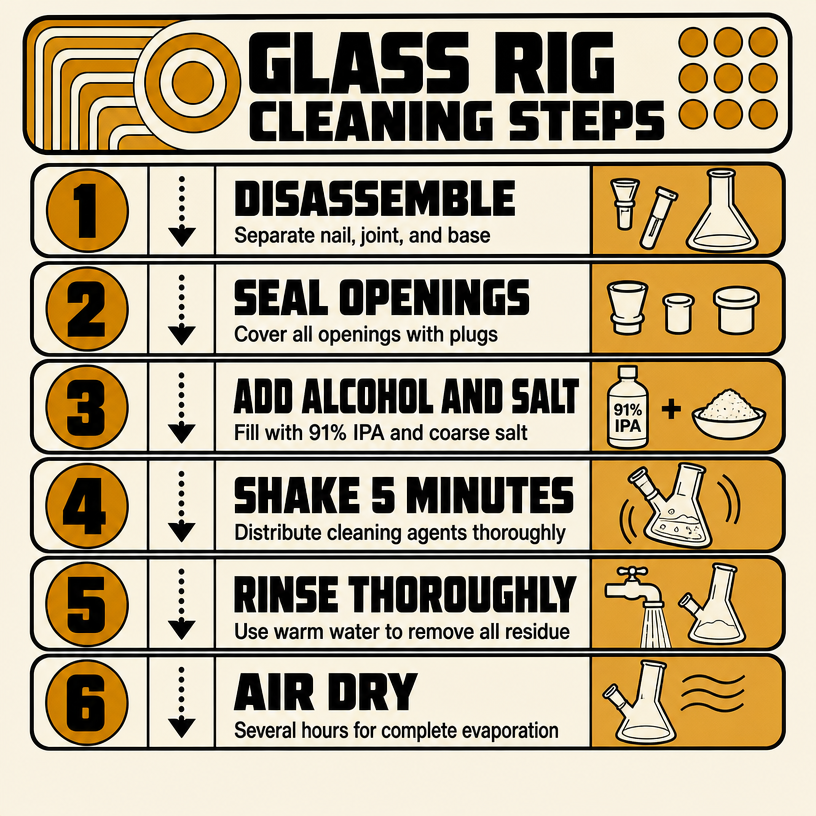
- Disassemble the rig by removing the nail or banger, the joint, and any other removable parts.
- Seal all openings on the base and neck using plug caps, rubber stoppers, or tightly wrapped plastic wrap.
- Place the rig inside a sealable bag or container and add 91% isopropyl alcohol until the interior glass is fully submerged.
- Add 2 to 3 tablespoons of coarse salt into the alcohol-filled rig.
- Seal the bag or container and shake the rig vigorously for approximately 5 minutes. Heavily soiled rigs may require longer shaking or a second round of cleaning [1].
- Remove the rig from the bag and carefully unseal all openings over a sink or basin.
- Rinse the interior thoroughly with warm water, running it through every part of the rig until all traces of alcohol and salt are gone.
- Set the rig upside down on a clean towel and let it air dry completely for several hours before reassembling and using again [1].
Work in a well-ventilated area whenever you use isopropyl alcohol. Open a window or set up a fan to keep air circulating. The fumes from 91% alcohol are stronger than you might expect, and prolonged inhalation in a closed space can cause headaches or dizziness. Wearing rubber gloves protects your hands from the alcohol, which can dry out skin with extended contact. Set the rig on a folded towel to prevent it from rolling or slipping during the shaking process.
Make sure all openings on the rig are sealed tightly before you begin shaking. Use plug caps, rubber stoppers, or several layers of tightly wrapped plastic wrap to seal the joint, the downstem opening, and the top of the neck. Any leak will spray alcohol solution everywhere when you start shaking. It also means less solution reaches the interior surfaces, which reduces cleaning effectiveness.
The shaking step is where the actual cleaning happens. Seal the rig inside a plastic bag or container with the alcohol and salt, then shake it vigorously for approximately 5 minutes [1]. The motion forces the salt and alcohol against every interior surface. Heavily soiled rigs may require a longer shaking time or a second round of cleaning before all residue is removed. You will often see the solution inside the bag turn dark amber or brown as reclaim dissolves out of the rig.
Read The Complete Guide to Cleaning Smoking Accessories for more detail.
Read What Is a Dab Rig and How Do You Use One? for more detail.
Read How Do I Maintain My Vaporizer for Best Performance? for more detail.
Can You Clean a Dab Rig with Hot Water Instead?
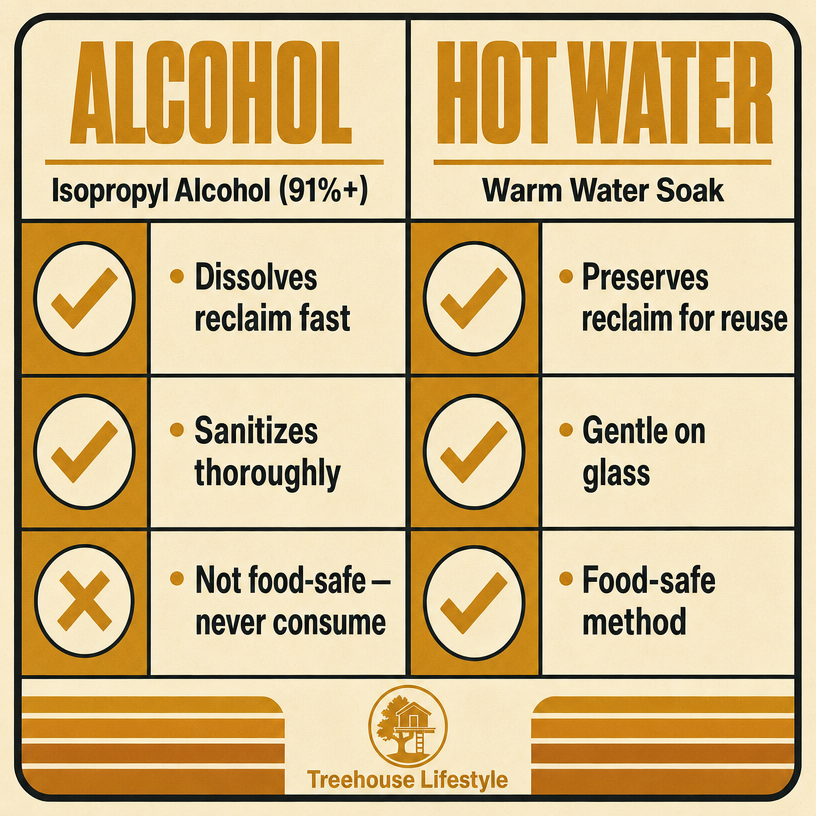
Hot water is a simple and effective alternative for users who want to avoid isopropyl alcohol altogether. This method works well for regular maintenance cleaning and is the preferred choice for anyone who wishes to collect and reuse reclaim [1]. The hot water loosens reclaim residue without dissolving it, which means the reclaimed material stays intact and can be saved for later use. This approach requires no special supplies beyond what you already have in your kitchen.
- Disassemble the rig completely, separating the base, neck, joint, nail or banger, and any other removable pieces.
- Bring water to a temperature just below boiling, then remove it from the heat source.
- Submerge the disassembled rig pieces in the hot water and let them soak for 30 to 60 minutes to allow the heat to loosen the residue.
- After soaking, scrub each piece with a soft brush or non-abrasive pad to remove loosened reclaim.
- Rinse each piece thoroughly with clean warm water.
- Set all pieces upside down on a clean towel and let them air dry completely before reassembling.
Temperature control matters a great deal with this method. Do not use boiling water under any circumstances. Extreme heat can crack or shatter glass, especially if the rig has any pre-existing stress cracks or weak spots [1]. Boiling water is 212 degrees Fahrenheit at sea level, and the thermal shock from pouring it into a room-temperature glass rig is more than enough to cause damage. Hot tap water or water heated to around 180 to 190 degrees works well.
The soaking time depends on how much residue has built up inside the rig. Light residue may come clean after 30 minutes of soaking, while heavy buildup may require 60 minutes or more. You can let the rig soak longer with no risk of damage, which makes this a good method to start before bed and finish cleaning in the morning. After soaking, scrub each piece with a soft brush or non-abrasive pad to remove any remaining residue before rinsing.
Read E-Rig vs Traditional Dab Rig: Which Should You Choose? for more detail.
How Often Should You Clean Your Dab Rig?
Cleaning frequency depends on how often you use the rig and the type of concentrates you dab. Thicker oils and concentrates with more lipids tend to leave heavier residue than lighter dabs, and some types of concentrates produce more reclaim than others. Paying attention to taste is one of the easiest ways to know when it is time to clean. If your dabs start to taste stale or muted, residue is almost certainly building up inside the rig, even if you cannot see it yet.
- Light users who dab a few times per week should clean every 1 to 2 weeks.
- Moderate to heavy users who dab daily should clean every few days to once per week.
- Watch for changes in taste and visible reclaim buildup as signals that your rig needs cleaning.
- Rinsing the rig with warm water immediately after using thicker concentrates can help extend the time between deep cleanings.
Visible reclaim buildup inside the glass is an obvious signal that cleaning is overdue. The darker and thicker the buildup, the longer it has been sitting. The longer residue sits, the harder it becomes to remove. A thin layer of fresh reclaim wipes away easily. A thick, hardened crust from weeks of neglect may require multiple soaking cycles and aggressive scrubbing to fully remove.
Developing a regular cleaning schedule is easier than waiting for problems to appear. Light users who dab a few times per week can maintain a clean rig by deep-cleaning every one to two weeks. Moderate to heavy users who dab daily should clean every few days to once per week. Between deep cleans, a quick warm water rinse after each session keeps residue from hardening and bonding to the glass permanently.
Browse Glass Dab Rigs to explore related options.
What Is Reclaim and Should You Save It?
Reclaim, short for reclaimation, is the residue that collects in your rig after dabbing. It forms when vaporized concentrates cool down and condense along the inside surfaces of the rig [1]. The vapor passes through the water in the base, where some of it cools and condenses back into a liquid. That liquid runs back down the neck and settles in the base as reclaim. Over time, repeated dabbing builds up layers of this residue.
- Reclaim is the concentrated residue that collects inside the rig after dabbing sessions.
- Cleaning with isopropyl alcohol makes the resulting reclaim unsafe to consume due to alcohol contamination.
- Use food-grade grain alcohol instead if you want to collect reclaim for later use, and label all containers clearly.
- Reclaim collected with grain alcohol can be dabbed later, though it tends to be more sedating than fresh concentrates.
Reclaim has a dark amber to brown color and a thick, sticky texture. It contains concentrated material that was not fully vaporized during the dabbing process. Some dabbers consider reclaim a bonus, since it represents concentrate that was not consumed in the original session. Others view it as waste that needs to be cleaned out before it affects flavor.
The key safety point to understand is that the cleaning method you choose determines whether reclaim is safe to consume. Isopropyl alcohol is not safe to consume under any circumstances [1] [2]. If you clean your rig with isopropyl alcohol, the resulting reclaim solution is contaminated with alcohol and must be discarded. Poisoning from ingesting isopropyl alcohol can cause serious illness and requires prompt medical attention.
Users who wish to collect and reuse reclaim should use food-grade grain alcohol instead, such as Everclear [1]. The process is the same as the isopropyl alcohol method, but grain alcohol is safe for consumption. The end result produces reclaim that can be saved and dabbed later. Always label containers clearly to prevent anyone from accidentally consuming the wrong substance. Reclaim collected with grain alcohol tends to be more sedating than fresh concentrate.
What Are the Parts of a Dab Rig Called?
Knowing the anatomy of your dab rig helps you clean each component correctly and troubleshoot performance issues over time. Each part plays a role in how the rig functions, and residue can affect each one differently. When you disassemble the rig for cleaning, you will handle each of these parts separately, so understanding what each one does makes the process more intuitive.
- The base, also called the water chamber, holds the water that cools the vapor before you inhale.
- The neck connects the base to the joint and directs vapor upward.
- The joint is the connection point where the nail or banger attaches to the rig.
- The nail or banger is the heated component where concentrates are placed and vaporized.
- The dab tool is used to handle concentrates and place them onto the nail or banger.
- The carb cap limits airflow over the nail to help vaporize all the concentrate efficiently.
The base, also called the water chamber, holds the water that cools the vapor before you inhale. Residue collects here as vapor condenses back into liquid after passing through the water. The neck connects the base to the joint and directs vapor upward toward the nail or banger. Both the neck and the base are hollow and can accumulate residue along their interior walls.
The joint is the connection point where the nail or banger attaches to the rig. This is one of the most important areas to clean because airflow passes through here constantly, and any buildup can restrict vapor flow and affect the flavor of your dabs. The dab tool is used to handle concentrates and place them onto the nail or banger, and should be cleaned periodically as well.
The terms nail and banger are used interchangeably in most regions [1]. Both refer to the heated component where concentrates are placed and vaporized. Some users prefer bangers for their angled design, while others use nails with flat tops. The carb cap limits airflow over the nail to help vaporize all the concentrate efficiently, and reclaim can build up on all of these components during use.
What Mistakes Should You Avoid When Cleaning a Dab Rig?
A few common errors can damage your rig or leave it in poor condition even after you think the cleaning is complete. Most of these mistakes are easy to avoid once you know what to watch for, and avoiding them can significantly extend the life of your rig. Taking a few extra minutes to do things right saves you from having to buy a replacement rig down the road.
- Avoid using isopropyl alcohol below 91% concentration, as the water content makes it ineffective at dissolving reclaim.
- Do not skip the air-dry step. Using a rig while it is still wet can cause burns and leaves alcohol residue inside.
- Never use abrasive scrubbers, steel wool, or rough brushes on glass surfaces, as they can scratch and weaken the glass.
- Avoid using boiling water, which can crack or shatter glass due to thermal shock.
- Do not let reclaim sit for weeks between cleanings, as it becomes progressively harder to remove the longer it sits.
Glass is fragile, especially where the walls are thin around the joint and the base. Even small impacts or sudden temperature changes can cause cracks or fractures that may not be visible right away but weaken the glass over time. This is why avoiding boiling water and abrasive scrubbers matters so much with glass rigs.
One of the most common mistakes is using isopropyl alcohol below 91% concentration. The water in lower concentrations dilutes the alcohol to the point where it cannot dissolve reclaim effectively. You end up with a rig that looks clean on the surface but still has residue underneath. Always check the label before you buy, and avoid products marketed as rubbing alcohol unless they specify 91% or higher.
How Do You Maintain a Dab Rig Between Cleanings?
A few quick habits after each session can reduce how often you need to do a deep clean. These steps take less than a minute and go a long way toward keeping your rig in good condition between thorough washings. The goal is to prevent residue from hardening and bonding to the glass in the first place, which is always easier than removing it after it has set.
- Run warm water through the rig immediately after each session to flush out fresh residue before it sets.
- Wipe the nail or banger with a cotton swab while it is still warm but not hot to the touch.
- Store the rig with the opening covered to reduce dust and debris entering the interior.
- Rinse the rig immediately after using thicker concentrates that leave more residue.
- Use a small brush on the joint and downstem each week to prevent buildup in those hard-to-reach areas.
Cleaning the nail or banger while it is still warm is the single most effective between-session maintenance step you can take. Warm reclaim is much softer and easier to wipe away than cold, hardened residue that has been sitting for hours. A cotton swab works well for this task, though you should let the nail cool slightly before cleaning to avoid accidental burns.
Running warm water through the rig immediately after each session flushes out fresh residue before it has a chance to set and harden. This is especially important after using thicker concentrates that leave more residue behind. Store the rig with the opening covered to reduce dust and debris entering the interior, and clean the joint and downstem with a small brush each week to prevent buildup in those areas.
What Are Common Questions About Smoking Accessories?
Can I use isopropyl alcohol to clean my dab rig?
Yes. Use 91% concentration or higher. Lower concentrations are diluted with too much water to effectively dissolve reclaim residue. After cleaning, rinse thoroughly with warm water and let the rig air dry for several hours before use.
How often should I clean my dab rig?
Light users should clean every one to two weeks. Moderate to heavy users may need to clean every few days. Visible reclaim buildup and a noticeable change in taste are clear signals that your rig needs cleaning.
What supplies do I need to clean a dab rig?
You need 91% isopropyl alcohol (or higher), coarse salt such as rock salt or sea salt, a sealable bag or container for shaking, warm water for rinsing, and optional cotton swabs or brushes for detailed parts.
What happens if I do not clean my dab rig?
Reclaim residue accumulates over time and can affect the flavor of your dabs, making them taste stale or harsh. Heavily soiled rigs require more effort to clean and the residue can become harder to remove the longer it sits.
Can I clean my dab rig without isopropyl alcohol?
Yes. A hot water soak is a simple alternative. Submerge the disassembled rig in hot (not boiling) water, let it sit to loosen residue, scrub with a brush, then rinse and air dry. This method is popular with users who want to collect and reuse reclaim.
What Is the Best Cleaning Routine for Your Dab Rig?
Keeping your dab rig clean is one of the simplest ways to protect your investment and enjoy better-tasting dabs. The alcohol and salt method is the fastest option for a thorough clean, while the hot water method works well for those who prefer to avoid harsh chemicals and want to collect reclaim for later use.
No matter which method you choose, the most important habit is consistency. Rinsing your rig after each session and wiping down the nail or banger while it is still warm prevents heavy buildup from forming in the first place. A rig that is cleaned weekly takes only a few minutes, while a rig that has been neglected for a month can take much longer to restore.
Assemble your supplies, follow the step-by-step process, and your rig will stay in good working condition for a long time. Regular maintenance costs you a few minutes per week and pays back every time you take a dab and taste the difference that a clean rig makes.
Where Does This Smoking Accessory Information Come From?
- wikiHow: How to Clean a Dab Rig: 3 Quick & Easy Methods
- National Capital Poison Center: Isopropyl Alcohol
- Centers for Disease Control and Prevention: Cannabis and Public Health – Health Effects