

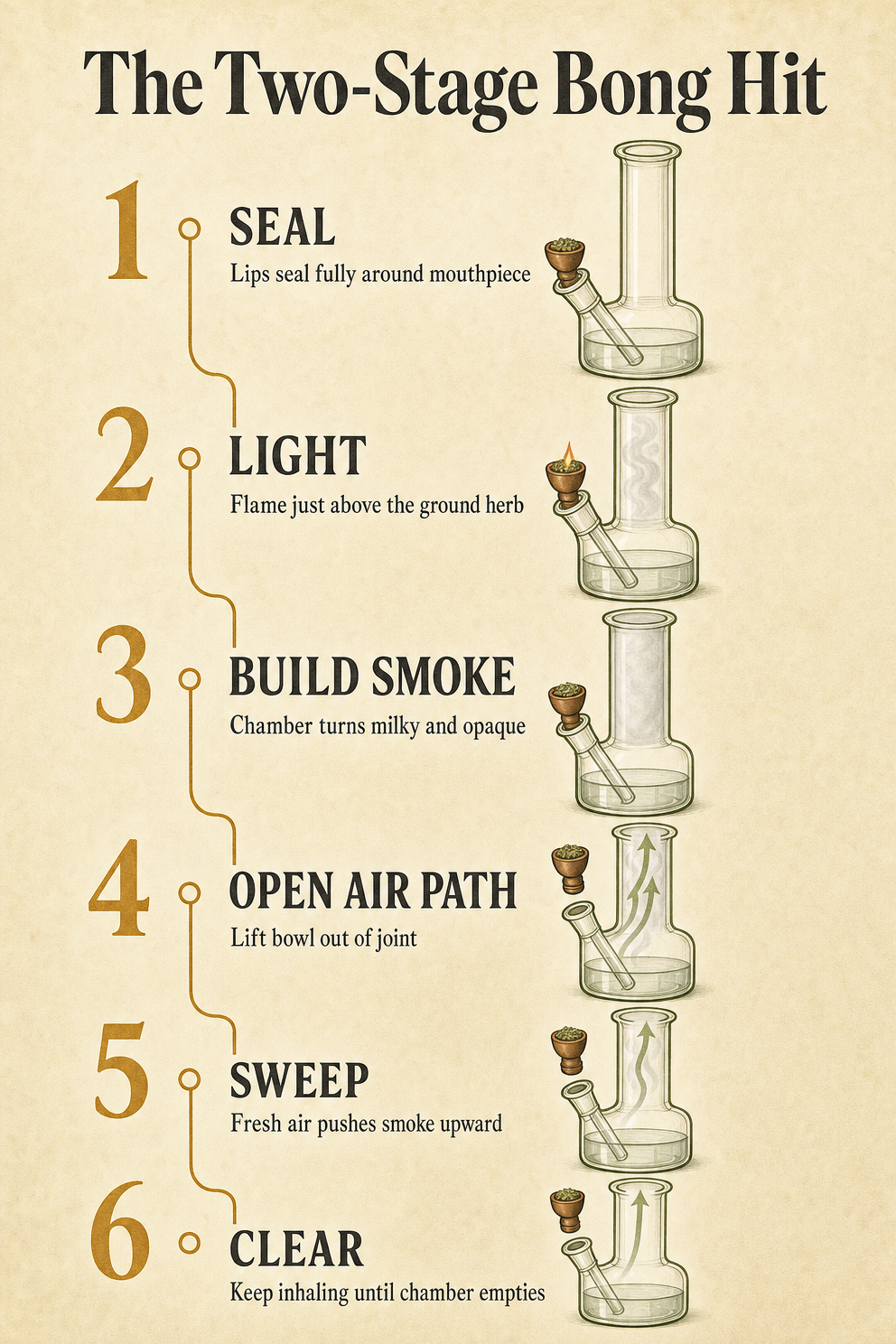
Learning how to hit a bong comes down to one two-stage airflow change. First you close the air path and let smoke build in the chamber while the water bubbles [2]. Then you open the air path, either by lifting the removable bowl out of the joint or by uncovering a small side hole, so fresh air sweeps that smoke up the tube to the mouthpiece.
Everything before that is setup. Water needs to cover the slits at the bottom of the downstem by roughly half an inch to one inch, the bowl needs a loose pack, and your lips need a complete seal on the mouthpiece. When those three things are right, the rest of the hit is mostly about timing [3].
The cue to switch from filling the chamber to clearing it is visual, not a stopwatch. The chamber turns from clear to an opaque, milky column, and that is your signal to ease the flame away [2]. This guide walks the full sequence in order, explains how the two clearing designs differ, and covers the small airflow adjustments that decide whether a pull stays comfortable or turns into a coughing fit.
What Are the Parts of a Bong You Use During a Hit?
A bong looks complicated, but only four parts matter while you are actually taking a hit [2]. Smoke moves through them in a fixed order, and a problem anywhere along that path shows up as a pull that feels wrong.
Each part has one job. The bowl holds the herb and acts like a valve you can lift. The downstem carries smoke down into the water. The water chamber is where smoke collects and stacks up. The mouthpiece is where you seal your lips and inhale [9].
That two-stage airflow change is the real difference between a bong and a dry piece such as Hand Pipes. A dry pipe delivers smoke as it burns. A bong lets you build a chamber’s worth of smoke first, then move it in one steady draw [8].
Resin buildup slowly narrows those same air paths, which is why a piece that pulled easily last month can start feeling stubborn. How Often Should You Clean Smoking Accessories? covers how often to clean so the airflow stays predictable.
- Bowl or slide: holds the ground herb and lifts out of the joint to open the air path on most modern glass [2].
- Downstem: the tube that carries smoke from the bowl down into the water, with slits near its base that sit below the water line [3].
- Water chamber: the volume where smoke collects and builds while the air path stays closed [4].
- Mouthpiece: the opening you seal your lips against, since the seal is what lets the pull do its work [8].
How Much Water Should You Put in a Bong?
Water level shapes a hit more than any other setup choice. The target is simple: cover the slits or holes at the bottom of the downstem by about half an inch to one inch [3]. Below that, smoke passes mostly through open air instead of water. Above it, the pull turns heavy and water starts climbing toward the mouthpiece.
Percolators follow the same rule as the downstem. Each percolator breaks smoke into smaller bubbles, but only the openings sitting under water are doing anything at all [8]. A dry percolator chamber is one of the most common reasons a piece pulls unevenly.
An ice catcher is not a fill line. Water belongs at the bottom of the piece where the downstem and percolators sit, and ice sits above the water, so it only contacts smoke that has already passed through the water stage [5]. Filling up to the ice pinches is a common beginner cause of splashback.
Water temperature is a preference rather than a rule, and published guides disagree. One retailer suggests distilled water at roughly room temperature with only a couple of ice cubes, a manufacturer warns that extreme temperatures stress the glass, and other guides favor cold water [6]. All of them agree the fill level matters more than the temperature.
Pieces with more than one chamber need a little more care, because each chamber has its own water line. What Are the Parts of a Bong and What Does Each One Do? walks through what each chamber does and where the water belongs.
How much herb you load interacts with the water level too. A bowl packed tight restricts the same airflow the water level controls, so How Do You Pack a Bowl So It Burns Evenly? is worth reading alongside this section.
- Fill until the downstem’s slits sit under the water, not level with the surface [3].
- Keep every percolator opening submerged, or that chamber does nothing [8].
- Use the ice catcher for a couple of cubes, not as a water line [5].
- Start low and add water in small amounts instead of pouring to a guessed level [5].
- Pull air through the mouthpiece before lighting; every chamber should bubble evenly [9].
- Distilled water avoids mineral spotting on the glass over time [5].
- For a full anatomy walkthrough before you fill anything, see What Is a Bong and How Does It Work?.
How Do You Set Up a Bong Before the First Hit?
Setup is where most problems get prevented, and it is the part of learning how to use a bong that people skip. A few minutes of checking joints, water, and airflow saves you from a pull that feels weak and a hit you end up blaming on your technique.
Joint fit is the quiet one. Bowls and downstems are sized in millimeters, commonly 10mm, 14mm, and 18mm, with 14mm the most common on mid-sized bongs [9]. A bowl that does not match the joint wobbles, leaks air around the seal, and produces a thin, airy pull that looks exactly like bad technique [3].
Then pack the bowl. Guides agree on the same approach: a medium grind, loosely filled, and only gently tamped on top so the surface springs back [4]. A tightly compressed or overfilled bowl restricts airflow, burns unevenly, and can pull fine particles down into the downstem [10].
Adding an ash catcher puts one more stage ahead of the downstem, which changes how quickly the chamber fills and how much debris reaches the main piece. What Are Ash Catchers and Do You Actually Need One? covers when that trade is worth it.
- Rinse a new piece with warm water before the first use to clear dust and residue from shipping [4].
- Fill to the downstem slits, then confirm every percolator is covered [3].
- Seat the downstem and bowl snugly so the joints do not leak air [9].
- Confirm the bowl’s joint size matches the piece: 10mm, 14mm, or 18mm [9].
- Grind medium and load loosely, tamping only the top layer [4].
- Run a suction test by pulling air through the mouthpiece and listening for even bubbling in every chamber [3].
- Clear a seat and check your flame source before you start, so nothing interrupts the hit halfway through [2].
What Is the Step-by-Step Way to Hit a Bong?
This is the whole sequence in order. Read it once before you light, then work through it slowly the first few times [2].
The seal comes first. Guides describe mouth position differently, with lips sealed inside the mouthpiece, lips wrapped around the outside, or the mouthpiece resting over the lips, but the shared requirement is a complete seal with no air leaking around it [8]. Leaking air weakens the pull and leaves smoke sitting in the chamber.
Then the pull itself. Inhale slowly enough that the water bubbles steadily instead of churning [3]. Hold the flame just above the ground herb and let your inhale draw it down rather than pushing the lighter into the bowl [10]. Keep inhaling while the chamber fills.
Watch the chamber rather than the clock. When it turns from clear to an opaque, milky column, ease the flame away and keep your inhale steady [2]. Smoke left sitting in the chamber has time to go stale, and clearing a stale chamber tastes worse than pulling a fresh one.
Pieces with extra chambers, such as Recycler Bongs, hold more volume, so the fill stage takes longer and the milky-chamber cue arrives a beat later [8].
Finally, breath-holding. A glass manufacturer states there is no benefit to holding smoke in for long periods and suggests exhaling at a comfortable pace, and public guidance advises against deep inhalations and trying to hold your breath [11].
- Seal your lips fully on the mouthpiece with no gap around them [9].
- Hold the flame just above one edge of the ground herb [4].
- Inhale slowly and steadily so the water bubbles rather than churns [3].
- Keep inhaling until the chamber turns milky and opaque [2].
- Ease the flame away and keep your inhale going [4].
- Open the air path by lifting the bowl or uncovering the carb hole [6].
- Keep inhaling so fresh air sweeps the chamber empty before you exhale [10].
- Exhale at a comfortable pace instead of holding the smoke in [2].
Do You Pull the Bowl Out or Use the Carb Hole to Clear a Bong?
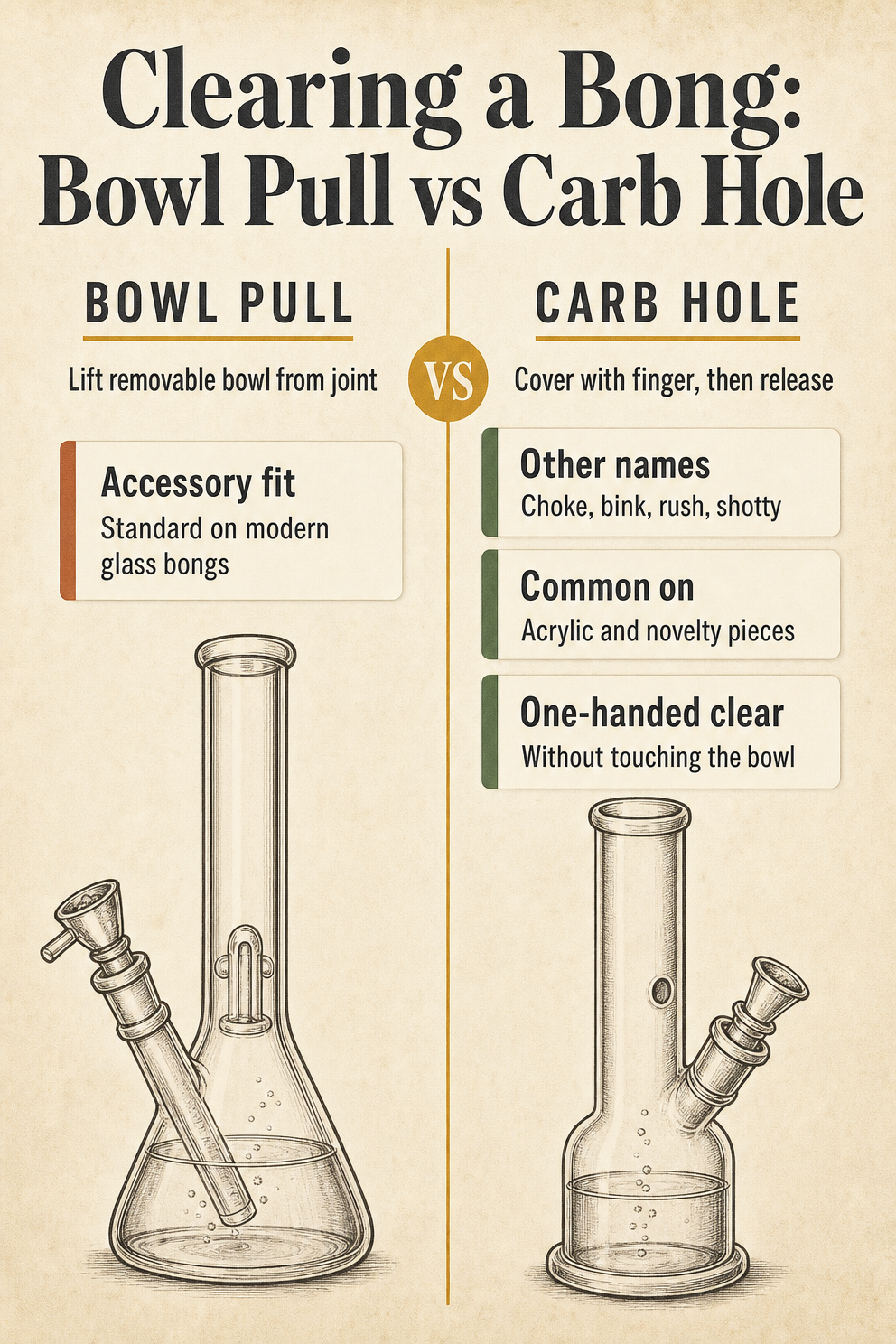
The piece decides for you, but it helps to know which design you are holding before you light it. There are two standard clearing mechanisms, and they change where your hands go [1].
On most modern glass bongs, the bowl or stem is removable. While it is seated, the chamber fills. Lifting it out of the joint opens the air path, and fresh air rushes in through the joint and downstem to sweep the chamber [2]. Because the bowl comes out, these pieces also accept interchangeable bowls, downstems, and ash catchers [6].
On pieces fitted with a small side hole, you keep that hole covered with a finger while the chamber fills, then uncover it to clear while you keep inhaling [6]. This design allows one-handed clearing without touching a bowl, and it is common on acrylic and novelty pieces [6].
The naming is genuinely inconsistent. The same side hole is written as the carburetor, carb, choke, bink, rush, shotty, kick hole, or simply hole, and some guides call the removable bowl itself the carb because it performs the same job [1].
One argument is worth knowing about rather than settling. A manufacturer argues a carb hole is redundant on a bong because a side port can pull air that bypasses the water path [6]. That is a maker’s position, not a universal rule, and plenty of people use carb pieces every day.
Whichever design you have, the motion is the same: keep inhaling as the air path opens. Stopping early leaves smoke in the chamber [7].
- Bowl pull: keep the bowl seated while the chamber fills, then lift it out of the joint to clear [2].
- Carb hole: cover the hole with a finger while filling, then uncover it while still inhaling [6].
- Other names for the same side hole: choke, bink, rush, shotty, kick hole [1].
- Carb pieces are common in acrylic and novelty designs and allow one-handed clearing [6].
- Removable bowls are standard on modern glass and work with interchangeable accessories [9].
- Either design relies on the same timing, since the chamber clears when fresh air enters the air path [7].
| Clearing design | How you clear it | Where you see it |
|---|---|---|
| Removable bowl or stem | Keep the bowl seated while the chamber fills, then lift it out of the joint and keep inhaling so fresh air sweeps the chamber [2] | Standard on modern glass bongs, and it accepts interchangeable bowls, downstems, and ash catchers [6] |
| Side carb hole | Cover the hole with a finger while the chamber fills, then uncover it while you keep inhaling [6] | Common on acrylic and novelty pieces, and it allows one-handed clearing [6] |
| Names for the same hole | Some guides call the removable bowl itself a carb, because it does the same job [1] | Carburetor, carb, choke, bink, rush, shotty, kick hole, or simply hole [1] |
Why Does Your Bong Hit Feel Harsh or Make You Cough?
Most harsh or hard-to-clear hits are airflow problems rather than piece problems. The useful move is to read the symptom and fix the specific thing that caused it [2].
Start with water level and the bowl. Water filled too high makes the pull heavy and can send water up the tube. Water filled too low lets smoke pass through open air instead of through the water stage. An overpacked bowl restricts airflow from the other end [3].
Then check your seal and your pull speed. A lip gap around the mouthpiece leaks air, which weakens the pull and leaves the chamber half full when you run out of breath. Pulling hard enough to churn the water has a similar effect, because it overwhelms the piece instead of moving smoke through each stage [9].
Timing matters too. If you fill the chamber and then pause to find a lighter, answer a question, or reposition the piece, the smoke sits and goes stale [2]. If a hit feels like more than you can take, cover the mouthpiece with your hand to trap the smoke, then finish the chamber in a second pull instead of dragging water up the tube [10].
One honest note about what a bong does and does not change: the CDC states that smoked cannabis, regardless of how it is smoked, can harm lung tissue, and research on whether bong water meaningfully removes compounds from smoke is still unsettled [12]. Technique changes how airflow moves through the piece. It does not change what is in the smoke.
- Pull feels heavy or clogged: lower the water level so it just covers the downstem slits [3].
- Bowl burns unevenly: loosen the pack and tamp only the top layer [10].
- Chamber will not clear: check for a lip gap, then keep inhaling as you open the air path [9].
- Water climbs the tube: the piece is overfilled or you are pulling too hard [10].
- Hit feels like more than you can take: cover the mouthpiece and finish the chamber in a second pull [10].
- Taste is off: the chamber sat too long before you cleared it [2].
- Pull stays weak after all of that: check that the bowl matches the joint size [9].
What Are the Rules for Sharing a Bong?
Sharing changes how you pack and light, and there is one straightforward routine worth defaulting to: one hit per person [10].
Cornering is the standard way to leave flower for the next person. You light only one edge of the pack instead of the whole bowl, so the rest stays unburned and the next person lights a fresh corner [7]. Over a few turns you work your way around the bowl rather than straight through it.
Snapping is the opposite approach. You pack a single-hit bowl, pull it completely in one go, and repack fresh for the next person [7]. It keeps every turn fresh and removes the question of what is left in the bowl, at the cost of packing more often.
The piece itself is part of the equation. Public guidance from a substance-use organization is to not share joints, vaping devices, pipes, or bongs, and to wash your hands before putting any cannabis product to your mouth [11]. If you do share, that guidance is worth weighing, and cleaning the piece between sessions is the habit that keeps it pulling the way it did when it was new.
- Default to one hit per person when you pass a piece [10].
- Corner the bowl by lighting one edge at a time so green flower remains for the next person [7].
- Snap a single-hit bowl when you want each turn to start fresh [7].
- Keep your finger on the carb or your hand ready at the bowl so you can clear the chamber before passing [6].
- If you cannot finish the chamber, trap the smoke with your hand and finish it rather than passing a full chamber [10].
- Public guidance recommends not sharing pipes and bongs at all, and washing your hands before use [11].
What Should You Check on a Bong Bowl and Downstem?
The bowl and downstem hold the herb and shape the air path, and they are the parts most likely to be mismatched when you buy a replacement.
Joint size is measured in millimeters. Most pieces use 10mm, 14mm, or 18mm, and 14mm is the most common on mid-sized bongs [9]. A bowl that does not seat properly wobbles, leaks air around the joint, and produces a pull so weak that you assume your technique is the problem [3].
Spare parts change how a piece behaves. A deeper bowl holds more herb per pack, which changes how long the fill stage takes. A longer downstem changes where the water line sits. An ash catcher adds a stage ahead of the downstem and collects most of the debris before it reaches the main chamber [4].
Interchangeable parts are also the easiest maintenance win, because a clean bowl and downstem pull differently from a coated one. Soaking those parts while you clean the main body keeps the air path open [2].
If you are replacing a bowl or building a spare set, most Bongs listings state the joint size in millimeters, so match that number before you order. Matching it the first time saves a return, and a multi-part order is easy to justify when Treehouse offers free shipping on orders $150+.
- Check the joint size on both the piece and the replacement: 10mm, 14mm, or 18mm [9].
- Seat the bowl and press gently; a wobble means a mismatched or worn joint [3].
- Look through the downstem for resin narrowing the opening [2].
- Confirm the downstem’s slits sit below the water line once it is seated [3].
- Consider a spare bowl so you can swap and clean without stopping [6].
- An ash catcher adds a stage that collects debris ahead of the downstem [4].
| Part | What it changes about the hit | What to check before you order |
|---|---|---|
| Bowl | How much herb a pack holds, which sets how long the fill stage takes | Joint size: 10mm, 14mm, or 18mm, with 14mm the most common on mid-sized bongs [9] |
| Downstem | Where the water line sits and how far smoke travels before it reaches the water | Slits sit below the water line once seated, with no resin narrowing the opening [3] |
| Ash catcher | Adds a stage ahead of the downstem and collects most of the debris before it reaches the main chamber [4] | Whether the extra stage is worth a slower fill |
Frequently Asked Questions
How do you know when to stop lighting and clear a bong?
Watch the chamber rather than counting seconds. The cue is the column turning from clear to an opaque, milky white as smoke fills it [2]. At that point ease the flame away, keep the inhale steady, and get ready to open the air path. If you fill the chamber and then leave it sitting while you look for a lighter, the smoke has time to go stale, and clearing it tastes worse than pulling a fresh one.
Do you clear a bong by pulling the bowl or by using the carb hole?
The piece decides for you. If the bowl or stem lifts out of the joint, that is your clearing mechanism: while the bowl is seated the chamber fills, and lifting it opens the joint so fresh air rushes through the downstem and sweeps the chamber [2]. If the piece has a small side hole, keep that hole sealed with a finger while you fill the chamber, then uncover it to clear while you keep inhaling [6].
How do you keep bong water out of your mouth?
Overfilling is the usual cause. Water only needs to sit about half an inch to one inch above the slits at the bottom of the downstem, and the ice catcher is not a fill line [3]. Before you light, pull air through the mouthpiece and listen: every chamber should bubble evenly, and a hollow or silent sound means a dry percolator. If a hit feels like more than you can clear, cover the mouthpiece with your hand to trap the smoke, then take it in a second pull [10].
Why does my bong feel hard to pull?
Check the four usual suspects in order: water filled too high, an overpacked bowl, a bowl that does not match the joint so air leaks around it, and an inhale so forceful that the water churns instead of bubbling [3]. A well-packed bowl is a medium grind, loosely filled and only gently tamped on top [4]. Slower, steadier pulls let smoke move through the water and each percolator, and the pull should feel like sipping through a straw [2].
Can you use a bong with a banger instead of a bowl?
That is the difference between the two piece types. A bong carries a bowl for ground flower, while a dab rig carries a banger for concentrate, and the two are built around different materials [8]. Bubblers are the third option in this family: smaller, often shaped like a hand pipe, but still water-filtered. If your bowl and downstem are removable and sized to the joint, they swap out, which is why joint size is worth checking before you buy a replacement [9].
Does an ice catcher change how you hit a bong?
Only after the water stage. Water belongs at the bottom of the piece where the downstem and percolators sit, and ice sits above the water, so it works on smoke that has already passed through [5]. Guides disagree on how much ice to use, and one retailer suggests only a couple of cubes rather than filling the catcher. What matters either way is the water line, because filling up to the ice pinches is a common cause of splashback [3].
What Should You Remember Before Your Next Bong Hit?
Every bong hit is the same two-stage airflow change. Close the air path, build smoke in the chamber, then open the air path so fresh air sweeps it out. A water level that covers the downstem slits, a loose pack, and a full lip seal are what let that sequence work [2].
When something feels off, work through the airflow checklist rather than your technique: water level, bowl pack, joint fit, lip seal, and pull speed. Most of the time the fix is one of those five [10].
Then practice the sequence slowly until the timing is automatic. The chamber tells you when to switch stages. You just have to watch it [3].
Sources
- Wikipedia: Bong
- Thick Ass Glass: How To Use A Bong Without A Carb Hole
- Thick Ass Glass: How High to Fill a Bong: Guide to Smooth, Splash-Free Hits
- 420 Science: How to Use Your New Bong
- 420 Science: How to Get the Perfect Bong Rip
- Billymart: Bong Carb Hole Explained: What Does A Carb Do?
- Bern Gallery: How to (Properly) Smoke A Bong
- Leafly: What is a bong?
- Bong Warehouse: How to Start Smoking a Bong for New Users
- VICE: A Beginner’s Guide to Buying and Using a Bong
- Canadian Centre on Substance Use and Addiction: COVID-19 and Cannabis: How to Reduce Your Risk
- Centers for Disease Control and Prevention: Cannabis and Lung Health