
To replace a bong downstem, confirm the joint size and length, free the old stem without cracking the glass, and seat the new one so its slits sit below the waterline [1] [2] [3] [4]. The standard ground-glass sizes are 10mm, 14mm, and 18mm, with 14mm female the most common on modern mid-sized bongs.
How Do You Know What Size Downstem Your Bong Takes?
Every modern ground-glass bong uses one of three joint diameters: 10mm, 14mm, or 18mm [1] [2]. Most mid-sized glass in the 10-to-16-inch range ships with a 14mm female joint, while larger beakers and straight tubes often pair an 18mm female joint with an 18mm bowl. A 10mm female joint shows up on smaller one-hitters and compact pieces.
The fastest field test is the dime test, which uses a US dime (about 18mm across) to narrow down the joint on the bong itself [3]. Drop the dime into the female joint and watch how far it goes. If it does not enter at all, the joint is 10mm. If it drops halfway in and stops, the joint is 14mm. If it slides all the way inside, the joint is 18mm.
For a more precise check, measure the joint opening with a ruler or a pair of calipers. The opening should read roughly 10mm, 14mm, or 18mm across the inner diameter [5]. As a rough rule of thumb, 14mm is about the width of an adult pinky finger and 18mm is closer to a thumb [6].
If the existing downstem is still in the bong, look at its two-number label. A downstem marked 18/14 or 14/10 is telling you the outer joint size first and the inner bowl-joint size second [4] [6]. That label is the easiest answer when the stem is intact, and it is worth writing down before you order a replacement. For a deeper walk-through on the measurement steps themselves, the How Do You Measure a Downstem Correctly Before Buying a Replacement? guide covers the same process from a different angle.
- Three modern ground-glass diameters: 10mm, 14mm, 18mm (with 9.5mm rubber-grommet stems appearing on older or budget pieces).
- Dime test results: no entry = 10mm, half-entry = 14mm, full entry = 18mm.
- Two-number label format (for example 18/14) lists the outer bong-joint first and the inner bowl-joint second.
- Pinky-width approximation works as a quick gauge — pinky ≈ 14mm, thumb ≈ 18mm.
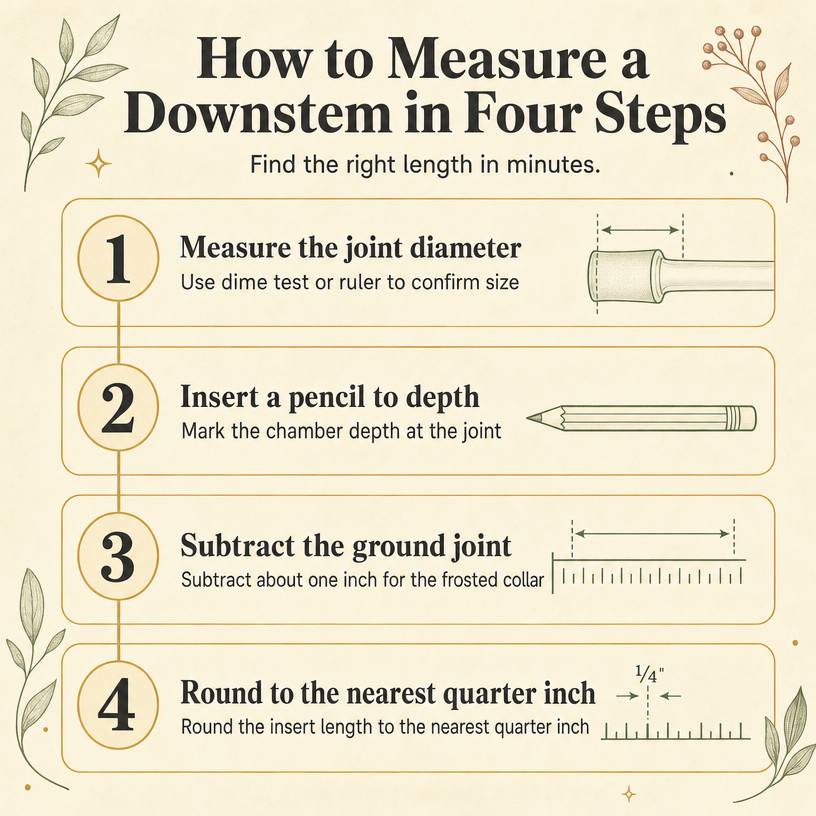
How Do You Measure Downstem Length Correctly?
Downstem length is measured from the bottom edge of the frosted (ground) joint down to the very tip of the diffuser, not from the top opening of the joint [2] [3]. Measuring from the top of the joint adds roughly an inch — the height of the frosted collar — and produces a stem that is one full size too long. That is the single most common reason a new downstem presses against the chamber floor or fails to seat at all.
A pencil is the easiest field tool for getting the correct insert length on a beaker or straight tube [5]. Insert a pencil through the female joint, lower it until the tip touches the chamber floor, mark the pencil right where it exits the joint, pull it back out, and measure from the mark to the tip. Subtract about one inch for the ground joint, and round the result to the nearest quarter inch [4].
For shorter pieces (under 10 inches tall) a 3-inch insert length is usually right; for 10-to-14-inch pieces a 4-inch insert length is the common starting point; for taller pieces a 5-inch insert length is a reasonable default [7]. Those are starting points, not rules, and the actual chamber shape matters — a beaker with a wide base can take a slightly longer stem than a straight tube of the same height.
Before you order, check the live product on a piece like the SeshGear Jellyfish Double Chamber Glass Beaker Water Pipe – 17" / 14mm F / Colors Vary to see how manufacturers list both numbers on the listing (joint diameter first, insert length second). That makes it easy to match what you measured to what is in stock.
- Measure from the bottom of the frosted joint to the diffuser tip — not the top of the joint.
- Subtract about one inch from the pencil-marked total to account for the ground joint.
- Round the insert length to the nearest quarter inch before ordering.
- Rough sizing guide: ~3 inches for short pieces, ~4 inches for mid-size, ~5 inches for tall pieces.
What Is the Difference Between 14mm and 18mm Bong Joints?
The 14mm and 18mm labels describe the inner diameter of the female ground joint in millimeters [1] [2]. A dime (about 18mm) slides all the way into an 18mm female joint but only halfway into a 14mm joint [3]. That is the simplest physical test if you are standing at a counter trying to tell two pieces apart.
On modern mid-sized bongs — roughly 8 to 14 inches tall — 14mm is the more common size, and most replacement bowls are sold in 14mm to match [2]. On larger beakers, straight tubes, and thicker scientific-style glass, 18mm is more common, and 18mm bowls are easier to find in bigger formats. Many headshops carry both because both are standard.
You can pair an 18mm bowl with an 18/14 downstem in a 14mm bong, or a 14mm bowl with a 14/18 downstem in an 18mm bong — the second number is the inner bowl-joint and accepts whatever bowl size you want to use [4] [6]. This is also why a "14mm downstem" and a "14mm bowl" can come from different pieces and still seal correctly.
If you want to compare 14mm and 18mm across more glass types, the What Are 10mm, 14mm, and 18mm Glass Joint Sizes? guide covers the wider 10/14/18 family and when each size shows up in production glass.
- 14mm female = dime drops halfway in; 18mm female = dime slides all the way in.
- 14mm is the most common size on mid-sized modern bongs; 18mm shows up more on larger pieces.
- The first number on a downstem label is the outer bong-joint; the second is the inner bowl-joint.
- Common pairings: 18/14 and 14/10 downstems bridge a bong-joint and a smaller bowl-joint.
| Feature | 14mm joint | 18mm joint |
|---|---|---|
| Dime test result | Dime drops halfway in | Dime slides all the way in |
| Finger-width gauge | About the width of a pinky | About the width of a thumb |
| Typical bong size | Mid-sized 8–14 in. pieces | Larger beakers and straight tubes |
| Bowl availability | Widely stocked | Widely stocked, common in larger sizes |
How Do You Remove a Stuck Downstem Without Breaking the Joint?
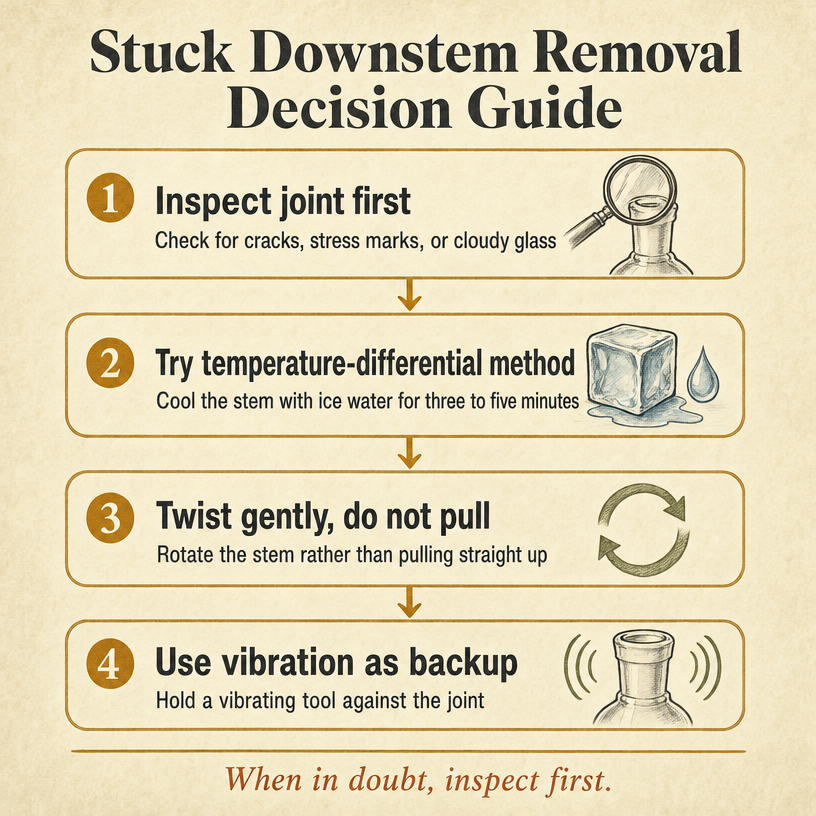
Before you try to free a seized downstem, inspect the female joint under good light for any sign of damage [8]. Hairline cracks, white stress marks, or cloudy patches around the joint are all red flags — forcing a stem out of a damaged joint will usually finish breaking it, and at that point a replacement bong is often the lower-cost option.
If the joint looks healthy, the safest removal method is temperature differential [8]. Fill the chamber with enough warm water to cover the joint area, let it sit for two to three minutes so the glass expands slightly, then pour out the warm water and replace it with ice water on the submerged portion of the stem only. The cold contracts the male joint faster than the female, and after three to five minutes a gentle twist — never a straight pull — usually frees the stem.
If the temperature method does not work, the manufacturer-recommended backup is vibration [9]. Hold the bong upside down over a cushioned mat (a folded towel works), then hold a vibrating object — an electric toothbrush, a phone on vibrate, or an electric razor — against the outside of the joint for a few seconds. The vibration helps break the bond between the ground surfaces. Keep the mat underneath in case the stem releases suddenly.
Once the stem is loose, clean the female joint with warm water and a cotton swab before seating the new one. A small amount of isopropyl alcohol on the swab is acceptable for any resin that does not lift with water [8]. For more on cleaning the surrounding glass without stress fractures, the How Do You Clean a Glass Pipe Without Breaking It? guide covers the broader pipe-cleaning routine.
- Inspect the joint first — cracks, white stress marks, or cloudy glass mean stop and reconsider.
- Use warm water on the chamber and ice water on the stem for three to five minutes to create a temperature differential.
- Twist gently rather than pulling straight up — straight pulls are the leading cause of broken joints.
- Use vibration (toothbrush, phone, razor) as a backup, with a cushioned mat underneath in case the stem drops.
How Do You Install a New Downstem So It Seats Properly?
Start by dry-fitting the new downstem into the female joint before you add any water [1]. The frosted ground joint should slide in with light hand pressure and stop on its own — it should not drop all the way to the chamber floor, and it should not need to be forced. If either happens, the size or length is wrong and the stem should come back out before anything is filled.
Once the stem seats, check the diffuser position with a dry fit. The diffuser tip should sit roughly a quarter to half inch above the chamber floor [1] [4]. Too close and the tip can press against the glass during temperature changes; too far and the slits sit above the waterline. When the bong is filled to the typical water level, the diffuser slits should be submerged by about half an inch so bubbles form below the surface [7].
After dry-fitting, remove the stem and fill the bong to the desired water level, then reinsert the downstem. A clean ground joint seals on its own with no wax, no tape, and no sealant. If you see air bubbles rising from the joint itself when the bowl is clear, the joint is not fully seated — pull the stem, dry the surfaces, and reseat. For a wider selection of replacement downstems in 14mm, 18mm, and 10mm, the Downstems collection groups the options by joint size and length.
- Dry-fit the new stem first — the ground joint should slide in with light pressure and stop on its own.
- Diffuser tip should sit roughly ¼ to ½ inch above the chamber floor for clearance and airflow.
- Diffuser slits should sit roughly ½ inch below the waterline when the bong is filled.
- No wax or sealant is needed on a clean ground joint — reseat if air bubbles leak from the joint itself.
Can You Use a Different-Size Downstem With an Adapter?
Yes — a ground-glass adapter bridges a 14mm female joint to an 18mm male stem (or any other standard pairing) without modifying the bong itself [2] [4]. The adapter is a short piece of glass with a male joint on one side and a female joint on the other, and the matching size is what makes the seal work.
Before adding an adapter, inspect the bong’s female joint the same way you would before removing a stuck stem. Hairline cracks, white stress marks, or cloudy glass mean an adapter will not fix the underlying problem and the joint should not be loaded with extra weight [8]. The bong joint has to be healthy for the adapter to seal.
Pick an adapter that matches both ends exactly. A 14mm-to-18mm adapter has a 14mm male on one end and an 18mm female on the other; pairing it backwards will leave a gap that no amount of pressure will close [6]. Many headshops label adapters with both numbers in the same first/second format as downstems.
Once the adapter is in place, the bowl-and-downstem pairing is determined by the open end of the adapter, not the bong itself. That makes adapters a useful option when the original joint size is uncommon or out of stock. For a wider catalog of pieces that already accept standard 14mm or 18mm hardware, the Glass Bongs collection groups current production glass by joint family.
- Adapters bridge a bong joint and a different-size stem without modifying the bong.
- The bong joint must be free of cracks and stress marks before adding any adapter.
- Match both ends of the adapter exactly — the first number is the male side that enters the bong.
- After the adapter is seated, the bowl size is set by the open end of the adapter, not the bong.
How Do You Know When to Replace the Downstem Instead of the Whole Bong?
Replace the downstem when the female joint on the bong is intact and the chamber is otherwise usable [1] [2]. A clean, undamaged joint is the only thing the new stem actually depends on, and a replacement stem is a small part of the cost of a new piece. Most swaps on a healthy bong take less than ten minutes including the warm-up and cool-down.
Replace the bong when the joint shows hairline cracks, white stress marks, or cloudy glass [8]. Those are signs of borosilicate fatigue, and forcing a seized stem through a fatigued joint usually finishes breaking it. At that point the cost of a replacement stem plus the chance of a cracked bong is already past the cost of a new mid-range piece.
Other signs that the bong itself is ready to retire include star cracks radiating out from the joint, a chipped rim that no longer mates with a bowl, or a base that no longer sits flat. None of those can be fixed with a downstem swap. A replacement stem only solves the stem problem.
When the bong is healthy but you want to step up to a larger chamber or a percolator, that is a separate decision and the original piece can usually be repurposed, sold, or given away. Pieces like the Pulsar Cute Doggies Beaker Glass Water Pipe – 9.75" / 14mm F show how mid-sized beakers are typically paired with a 14mm female joint and a 4-inch downstem as a baseline configuration.
- Replace the downstem when the bong’s female joint is intact and the chamber is reusable.
- Replace the bong when the joint has hairline cracks, white stress marks, or cloudy glass.
- Star cracks around the joint, a chipped rim, or an uneven base are bong-level problems.
- Stem upgrades and chamber upgrades are separate decisions — a healthy bong can usually be reused.
Frequently Asked Questions
How do I know what size downstem my bong takes?
Use the dime test on the female joint: the dime does not enter a 10mm joint, sits halfway inside a 14mm joint, and slides fully inside an 18mm joint. You can also measure the joint opening with a ruler — 10mm, 14mm, and 18mm are the three modern ground-glass diameters.
How do I measure downstem length correctly?
Measure from the bottom edge of the frosted (ground) joint down to the diffuser tip, not from the top opening. Measuring from the top adds roughly an inch and produces a stem that presses against the base of the chamber.
What does a diffused downstem do differently from a straight one?
A diffused downstem has slits at the tip that break the incoming smoke into smaller bubbles, which sit below the waterline. A straight stem has a single open end and produces larger bubbles through the same water volume.
Can I use a different-size downstem with an adapter?
Yes — a ground-glass adapter bridges a 14mm female joint to an 18mm male stem (or any other standard pairing). The bong joint must be free of cracks, and the adapter must match both diameters exactly.
How do I know when to replace the downstem instead of the whole bong?
Replace the stem when the joint is clean and unbroken. Replace the bong if the joint shows hairline cracks, white stress marks, or cloudy glass — forcing a stem out of a damaged joint will usually finish breaking it.
What Should You Double-Check Before You Order a Replacement Downstem?
Before you check out, confirm three numbers: the joint diameter on the female joint (10mm, 14mm, or 18mm), the insert length measured from the bottom of the frosted joint to the diffuser tip, and the second number on the label that matches the bowl you actually want to use. If all three line up, the new stem will seat cleanly and the slits will sit below the waterline on the first try.
If the joint has any sign of damage — hairline cracks, white stress marks, cloudy glass — set the downstem aside and look at the bong first. A replacement stem cannot fix a fatigued joint, and for a healthy mid-sized beaker the swap itself usually takes less time than the warm-up and cool-down. For current 14mm and 18mm options in the catalog, the downstem collection groups pieces by joint size and length so the label numbers map directly to what you measured.
Sources
- DankStop: How To Measure And Buy A Downstem
- Thick Ass Glass: How to Know What Size Downstem You Need
- DankGeek: How to measure a downstem and find the right joint size
- Thick Ass Glass: Downstem Sizing & Measurement Guide
- 420 Science: Measuring your Bowl or Downstem
- Bern Gallery: How to Figure Out the Size of Your Downstem
- AFM Smoke: 14mm vs 18mm Bong Joint Sizes: How to Measure and What Fits
- Thick Ass Glass: How to Remove a Stuck Downstem Without Breaking Glass
- GRAV: LESSONS: How to Loosen your Removable Downstem