

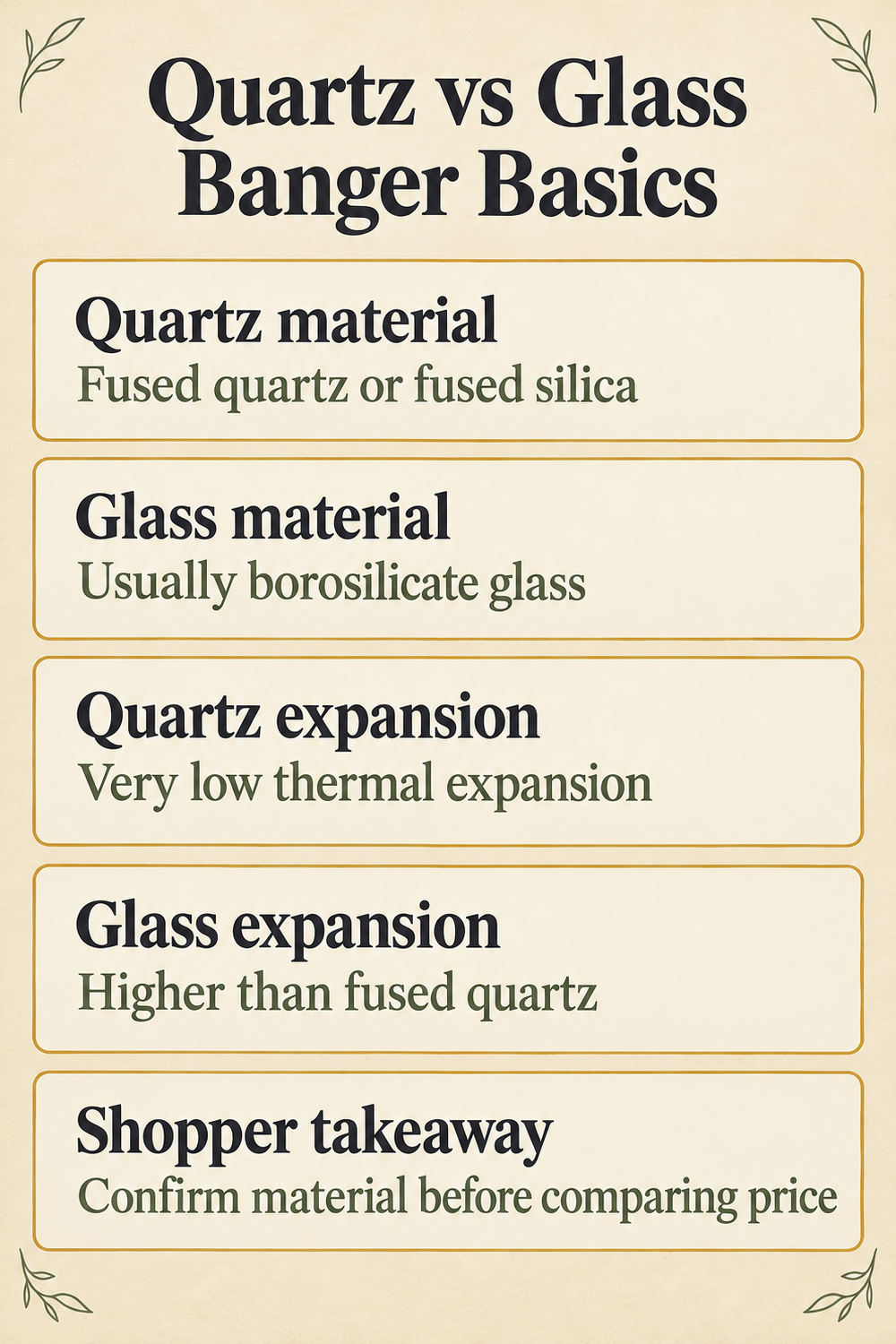
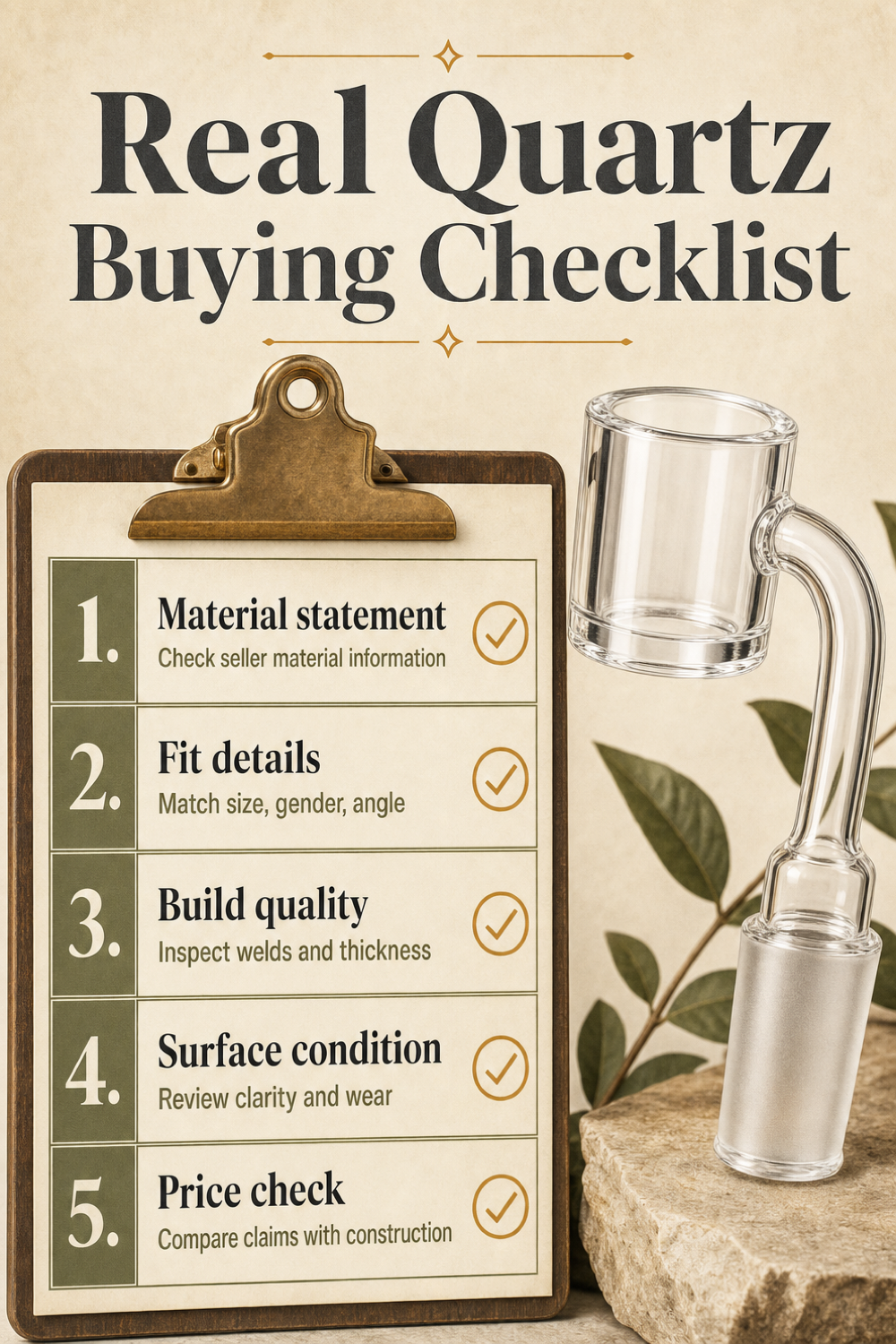
A real quartz banger is usually made from fused quartz or fused silica, while a glass banger is usually borosilicate glass. Check the seller’s material statement first, then use clarity, tap sound, fit details, construction quality, and wear signs as supporting clues. Those checks help, but they do not prove the material by themselves. Use the clues together before you judge the price.
What does real quartz mean when a shop sells a quartz banger?
In a shop listing, real quartz usually means fused quartz or fused silica. Those terms are closely related in retail banger language. A glass banger, on the other hand, usually means borosilicate glass, which is also used in many lab and accessory products. The phrase quartz vs glass is shorthand, but the details still matter. [1] [4]
That does not mean every item with quartz in the name is automatically a better buy. Material is one part of the decision. You still need the right joint size, a clean bucket, a solid weld, and a seller that gives clear specs. A vague listing can make even a nice-looking piece hard to judge.
If you are browsing Quartz Bangers, compare listings the same way you would compare other Replacement Parts. Read the material line, check the photos, and make sure the part actually fits your setup. Do not let a shiny photo do all the work.
Some shoppers also compare a quartz banger with a full glass rig or bubbler, such as GRAV® Wedge Bubbler – Assorted Colors, because the words glass and quartz can get mixed together in product pages. Keep the part in view: the banger material is not the same question as the material of the whole rig.
A helpful listing usually names the material and the part in the same sentence. For example, it should be clear whether the bucket is quartz, whether the joint is a certain size, and whether any included piece is separate. If the page makes you infer those details from a photo, view that as missing information, not proof.
- Quartz banger usually means fused quartz or fused silica, not ordinary window-style glass.
- Glass banger usually means borosilicate glass, though the seller should say that clearly.
- Material names help you compare options, but they do not replace fit, weld, and thickness checks.
- A clear listing should explain the material without hiding behind vague words like premium or upgraded.
What is the practical difference between a quartz banger and a glass banger?
The biggest practical difference is how the two materials respond to temperature changes. Technical Glass Products lists fused quartz with a very low coefficient of thermal expansion: 5.5 x 10^-7 cm/cm °C from 20°C to 320°C. It also lists a softening point of 1683°C. Those numbers explain why fused quartz is used where repeated temperature swings matter. [1]
Borosilicate 3.3 glass is different. John Morris Group lists borosilicate 3.3 with a thermal expansion value of 3.3 x 10^-6 K^-1 and a softening point of 820°C. That is still a useful glass for many products, but it is not the same material profile as fused quartz. [3]
For shoppers, the takeaway is simple: quartz is not magic, and glass is not automatically a poor choice. Quartz changes size less during heating and cooling, while borosilicate glass has a lower softening point. If you want the deeper material background, What Is a Quartz Banger and How Do You Choose One? is the natural next read, and Why Do Dabbers Prefer Quartz Pipes and Bangers? explains why many shoppers focus on quartz for banger-style parts.
Also remember that material facts do not solve every buying problem. A poorly made quartz banger can still be a bad fit. A glass banger can still be exactly what a shopper meant to buy if the listing is honest and the part matches the setup. If you are replacing worn accessories, When Should You Replace Bowls, Downstems, Screens, and Seals? can help you separate material questions from replacement timing.
Helios Quartz describes fused quartz as having low thermal expansion and high thermal shock resistance, with softening behavior around 1630°C rather than a sharp melting point. That supports the same practical message: the material has a different heat profile from borosilicate glass, but you still need the product page to confirm what is being sold. [2]
- Fused quartz has much lower thermal expansion than borosilicate 3.3 glass.
- Fused quartz has a much higher listed softening point than borosilicate 3.3 glass.
- Borosilicate glass is still a real material category, but it should not be sold as quartz.
- The best choice depends on truthful specs, fit, construction, and price together.
| Shopper question | Real quartz banger | Glass banger |
|---|---|---|
| Common retail material | Fused quartz or fused silica | Usually borosilicate glass |
| Thermal expansion | Very low thermal expansion | Higher than fused quartz |
| Listed softening point | About 1683°C in the cited fused quartz data | About 820°C for borosilicate 3.3 in the cited data |
| Best first verification step | Confirm the seller states fused quartz or fused silica | Confirm the seller states borosilicate glass |
| Buying reminder | Still check fit, welds, shape, and surface condition | Still check fit, listing honesty, and build quality |
How can you check if a banger is quartz before trusting the listing?
Start with the written listing, not the photo. A good product page should say fused quartz, fused silica, or borosilicate glass in plain language. If the page only says crystal-clear, premium, luxury, or high heat, you still do not know the material. Marketing words are not a material spec.
Next, use appearance and sound as clues. High-purity quartz is often very clear or slightly milky. Glass can vary more in color and clarity. Some consumer guides note that quartz may make a lower, duller tap sound, while glass may make a higher tink sound. These clues can support your judgment, but they do not replace seller information. [5]
Look at the whole product page. Does it show the joint size? Does it name the angle? Does it mention the bucket style and wall thickness? A seller that gives real fit details is usually giving you more to verify. A page with almost no specs leaves you guessing.
If you compare a listing to a complete rig product like SILICONE BEAKER BONG WITH REMOVABLE GLASS BOWL, do not confuse the removable bowl, banger, or accessory with the body material of the whole piece. Check the exact part you are buying. That one detail prevents a lot of bad assumptions.
Reviews can help when they discuss fit and accuracy, but be careful with loose phrases. A review saying that a part feels heavy or looks clear is only one clue. A review saying the seller confirmed fused quartz gives you more useful context. Keep the strongest evidence at the top of your decision.
- Read the material line first, and look for fused quartz, fused silica, or borosilicate glass.
- Compare photos for clarity, milkiness, color, bucket shape, and surface finish.
- Use tap sound only as a clue, because it is not a lab-grade material test.
- Check reviews for repeated comments about fit, weld quality, and listing accuracy.
- Walk away from listings that use big claims but skip basic material and fit details.
What construction details matter as much as the quartz label?
A real quartz label does not help if the banger does not fit your rig. Most shoppers need to check joint size, joint gender, and neck angle before anything else. Common sizes include 10mm, 14mm, and 18mm. Common angles include 45-degree and 90-degree necks. [4] [6]
After fit, inspect the build. Look at the weld between the neck and bucket. It should look even, not messy or thin in one spot. Check the bottom and sidewall thickness if the listing gives that information. A banger can be made from the right material and still feel poorly finished.
Bucket shape also matters. Some buckets are made for terp pearls, inserts, or caps. Some are simple everyday shapes. The right choice depends on the accessories you already use. A product like GRAV® 14mm 45° Quartz Hourglass Banger Set is useful to study because it states size and angle clearly instead of making you guess.
Surface condition matters too. Scratches, chips, rough seams, or cloudy patches on a new item should make you pause. On a used item, those marks may be wear. On a new item, they may point to handling, storage, or finish problems.
Think of the quartz label as the start of the inspection, not the finish line. A good product page lets you answer basic fit questions before checkout. If you need to message the seller for every important detail, compare that friction against another listing with clearer specs.
- Confirm joint size first, because 10mm, 14mm, and 18mm parts are not interchangeable.
- Match joint gender and angle before judging price or appearance.
- Inspect the weld, bucket, wall thickness, and bottom shape in the listing photos.
- Check whether the bucket shape works with your cap, pearls, insert, or other accessory.
- Review the return policy before buying if the listing photos or specs are limited.
Can real quartz still chip, crack, or get cloudy over time?
Yes. Real quartz can still chip, crack, or get cloudy. Fused quartz changes dimension less during temperature changes than glass, but that does not make it impossible to damage. Impact, poor construction, rough handling, and repeated very hot use can all affect the surface or shape over time. [2] [4]
Cloudiness is one of the most misunderstood clues. It can develop on quartz after repeated high-temperature use and surface contamination. That cloudiness does not automatically mean the banger was fake. It means you should judge the original listing, the age of the part, the surface pattern, and how it was used. [7]
A brand-new banger that arrives cloudy, chipped, scratched, or oddly shaped is a different issue. In that case, compare the item to the product photos and contact the seller quickly. Keep the packaging and take clear photos before using the part.
For used pieces, focus on patterns. A single chip at the edge may come from impact. Heavy cloudiness in one hot area may come from repeated use. A crooked neck or thin weld points back to construction, not just material.
This is where honest expectations help. Quartz can be a useful material choice for this category, but it is still a physical object with edges, welds, and surfaces. If the part is dropped, knocked against a hard surface, or made with thin weak spots, the material name cannot erase that damage.
- Real quartz can still chip from impact or rough handling.
- Cloudiness can come from repeated high-temperature use and surface residue, not only from fake material.
- A new item with chips, cracks, or odd shape should be compared to the listing right away.
- Wear clues are most useful when you combine them with the original seller specs.
When is paying more for a quartz banger worth it?
Paying more for a quartz banger makes the most sense when the listing gives you proof points, not just a higher price. Look for a clear fused quartz or fused silica material statement, useful photos, exact fit details, and a shape that matches how you use your setup. The price should match the information given.
The price premium is harder to justify when the listing is thin. If a seller skips joint size, angle, bucket dimensions, material details, and close-up photos, you are being asked to trust a label. That is not enough when cheaper glass options are available and clearly described.
Also compare the part to your real need. If you are replacing a broken accessory, fit and availability may matter more than buying the highest-priced option. If you are upgrading a setup you use often, clearer material specs and better construction details may be worth more attention.
Treehouse Lifestyle carries accessories for online shoppers nationwide, so the smart move is to compare the spec details before checkout. When the order includes other gear, the phrase to remember is free shipping on orders $150+. That is useful only if the parts are the right fit in the first place.
A good final test is whether you could explain the price difference in one sentence. If the answer is fused quartz, correct fit, clean welds, solid bucket design, and clear seller specs, the premium is easier to understand. If the answer is just because it says quartz, keep comparing.
- Check the material statement before using quartz as a value signal.
- Match size, gender, and angle to your rig before comparing prices.
- Study close-up photos for weld quality, bucket shape, thickness, and surface finish.
- Compare the seller’s details against cheaper glass options, not just against the word quartz.
- Buy the part that fits the setup and has clear specs, not the one with the loudest label.
Frequently Asked Questions
Is a quartz banger the same thing as a glass banger?
No. In retail use, a quartz banger usually means fused quartz or fused silica, while a glass banger usually means borosilicate glass. Always check the seller’s material statement because listings can be vague.
Can you prove quartz at home with one simple test?
Not with lab-level certainty. You can use the listing, appearance, tap sound, fit details, and construction clues to make a better judgment, but those checks should support seller documentation.
Does cloudy quartz mean the banger is fake?
Not by itself. Cloudiness can develop after repeated high-temperature use and surface contamination. Judge it with other clues, including the original listing, surface pattern, age, and build quality.
What banger fit details should I check before buying?
Check joint size, joint gender, neck angle, bucket shape, wall or bottom thickness, weld quality, and surface condition. A real quartz label will not help if the part does not fit your rig.
How should you decide if a quartz banger is real enough to buy?
Decide by stacking evidence. First, read the material statement. Then check the fit details, construction, photos, seller information, and price. Real quartz usually means fused quartz or fused silica, while glass usually means borosilicate glass, but the listing should make that clear.
Do not expect a home clue to prove everything. Appearance, tap sound, weight, and wear can help you spot concerns, but they work best beside clear seller specs. A good purchase is not just quartz by name. It is the right material, the right fit, and a listing that gives you enough information to buy with confidence.
Before you buy, slow down and compare the part against the product page, not just the photo. Check the material name, joint size, wall thickness, weld points, and included measurements. If a listing avoids the word quartz, gives no dimensions, or uses vague phrases like premium clear glass, read that as a reason to ask questions. A solid quartz listing should make the fit, use case, and care needs easy to understand before checkout.
A simple home check also helps after delivery. Compare the received part with the invoice, then save the box, label, and product page screenshot until you confirm the fit. Look for clear joints, even edges, and a stable base. If the part seems lighter than expected, has rough seams, or does not match the stated size, contact support before using it. Good records make an exchange easier and keep the setup plan on track.
Sources
- Technical Glass Products: Properties of Fused Quartz
- Helios Quartz: Fused Quartz Properties: Thermal, Optical & Chemical
- John Morris Group: What Is Borosilicate Glass? Properties, Types and Laboratory Uses
- Simple Glass Pipe: Quartz vs Glass Bangers — Differences, Sizes & Buying Guide
- Grasscity: Quartz vs Glass Dab Rigs: Which Is Better?
- Badass Glass: Quartz vs Glass Banger: What’s the Difference and Which is Better?
- Thick Ass Glass: What Is a Quartz Banger? A Complete Guide