

A nectar collector is a straw-style concentrate device: you heat the tip first, then touch it to concentrate sitting in a dish, and draw in as the material vaporizes on contact [1]. That order is the reverse of a dab rig, where concentrate is loaded onto a surface that is already hot.
What Is a Nectar Collector?
A nectar collector is a straw-shaped tool built for solid and semi-solid concentrates. The design flips the order of a traditional dab. Instead of dropping concentrate onto a hot surface, you heat the tip and then touch that tip to the material waiting in a dish [1]. The concentrate stays put and the hot part moves to it.
That reversal shapes everything else about the tool. Because the tip is the moving part, there is no banger to load and no carb cap to time. A session can be run one-handed, which is a big part of why so many people keep a straw on the shelf next to a full tabletop setup [2].
The naming is the first thing that trips up new buyers. Retailers do not agree on one term, and search results mix them freely. The same shape may appear as a nectar collector in one shop, a dab straw in another, and a honey straw in a third, which makes comparing listings harder than it should be.
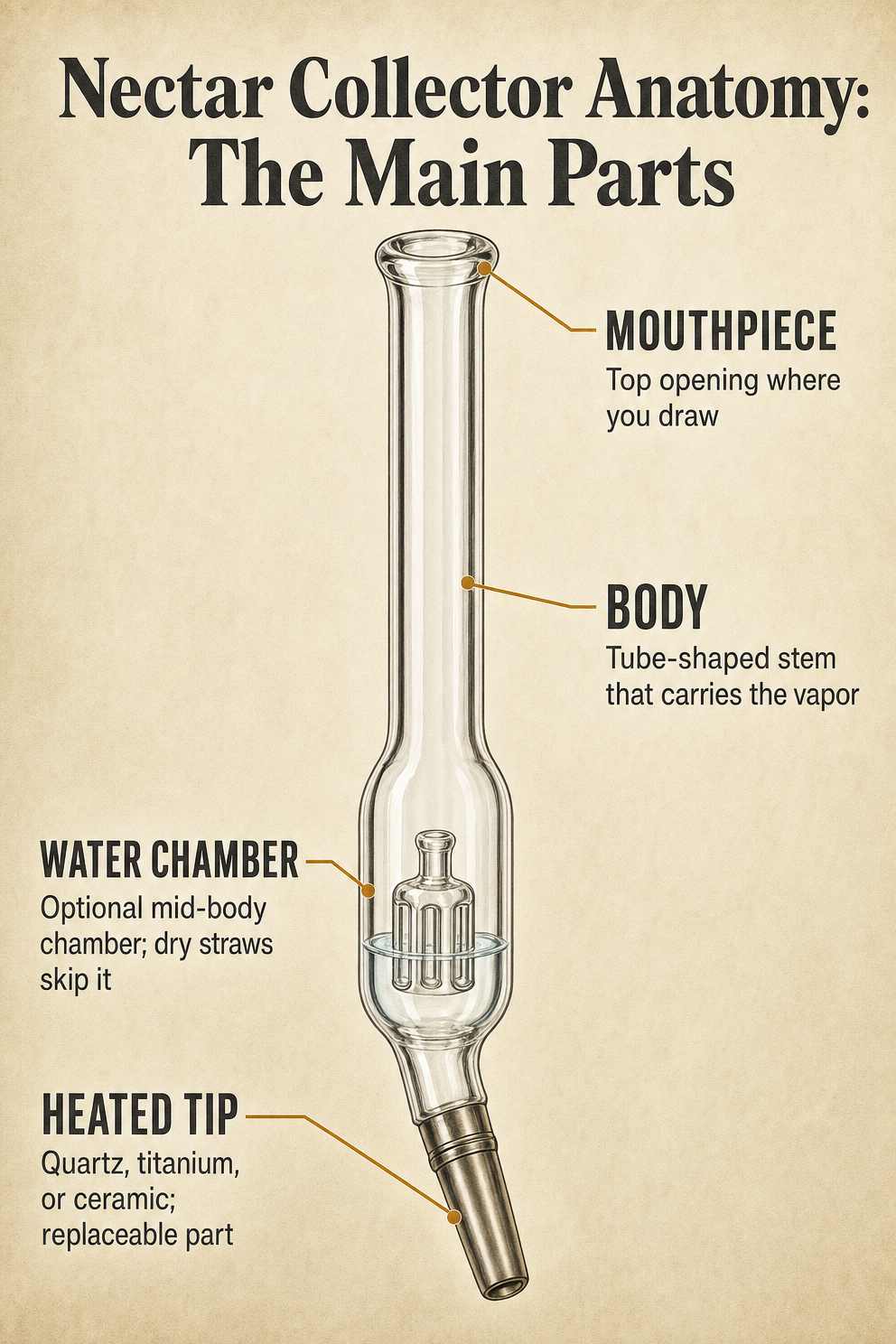
Underneath the labels the build is consistent. There is a widened tip on one end, a tube-shaped stem in the middle, and a mouthpiece at the top [3]. Some bodies add a small water chamber in the middle of the stem, and dry versions skip it entirely [7].
The rest of this guide covers the parts, a step-by-step session, tip materials, torch-free electric models, cleaning and storage, and how a straw compares with a full rig. This article is also the entry point to a wider shelf of concentrate gear: you can see the full range of shapes in Nectar Collectors, and browse the wider Dab Rigs category if you are also weighing a tabletop setup. A banger-based rig works on a different rhythm, which is why pieces like Human Grade Terp Bubble Slurper Bangers sit on a separate buying list from a glass straw.
- Nectar collector – the most common name in US listings and retailer guides [1].
- Dab straw or dabbing straw – used interchangeably with nectar collector by many shops [2].
- Honey straw – the name retailers often use for the dry, waterless version [7].
- Vapor straw – a broader term some retailers prefer for the same shape [7].
- What stays the same under every name: one heated tip, one tube-shaped body, and one mouthpiece [3].
What Are the Parts of a Nectar Collector?
A nectar collector is a short assembly, and that is part of its appeal. Knowing the order of the parts makes it easier to compare listings, because two devices that look different online often use the same basic stack [4].
The tip is the part that takes heat and the part that wears. On most models the tip is removable, so you can replace that one piece instead of replacing the whole device [2].
Tips are commonly offered in 10 mm and 14 mm sizes, and the difference matters because the tip has to match the body it screws or slots into [6]. That is the main reason a tip and a body are usually bought as a matched pair.
The water chamber is optional and easy to spot in photos. It is a wider section in the middle of the stem that you can fill with water. A dry straw, often sold as a honey straw, has no chamber at all [3].
The small hardware is easy to overlook until a part goes missing. Connectors, joints, and keck clips are what hold the pieces together as one unit [3]. It also helps to see how the stationary version of a concentrate setup is built, which is covered in What Is a Dab Rig and How Do You Use One?, and the small tools that go with either path are explained in What Are Dab Tools and How Do You Choose the Right One?. If you are still choosing a main piece, What Is a Bong and How Does It Work? covers how water filtration is arranged on a larger body.
- Heated tip, also called a nail or a coil tip – the part you heat and the part that contacts the concentrate [2].
- Tube-shaped body – the stem that carries vapor away from the tip and toward the mouthpiece [6].
- Water chamber – an optional mid-body section you can fill with water; dry straw models leave it out [3].
- Mouthpiece – the top opening where you draw [4].
- Connectors and clips – the joints and keck clips that hold the assembly together [3].
How Do You Use a Nectar Collector Step by Step?
A manual session is short, but the order of the steps matters. The sequence below is the one retailer and manufacturer guides agree on, with a note on why each step is there [4].
Heat timing is where guides disagree most. Published tables put quartz at roughly 20 to 30 seconds of heat in one guide and 40 to 50 seconds in another, because torch output and tip thickness both vary [6] [2]. Take any number as a starting point and read the tip itself rather than the clock.
The tip glows while it is being heated. Guides consistently advise waiting for that glow to fade before the tip touches concentrate, because contact while the tip is still glowing burns the material instead of vaporizing it [7].
Dose is set by contact time rather than by loading a fixed amount. One source describes a 1 to 2 second touch as a small hit and a 3 to 5 second touch as a larger one, because vaporization stops as soon as the tip is lifted away from the concentrate [7].
If you already run a banger-based setup, What Are Terp Pearls and How Do You Use Them? covers an accessory from the same family that pairs with that approach. The steps below are the straw equivalent, start to finish.
- Assemble the device and check that the tip is seated and the joints are tight [4].
- Fill the water chamber only if your model has one, and only enough to cover the percolator openings [6].
- Set the concentrate on a heat-resistant dish or surface before you pick up a heat source [4].
- Heat the tip evenly, moving the flame so no single spot takes all the heat [6].
- Stop heating and let the glow fade. Contact while the tip is still glowing burns material instead of vaporizing it [7].
- Touch the tip to the side or edge of the concentrate rather than pressing down into the center [6].
- Draw slowly and steadily while the tip is in contact, then lift the tip away to end the draw [5].
- Set the tool down on a heat-resistant stand, tray, or dish. The tip stays hot for a stretch after a session, so decide where it lands before you start [7].
- Let the device cool, then swab residue out of the air path before you put it away [8].
Do You Need a Torch, or Should You Buy an Electric Nectar Collector?
The torch question comes down to how much guesswork you want to own. Torch-heated models cover glass and silicone bodies and rely on the user reading heat and cool-down by eye, which is exactly where the temperature-guesswork complaint comes from [1].
Electric models replace the torch with a rechargeable battery and a heating element or coil. You press a button and the tip usually reaches working temperature in about 5 to 15 seconds [9].
Current units are described as holding set temperatures in the roughly 450 to 750 degrees Fahrenheit band, and the heating elements come in ceramic, quartz, or titanium-wrapped builds with different heat-up speeds [9].
Coil technique differs from a glass straw. Touch the side of the coil to the concentrate instead of submerging the tip, because oversaturating or burying the coil clogs the airway and leaves material poorly vaporized [8].
If you go the torch route, the practical habit is aim: point the flame at the tip and keep it away from other people, fuel canisters, and anything combustible. The user still reads the heat by eye, which is the trade-off that comes with the torch path.
If you would rather skip the straw form factor entirely, Dr Dabber XS e-Rig Portable Vaporizer is a battery-powered concentrate option worth comparing before you commit to a torch.
- Torch-heated glass straw – the simplest build, no battery, warmth read by eye [4].
- Torch-heated silicone body – lower in weight, cheaper, and drop-resistant for travel, but it still needs a torch [9].
- Electric straw with a coil tip – button heat, about 5 to 15 seconds to working temperature [9].
- Electric straw with a bubbler attachment – adds a water chamber between the tip and the mouthpiece [9].
- Coil service life – depends on use and maintenance, with replacement due when flavor drops or the tip turns black [8].
Which Tip Material Is Right for You: Quartz, Titanium, or Ceramic?
Tip material is the choice buyers revisit most often, because tips are interchangeable on most bodies. That means material is a decision you can come back to rather than a permanent one [2].
Quartz heats fast and cools fast, and it is the material retailers describe as the flavor-forward option [5].
Titanium heats more slowly but holds heat longer, and it is described as the most durable of the three [5].
Ceramic heats slowly and evenly, but it chips or cracks more easily than the other two [3].
There is a pairing habit worth knowing about. Quartz tips are often paired with glass bodies, while titanium is often paired with silicone bodies [3].
A more useful frame than ranking the three is asking how you actually dab. Quick repeat touches favor a tip that recovers fast. Fewer, longer sessions favor a tip that holds heat. A tool that travels favors a body and a tip that can take a knock.
- Quartz – heats fast, cools fast, and is described as the flavor-forward pick [5].
- Titanium – slower to heat, holds heat longer, and is described as the most durable [2].
- Ceramic – heats slowly and evenly, but chips or cracks more easily than the other two [3].
- Interchangeable tips – most bodies accept more than one material, so the decision is not permanent [2].
Nectar Collector vs Dab Rig: Which One Fits Your Setup?
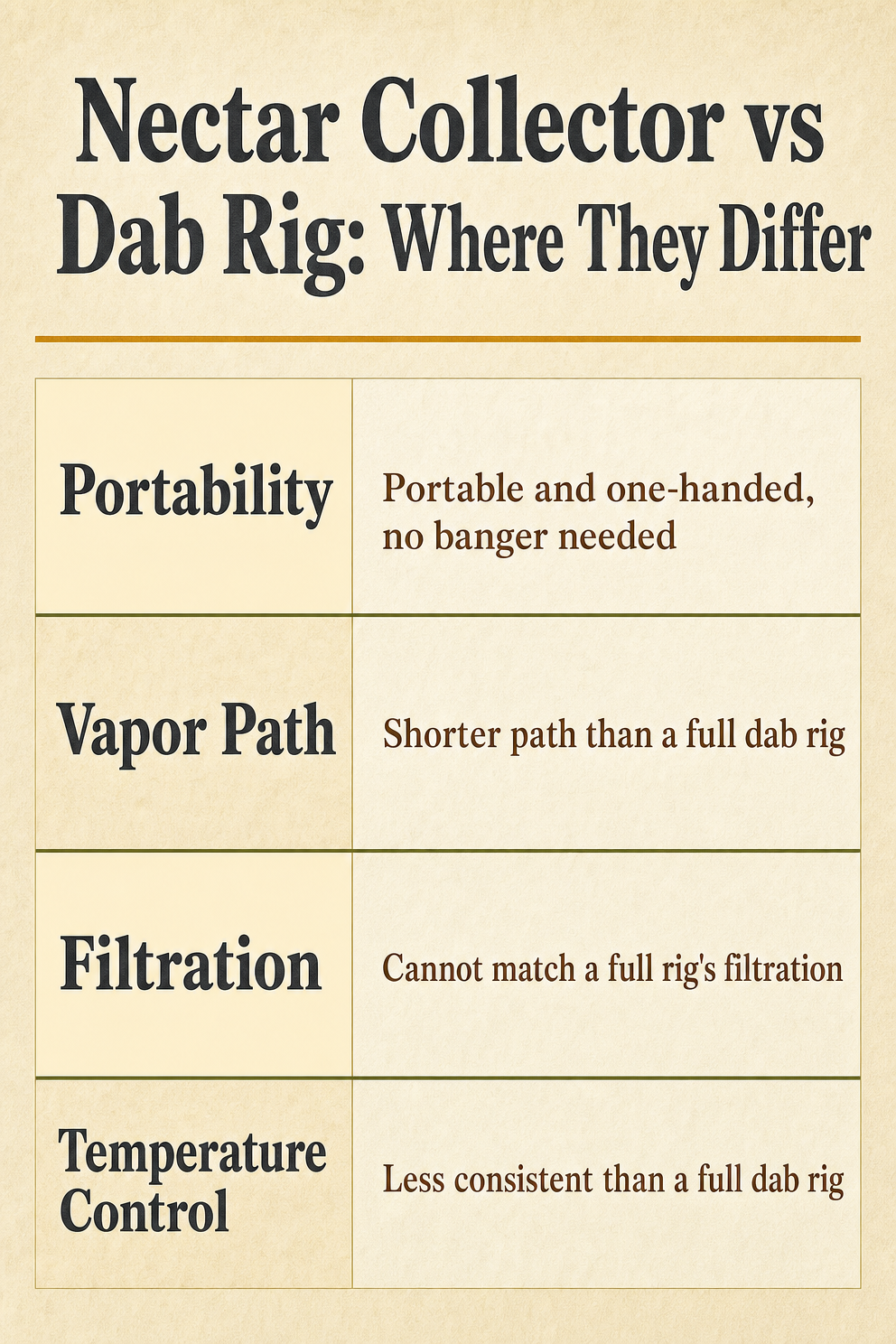
A nectar collector and a dab rig are not a better and a worse version of the same thing. They are two ways of arranging the same idea: heat, concentrate, and a path to a mouthpiece [1].
The straw wins on portability and setup time. There is no banger to prepare, no carb cap to time, and no table required. It can be used one-handed, which is why it travels well [4].
The rig wins on control. A full rig keeps the heat source and the material in one place, adds a longer vapor path, and offers more filtration options and steadier temperature. A straw is not built to match that [7].
A simple way to decide is to answer three questions: where do you use it, how often, and how much setup do you want to own before the first draw. The limits below are the ones owners mention most often, and the table that follows sets the two devices side by side.
- Torch temperature is read by eye, so timing takes practice [1].
- Touching the tip to concentrate for too long wastes material and leaves the rest behind in the dish [1].
- Reclaim builds up inside the body and narrows the air path over time [8].
- There is a technique learning curve around timing and draw speed that only shrinks with practice [7].
| Factor | Nectar collector | Dab rig |
|---|---|---|
| Portability | Portable and usable one-handed [4] | Stays on a table [7] |
| Setup | No banger, no carb cap, no table needed [4] | Needs a banger, a carb cap, and a heat source [4] |
| Vapor path | Shorter path to the mouthpiece [7] | Longer path with more cooling [7] |
| Filtration | Cannot match a full rig’s filtration [7] | More filtration options [1] |
| Temperature consistency | Read by eye on torch models [1] | Steadier temperature [1] |
How Do You Clean and Store a Nectar Collector?
Reclaim is the reason cleaning matters on a mechanical level. Residue accumulates along the air path inside the body, progressively narrows it, and reduces performance over time [8].
One caution applies to silicone parts. Continued isopropyl alcohol use on silicone can make it brittle and cause it to lose flexibility [5].
On an electric unit, the removable heating element and the mouthpiece are cleaned the same way as a glass straw [8].
Storage habits matter as much as cleaning. Empty any water out of the chamber before the device goes away, keep the parts together, and let everything dry fully so nothing sits wet in a drawer [7] [3].
- Empty any water from the chamber and let the device cool fully before you take it apart [7].
- Disassemble the tip, body, and mouthpiece so every piece can be reached [2].
- Soak the glass parts in isopropyl alcohol, often with coarse salt as an abrasive [2].
- Swab residue out of the air path after each session so reclaim never hardens in place [6].
- Rinse the parts and let them air dry completely before reassembly [2].
- Store the device dry and assembled, with the tip protected and the parts kept together for the next session [3].
What Concentrates Work Best in a Nectar Collector?
The format matters for a physical reason. The tip is dipped into the material, so the concentrate has to sit in a dish and stay put while you bring the tip down to it [2].
Consistency changes how the material picks up. A softer concentrate grabs onto a warm tip quickly, while a brittle one needs a firmer touch at the edge to break off what you want [5].
Two formats are not part of the design at all. Loose leaf flower has nothing for the tip to pick up, and cartridge oil belongs in a cartridge rather than in a dish [3] [5].
A simple rule for stocking up: pick a consistency that holds its shape in a dish, and keep the dish and dab tool with the collector so starting a session is a single grab. Treehouse Lifestyle offers free shipping on orders $150+, so a dish, a dab tool, and the collector itself can arrive in one order.
- Wax – soft and easy to pick up on a warm tip [2].
- Shatter – brittle and glassy, so it holds its shape in a dish [2].
- Budder and crumble – semi-solid textures that scoop cleanly [2].
- Live resin and rosin – softer consistencies with more give [5].
- Hash – a solid that stays where you place it [2].
- Not designed for – loose leaf flower or cartridge oil [3].
Frequently Asked Questions
Do you need a torch to use a nectar collector?
Torch-heated models do. Electric nectar collectors replace the torch with a rechargeable battery and a heating element or coil, and the tip typically reaches working temperature in about 5 to 15 seconds after the button is pressed.
How much concentrate does a nectar collector use per hit?
Dose is set by contact time rather than by loading a fixed amount. One source describes a 1 to 2 second touch as a small hit and a 3 to 5 second touch as a larger one, because vaporization stops as soon as the tip is lifted away from the concentrate.
Can you use flower or vape cartridges in a nectar collector?
No. Nectar collectors are built for solid and semi-solid concentrates such as wax, shatter, budder, crumble, live resin, rosin, and hash. They are not designed for loose leaf flower or for cartridge oil.
Are nectar collector tips replaceable?
Usually yes. Tips are commonly offered in 10 mm and 14 mm sizes, and on most models the tip is a replaceable part rather than a fixed component, which means one body can run quartz, titanium, or ceramic over time.
How often should you clean a nectar collector?
Swab residue out after each session, and periodically disassemble the tip, body, and mouthpiece and soak the glass parts in isopropyl alcohol, often with coarse salt as an abrasive. Reclaim left along the air path progressively narrows it and reduces performance.
What Should You Look For Before Choosing a Nectar Collector?
Start with the shape of your sessions rather than the shape of the device. A nectar collector is a good fit if you want a portable, one-handed tool that skips the banger and the carb cap, and if you are willing to learn a heat cue by eye. A full rig is a better fit if you want a longer vapor path, more filtration options, and steadier temperature, and if you are happy keeping the setup on a table.
From there, work through the parts in order. The tip is the piece you will replace first, so pick a material that matches how you dab: quartz for quick repeat touches, titanium for longer sessions, ceramic for even heat with a gentler hand. Match the tip size to the body, and decide whether you want a water chamber or a dry straw. If you would rather not read heat by eye at all, an electric model trades the torch for a battery and a button.
Whichever you pick, buy the accessories at the same time. A heat-resistant stand, a dab dish, and a dab tool turn a session into a single grab instead of a scavenger hunt, and a few minutes of cleaning after each session keeps the air path clear. Think of the tip as a wear part, keep the parts together, and the device will stay ready whenever you reach for it.
Sources
- Puffco: Nectar Collector Guide: What It Is & How to Use One
- Yo Dabba Dabba: What Is A Nectar Collector and How Does It Work?
- HEMPER: What is a Nectar Collector: A Beginners Guide
- LOOKAH: How to Use a Nectar Collector? Step by Step Guide
- LOOKAH: What is a Dab Straw? How To Use and Clean it?
- Smoke Cartel: How to Use a Nectar Collector for Smooth Dabs
- Roots Glass Supply Co.: What Is a Nectar Collector? Types & How to Use One
- E-Nail.com: Electric Nectar Collector FAQ
- Oil Slick: Electric Nectar Collectors: Are They Worth It in 2026?
- U.S. Consumer Product Safety Commission: Sondiko Butane Torches Recalled Due to Risk of Serious Injury or Death from Burn and Fire Hazards
- Puretane: The Complete Guide to Butane Torch Safety and Maintenance
- Butane Source: Basic Safety and Usage Tips for Butane Torches
- B Golden Jewelry School: Using a torch safely in your house