
Hard-water stains on glass are white, chalky calcium carbonate deposits left behind when tap water evaporates, and they can be removed by filling the chamber with household white vinegar (typically 4 to 8 percent acetic acid) or a 5 to 10 percent citric acid solution in warm water. Add a tablespoon of coarse salt, seal the openings, shake gently, and soak for twenty to sixty minutes. [1] [4]
The acid reacts with the calcium carbonate to release carbon dioxide, which is the visible fizzing that shows the descaling is working, and the piece finishes with a hot water rinse followed by a distilled water rinse. [6]
Hard-water stains are chemically distinct from resin and tar, which are hydrophobic and require isopropyl alcohol rather than acid, so a piece that has both types of buildup needs an alcohol-and-salt step first and an acid-descale step second. [7]
To stop the stains from returning, switch to distilled water for the final rinse and for daily use water in the piece, because distilled water contains essentially no dissolved calcium or magnesium and leaves nothing behind when it evaporates. [1]
Most glass bongs, pipes, and rigs are made from borosilicate glass, which is highly resistant to water, neutral solutions, and dilute organic acids like vinegar and citric acid, so neither cleaner will damage the glass at room temperature. [9]
What Causes Cloudy White Stains on Glass Bongs and Pipes?
That cloudy white film on a glass bong or pipe is almost always hard-water scale, not resin and not damage to the glass. Hard water is water that contains a high concentration of dissolved calcium and magnesium ions, which it picks up as it moves through limestone and dolomite rock before it reaches the tap. [1] [5]
When that water sits on a glass surface and evaporates, the calcium and magnesium do not evaporate with it. They are left behind as a thin layer of calcium carbonate, which is the same chalky residue that spots shower glass, dishes, and faucets in homes across hard-water regions. [7]
Calcium carbonate is poorly soluble in water on its own, at about 0.013 grams per liter at room temperature, which is exactly why the film stays put after a plain water rinse. It is, however, readily soluble in dilute acids, and that detail is the whole reason vinegar and citric acid work. [3]
The film is unsightly and obvious on clear glass, which is why most owners want to remove it as soon as it builds up, and you do not have to worry about scratching or etching from the buildup itself. If you want a steady supply of fresh brushes, salts, and acid-based descalers, the Cleaning Supplies section at Treehouse Lifestyle has a small, focused set of options with free shipping on orders $150+.
The hardness of your local water supply controls how quickly that film appears. The U.S. Geological Survey breaks tap water into four official buckets based on milligrams per liter of calcium carbonate, and the next section walks through what each bucket means for cleaning cadence.
- Source rock: limestone and dolomite underground release calcium and magnesium ions into groundwater as it flows past.
- Dissolved load: calcium and magnesium ions travel through pipes as invisible dissolved minerals alongside the water itself.
- Tap water at the piece: every fill, splash, and rinse carries those dissolved ions into the chamber.
- Evaporation on glass: when the water evaporates off the glass, the dissolved ions stay behind and bond to the surface.
- Calcium carbonate film: the ions combine with carbonate to form a thin, chalky white layer of calcium carbonate, which is the hard-water stain.
What Are the Four Levels of Water Hardness?
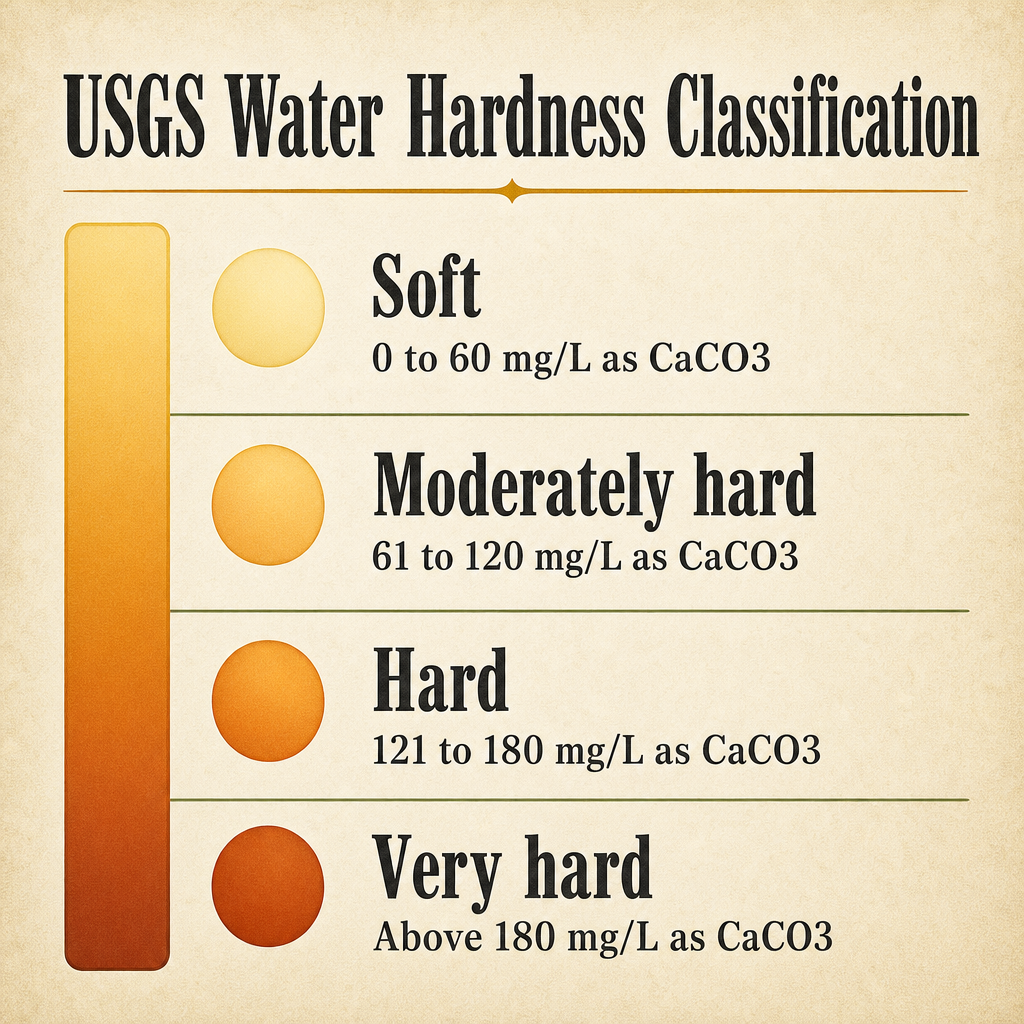
The U.S. Geological Survey classifies water hardness by the concentration of dissolved calcium and magnesium reported as milligrams per liter of calcium carbonate, and the bucket your local supply falls into predicts how often a glass piece will stain. [1]
Hardness actually comes in two flavors that get combined into the classification. Carbonate hardness, also called temporary hardness, comes from calcium and magnesium bound to bicarbonate ions, and it can be removed by boiling the water. Non-carbonate hardness, also called permanent hardness, comes from calcium and magnesium bound to sulfate, chloride, or nitrate ions, and boiling will not touch it. Both leave the same white film on glass, and both respond to acid descaling in the same way. [5]
If you want a wider background on keeping the whole collection clean, the The Complete Guide to Cleaning Smoking Accessories covers every glass, pipe, and rig material from silicone to quartz. For the specific wash routine, the step-by-step How Do You Clean a Bong the Right Way? walks through the standard alcohol-and-salt soak followed by an acid rinse. The What Is the Difference Between a Bubbler and a Bong? piece is also useful when you are deciding whether a bubbler or a beaker style is easier to keep clear over time.
Knowing where your tap water sits on this scale is the difference between rinsing a piece once a week and waiting for a cloudy haze to creep back after every use. The four buckets are listed below, and the harder your water, the more often you will want to give the piece a quick acid rinse.
- Soft, 0 to 60 mg/L as CaCO3: leaves little to no visible film on glass, and a monthly acid rinse is more than enough.
- Moderately hard, 61 to 120 mg/L as CaCO3: produces a faint haze within a few weeks, and a biweekly light rinse keeps the glass clear.
- Hard, 121 to 180 mg/L as CaCO3: shows visible film in a handful of uses, and a weekly acid rinse plus a distilled final rinse is the practical rhythm.
- Very hard, above 180 mg/L as CaCO3: builds a noticeable chalky layer in days, and a distilled-water final rinse after every use is worth the effort.
What Is the Difference Between Hard-Water Stains and Resin Buildup?
A glass bong or pipe can collect two very different kinds of buildup at the same time, and using the wrong cleaner for either is the most common reason a cleaning attempt fails. The first type is hard-water scale, an ionic mineral film left behind when tap water evaporates. The second type is resin and tar, a sticky mix of plant lipids and oils that coats the inside of the piece over repeated use. They look similar at a glance, but they are chemically opposite, and they each dissolve in a different kind of cleaner. [4] [7]
Resin is hydrophobic, which means water alone will not move it. It needs a non-polar solvent such as isopropyl alcohol, paired with a coarse salt as an abrasive, to lift it off the glass. Hard-water scale is ionic, which means alcohol will not touch it. It needs a dilute acid such as vinegar or citric acid, again paired with a coarse salt, to break the calcium carbonate down. [4]
The diagnostic shortcut is color and texture. Resin is amber to brown and has a slightly greasy feel when rubbed with a fingertip. Hard-water scale is chalky white to off-white and feels gritty under a fingernail, almost like dried toothpaste. A piece that has both needs an alcohol-and-salt cleaning step first to strip the resin, followed by a vinegar or citric acid descaling step to remove the mineral film underneath. [7]
If you are hunting for a piece that shows the resin-to-clear path clearly, the SILICONE BEAKER BONG WITH REMOVABLE GLASS BOWL is a good reference beaker with a removable glass bowl that lets you see the chamber walls before and after cleaning.
Once you know which buildup you are dealing with, picking the right cleaner stops being guesswork and starts being a chemistry problem with a clear answer.
- Hard-water scale: white to off-white and chalky, ionic mineral film, does not dissolve in water or alcohol.
- Resin and tar: amber to brown and slightly greasy, hydrophobic plant lipids, does not dissolve in water.
- Right cleaner for scale: a dilute acid such as vinegar or citric acid, which reacts with calcium carbonate to release carbon dioxide.
- Right cleaner for resin: a non-polar solvent such as isopropyl alcohol, which dissolves the lipids without needing heat.
- Order of operations on a dual-buildup piece: do the alcohol-and-salt soak first, then follow with the vinegar or citric acid descaling step.
| Feature | Hard-water stains | Resin and tar |
|---|---|---|
| Color | White or chalky | Amber to brown |
| Origin | Dissolved calcium and magnesium in tap water | Plant lipids and oils from repeated use |
| Chemistry | Ionic mineral film, calcium carbonate | Hydrophobic mix of lipids and tars |
| Water solubility | Low, needs acid to dissolve | Very low, needs alcohol to dissolve |
| Right cleaner | Vinegar or citric acid | Isopropyl alcohol |
Can Vinegar and Citric Acid Remove Hard-Water Stains From Glass Safely?
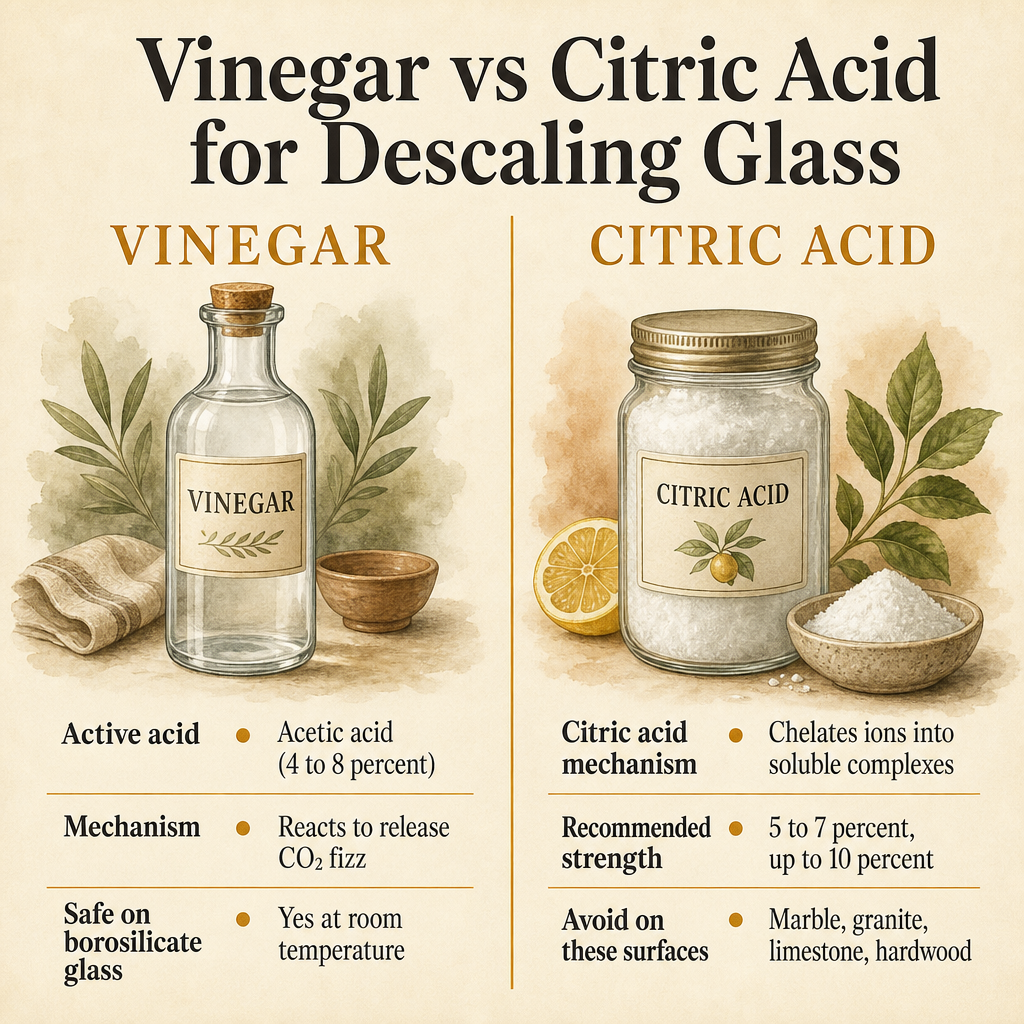
Both white vinegar and citric acid work on borosilicate glass at room temperature, and both will dissolve the same calcium carbonate film. The difference between them comes down to concentration, mechanism, and the surfaces around the piece that you need to keep the acid off. [4]
White vinegar is typically 4 to 8 percent acetic acid. It works by reacting directly with calcium carbonate in the reaction CaCO3 plus 2 CH3COOH yields calcium acetate, water, and carbon dioxide, and that carbon dioxide is the visible fizz you see when vinegar hits limescale. [2] [6] [8]
Citric acid is a mild organic acid that works by chelation rather than direct reaction. It binds calcium, magnesium, and iron ions into water-soluble complexes that can be rinsed away, which is why citric acid is a popular ingredient in kettle descaling products and dishwasher rinse aids. A 5 to 7 percent solution in warm water handles light film, and bumping the concentration up to 10 percent covers heavier, baked-on buildup. [4]
At the dilutions sold in grocery stores, vinegar splash protection and basic ventilation are the only sensible precautions. The CDC NIOSH Pocket Guide lists acetic acid with a NIOSH or OSHA permissible exposure limit of 10 parts per million as a time-weighted average, and an immediately dangerous to life or health value of 50 parts per million, which is far above what a routine vinegar soak releases into a room. [2]
If you are descaling around the sink, keep citric acid away from natural stone countertops such as marble, granite, and limestone, because it will micro-pit the surface, and keep it away from stainless steel finishes that can micro-etch. Vinegar should be kept off the same stones for the same reason. A piece like the INSIDE OUT DICHRO HAND PIPE SPOON is a good test subject, since the inner chamber walls are borosilicate glass with no surrounding stone to worry about.
Both acids hold up at room temperature on borosilicate glass, with the specific lab-grade exception being hot concentrated alkaline solutions and a few acids such as hot phosphoric acid, which are not present in either cleaner. [9]
- Active acid: vinegar is acetic acid at 4 to 8 percent, citric acid is dosed at 5 to 7 percent in warm water and up to 10 percent for heavier buildup.
- Mechanism: vinegar reacts with calcium carbonate to release carbon dioxide fizz, citric acid chelates calcium, magnesium, and iron ions into soluble complexes.
- Visible signal: vinegar produces noticeable fizz within a minute, citric acid works quietly and is judged on the result rather than the bubbling.
- Working time: vinegar soaks of twenty to sixty minutes cover moderate film, citric acid soaks run slightly faster on light buildup because the chelation step does not need to release gas.
- Avoid on stone: both should be kept off marble, granite, and limestone, and citric acid should be kept off stainless steel finishes and hardwood floors.
- Borosilicate compatibility: both hold up at room temperature on quality glass, with documented exceptions limited to hydrofluoric acid and hot concentrated alkaline solutions.
| Feature | White vinegar | Citric acid |
|---|---|---|
| Active acid | Acetic acid, 4 to 8 percent | Citric acid, 5 to 7 percent light, 10 percent heavy |
| Mechanism | Reacts with calcium carbonate to release CO2 | Chelates calcium and magnesium into soluble complexes |
| Visible signal | Fizzing within a minute | Quiet, judged on rinse result |
| Soak time | Twenty to sixty minutes moderate, several hours heavy | Ten to thirty minutes light, sixty minutes heavy |
| Avoid on | Marble, granite, limestone, natural stone | Marble, granite, limestone, stainless steel, hardwood |
| Borosilicate compatibility | Yes at room temperature | Yes at room temperature |
What Is the Step-by-Step Method to Remove Hard-Water Stains From a Glass Piece?
The full acid-descale procedure is the same eight steps regardless of which acid you choose. The steps below assume the piece has already been cleared of resin using an alcohol-and-salt soak, which is covered in the How Do You Clean Glass Accessories With Isopropyl Alcohol? guide, because resin will block the acid from reaching the calcium carbonate film underneath. [4] [7]
Choose vinegar for a fast visible-fizz descaling and citric acid for a quieter, chelation-based approach. Either way, the eight steps below will get the piece clear without damaging borosilicate glass at room temperature. [2] [6] [8]
For heavy, baked-on scale, extend the soak to several hours, and for very light haze, a quick ten-minute soak is usually enough. The acid is doing the work while the piece sits, so patience is more useful than scrubbing harder.
- Rinse with warm water: flush the chamber with warm tap water to loosen and remove any loose film or leftover alcohol-salt residue.
- Fill with white vinegar or 5 to 10 percent citric acid: pour enough of the chosen acid into the chamber to cover every stained surface.
- Add a tablespoon of coarse salt: use kosher salt, rock salt, or Epsom salt, since fine table salt dissolves too quickly to act as an abrasive.
- Seal the openings: cover the mouthpiece and any other open ports with stoppers, plugs, or clean gloved thumbs to keep the solution inside.
- Shake gently for thirty seconds: swirl the coarse salt through the acid to scrub loosened mineral film without scratching borosilicate glass.
- Soak for twenty to sixty minutes for moderate buildup, or several hours for heavy scale: the acid keeps working while the piece sits.
- Rinse with hot tap water: pour out the acid solution and rinse the chamber thoroughly with hot water to flush dissolved mineral residue.
- Final rinse with distilled water: do one last rinse using distilled water so no new calcium and magnesium are deposited as the piece air-dries.
Why Does a Distilled Water Rinse Prevent Hard-Water Stains From Coming Back?
Distilled water is steam that has been condensed back into liquid, which strips out the dissolved calcium and magnesium that cause the film in the first place. When distilled water evaporates off a glass surface, it leaves nothing behind, because there is essentially no mineral load to deposit. [1] [7]
Switching the final rinse from tap water to distilled water is the single most effective habit for keeping a piece clear after descaling. A daily-use and final-rinse switch to distilled water compounds over time, and a quick weekly rinse keeps the chamber walls clear between deep cleans. The maintenance routine below scales with the hardness of your local tap water.
Distilled water is the prevention step that closes the loop with the cause. The buildup you just removed was supplied by the tap water, so swapping the supply for distilled water removes the supply rather than escalating the cleaning. The Recycler Bongs collection at Treehouse Lifestyle is one place to browse styles that show off clear glass clearly.
- Fill the piece with distilled water for daily use: distilled water contains no dissolved minerals, so daily fills do not seed new calcium carbonate film.
- Switch the final rinse to distilled water: after the hot tap rinse, do one more rinse with distilled water so nothing is deposited as the piece air-dries.
- Add a weekly light rinse: once a week, fill the chamber with a 5 percent citric acid solution for ten minutes, then rinse with distilled water.
- Match the cadence to your water hardness bucket: soft water needs only the monthly deep soak, very hard water needs the weekly rinse plus a daily distilled rinse to keep the chamber crystal clear.
Which Cleaners and Chemicals Should Never Touch a Glass Bong or Pipe?
Borosilicate glass is documented as highly resistant to water, neutral solutions, and dilute organic acids, which is why the cleaning methods earlier in this article use only vinegar, citric acid, and coarse salt. Those mild-acid recommendations come with a short list of exclusions that apply to stronger cleaners and must not be confused with normal household descaling. [9]
Industrial limescale removers and some commercial descalers rely on stronger mineral acids that will actively etch a silica-based glass, and that is exactly why those products carry explicit warnings against use on glass surfaces that should not be etched. The acid in those products is what the warning is about, not the limescale itself. [10]
Fine table salt is also excluded from the cleaning routine, because it dissolves too quickly in vinegar or citric acid to act as a physical abrasive and contributes nothing to the scrubbing step. Stick to coarse kosher salt, rock salt, or Epsom salt instead.
If a product label warns against use on glass, marble, granite, or any natural stone, take that warning at face value and reach for vinegar or citric acid instead, which will dissolve the same calcium carbonate film without etching the surface.
- Hydrofluoric acid: attacks the silica network of glass even in trace amounts and is reserved for industrial glass etching, never for routine cleaning.
- Hot phosphoric acid: can etch or corrode borosilicate at elevated temperatures and should not be used for routine descaling of a bong or pipe.
- Hot concentrated alkaline solutions: sodium hydroxide above 30 percent at high temperatures can etch borosilicate, so caustic drain cleaners should never be used on a glass piece.
- Commercial limescale removers with strong mineral acids: many carry explicit warnings against use on glass surfaces that should not be etched.
- Fine table salt: dissolves too quickly in vinegar or citric acid to act as an abrasive and adds nothing to the scrubbing step.
- Abrasive powders such as Ajax or Comet: can micro-scratch borosilicate glass and leave hazy swirls that no amount of acid descaling will remove.
Frequently Asked Questions
How can I tell if a cloudy mark on glass is a hard-water stain or actual glass damage?
Hard-water stains lift or soak off with a dilute acid and a coarse salt, while scratches, pitting, or acid etching stay put no matter how long you soak. Try a ten-minute vinegar soak on a small spot first. If the film lifts and the glass underneath looks clear, it was a mineral deposit. If the cloudy mark is still there, it is likely surface damage to the glass rather than a cleaning problem, and a stronger acid would only make it worse.
How long should I soak a glass piece in vinegar to remove hard-water stains?
For moderate mineral film, twenty to sixty minutes of soak time is enough. For heavy, baked-on scale, plan on several hours, and for very light haze a quick ten minute soak followed by a shake with coarse salt is usually sufficient. The acid is doing the work while the piece sits, and the visible fizz confirms the descaling reaction is active.
Will vinegar or citric acid damage borosilicate glass?
No, at room temperature and at the dilutions sold in grocery stores both acids hold up on borosilicate glass without leaving marks. Borosilicate is documented as highly resistant to water, neutral solutions, and dilute organic acids, and its documented exceptions are hydrofluoric acid, hot phosphoric acid, and hot concentrated alkaline solutions, none of which are present in vinegar or a citric acid cleaning solution. The two caveats are practical: keep citric acid off natural stone and stainless steel finishes in the surrounding area, and always rinse the piece with water after the soak.
Can I use a commercial limescale remover like CLR on a glass bong?
Most commercial limescale removers contain stronger mineral acids than vinegar or citric acid and carry explicit warnings against use on glass surfaces that should not be etched, which is exactly the case for a glass bong or pipe. For routine descaling, white vinegar or a 5 to 10 percent citric acid solution in warm water will dissolve the same calcium carbonate film without the etching risk, and the standard procedure covered in the article uses materials that are already in most kitchens.
What is the difference between temporary hardness and permanent hardness in water?
Carbonate hardness, also called temporary hardness, comes from calcium and magnesium combined with bicarbonate ions and can be removed by boiling the water, which drives off carbon dioxide and precipitates the minerals. Non-carbonate hardness, also called permanent hardness, comes from calcium and magnesium combined with sulfate, chloride, or nitrate ions and cannot be removed by boiling. Both forms leave the same kind of mineral film on glass, and both respond to acid descaling in the same way.
How do I know if my tap water is hard enough to leave visible deposits on glass?
The U.S. Geological Survey classifies water as soft at 0 to 60 mg/L as calcium carbonate, moderately hard at 61 to 120 mg/L, hard at 121 to 180 mg/L, and very hard above 180 mg/L. Most municipal water suppliers publish an annual water quality report with the local hardness number, and any reading above about 120 mg/L will visibly film a glass piece within a few uses if the piece is not rinsed with distilled water.
Should You Use Vinegar, Citric Acid, or Both to Keep a Glass Piece Clear?
Hard-water stains are not damage to the glass, but they are the predictable result of letting calcium- and magnesium-rich tap water evaporate off a borosilicate surface. The practical way to deal with them is to dissolve the calcium carbonate with a dilute acid and then stop feeding it fresh minerals from the tap.
White vinegar at 4 to 8 percent acetic acid is the easiest acid to find, and it works by a direct reaction with calcium carbonate that releases visible carbon dioxide fizz. Citric acid at 5 to 7 percent in warm water is the gentler option and works by chelation, which is quieter but just as effective on light to moderate film. Both hold up on borosilicate glass at room temperature, neither needs heat, and either one paired with a tablespoon of coarse salt and a twenty-to-sixty-minute soak will clear the typical haze.
The two habits that keep the glass clear long after descaling are a final rinse with distilled water and switching the daily-use water in the piece to distilled. Distilled water strips out the dissolved calcium and magnesium, so evaporation leaves nothing behind. Combined with a once-a-week light citric acid rinse in hard-water regions, the routine is enough to keep a glass bong or pipe looking as clear as the day it was unboxed.
Sources
- U.S. Geological Survey (USGS) Water Science School: Hardness of Water
- CDC NIOSH (Pocket Guide to Chemical Hazards): Acetic acid
- Wikipedia (open chemistry reference): Calcium carbonate
- CORECHEM Inc. (chemical supplier): Cleaning with Citric Acid? Here’s What You Need to Know
- PubMed Central / NIH (International Journal of Preventive Medicine): Potential Health Impacts of Hard Water
- ScienceDirect / Desalination (Elsevier): Exploitation of acetic acid for calcite dissolution in small-capacity desalination plants
- Aquasana (water-treatment manufacturer): 5 Ways to Remove and Prevent Hard Water Stains
- American Chemical Society (ACS): The Fate of Calcium Carbonate
- The Lab Depot (laboratory equipment supplier): What Is Borosilicate Glass: Properties, Benefits & Best Practices in the Lab
- ScienceDirect / Journal of Non-Crystalline Solids (Elsevier): Chemical etching of glasses in hydrofluoric acid: A brief review