

A spinner perc is a disc set across the water chamber of a bong or dab rig, with angled slits cut into it like fan blades. Inhaling forces smoke out through those cuts instead of a straight downstem, so water and smoke spin into a rotating column. It is a moderate diffuser, and the same glass is sold as a turbine, cyclone, or vortex perc.
What is a spinner perc and what does it do to the smoke?
Start with what the part physically is. A spinner disc is a flat piece of glass set horizontally inside the water chamber, with a ring of narrow cuts around its edge or across its face. Nothing on it moves. The glass is fixed and sealed to the tube, and the spinning you see happens in the water above the disc, not in the hardware.
Now follow one pull. Air comes down the downstem into the chamber below the disc, and the only way out is through those angled cuts. Because each cut points sideways rather than straight up, the air leaves the disc along the wall of the chamber instead of rushing upward. That sideways exit is the entire mechanism: it redirects the flow tangentially and drags the surrounding water into a rotating column [3].
The result is a different bubble pattern than a straight downstem gives you. Instead of one wide rush of large bubbles, the smoke is pushed out as many small streams that get folded back into moving water for the length of the pull. Smaller bubbles mean more smoke-to-water surface area per inhale, which is the same principle every percolator style is built around [9].
That is also why the style shows up across glass categories. The disc appears in full-size water pipes and in Dab Rigs, and the parts that pair with it — caps, pearls, cleaning gear — sit in Accessories on most shop menus. The hardware is the same idea at different scales.
- Downstem: carries the pull down into the water chamber and sets the starting direction of the airflow.
- Disc face: forces the entire pull through a narrow ring of openings instead of one wide mouth.
- Angled slits: turn the airflow sideways, so it leaves the disc along the chamber wall rather than straight up.
- Vortex: the sideways exit whips water and smoke into a rotating column instead of a straight bubble stream.
- Water contact: the rotation keeps breaking bubbles apart and folding them back into the water for the whole pull.
Is a spinner perc the same thing as a turbine, cyclone, or vortex perc?
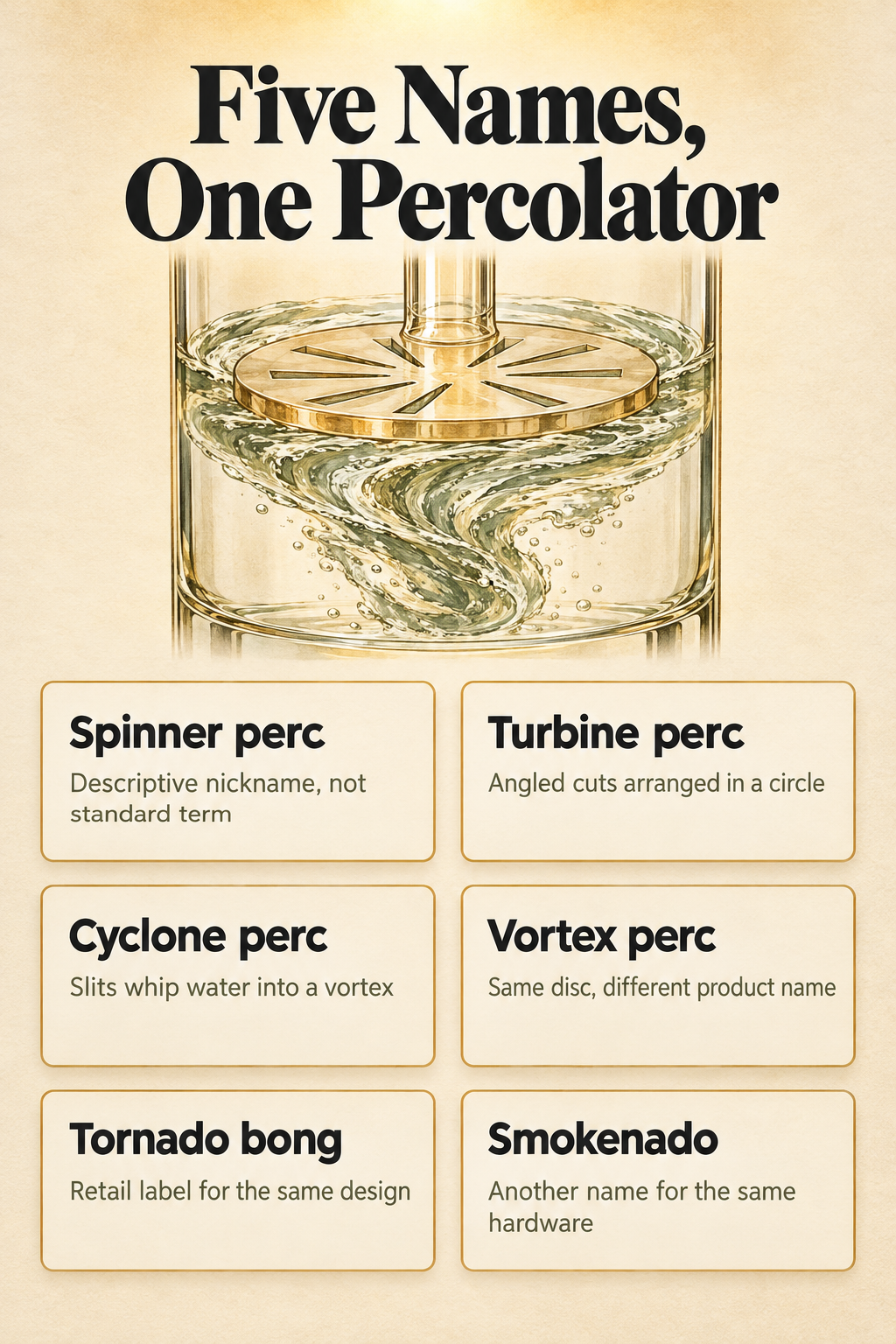
In practice, yes. Spinner, turbine, cyclone, vortex, tornado bong, and Smokenado all describe the same disc with angled slits cut around it [3]. There is no industry body that decides which name is correct, so each retailer, brand, and blog picks the label that reads best on its own product page.
That is why the name on the box tells you less than the parts description does. "Turbine" is the most common term in percolator explainers, where the disc is described as a ring of angled slits that pulls water and bubbles into a whirlpool [5]. "Cyclone" and "vortex" tend to appear in marketing copy and in multi-stage piece names, because the effect is the selling point [4]. "Spinner" is a plainer, more descriptive word that has spread because it is easy to picture.
The useful takeaway: two pieces with completely different labels can still be the same internal part. Compare slit geometry, slit count, and stage count instead of names, because those are the details that change performance.
If you want the wider context, What Is a Percolator Bong and How Does It Work? lays out the seven main percolator styles, and What Is a Bong and How Does It Work? covers the parts of a water pipe from bowl to mouthpiece. For how a spinning chamber differs from a recycling one, Recycler Bong vs. Percolator Bong: What Is the Difference? is the direct comparison. On the concentrate side, What Should You Know Before Buying Honeybee Herb Quartz and Bangers? explains quartz and banger options, and What Is a Dab Rig and How Do You Use One? covers rig basics.
- Turbine perc: the most common term in percolator explainers, usually describing angled slits arranged in a circle.
- Cyclone perc: the same disc, named for the whirlpool it creates inside the chamber.
- Vortex perc: a descriptive label used in product names and multi-stage piece listings.
- Spinner perc: a plainer nickname for the identical part, popular because it is easy to picture.
- Tornado bong or Smokenado: retail naming that frames the rotation as the headline feature of the whole piece.
Why does a spinner perc feel like more drag at the start of the pull?
Because the rotation has to start. The first moment of a pull has to move standing water through narrow angled cuts, and moving water sideways takes more effort than letting it rise straight up. That is the moderate resistance people notice in the first second or two.
Once the column is turning, the pull changes character. The water is already in motion, the slits have a steady flow through them, and the draw settles into a consistent feel for the rest of the inhale [3]. That ramp-up is normal for the design. It is not a defect, and on its own it does not mean the piece is clogged — a piece that gets harder every week is buildup, covered further down.
The disc is doing a second job at the same time. On a hard pull, water climbs the walls of a chamber and heads for the mouthpiece. The flat disc blocks that path, and the rotation pushes water outward toward the glass rather than up the neck. That combination is why turbines are commonly listed as a splash-control choice rather than just an airflow feature.
Use the sequence below as a diagnostic. If your piece skips step two or three, the cause is usually the water level or a partly blocked slit, not the disc itself.
- Inhale begins: you feel moderate resistance as standing water is pushed toward the angled cuts.
- Rotation engages: airflow through the slits becomes steady, and the water starts turning as one column.
- Steady cyclone: the rest of the pull feels consistent, with bubbles travelling around the chamber rather than straight up.
- Splash control: the flat disc and the outward push of the rotation keep water from climbing toward the mouthpiece.
- Pull ends: the column slows and settles, and the water drops back to its resting level below the disc.
How does a spinner perc compare to honeycomb, matrix, and other percs?
A spinner is a moderate diffuser, not a maximum one. It uses comparatively few openings — commonly somewhere around six to twelve angled cuts — while a honeycomb or matrix disc is drilled with dozens of small holes [3]. Fewer openings means less total bubble surface area, so it gives up some diffusion compared with the busiest designs.
What it keeps in exchange is control. Fewer, larger openings pull harder per hole but offer less total restriction once the rotation is running, and the shorter air path through the water dulls flavor less than a stack of drilled discs does [9]. That is the trade: less diffusion, more of the material’s own character left in the pull, plus a visual effect you can actually watch.
Stacking is the other half of the comparison. Because the disc shape is flat and easy to fit, turbines are usually one stage in a multi-perc piece rather than the only percolator in it [4]. Each added stage increases drag and adds another component to clean, and the performance gain levels off past two or three stages. A three-turbine tube is not three times the diffusion of a one-turbine tube; it is mostly three times the cleaning.
That is also why heavy diffusion is often described as a poor match for concentrates. Honeycomb and matrix designs cool aggressively and can dull the more delicate flavor notes in a concentrate, so small single-stage rigs and turbines are the usual suggestion for dabs, while multi-perc bongs are described as better suited to flower [4]. If you are shopping the wider category, Bongs is the place to compare shapes side by side.
One honest caveat: none of this changes what a water pipe does chemically. Water removes some water-soluble compounds and larger particles, but most smoke chemicals and fine PM2.5 particles still pass through, and one study measured average room PM2.5 of about 1,300 micrograms per cubic meter while cannabis was being smoked from a bong [11]. A spinner perc is an airflow and splash feature, not a filtration guarantee.
- Spinner or turbine: roughly six to twelve angled cuts, moderate diffusion, moderate drag with a short ramp-up, preserves more flavor, easy to stack.
- Honeycomb: a flat disc drilled with dozens of small holes, strong diffusion, higher drag, dulls more flavor, more surface to clean.
- Matrix: several stacked drilled discs, the strongest diffusion of the group, the most drag, and the most cleaning work per session.
- Inline: a horizontal tube with slits along its length, gentle diffusion, low drag, and the easiest of these to rinse out.
- Stacking: each added stage raises drag and adds a component to clean, with gains flattening past two or three stages.
| Perc style | Openings | Diffusion | Drag | Flavor | Cleaning |
|---|---|---|---|---|---|
| Spinner or turbine | About six to twelve angled cuts | Moderate | Moderate, short ramp-up | Keeps more | Moderate |
| Honeycomb | Dozens of small holes | Strong | Higher | Dulls more | More surface to clean |
| Matrix | Stacked drilled discs | Strongest | Highest | Dulls the most | Most work per session |
| Inline | Slits along a horizontal tube | Gentle | Low | Keeps more | Easiest to rinse |
How much water should go in a spinner perc bong?
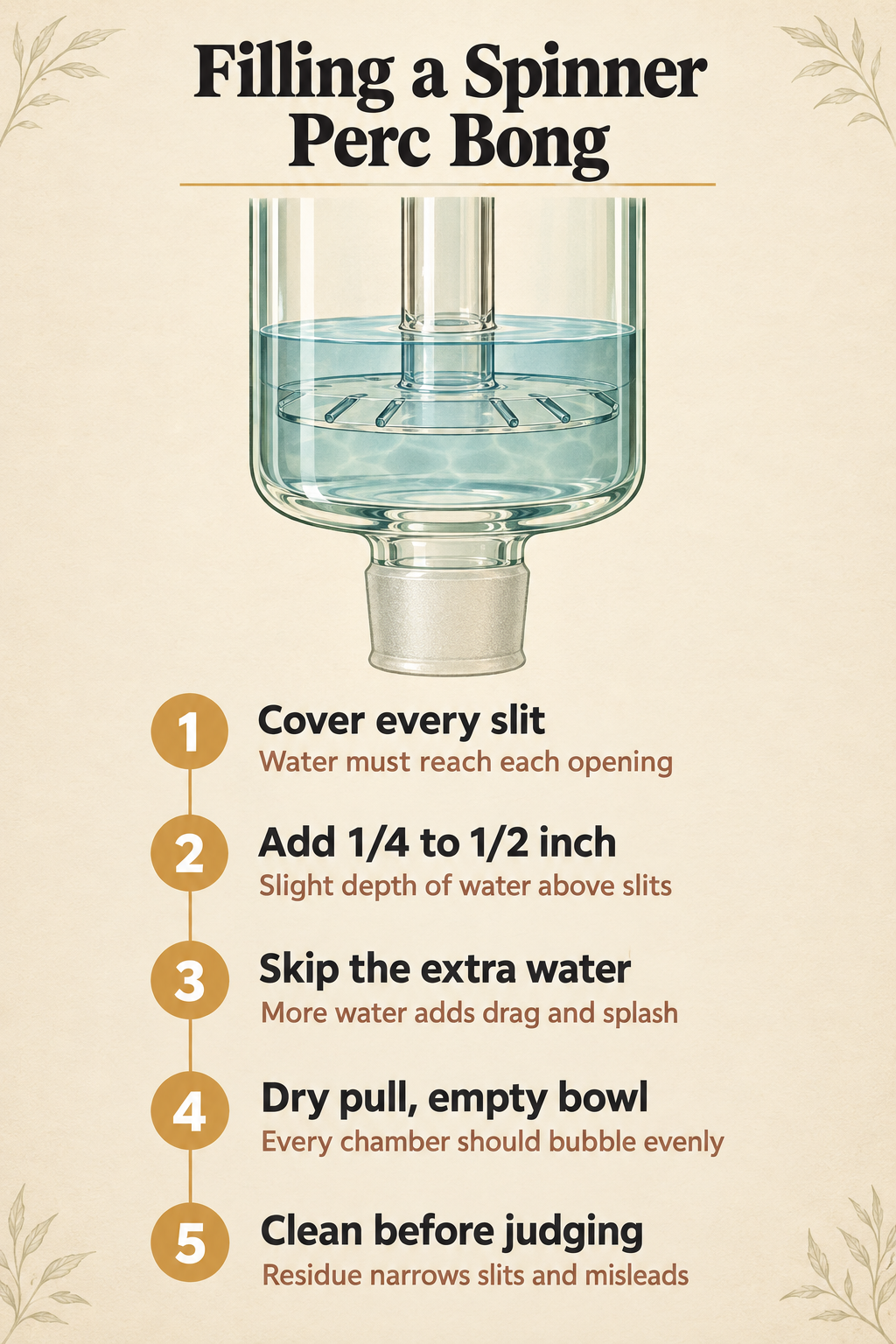
The working rule is short: cover every perc opening, then stop. In practice that lands at roughly a quarter inch to half an inch of water above the slits — enough to seal them, not enough to drown them [6].
There are two ways to get it wrong, and they feel opposite. Too much water mostly adds drag and splash rather than more diffusion, because the extra depth is just weight the pull has to move. Too little water is quieter and sneakier: if the disc sits above the waterline, the smoke simply flows past it and the perc does nothing at all [6].
Then confirm it with a dry pull and an empty bowl. Every chamber should bubble evenly and steadily, with no dead spot on one side of the disc and no water arriving at your lips. If water reaches your mouth, you have poured too much. If one side of the disc barely moves, the slits on that side are likely restricted.
Clean glass belongs in this procedure, not after it. Residue narrows the slits, so a fill that would be perfect in a fresh piece can feel wrong in a dirty one, and the natural reaction is to add more water and make it worse [6]. Judge the level on a clean piece first.
- Fill through the downstem opening until water just covers the disc.
- Stop once every slit is submerged, at about a quarter inch to half an inch above them.
- Skip the extra water; depth beyond that point buys drag and splash instead of diffusion.
- Dry pull with an empty bowl and watch for even bubbling across the whole disc.
- If water reaches your lips, pour some out and re-check.
- Clean the piece before judging a fill, because residue narrows the slits and misleads you.
How do you clean a spinner perc without wrecking the slits?
Perc pieces need more frequent cleaning than a plain downstem bong, and a slitted disc is the fussiest version of that rule. Resin collects in the openings, and once they gum up the perc stops diffusing properly and the pull gets progressively harder [5].
The habit that protects a spinner is frequency over force. Short, regular soaks keep buildup soft enough to rinse away, while long gaps let it set into the corners of the slits where nothing can reach. Scrubbing harder will not fix it. The geometry is the fragile part, not the glass.
Watch the seal where the disc meets the tube. That joint is what forces the whole pull through the slits, and a chip there turns a spinner into a piece with a bypass. Handle the chamber by the tube, not by the disc, when you rinse or drain it.
Finally, re-check the water level after every clean. A piece that has been running with narrowed slits often needs less water than the owner expects, because the old fill was compensating for the restriction. Cleaning changes the correct answer.
- Rinse immediately after a session with warm water to stop resin from setting in the slits.
- Soak the chamber in a cleaning solution on a short cycle rather than waiting for visible buildup.
- Agitate gently and let the liquid do the work; the angled cuts are small and easy to damage with force.
- Flush through the disc from both directions so loosened residue leaves the slits instead of packing in.
- Inspect the slits against a light for even openings, and check the disc seal for chips.
- Refill and dry pull to confirm even bubbling before you use the piece again.
What does "spinner" mean on a SeshGear bong or dab rig?
This is the trap, and it catches people who shop by product name alone. Not every piece sold with "spinner" in the title has a spinner perc. Sometimes the word describes a moving decoration built into the glass, and the percolation is handled by an ordinary diffuser downstem.
The SeshGear Spinner Beaker Glass Water Pipe is the clearest example. It is an 11.75-inch beaker with a built-in glass fidget spinner set into the neck, a bullet-hole ice catcher, borosilicate construction, a diffuser downstem, and a 14mm male herb slide. The spinner rotates as a hands-on novelty feature, and the listing describes no angled-slit disc [7].
The same naming shows up in the dab category. The SeshGear Spinner Glass Dab Rig is an 8.5-inch bent-neck rig with a built-in glass fidget spinner in the neck, matching spinner accents on the mouthpiece and base, a fixed diffuser downstem, borosilicate glass, and an included 14mm male quartz banger [8]. Again, the spinner is a feature of the neck, not a percolator stage.
None of that makes these bad pieces. A beaker with a diffuser downstem and an ice catcher is a familiar, predictable setup, and a compact rig with a fixed downstem is easy to live with. It just means you should buy it for what it is rather than for an effect it does not have. Both ship under the store’s standard terms, which include free shipping on orders $150+.
So read the parts list, not the name. The checklist below is what separates a decorative spinner from a real spinning perc.
- Neck hardware: if the spinner is described as sitting in the neck or mouthpiece, it is decoration, not percolation.
- Downstem type: a diffuser downstem means the diffusion happens at the bottom of the tube, not at a disc in the chamber.
- Percolator description: look for explicit language about a disc, plate, slits, or angled cuts inside the water chamber.
- Chamber count: a single straight chamber with one water section is not a multi-stage perc piece.
- Joint size and accessories: a stated 14mm joint and included slide or banger tell you what the piece is actually set up to do.
- Feature wording: "fidget spinner" and "spinner accents" describe moving parts and styling, not airflow.
Is a spinner carb cap the same thing as a spinner perc?
No. It is the same word applied to different hardware, and confusingly, this version is genuinely functional rather than decorative. A spinner carb cap has multiple angled air channels that turn the draw into a vortex inside the banger, with the goal of moving terp pearls around the bucket so you are not steering the cap by hand [1]. Manufacturers also list them as spinner caps, vortex caps, or auto-spin caps [2].
The contrast worth knowing is with a bubble cap. A bubble cap has one or two holes, and you rotate it yourself to aim airflow and push pearls where you want them. A spinner cap has several angled channels and creates the vortex automatically. Spinners are the hands-free option for moving pearls; a directional cap gives you more manual control over where the material sits [2].
Fit is where people get burned. Honeybee Herb lists its Triangle Spinner Carb Cap for most standard 25mm flat-top quartz bangers and terp slurper bangers, and states plainly that it is neither universally compatible nor cold-start compatible [1]. Check your banger’s opening diameter and top shape before ordering, because a cap that does not seat will not spin anything.
Pearls are the other half of the setup. A spinner cap still controls airflow without them, but moving pearls is the point of the design, and whether they actually spin depends on the whole setup including cap fit and the specific banger [1]. If you are buying pearls, 6mm is the standard size and 4mm is also common; an undersized pearl can be pulled into the neck, and an oversized one may not fit or work properly [10].
- Spinner cap: several angled channels, automatic vortex, hands-free pearl movement, fit-dependent.
- Bubble cap: one or two holes, manual rotation, more direct control over where airflow points.
- Pearl size: 6mm is standard and 4mm is common; too small risks pulling a pearl into the neck.
- Banger fit: 25mm flat-top and terp slurper bangers are the usual targets, but compatibility is not universal.
- Cold start: spinner caps are generally not rated for cold-start use, so check before you plan around it.
| Trait | Spinner cap | Bubble cap |
|---|---|---|
| Air channels | Several angled channels | One or two holes |
| Vortex | Created by the channels on the inhale | None; you aim the airflow by hand |
| Pearl movement | Hands-free once the cap seats | Needs manual rotation |
| Control | Less directional control | More direct control over where airflow points |
| Fit | Check opening diameter and top shape | Check opening diameter and top shape |
Frequently Asked Questions
Does a spinner perc actually spin the water?
Yes. The angled slits redirect airflow sideways, so an inhale drives the water and smoke around the chamber in a rotating column instead of sending a straight stream of bubbles up through it. The glass itself does not move — the rotation happens in the water above the disc.
Is a spinner perc the same as a turbine perc?
In practice, yes. Spinner, turbine, cyclone, vortex, tornado bong, and Smokenado all describe the same disc with angled slits cut around it. "Spinner perc" is a descriptive nickname rather than a standardized manufacturer term, so the parts description on a listing tells you more than the product name does.
Does a spinner perc filter better than a honeycomb or matrix perc?
No. It is a moderate diffuser, not a maximum one. A spinner or turbine disc typically uses somewhere around six to twelve angled cuts, while honeycomb and matrix discs use dozens of holes, so the spinner trades some bubble surface area for less flavor dulling and a more visible effect.
Will a spinner carb cap fit the banger I already own?
Not necessarily. Spinner caps are not universal. Honeybee Herb lists its Triangle Spinner Carb Cap for most standard 25mm flat-top quartz bangers and terp slurper bangers, and states that it is neither universally compatible nor cold-start compatible, so check your banger’s opening and top shape before ordering.
Do you need terp pearls for a spinner carb cap to work?
The cap still controls airflow without pearls, but moving pearls is the point of the design. Whether they actually spin depends on the whole setup, including cap fit and the specific banger, so a spinner cap is not a guarantee of spinning pearls on every rig.
Is a spinner perc a good choice for a dab rig?
It can be. Heavy diffusion designs such as honeycomb and matrix cool aggressively and can dull the more delicate flavor notes in a concentrate, which is why small single-stage rigs and turbines are often suggested for dabs while multi-perc bongs are described as better suited to flower.
What should you take away before you buy a spinner perc?
A spinner perc is one of the simpler ideas in glass: a disc with angled cuts that turns a straight pull into a rotating one. It is a moderate diffuser with a short ramp-up in drag, a flat plate that helps control splash, and a lot of alternative names — turbine, cyclone, vortex, tornado, Smokenado — that all point at the same part.
Judge a piece by its parts list rather than its title. A disc with angled slits inside the water chamber is a spinner perc. A glass spinner built into the neck is a fidget feature, and a spinner carb cap is concentrate-side hardware with angled channels of its own. Those three things share a word and nothing else.
Once you own one, the maintenance is straightforward: keep the water just above the slits, dry pull to confirm even bubbling, and clean on a short cycle so the cuts stay open. Do that and the piece behaves the way the design intends, pull after pull.
Sources
- Honeybee Herb: Triangle Spinner Carb Cap
- Honeybee Herb: Cyclone Vortex Carb Cap
- Mood: Turbine Percs Bongs Explained: Everything Behind the Swirling Vortex Hit
- AFM Smoke: Percolator Bongs Explained: Types, Benefits, and How to Clean Them
- Weedmaps: Everything you need to know about percolator bongs
- Thick Ass Glass: How to Fill a Percolator Bong (Every Perc Type)
- World of Bongs (SeshGear product listing): Spinner Beaker Glass Water Pipe – 11.75"
- Discreet Smoker (SeshGear product listing): SeshGear Spinner Glass Dab Rig w/ Banger – 8.5" / 14mm F
- LOOKAH: What is a Percolator Bong and How does it Work?
- Honeybee Herb: What Are Terp Pearls, And How Are They Used?
- UCSF Center for Tobacco Control Research and Education: New Study: Secondhand Bong Smoke is Full of Hazardous Fine Particles