

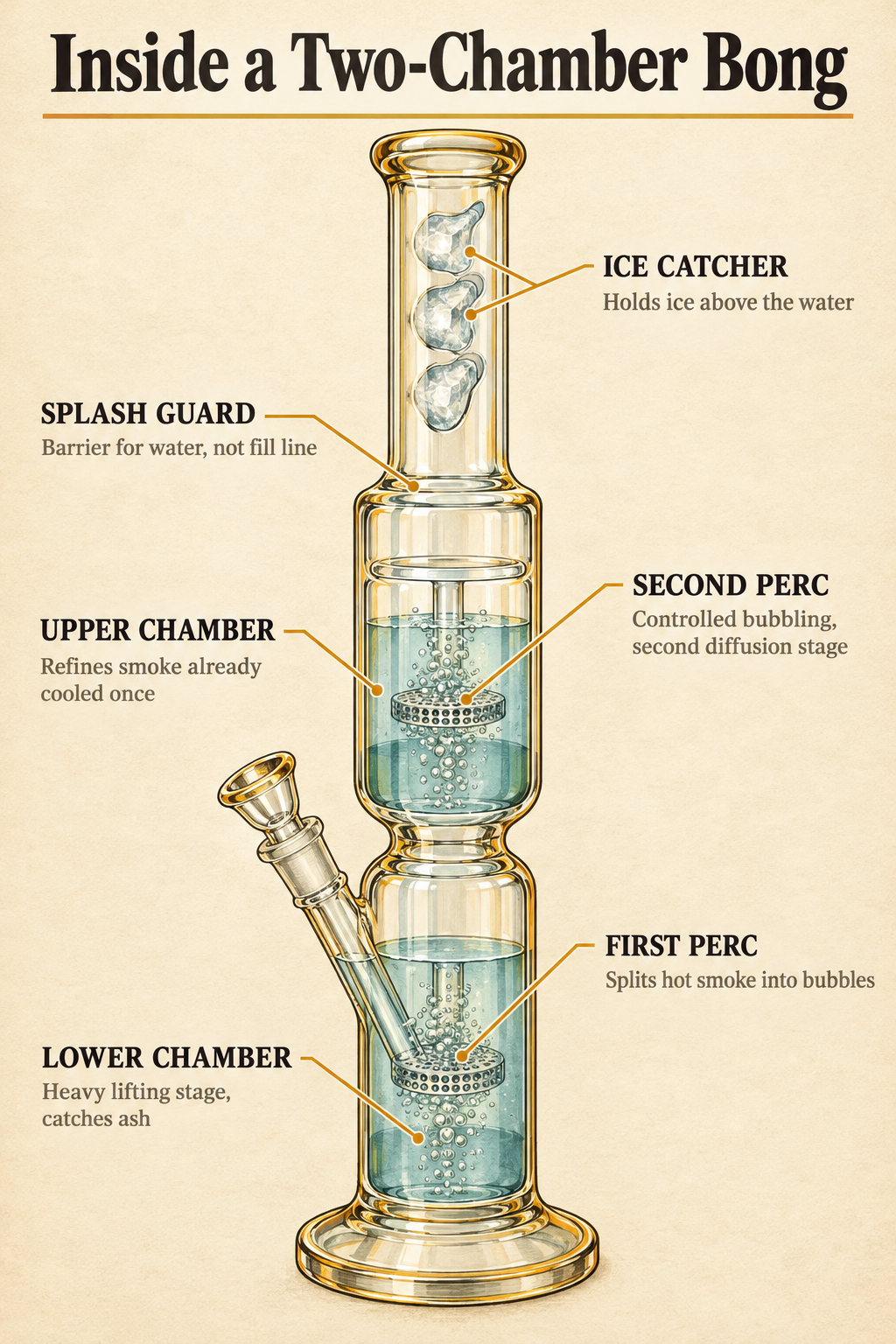
A double chamber bong runs each pull through two separate water chambers inside one piece, each with its own perc, before the smoke reaches the neck. The lower chamber takes the hot, concentrated stream from the downstem or base perc, splits it into bubbles, and drops heavier ash there. The upper chamber re-diffuses smoke that has already cooled once, so it should bubble in a controlled way rather than surge.
That second stage is not free. You pay for it in drag, in two water lines to manage, and in cleaning time. Here is what the second chamber actually changes, when two chambers are worth that trade, and how to fill one so both stages do their job.
What Is a Double Chamber Bong?
A double chamber bong is glass with two enclosed sections stacked in one body, each holding its own water and its own diffuser, so the pull passes through both before it reaches your mouth. Trade sources also call these two-chamber or multi-chamber pieces, and the two-chamber case is one specific version of the multi-chamber category [1]. A double chamber water pipe and a double chamber bong describe the same setup.
The word shoppers trip over most is chamber. A chamber is an enclosed section the air passes through, and it may hold water or stay dry. A perc is a different part entirely: the internal structure, such as a tree, showerhead, matrix, honeycomb or UFO, that breaks airflow into bubbles. That is why a single-chamber bong can still carry a perc, and why a two-chamber bong is really a stack of chambers that each carry their own [7].
If you are shopping by shape rather than by label, two-chamber pieces sit inside the wider families of Glass Bongs and Beaker Bongs. One example of the form on our own shelf is the SeshGear Jellyfish Double Chamber Glass Beaker Water Pipe – 17" / 14mm F / Colors Vary, which puts a jellyfish perc above a beaker base.
Labels on product pages are not interchangeable, and the differences matter at checkout:
- Multi-chamber is a catch-all for anything beyond a standard single chamber, with double chamber naming the two-chamber case specifically [1].
- Dual perc means two percolators, which may or may not sit in separate bodies of water [8].
- Double barrel gets used for two different shapes: two chambers stacked in one tube, or two tubes running side by side [2].
- Two chambers can be built from almost any perc type, so the phrase alone does not tell you which percs you are getting [9].
What Does the Second Chamber Actually Do?
Follow one pull through the piece and the two stages stop looking like duplicates. The path is the same on nearly every two-chamber design, whether the lower stage is a removable downstem in a beaker base or a fixed perc built into the tube [3].
Notice that the two stages are not doing the same job. The lower stage meets a hot, concentrated stream and has to break it apart. The upper stage meets smoke that has already been through water once, so the bubbling should look even and calm rather than like a surge [9].
Then there is the bill. Every stage is something the inhale has to push air through, so a two-chamber pull starts slightly slower than a single-chamber pull and develops in layers [2]. Good designs offset that resistance with opening size, perc placement and the spacing between chambers. A badly balanced stack turns an easy pull into a slow one. For the mechanics of the internal structures themselves, our guide to What Is a Percolator Bong and How Does It Work? goes one level deeper, and What Does a Triple Perc Bong Actually Do? shows what happens when a third stage is stacked on top.
One more part needs separating from the second stage. A splash guard is a barrier above the percs, in the neck, that sends water back down toward the chamber instead of up into the mouthpiece. It adds a small amount of drag, and it is not a chamber to fill [6].
Here is that path in order, from the bowl to your lips:
- The downstem or base perc releases the incoming stream under water in the lower chamber.
- The lower perc splits that stream into many small bubbles across its slits or holes [6].
- Heavier ash and particulate settle in the lower water instead of travelling further up [3].
- Smoke crosses the gap between chambers and enters the upper body of water.
- The second perc re-diffuses smoke that has already given up heat once, so it bubbles in a controlled way [3].
- The smoke passes the neck, past any splash guard, and out the mouthpiece.
Is a Double Chamber Bong Better Than a Single Chamber Bong?
The honest answer is that it depends on how you want to pull and how much upkeep you will do, not on which form wins. One manufacturer calls two chambers the sweet spot for most people, citing more diffusion than a single-perc piece while the draw stays easy, and notes that three or more chambers add water, more bubbling, a heavier pull and more glass to clean [2].
Another specialist source puts it just as plainly: neither layout is better for everyone. A single chamber with a good perc is easier to pull and quicker to clean, while a multi-chamber piece rewards someone who wants a slow, bubbly draw and does not mind the upkeep [7].
If you want to compare perc styles before you count chambers, What Is an Inline Perc and How Does It Work? covers the inline design that often sits in the lower position on modern pieces.
Laid out side by side, the trade-offs look like this:
- Stages: one chamber means one water stage, while two chambers means two, each with its own perc [2].
- Water to manage: a single body of water is one fill line to watch, while a two-chamber piece has two lines that can shift during use [4].
- Pull feel: two stages start slower and develop in layers, while one stage responds right away [3].
- Cleaning: every extra chamber and the passages between them are harder to reach [1].
- Price: published guidance puts double chamber and recycler-style pieces above basic single-chamber glass [1].
- Who each suits: one chamber for someone who wants a quick pull and simple cleaning, two chambers for someone who wants a slow, layered pull and will keep up with the maintenance [7].
| Trade-off | Single chamber | Double chamber |
|---|---|---|
| Water stages | One | Two, each with its own perc |
| Water to watch | One fill line | Two lines that can shift while you pull |
| Pull feel | Responds right away | Starts slower, develops in layers |
| Cleaning | Quicker to reach every surface | More chambers and passages to reach |
| Who it suits | A quick pull and simple upkeep | A slow, layered pull and steady maintenance |
How Much Water Goes in Each Chamber of a Double Chamber Bong?
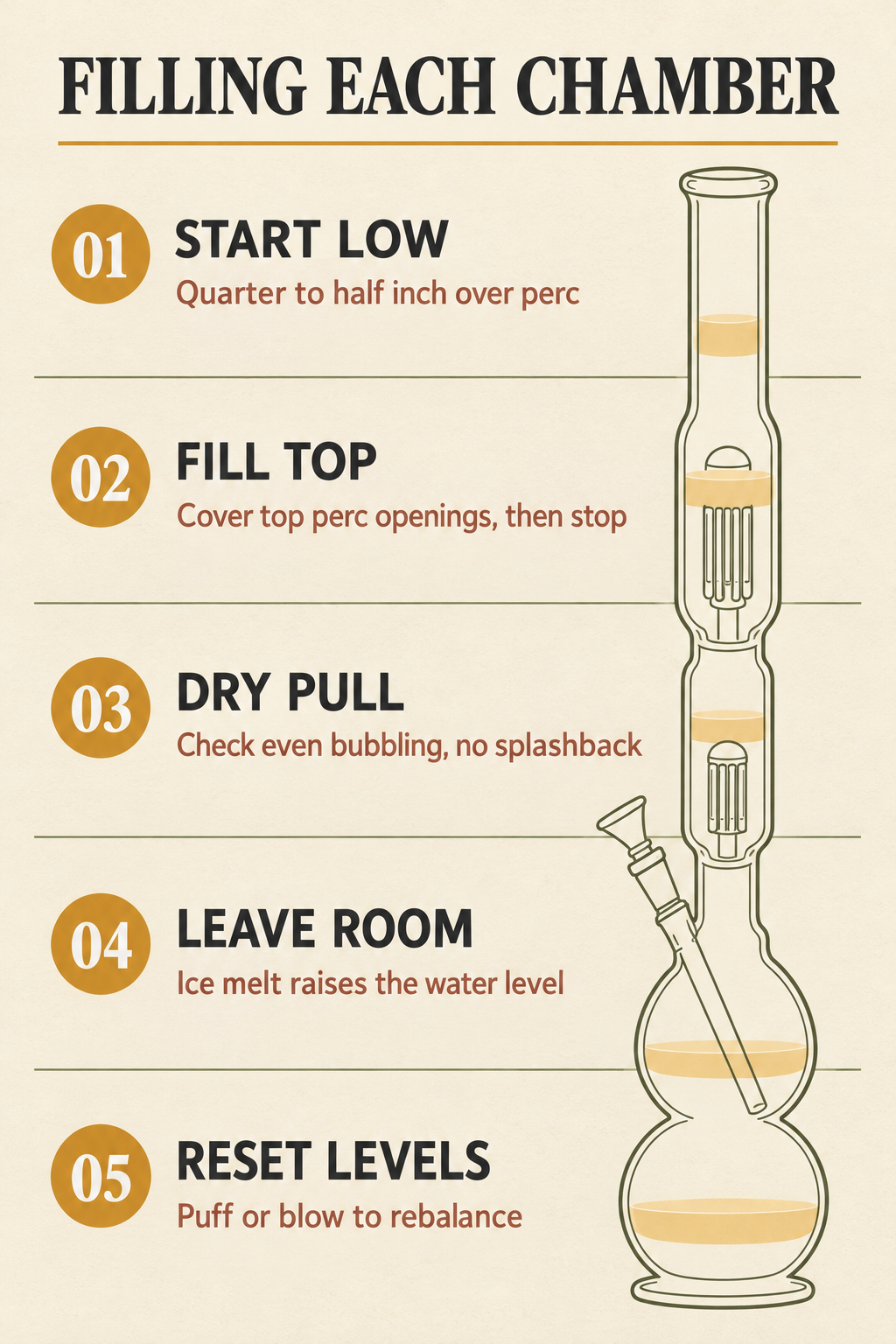
Set water level per chamber, and measure from the perc openings rather than from the base. The working target is roughly a quarter to a half inch of water over each perc’s slits or holes [4].
Two things get mistaken for fill lines constantly. Ice pinches and splash guards are not fill lines, and filling to them is a reliable route to splashback [5]. If you have ever taken a mouthful of water off a fresh fill, that is usually the reason.
Not every chamber has to run wet. A perc with no water over it simply does not diffuse and nothing breaks, so some owners leave the top perc dry for a more open pull and fill everything when they want the most diffusion [5]. Some upper chambers are designed to run dry, and a chamber with no perc inside it to cover should be left empty rather than filled [7].
Fill in this order and the piece will behave:
- Set the piece on a level surface and fill the lower chamber first, covering the lower perc openings by about a quarter inch.
- Fill the upper chamber second, until its perc openings are just covered, then stop [5].
- Do a dry pull with an empty bowl: every chamber should bubble evenly and no water should reach your lips [4].
- Start slightly under-filled if you plan to use ice, because melting ice raises the water level mid-session [4].
- Let the piece sit a minute so trapped air settles, then re-check both lines before you load the bowl.
Why Does Water Move Between Chambers While You Pull?
Water moving between chambers on a two-chamber piece is normal behaviour, not a defect. One chamber can appear to steal water from the other during use, and chamber pressure on multi-chamber pieces can pull water up from the upper chamber [4].
Think of this as part of the fill routine rather than a fault worth returning the piece over. A two-chamber bong is a small system with two water lines, and those lines will move as you use it. Checking both before a session and again after one is the entire habit [6]. For the wider picture of how the whole piece works, What Is a Bong and How Does It Work? covers the parts top to bottom.
The corrections are small and quick, and none of them needs a full refill:
- Puff or blow gently through the mouthpiece to push water back down into the chambers [4].
- Dump a little water out of the bottom chamber rather than topping up the top one [4].
- Let the piece sit for a minute and re-check, because trapped air pockets between stacked discs settle and shift the levels [5].
- Expect a piece to look off when it is cold and behave fine once it is working [6].
Are Double Chamber Bongs Harder to Clean and to Clear?
Yes on both counts, though for different reasons. On cleaning, every extra chamber and perc is another place for residue to collect, and the passages between them are harder to reach, which is why trade sources describe complex pieces as more involved to maintain than single-chamber glass [1].
On clearing, the difficulty comes from drag rather than from anything in the smoke. The pull is longer and more layered on a two-chamber piece, so clearing takes a beat more patience than a straight tube with one water stage [3].
That is the trade-off in plain terms. You get a second stage of bubbling and a longer path through water, and you take on two water lines to watch, a slower start to the pull, and a more involved clean. Someone choosing between a two-chamber piece and a simpler one is really choosing how much of that upkeep they want to sign up for [6].
A routine that works on a two-chamber piece:
- Dump the water and give the piece a warm rinse to loosen surface residue.
- Soak every chamber in high-percentage isopropyl alcohol with coarse salt, working the mix through each section rather than only the base [4].
- Agitate gently and let it sit so the salt can work at the slits and holes where residue collects.
- Rinse thoroughly until no salt remains, then refill and check that every chamber bubbles evenly.
- Do a full clean weekly if you use the piece daily [4].
Which Double Chamber Bongs Should You Actually Look At?
The phrase double chamber does not tell you which percs you are getting, so read the spec line rather than the collection name [2]. Our own catalog shows how little the label specifies: five double chamber listings, and each one names two distinct perc structures rather than a single wet chamber plus a guard [11].
Published price guidance and our shelf disagree, so it is worth stating both instead of blending them. One trade guide puts double chamber and recycler-style pieces at roughly $100 to $250 [1], while our four in-stock SKUs run $62.99 to $91.99 [11]. The lower band reflects the brands and build sizes we carry, not a claim that two-chamber glass is generally cheap.
Two details apply across all four in-stock pieces. Each has an ice catcher, in a three-pinch or bullet-hole design, which changes how you fill it: melting ice raises the water level, so start under-filled [4]. Each also ships with a 14mm male herb slide, so there is no separate bowl to buy. On a cart in this range, free shipping on orders $150+ is worth factoring into the total.
Here is what is on the shelf as of November 2026, all in the Percolator Bongs family rather than a specialty corner of the store:
- SeshGear Double Chamber Glass Beaker, 12 inches, $62.99, in stock: a UFO perc with a diffuser downstem and a second chamber for a second stage, plus a three-pinch ice catcher [14].
- Pulsar Double Chamber Rocket Perc Chugger, 15.25 inches, $85.90, in stock: a 4-arm rocket perc and a 12-arm jellyfish perc, plus a slitted dry diffuser in the neck and a bullet-hole ice catcher [12].
- SeshGear Jellyfish Double Chamber Glass Beaker, 17 inches, $89.99, in stock: a removable diffuser downstem in the beaker base and a jellyfish perc suspended in the neck above it [13].
- Pulsar Double Chamber Bubble Glass Water Pipe, 14 inches, $91.99, in stock: dual matrix percs with a secondary diffusion chamber that extends the path, plus a three-pinch ice catcher [15].
- Pulsar Kink Neck Double Chamber Chugger, 17.25 inches, $77.99: currently out of stock, so not one to plan a session around [11].
Frequently Asked Questions
Do you have to fill every chamber on a double chamber bong?
No. A perc with no water over it simply does not diffuse and nothing breaks, so some owners deliberately leave the top perc dry for a more open pull and fill everything when they want the most diffusion. Some upper chambers are designed to run dry, and a chamber with no perc inside it to cover should be left empty rather than filled.
Is a dual perc bong the same thing as a double chamber bong?
No, and the difference matters when you are shopping. Double chamber means two separate water chambers that the smoke passes through twice, while dual perc means two percolators, which may or may not sit in separate water chambers. A piece can be dual perc with a single body of water, so check where the percs actually sit before assuming you are buying two stages.
Are double chamber bongs harder to pull than single chamber bongs?
They are slower to start, because every stage is something the inhale has to push air through. A well-built two-chamber piece offsets that with opening size, perc placement and chamber spacing, so the pull feels steady and layered rather than strained. A badly balanced stack turns an easy pull into a slow one, which is the thing worth watching for when you compare pieces.
How often should you clean a double chamber bong?
Plan on a weekly full clean if you use it daily, the same cadence any complex glass piece needs. The routine is a soak in high-percentage isopropyl alcohol with coarse salt, worked through every chamber rather than just the base. The extra chambers and the passages between them are where residue collects and where reaching it takes the most effort.
Why does my top chamber run dry while I am pulling?
Water shifting between chambers is normal on a two-chamber piece. One chamber can appear to steal water from the other during use, and chamber pressure can pull water up from the upper chamber. A short puff or a blow through the mouthpiece, or dumping a little water out of the bottom chamber, usually rebalances the lines without a full refill.
So Should You Buy a Double Chamber Bong?
Buy one if you want a slow, layered pull and you are willing to look after two water lines and a more involved clean. The second chamber is a real second stage, not a marketing label: it re-diffuses smoke that the lower perc has already broken up, and it adds a stretch of path through water that a single-chamber piece simply does not have [3].
Skip it if you want the simplest glass you can own. A single chamber with a good perc is easier to pull and quicker to clean, and no source reviewed here argues that two stages are better for everyone [7]. What two chambers change is temperature, bubbling and drag. They do not change the physics of what you are pulling, and none of that is worth paying for if the upkeep will keep the piece on a shelf.
If you do buy one, set both water lines a quarter to a half inch over the percs, dry pull to confirm even bubbling, and start under-filled when you add ice [4]. Then read the spec line on the product page, because double chamber tells you how many stages you are getting and nothing about which percs are inside them [2].
Sources
- Grasscity: What Is a Double Chamber Bong & How Does It Work?
- Thick Ass Glass: Double & Multi Chamber Bongs: 8-30 in Thick Glass
- Thick Ass Glass: Multi-Chamber Bongs: How They Work and How to Use One
- Thick Ass Glass: Filling a Double Chamber Bong: Water Levels and Tips
- Thick Ass Glass: How to Fill a Percolator Bong (Every Perc Type)
- Thick Ass Glass: How Does a Bong Work? The Physics, Parts and Percolators Explained
- Shatter Kitchen: Multi-Chamber Bongs Explained: How They Work and Who They Are For
- Fat Buddha Glass: Double Chamber Bongs | Two-Chamber Water Pipes
- HEMPER: Understanding Different Types of Percs: From Simple to Complex
- Far&Dotter: Pulsar 18.5" Dual Jellyfish Perc Water Pipe
- Treehouse Lifestyle (WooCommerce Store API): Store API product search: double chamber
- Treehouse Lifestyle (WooCommerce Store API): Pulsar Double Chamber Rocket Perc Chugger Glass Water Pipe – 15.25 in / 14mm F
- Treehouse Lifestyle (WooCommerce Store API): SeshGear Jellyfish Double Chamber Glass Beaker Water Pipe – 17 in / 14mm F / Colors Vary
- Treehouse Lifestyle (WooCommerce Store API): SeshGear Double Chamber Glass Beaker Water Pipe – 12 in
- Treehouse Lifestyle (WooCommerce Store API): Pulsar Double Chamber Bubble Glass Water Pipe – 14 in / 14mm F / Clear