

A triple perc bong is a water pipe with three separate percolation stages, and those stages rarely look alike. They can be three stacked honeycomb discs, three different percs in a row, three water chambers, or three compact perc rings inside a recycler. Three stages also cost you something: more drag, softer flavor, and more cleaning.
What Does Triple Perc Mean on a Bong?
Start with the words, because the trade never settled them. A seller may use double, dual, or 2 chamber for a piece with two water stages, triple or 3 chamber for three, and multi-stage or multi-perc for anything with more than one perc [3]. That vocabulary is not a standard. It counts stages, and it says nothing about the design inside the glass. Two bongs both sold as triple perc can have completely different insides.
The second trap is that retail names count things that are not percs at all. A triple ice catch, or a 3-pinch ice catcher, means three glass pinches in the neck that hold ice cubes. It says nothing about percolation. One piece in our current catalog uses triple in its title for its ice catch while running a single horizontal inline perc [14]. Read the feature list, not the numbering.
The check that works is counting water stages in the photos instead of counting the word triple. Look for how many separate bodies of water you can see, where the tube narrows or steps, and how many diffuser plates sit inside the glass [2]. If you would rather compare finished pieces that way, browse Bongs and run the same count on each listing photo.
- Double, dual, or 2 chamber: two water stages in one piece, usually a lower chamber plus one upper perc.
- Triple or 3 chamber: three water stages, whether that means three discs in one tube or three separate pools.
- Multi-stage or multi-perc: any piece with more than one perc, with no promise about how many stages that turns out to be.
- Triple ice catch or 3-pinch ice catcher: three glass pinches that hold ice in the neck, not three percolators.
- Triple perc straight tube: one tall body with three diffusion plates welded across it, which is the layout most listing photos of this style show.
What Are the Different Ways to Build Three Perc Stages?
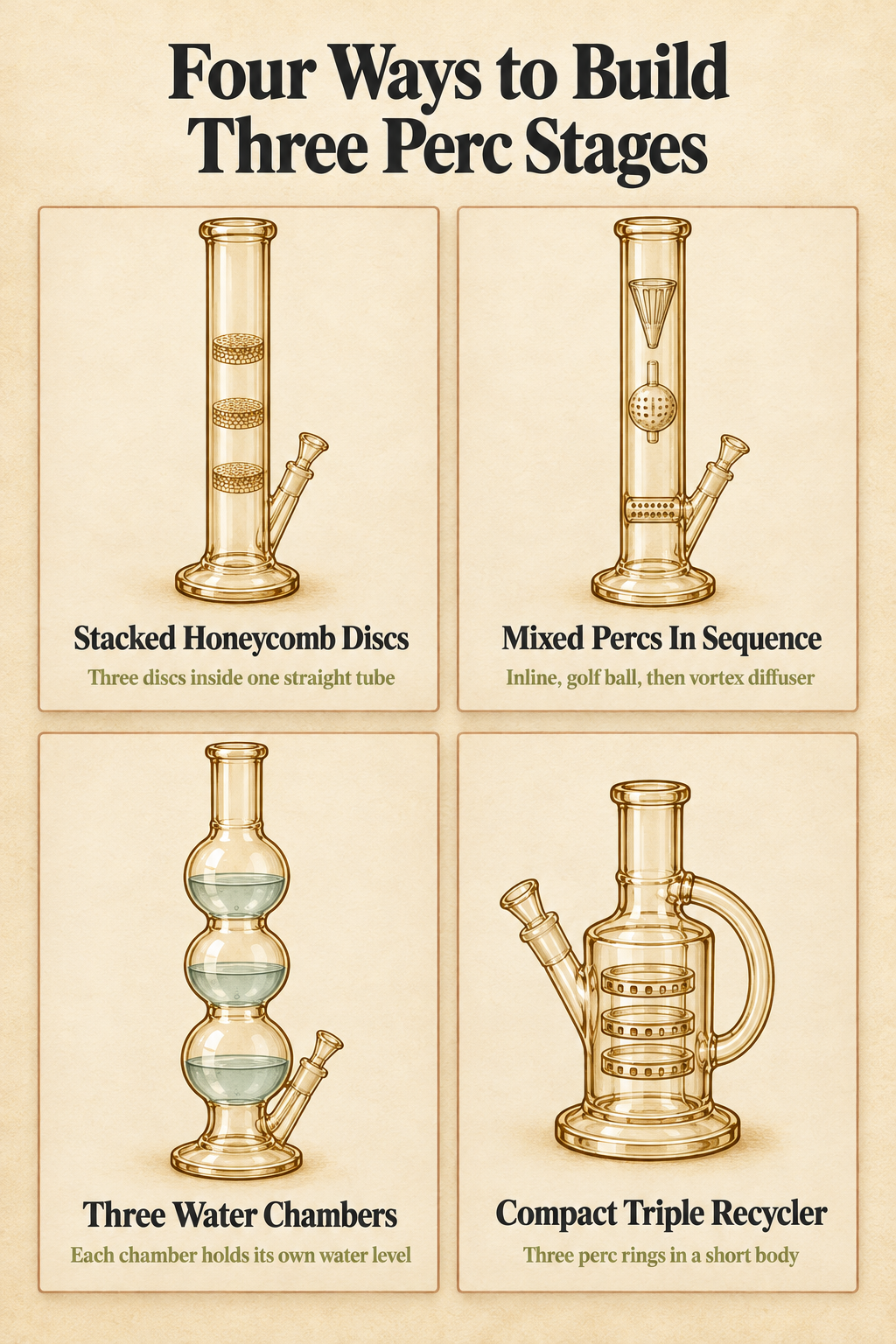
The phrase hides four different builds. Each one delivers three stages in a different physical arrangement, and that is why drag and water levels differ between two pieces with the same stage count. If you want the single-stage version of the idea first, see What Is a Percolator Bong and How Does It Work?.
Stacked honeycomb discs are the easiest to spot. Three perforated plates are welded across one straight tube, and water sits above each plate. Our 15-inch three-disc piece is this layout, and the plates read as three horizontal lines across the glass in its photos [10]. A showerhead perc, which What Is a Showerhead Perc and Which One Should You Buy? explains, is the simpler one-plate version of the same motion. All three stages share one air path, so the whole tube has to carry water to depth before the top plate starts working.
Mixed percs in sequence is the second build. Instead of repeating one design three times, the builder chains different ones. Our 17-inch piece runs an inline perc at the base, a golf ball perc above it, and a vortex diffuser splashguard at the top [12]. Each stage diffuses differently, and the top stage doubles as splash control. The vortex stage is the part What Is a Vortex Percolator and How Does It Work? covers in detail.
Three separate water chambers is the third. The glass steps in and out to form three distinct pools, each with its own level. That is the layout most people picture when they hear three-chamber bong, and it is the one where water can move between stages [3].
The fourth is three perc rings packed into a compact recycler. There is no tall tube to fill. The piece is short, the stages sit close together, and a return path carries water back down so the chambers do not flood. Our 8-inch triple stack is this family [13], and its stacked chambers follow the same logic as What Is a Swiss Perc, and Which Swiss Perc Bong Should You Buy?. The short return path that keeps a recycler from flooding is the difference Recycler Bong vs. Percolator Bong: What Is the Difference? walks through.
You can tell them apart before you buy. Count water bodies, look for sandwiched discs, look for a neck that steps in and out, or look for a return path down the side. One piece that pairs a tall straight body with a recycler-style path is Pulsar Far-Out Visitors Recycler Glass Water Pipe | 17.25" | 19mm F, which makes it a useful photo to test yourself against.
- Stacked honeycomb discs: three perforated plates welded across one straight tube, each with its own water level above it.
- Mixed percs in sequence: different designs chained together, such as an inline base, a golf ball perc, and a vortex diffuser.
- Three separate water chambers: the glass steps in and out to form three pools, so each stage holds its own water and can share it.
- Compact triple recycler: three stages stacked in a short body with a return path, trading tube length for recirculation.
- What to check in a photo: count water bodies, look for sandwiched discs, look for a stepped neck, and look for a side return path.
Does a Triple Perc Bong Pull Harder Than a Single or Double Perc?
Yes, and the reason is mechanical rather than mysterious. Each stage adds restriction points and, more importantly, another body of water your draw has to move before bubbling starts. One manufacturer frames multi-perc resistance as hydrostatic pressure from stacked water columns plus airflow restriction [6]. A specialist seller puts it more plainly: many people describe pulling a three-stage stack as close to pulling air through a clogged straw [9].
The third stage is where that curve flattens. One comparison says a third disc adds only a marginal amount of diffusion while noticeably increasing drag [4]. Another says returns diminish after two stages, and a third says that past three stages you give up more than you gain [2][5]. That is why three gets described as the ceiling rather than as the starting point.
Clearing matters as much as starting. A piece you cannot clear in one breath leaves smoke sitting in the tube, and three-stage pieces hold more air volume than a shorter piece at the same water depth [6]. If you are deciding between a tall three-stage tube and a compact recycler, the shorter piece is easier to clear even at the same stage count. For how one stage type changes the draw, What Is a Spinner Perc and How Does It Actually Work? covers the spinner.
- One stage: the least restriction and the least water to move, so it starts and clears fastest at a given height.
- Two stages: a noticeable step up in start-up effort, with the second chamber adding diffusion and a second water body to lift.
- Three stages: the practical ceiling, where the third stage adds a little more diffusion and a clearly larger amount of drag.
- Four or more: past the range specialist sellers describe, where maintenance and breakage climb faster than diffusion gains.
| Stage count | What the extra stage gives you | What it costs |
|---|---|---|
| One perc | A single diffusion pass and the least water to move | The least drag and the fastest clear |
| Two percs | A second diffusion pass and a second water body | A clear step up in start-up effort |
| Three percs | A third pass that adds only marginal extra diffusion | Noticeably more drag, more cleaning, more glass |
| Four or more | Little beyond what three already does | Upkeep and breakage climb faster than diffusion gains |
How Much Water Goes in Each Chamber of a Triple Perc Bong?
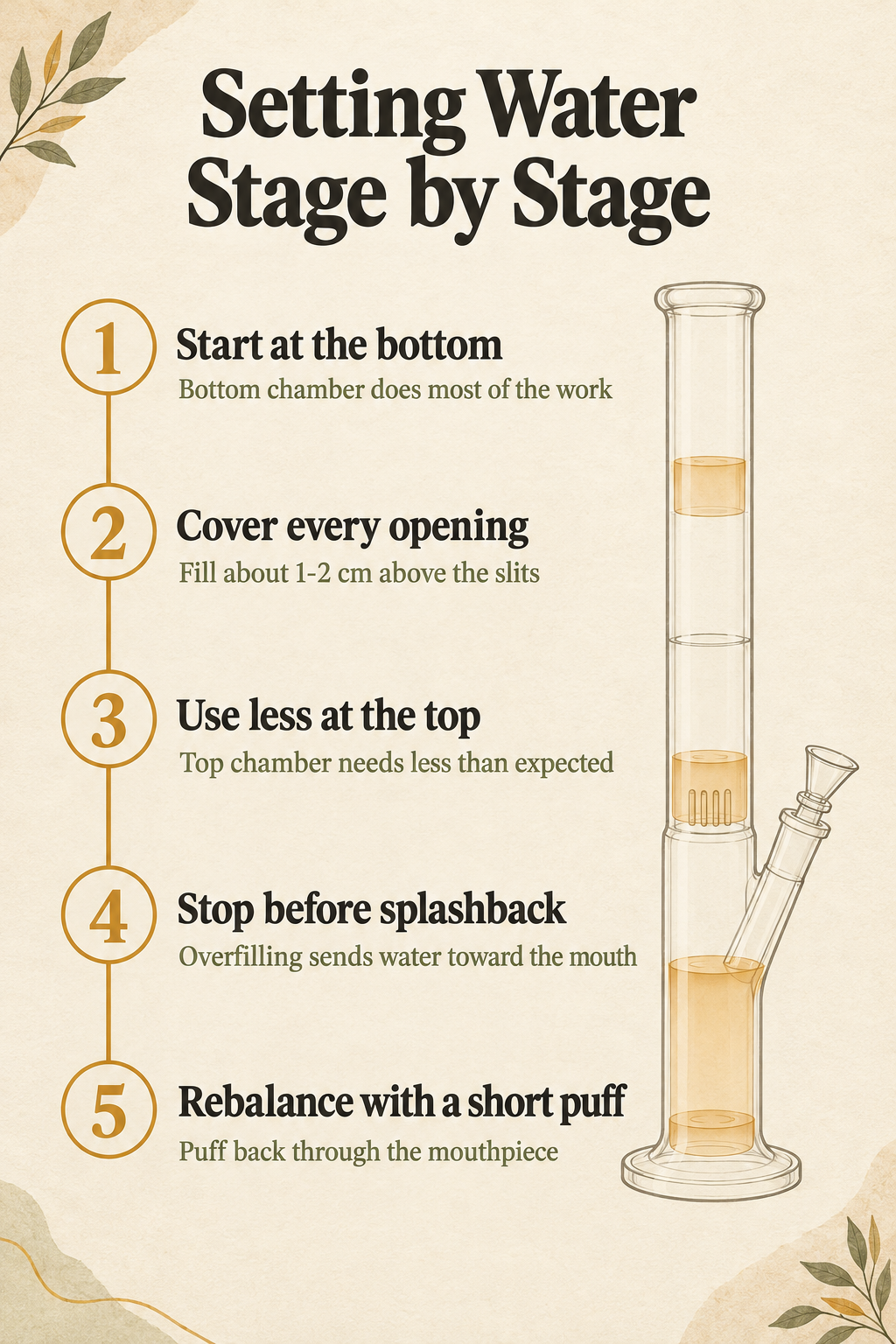
There is no single water line to hit. Water is set per stage, and each perc’s openings need to be just covered, roughly one to two centimeters or about half an inch above the highest slit or hole [4]. The bottom chamber does most of the work, and the top chamber needs less water than most people expect [3].
Overfilling is the most commonly cited cause of both splashback and a heavy pull [5]. Separate chambers also share water. If one stage stops bubbling or drains into another, a short puff back through the mouthpiece is the usual way to rebalance them. An overfilled top chamber plus a hard first pull is what sends water toward your mouth [3]. Both are routine multi-stage setup problems rather than defects, so they are worth learning once instead of buying around.
Then match your draw to the piece instead of the other way around. Start slower so the bottom stage fires before the upper ones join. Build to a steady draw rather than a hard pull, and expect clearing to take longer than it does on a single chamber [1].
- Fill the bottom chamber first, just enough to cover the highest slit or hole by about half an inch.
- Add water to the second stage only after the bottom stage holds its level, and stop at the same just-covered mark.
- Use less in the top stage than feels natural, because the top chamber is the one that reaches your mouth.
- Draw slowly once to check bubbling, and confirm every stage is active rather than one gurgling while another sits still.
- If a stage has stopped bubbling or drained into another, puff back through the mouthpiece to push the water back into place.
- If water reaches your mouth, pour a little out of the top stage before changing anything else about your setup.
Does a Triple Perc Bong Mute the Flavor?
Yes, some. Every pass through water strips volatile aromatic compounds, so heavy percolation tends to mute the top notes [4]. One manufacturer’s engineering write-up frames the trade as cooling versus aroma retention [6], and a specialist retailer files three or more stages under collector territory partly for that reason [2].
Keep the explanation mechanical rather than sensory, because it is a contact question. More passes mean more surface contact between what you are drawing and the water, and the aromatic compounds are the part that leaves first. That trade does not make the piece bad. It makes it a different tool than a single-chamber tube.
The dab case is the one place stage count changes the recommendation rather than just the trade-off. Multi-perc designs are usually described as flower pieces, because repeated water contact cools vapor and mutes the aromatic top notes concentrate users chase [15]. The compact three-perc recyclers in the catalog lean on recirculation and a short path instead of a tall tube for exactly that reason [13]. If you mostly dab, choose the short-path build and skip the tall stack. If you mostly smoke flower and want to see a stack of chambers working, the tall triple perc is the piece that does the thing you are buying.
- Each water pass costs a little aroma, and the top notes go first because they are the most volatile part of the mix.
- Two stages is where most of the diffusion gain lands, so a third stage mostly adds contact rather than a new capability.
- Three or more stages is enthusiast territory, and the mechanism itself is the appeal for the people who buy these pieces.
- Triple-stage dab rigs are built compact with a return path, trading tube length for a shorter and faster recirculating path.
Is a Triple Perc Bong Harder to Clean and Easier to Break?
Both costs are real, and both scale with the hardware. Cleaning load grows with stage count and with hole size: honeycomb discs and tree arms are described as the fastest-clogging designs, and drag climbs noticeably once resin builds up in the slits [2][4]. Weekly isopropyl alcohol with coarse salt is the standard routine [1].
Salt and alcohol cannot always reach the far side of a tight perc [5], which is why longer soaks and dedicated glass cleaners get recommended for multi-stage pieces. Stacked percs also turn routine maintenance into a chore that people work around by pushing water or alcohol between chambers instead of pulling the piece apart [9].
Breakage follows the same pattern. More internal glass means more places to break, since three stages add welds and sandwiched discs, and tree designs add thin arms that snap [2]. Sellers name cracked discs and snapped arms as the common failure points, and note that multi-perc pieces carry more breakable glass in transit than a plain beaker [5]. That matters for storage between sessions as much as it does for shipping.
- Empty the piece and rinse with warm water to lift loose resin before anything else.
- Pour coarse salt and isopropyl alcohol into the bottom chamber, then work it up stage by stage instead of flooding the whole tube at once.
- Soak longer than you would on a single perc, because the far side of a tight plate is the part the salt cannot reach.
- Plug both ends and shake in short bursts, then let the piece sit so the alcohol can work on each plate in turn.
- Rinse thoroughly with warm water and confirm every stage bubbles evenly before you set the piece back on the shelf.
- Store it upright and out of the way, since a stacked tube with a high center of gravity tips more easily than a beaker.
Which Triple Perc Bong Should You Buy?
Start with joint size, because it decides which slides and bangers fit. One manufacturer recommends 18mm joints for triple-stack pieces and 14mm for single or double [6]. In practice, pieces sold as triple perc ship with both, and the same 18.8mm ground joint gets sold as either 18mm or 19mm depending on the seller [1]. In our own catalog, the 15-inch triple honeycomb straight tube and the 8-inch triple stack recycler are 14mm female [10][13], while the 14-inch triple turbine straight tube and the 17-inch inline-plus-golf-ball straight tube are 19mm female [11][12].
Then height and handling, because multi-stage pieces are usually taller and heavier with a higher center of gravity than a single-chamber tube. Decide whether you can clear the piece you are looking at in one comfortable breath, and whether it fits where you plan to keep it.
Then the price finding, which surprises most people: cost does not track stage count in a simple way. Here is the range as it stands in our catalog. The 15-inch three-disc honeycomb straight tube is $67.99 [10]. The 17-inch inline-plus-golf-ball straight tube is $102.99 [12]. The 14-inch triple turbine straight tube is $143.50 [11], and the 8-inch triple stack Swiss recycler is $64.99 [13]. The 40 cm inline tube with a triple ice catch is $69.00 [14]. The 9-inch triple arm perc recycler is $79.99 [15]. All six were in stock when this was written. The cheapest of the group is a recycler and the priciest is a straight tube, so shop the build you want rather than the price tier you assume goes with it.
If you are close to the free shipping threshold, note that we offer free shipping on orders $150+, which can make a two-piece order cheaper than a single premium tube. Then run the checklist below against the listing before you add anything to the cart.
- Confirm the joint size and whether the slide or banger is included, since 14mm and 19mm parts do not swap.
- Check the height and weight, and decide whether you can clear the piece comfortably in one breath.
- Identify which of the four builds it is: stacked discs, mixed percs, separate chambers, or a compact recycler.
- Compare total cost across the range instead of assuming three stages means a premium price.
- Look for a splash guard or a stepped neck if water in the mouth has been a problem for you before.
- Count the upkeep you are signing up for, because more stages means longer soaks and more internal glass to keep intact.
Frequently Asked Questions
Is a triple perc bong the same as a three-chamber bong?
Not always. Sellers use triple or 3 chamber for a piece with three water stages, and one build does use three separate water chambers with their own levels. But three honeycomb discs stacked inside a single tube also get called triple perc, and so do three percs in sequence inside one body. Check whether the neck steps in and out for separate chambers or holds stacked discs inside one tube.
Does a triple perc bong filter more than one or two percs?
It repeats the diffusion step a third time, so what you draw passes through water three times instead of once. It is worth being clear about what that does and does not mean. Water filtration is not a risk-removal step. The CDC lists bongs and water pipes as one of the ways cannabis is smoked [7]. UCSF’s tobacco research center reports that bongs remove some water-soluble compounds and larger particles, while most smoke chemicals and fine particles still reach the person drawing on them [8].
Why is water coming up into my mouth from a multi perc bong?
The top chamber is usually overfilled, and a hard first pull carries that excess up the neck. Lower the level in the top stage so it just covers the openings, then start the draw slowly so the bottom stage fires first. If one stage has stopped bubbling or drained into another, a short puff back through the mouthpiece is the usual way to rebalance the water between chambers.
Is a triple perc bong harder to clean than a single perc?
Yes, and the load scales with both stage count and hole size. Honeycomb discs and tree arms clog fastest, and drag climbs noticeably once resin builds in the slits. Weekly isopropyl alcohol with coarse salt is the standard routine. Salt and alcohol cannot always reach the far side of a tight perc, so longer soaks and dedicated glass cleaners get recommended for multi-stage pieces.
How many percolators is too many?
Specialist sellers converge on two to three stages as the practical range and put three at the ceiling for most smokers. One comparison says a third disc adds diffusion only marginally while noticeably increasing drag, and another says that past three stages you give up more than you gain. Past that point you are adding maintenance and breakage risk faster than you are adding diffusion.
Does a triple perc bong work for dabs?
Compact triple-stage recyclers are sold as dab rigs, but multi-perc designs are usually described as flower pieces. Repeated water contact cools vapor and mutes the aromatic top notes concentrate users chase, so the triple-stage rigs in the catalog lean on recirculation and a short path rather than a tall tube. If you mostly dab, that short-path build is the one to look at.
So, Is a Triple Perc Bong Right for You?
A triple perc bong is a stack of trade-offs you can predict once you know which build you are looking at. Three stages in one piece means three rounds of diffusion. It also means more resistance from the extra water your draw has to move, a little less aroma, more cleaning time, and more internal glass that can crack. In exchange you get a piece with visible stages, a slower and more deliberate draw, and the kind of hardware that enthusiasts keep on the shelf rather than put away.
Buy one if you want the mechanism itself and you are willing to set water levels stage by stage, start your draw slow, and soak the piece weekly. Skip it if you want the easiest pull, the shortest cleaning routine, or a single small piece you can clear in one breath. Two stages gets most of the practical gain; three is the ceiling most sellers describe; past three you are collecting, not optimizing.
Whatever you pick, confirm the joint size, count the water stages in the photos rather than trusting the word triple, and check whether the title is describing percs or an ice catch. That one habit prevents most of the returns these pieces generate.
Sources
- Azarius (Black Leaf product guide): Triple Percolator Glass Bong — Black Leaf
- Oil Slick Pad: Types of Percs Explained: All 8 Bong Percolators Ranked
- Thick Ass Glass: Multi-Chamber Bongs: How They Work and How to Use One
- Azarius: Percolator Types Explained: Honeycomb, Tree & Showerhead
- SmokeMEGA: Multi-Percolator Bongs: The Best Filtration Bongs for Smooth Hits
- Croia Glass: Single Perc vs Multi Perc Bongs: Pros, Cons & Guide
- Centers for Disease Control and Prevention: About Cannabis
- UCSF Center for Tobacco Control Research and Education: New Study: Secondhand Bong Smoke is full of Hazardous Fine Particles
- Thick Ass Glass: How Many Bong Percolators Is Too Many?
- Treehouse Lifestyle: SeshGear Triple Honeycomb Perc Straight Tube Water Pipe – 15" / 14mm F / Colors Vary
- Treehouse Lifestyle: Pulsar Triple Perc Straight Tube Bong 14"
- Treehouse Lifestyle: Pulsar Triple Treat Straight Tube Water Pipe – 17" / 19mm F / Clear
- Treehouse Lifestyle: 8" Triple Stack Swiss Perc Recycler Dab Rig | Croia Glass
- Treehouse Lifestyle: Human Grade Inline Tube Triple Ice Catch Glass Water Pipe
- Treehouse Lifestyle: Pulsar Debonaire Diamond Triple Perc Glass Recycler Dab Rig – 9" / 14mm F / Clear