

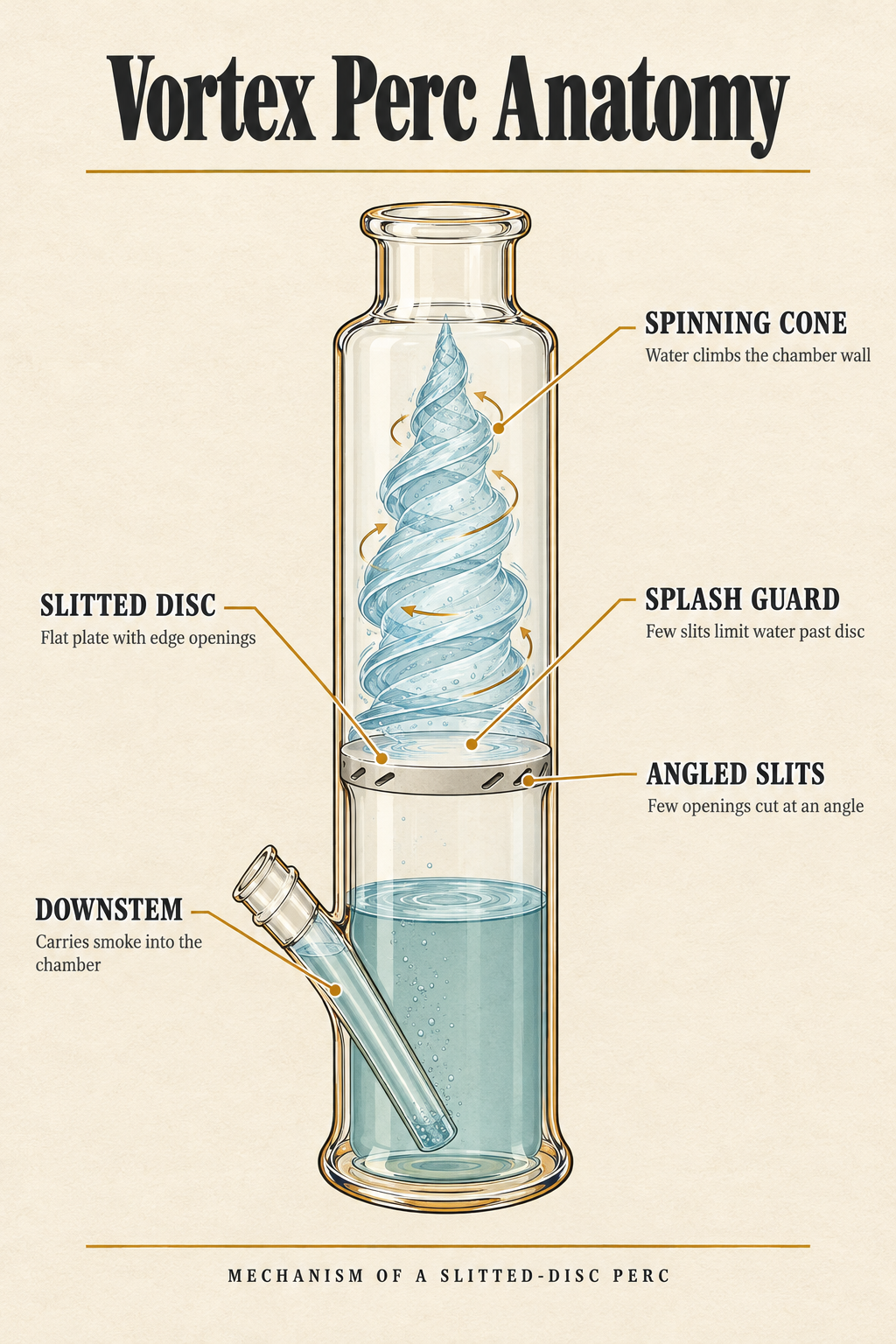
A vortex percolator is a disc, or a disc-shaped insert, with only a few slits cut at an angle around its edge. Pull on the piece and smoke and water get forced out through those angled openings, so the mixture travels in a circle instead of going straight up, and the water climbs the chamber wall as a spinning cone [3].
That is the entire mechanism, and it is the opposite approach to a hole-count perc. Honeycomb, matrix, tree, and fritted designs try to split smoke into as many small bubbles as they can. A vortex perc deliberately uses very few openings and asks the angle of each cut to do the work instead [1] [4].
Two things trip buyers up. The naming is inconsistent, so the same slitted disc gets sold as a turbine perc, a cyclone perc, and a vortex perc. And the word vortex also turns up on pieces that do not spin water at all, including upper-chamber air inlets, angled external intakes, recycler bodies, and dab carb caps.
This guide walks the mechanism, sorts out the labels, compares the design with other percs, covers the fill rule, separates a perc from a recycler, and finishes with the specs worth checking on a product listing.
What Is a Vortex Percolator and How Does It Work?
Start with the shape. The perc is a flat disc, or a disc-shaped insert sealed across the chamber, with a small number of slits cut around its perimeter. Those slits are angled rather than pointing straight up, and that angle is the whole design [3] [4].
Because the openings point sideways, drawing air pushes smoke and water through them along a circular path. The water does not bubble up in the middle of the chamber. It gets thrown outward, climbs the inside wall, and forms a rotating cone with a hollow center [3].
This is why opening count matters less here than it does elsewhere. A honeycomb or matrix disc is built to maximize the number of small holes so smoke breaks into many fine bubbles [1]. A vortex disc does the opposite on purpose: it uses a handful of larger angled openings and relies on the spin to keep smoke moving against water instead of through it in a straight line [4].
The trade is straightforward. You get a distinctive water pattern and a disc that doubles as a splash guard, and you give up the finest bubble size in the category, which is why this design’s diffusion is described as moderate rather than maximum [1] [3].
If you are shopping around, most of this family is listed under Bongs, and the slitted downstems, discs, and spare parts that pair with them usually sit in Accessories. For the broader picture of how perc chambers work on any bong, What Is a Percolator Bong and How Does It Work? is the place to start.
- The bowl holds the material and sits at the top of the downstem.
- The downstem carries smoke down and into the water, below the level of the disc.
- The slitted disc sits across the chamber, with its angled openings just under the water line.
- Draw on the mouthpiece and the slits push smoke and water out at an angle instead of straight up.
- The water climbs the chamber wall as a spinning cone while smoke travels around the inside of the glass.
- Smoke leaves the spinning chamber, passes any upper stage, and reaches the mouthpiece.
Why Do Vortex, Turbine, and Cyclone Percolators All Look Alike?
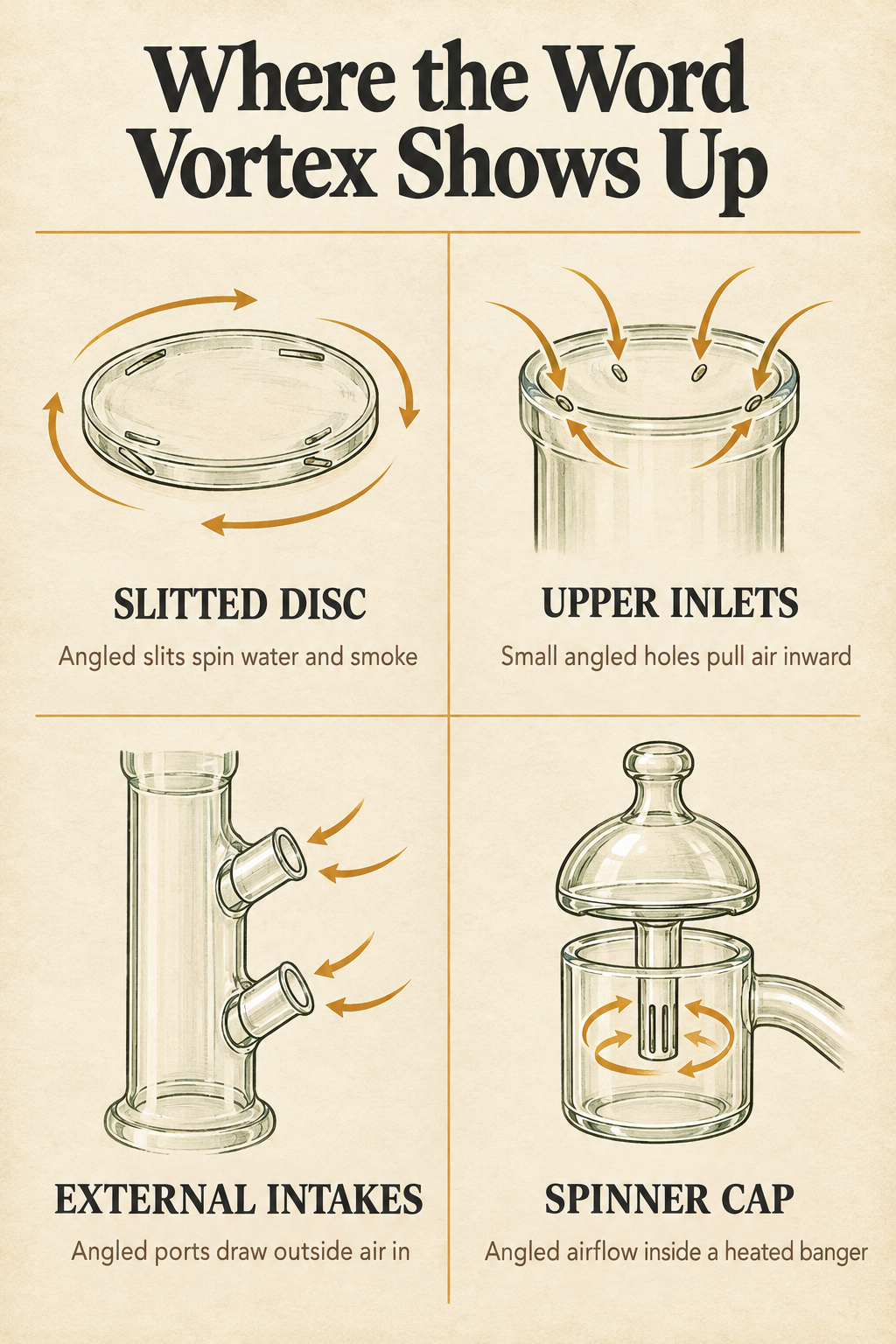
The first thing to know is that turbine, cyclone, and vortex are not competing technologies. They are three names for one family of disc designs, and the trade uses them interchangeably [3] [4]. At least one brand markets the same general effect as a tornado instead [8].
The second thing to know is that the word vortex also describes mechanisms that have nothing to do with a slitted disc. Some upper chambers carry small angled inlets that pull air in and spin vapor inside the glass, above a conventional perc [7] [8]. Those inlets work on a venturi principle, where fluid speeds up as it enters a constricted throat and its pressure drops, which is what draws air inward [12]. Other designs pull cool outside air through three or four angled external intakes to make a tornado shape [9].
There is also an older terminology split worth knowing. Some retailers count only the add-on chamber as a percolator and call a slitted downstem a diffuser, while others count the diffused downstem as the most common form of percolation [9] [1]. That is why two listings can describe the same internal part with different words.
These labels overlap with guides we publish elsewhere, too. Recycler bodies get their own treatment in What Is a Recycler Bong and How Does It Work?, showerhead diffusion in What Is a Showerhead Perc and Which One Should You Buy?, Swiss disc turbulence in What Is a Swiss Perc, and Which Swiss Perc Bong Should You Buy?, and dab airflow in What Are Carb Caps and How Do They Work?. For the wider map of shapes and chamber layouts, What Are the Different Types of Bongs? puts the pieces side by side.
- Turbine perc: a disc with angled slits that drives a circular motion. Points to a slitted disc.
- Cyclone perc: the same disc under a different trade name. Points to a slitted disc.
- Vortex perc: the same disc again, and the most common term on retail listings. Usually points to a slitted disc, but check the description.
- Tornado: a marketing name used for both slitted discs and upper-chamber inlet sets. Ambiguous, so read the geometry.
- Diffuser: a slitted or perforated downstem that spreads smoke into water. Some sellers do not count it as a perc at all.
- Venturi inlet: a small angled hole in an upper chamber that pulls air in and spins vapor. Not a slitted disc.
Is a Vortex Percolator Better Than a Showerhead or Honeycomb Perc?
Better at what is the honest way to frame it. The vortex disc is not the highest-diffusion design in the category and it is not trying to be. Honeycomb, matrix, tree, and fritted percs are all built around opening count, and each one pushes toward more, smaller bubbles and more surface area for smoke to pass [1]. The Swiss disc takes a third route, working by turbulence around its holes rather than by slits or hole count [4]. A vortex disc keeps the opening count low and uses the angle to keep things moving [4].
Drag is where the sources split. One comparison ranks the turbine design as the least restrictive perc type and puts fritted discs and stacked honeycombs at the heavy end [4]. Another calls these percs moderate-drag, because fewer diffusion points means fewer paths, and notes the water may need a moment to reach a full spin [3]. The table below sets the trade-offs side by side.
Fill tolerance and splash control favor the slitted disc. The narrow openings limit how much water gets past the plate, which is why these percs often sit at the top of a stack as a splash guard [3] [4]. The cost is a narrow fill window, so a level that would be fine on a hole-count perc can be off on a vortex perc. Cleaning favors simpler pieces, since added chambers mean more work [2].
- Vortex or turbine disc: a few angled slits, moderate diffusion, the least restrictive rank in one drag comparison, a narrow fill window, and splash-guard duty.
- Showerhead: a capped cylinder with many small holes, so more openings and more paths for smoke than a slitted disc.
- Honeycomb: a flat plate drilled with many holes; stacked honeycombs sit at the heavier end of the drag ranking.
- Tree: arms stacked in tiers, so smoke passes several water stages on the way up before it leaves the chamber.
- Fritted: a porous disc with the finest openings in the category, ranked last and heaviest in the same drag comparison, and the fussiest to keep clear.
| Perc type | Diffusion | Drag | Fill sensitivity | Splash duty | Cleaning |
|---|---|---|---|---|---|
| Vortex or turbine disc | Moderate: a few angled slits | Least restrictive in one comparison, moderate in the other | High: about a quarter inch of water over the slits | Yes: the few slits limit water past the plate | Low: one plate to rinse |
| Showerhead | More openings than a slitted disc | Not ranked in either comparison | Not flagged in the sources | Not described as a guard | Moderate: one capped cylinder |
| Honeycomb, stacked | Many drilled holes | Heavy at the stacked end | Not flagged in the sources | Not described as a guard | Rises with every added plate |
| Tree | Several water stages in tiers | Not ranked in either comparison | Not flagged in the sources | Not described as a guard | Higher: several tiers to rinse |
| Swiss | Turbulence around holes rather than slits | Not ranked in either comparison | Not flagged in the sources | Not described as a guard | Internal plate to rinse |
| Fritted disc | Finest openings in the category | Heaviest in the same comparison | Not flagged in the sources | Not described as a guard | Highest: pores are fussiest to keep clear |
Does a Vortex Percolator Add Drag, or Does It Pull More Freely?
The cone is built, not snapped. A steady, sustained inhale is what gets the water climbing, and a hard pull tends to break the pattern apart before it establishes [3]. If you have ever pulled once, seen nothing, and decided the perc was defective, that is the likely reason.
That disagreement shows up in the feel rather than on the spec sheet. What both descriptions share is that the restriction is concentrated in a few openings rather than spread across hundreds, so the feel changes sharply with water level: a quarter inch too much reads as a blocked piece [3] [4].
Chamber count changes the equation more than the disc does. Glassmaker guidance puts the useful number of percolator chambers at one or two, and warns that each added chamber raises draw resistance and cleaning work faster than it adds contact [1] [2]. A vortex disc is usually one stage in a two-stage piece, not the only thing between the bowl and your mouth.
- Stage count first. One diffusion stage plus one vortex disc pulls differently than three stacked chambers.
- Fill level second. Water above the slits adds restriction quickly, and a drowned cone reads as a blocked piece.
- Pull style third. A long, even draw builds the spin; a short hard pull does not.
- Disc position fourth. A disc high in the stack behaves differently from one sitting just above the water in a low chamber.
How Much Water Should a Vortex Percolator Bong Hold?
The rule is to cover the slits and stop. One guide puts the target at roughly a quarter inch of water above the openings [3]. That is a much tighter window than most bong owners are used to, and it is the biggest practical difference between a vortex perc and a hole-count perc.
Overfill drowns the cone. The water has no room to be thrown outward and climb the wall, so it churns instead and the piece feels blocked. Underfill leaves the slits partly dry and the spin never starts. A partly covered slit shows up as a cone that forms on one side of the chamber and not the other [3] [4].
- Set the piece on a level surface and fill through the mouthpiece or the bowl joint, whichever the piece uses.
- Stop when the water just covers the slits, checking from the side rather than from above.
- Add water a little at a time until it sits about a quarter inch above the slits.
- Fit an empty bowl and pull gently to confirm the cone forms and keeps spinning.
- If the water churns without climbing, pour some out; if the cone is ragged or partial, add a splash.
- Recheck for splashback toward the mouthpiece once the cone is stable, and adjust down if water is reaching the upper chamber.
What Is a Vortex Recycler, and How Is It Different From a Perc?
A recycler is a different structure from a perc, not another word for one. It uses two connected chambers plus a return path. Suction pulls water and vapor up an intake tube into an upper chamber, gravity drains the water back down a drain tube, and the loop repeats for as long as you keep inhaling [5] [6].
A plain perc bong is single-pass. Smoke goes through water once, then rises to the mouthpiece, and nothing returns. That is the whole distinction, and it holds whether the perc inside the piece is a slitted disc, a showerhead, or a fritted plate.
Recycler fill level has its own rule, separate from the vortex rule. Water should submerge the bottom of the intake tube without reaching high enough to fill the upper chamber at rest, which works out to roughly halfway up the lower chamber on a well-designed piece. Persistent gurgling usually means too much water or a clogged tube [6].
So a vortex recycler is a combination label. The recycling loop moves the water, and the vortex element is the spinning geometry inside that loop. The distinction matters because the loop, not the spin, is what recirculates water: a piece can recycle without spinning, and a piece can spin without recycling [5] [3].
- Chamber count: a recycler needs at least two connected chambers, where a perc needs one.
- Return path: a recycler has an intake tube and a drain tube; a perc has no return.
- Recirculation: water loops continuously while you inhale on a recycler, and moves through once on a perc.
- Fill rule: a recycler wants the intake tube base submerged without filling the upper chamber, while a vortex perc wants about a quarter inch over the slits.
- Flow shape: a recycler is defined by looping flow, a vortex perc by spinning flow, and a vortex recycler by both at once.
Is a Vortex Carb Cap the Same Thing as a Vortex Percolator?
No, and the difference is worth understanding before you buy either one. On a carb cap, vortex describes airflow geometry inside a heated banger rather than water percolation. A spinner or vortex cap uses angled inlets or a slotted stem to send incoming air around the inside of the banger instead of straight down, and that rotating air is what moves terp pearls and spreads concentrate across the heated surface [10] [11].
Fit is decided by the bucket, not the joint. A 10mm or 14mm rig joint tells you nothing about whether a spinner cap will seat on the banger; what matters is the diameter and shape of the banger’s top edge [11]. Some banger styles, including auto-spinner and slurper designs, are built for solid caps because the rotation comes from holes drilled into the banger itself rather than from the cap [10].
Our own catalog shows the word doing two jobs. The Vortex Bubble Carb Cap is listed as a bubble cap with vortex channels, while the Honeybee Herb Cyclone Vortex Carb Cap is described as a spinner cap with spiral vortex grooves at the base [13]. Same word, two different airflow designs.
- Where the air moves: around the inside of a heated banger on a cap, through water in a chamber on a perc.
- What it moves: rotating air moves terp pearls and concentrate on a cap, while spinning water moves smoke and water on a perc.
- What decides fit: the banger’s diameter and top shape for a cap, the chamber and joint of the piece for a perc.
- When a solid cap is the right call: on banger styles with airflow holes drilled into the bucket, such as auto-spinner and slurper designs.
What Should You Check Before Buying a Vortex Percolator Online?
The specs that actually vary between vortex listings are narrow, and most of them live in the description rather than the price. The first question is whether the listing describes the geometry at all. Vortex in a product title is a name, not a specification.
Our own catalog makes that concrete. The Borotech Twin Disc Vortex Recycler Bong is described by a twin-disc percolation system and a recycler body, and the published description never mentions a spinning or vortex element, so on that SKU the word is a product name until a spec confirms the disc geometry [13]. By contrast, the upper-chamber inlet designs spell the mechanism out, naming the venturi inlets or drilled vortex holes and the conventional perc sitting below them [7] [8].
Price is the easiest thing to check. The five vortex-named pieces in the current Treehouse Lifestyle catalog run from $19.99 for the two carb caps up to $89.90 for the recycler bong, with the two HEMPER rigs at $59.99 [13]. If you are building an order, free shipping on orders $150+ applies across the storefront.
- Confirm the geometry by looking for angled slits, a disc, or a named inlet set, not just the word vortex.
- Decide perc or recycler, since one stage versus two chambers with a return path changes both the fill rule and the price.
- Count the stages, keeping in mind that one or two perc chambers is the useful range and more adds restriction and upkeep.
- Check fill tolerance: a slitted disc wants about a quarter inch over the slits, while a recycler wants the intake base submerged.
- Verify what the vortex label refers to, whether a disc, an upper-chamber inlet set, an external intake, or a carb cap.
- Compare price against the mechanism rather than the name, then check stock and what ships with the piece.
Frequently Asked Questions
Is a vortex percolator the same thing as a turbine percolator?
In practice, yes. Trade usage is inconsistent, and the same disc-based percolator is sold as a turbine perc, a cyclone perc, and a vortex perc, with some brands marketing the effect as a tornado. These are labels for one family of designs rather than separate technologies, so compare the described geometry and opening count instead of the name in the title.
How can I tell a vortex perc from a recycler?
Look at the structure rather than the word vortex. A recycler uses two connected chambers plus a return path, so water travels up an intake tube into an upper chamber and drains back down while you inhale. A perc is a single-pass stage where smoke goes through water once and then rises to the mouthpiece. A piece can be both, which is usually what a vortex recycler label means.
Why does my vortex perc not spin?
The two usual causes are water level and pull style. The slits need to be covered by roughly a quarter inch of water, and too much can drown the cone while too little leaves the openings dry. The cone also builds from a steady, sustained inhale, so a hard snap tends to break it up instead of starting it.
Do I need more than one percolator chamber with a vortex disc?
Usually not. Glassmaker guidance puts the useful number of percolator chambers at one or two and warns that each added chamber raises draw resistance and cleaning work faster than it adds contact. A vortex disc is often used as the upper or final stage above a diffusion stage, partly because the disc also works as a splash guard.
Is a vortex carb cap the same as a vortex percolator?
No. A vortex carb cap directs air around the inside of a heated banger to move terp pearls and spread concentrate, while a vortex percolator spins water and smoke in a chamber. They also fit differently: cap fit is set by the banger’s diameter and shape rather than the rig’s joint size, and some banger styles are built for solid caps instead.
Which Vortex Piece Fits the Way You Actually Use Glass?
Pick by mechanism rather than by name. If you want a spinning cone inside the chamber, look for a slitted disc with angled openings and plan on a narrow fill window; the diffusion it gives you is moderate, not maximum.
If you want water moving continuously, you are shopping for a recycler, and the loop is the feature that matters. If you want airflow inside a heated banger, that is a spinner cap and the bong has nothing to do with it.
The one habit that will save you a return: read the product description for the geometry before you trust the title. Vortex, turbine, cyclone, and tornado are labels. Slits, discs, inlets, and return tubes are what you are actually buying.
Sources
- EHLE. Glass Atelier (Thomas Ehle, glassblower): Percolator – how it filters and cools your smoke
- EHLE. Glass Atelier (Thomas Ehle, glassblower): Percolator Bong – extra smooth hit due to increased filtration
- Smoke Cartel: Turbine Percolators: Vortex Filtration Explained
- MunchMakers: Percolator Bong Types: Complete Guide to All Percs
- HEMPER: How Does a Recycler Bong Work?
- AFM Smoke: Recycler Bong Guide: How They Work and Why They’re Worth It
- HEMPER: UFO Vortex Bong – product page
- HEMPER: Tornado Vortex Bong 6" – product page
- Waterbeds ‘n’ Stuff: Percolators and Advanced Filtration in Waterpipes
- Yo Dabba Dabba: What Is a Carb Cap and How Does It Work?
- VGEAR (Human Grade): Human Grade Spinner 2 Carb Cap
- Encyclopaedia Britannica: Venturi tube
- Treehouse Lifestyle (WooCommerce Store API): WooCommerce Store API product query: search=vortex